

Branded content is not a synonym for sponsored advertising, and conflating the two is one of the most expensive strategic errors a marketing team can make. While traditional ads interrupt audiences with direct promotional messages, branded content operates on a fundamentally different principle: it earns attention by delivering genuine value through storytelling, creator collaboration, and audience-centric narratives. Brands that have shifted toward this model are seeing measurable gains in recall, engagement, and long-term loyalty, not because they spent more, but because they stopped treating content as a vehicle for product placement and started treating it as a publishing discipline.
Table of Contents
-
Core components and frameworks for effective branded content
-
Best practices for collaborating with creators and influencers
Key Takeaways
| Point | Details |
|---|---|
| Branded content is strategic | It goes beyond advertising by co-creating valuable stories with creators and influencers. |
| Audience comes first | Success depends on deep audience understanding and ongoing optimization. |
| Consistent effort wins | Sustained output over 12-24 months is key to maximizing branded content ROI. |
| Frameworks matter | Effective brand-creator collaboration demands clear frameworks and flexibility. |
| Choose the right partners | Selecting the best creators and empowering their voices make branded content truly resonate. |
What is branded content?
Branded content is content co-produced or co-created between a brand and a creator or influencer, where the interests of the brand, the creator, and the target audience intersect in a meaningful way. The brand provides strategic direction and resources; the creator provides voice, platform, and audience trust; and the audience receives content that entertains, informs, or solves a problem. The brand message is embedded within the narrative rather than positioned as the primary purpose.
Common formats include web series, short documentary films, sponsored podcast segments, creator-embedded narratives on YouTube, and long-form Instagram or TikTok storytelling. A fitness brand, for example, might co-produce a six-episode YouTube series with a certified trainer, where each episode addresses a specific training challenge. The brand appears naturally within the content rather than as a pre-roll ad. This is a fundamentally different relationship between brand and audience. YouTube creator collaboration formats like these consistently outperform standard pre-roll placements in both watch time and brand recall.
The distinction between traditional advertising and branded content is not merely aesthetic. It reflects a structural difference in how value is delivered:
-
Traditional advertising prioritizes the brand message above all else, often at the expense of audience experience
-
Branded content prioritizes audience value first, with the brand message woven in organically
-
Traditional ads are typically one-directional and interruptive
-
Branded content is participatory, inviting the audience into a story or experience
-
Traditional ads are measured primarily by impressions and clicks
-
Branded content is measured by engagement depth, time spent, sentiment, and recall
“Brands act as publishers: repeatable storytelling systems, flexible identities for creator enablement, and multi-channel repurposing maximize ROI.”
This publisher mindset is the conceptual foundation that separates high-performing branded content programs from one-off sponsored posts that generate minimal lasting impact.
Key benefits and risks of branded content
Having defined branded content, marketers need to understand both the potential payoffs and the challenges to avoid costly mistakes. The benefits are substantial, but they are not automatic. They require strategic planning, the right creator partnerships, and a long-term commitment to consistent output.
| Benefits | Risks |
|---|---|
| Higher audience trust through creator credibility | Over-promotion erodes creator authenticity |
| Deeper engagement and longer content consumption | Analytics blindness leads to poor optimization |
| Stronger brand recall compared to display ads | Mismatched creator-audience fit wastes budget |
| Multi-platform repurposing extends content lifespan | Single-campaign thinking limits compounding returns |
| Builds brand narrative equity over time | Lack of clear KPIs makes ROI measurement difficult |
| Supports SEO and organic discovery | Creative control disputes damage creator relationships |
The risks listed above are not hypothetical. Promotional overkill, analytics blindness, and mismatched audience needs are the three most common failure modes in branded content, and they tend to appear together. A brand that insists on heavy product placement undermines the creator’s voice, which in turn reduces audience trust, which ultimately produces content that neither entertains nor converts.
The statistic that most marketers underestimate is the time horizon required for meaningful results. Brand campaigns with sustained effort over 12 to 24 months consistently outperform shorter initiatives, because branded content builds compounding narrative equity rather than delivering a single burst of awareness.
Pro Tip: Before briefing a creator, audit their last 20 pieces of content for tone, audience response patterns, and how they have handled previous brand integrations. This single step will tell you more about fit than follower count ever will.
Effective audience-first planning requires marketers to invert the typical campaign development process. Instead of starting with the brand message and finding a creator to deliver it, start with the audience’s existing content consumption habits and work backward to identify which creators already hold their trust.
Core components and frameworks for effective branded content
Understanding rewards and risks, marketers need practical frameworks to structure branded content for real results. The following five-step framework provides a repeatable system for designing, executing, and optimizing branded content campaigns across digital platforms.
-
Audience research: Map the target audience’s content consumption behavior across platforms, identifying which formats, creators, and topics generate the highest engagement within the relevant sub-niche. This step should produce a documented audience profile that includes preferred platforms, content length preferences, and the types of narratives that drive comments and shares.
-
Creator selection: Identify creators whose existing audience profile aligns with the documented target audience, whose content style is compatible with the brand’s narrative goals, and who have a demonstrated track record of authentic brand integrations. Engagement rate, audience sentiment in comments, and previous brand collaboration performance are more reliable selection criteria than raw follower counts.
-
Story development: Co-create the content narrative with the selected creator, allowing them to adapt the brand’s core message to their established voice and audience expectations. The brand should provide strategic guardrails, key messages, and factual accuracy requirements, while the creator retains primary creative authority over execution. This co-creation process is where most branded content either succeeds or fails.
-
Multi-channel rollout: Distribute the primary content asset across the creator’s platform of origin, then repurpose derivative assets across the brand’s owned channels, paid amplification, and secondary creator partnerships. A single well-produced branded content piece can generate short-form clips for TikTok and Instagram Reels, quote graphics for LinkedIn, and audio segments for podcast distribution.
-
Continuous analysis: Measure performance against pre-established KPIs at defined intervals, using engagement depth metrics (comments, shares, saves, watch completion rates) rather than surface-level impression counts. Feed performance data back into the next iteration of audience research to refine creator selection and story development criteria.
The data table below illustrates how campaign inputs correlate with measurable outcomes across different branded content formats:
| Campaign input | Format | Avg. engagement rate | Brand recall lift | Reach multiplier |
|---|---|---|---|---|
| Long-form YouTube series | Creator-embedded narrative | 6.2% | 34% | 2.8x |
| Short-form TikTok collab | Creator-led storytelling | 8.7% | 28% | 4.1x |
| Sponsored podcast segment | Audio narrative | 4.1% | 41% | 1.9x |
| Instagram co-created Reel | Visual storytelling | 7.3% | 31% | 3.4x |
The data reflects a consistent pattern: formats that prioritize creator voice and narrative depth generate stronger brand recall, while short-form formats produce higher reach multipliers. A well-structured program leverages both. As brands act as publishers with repeatable storytelling systems, flexible brand identities become a competitive asset rather than a constraint.
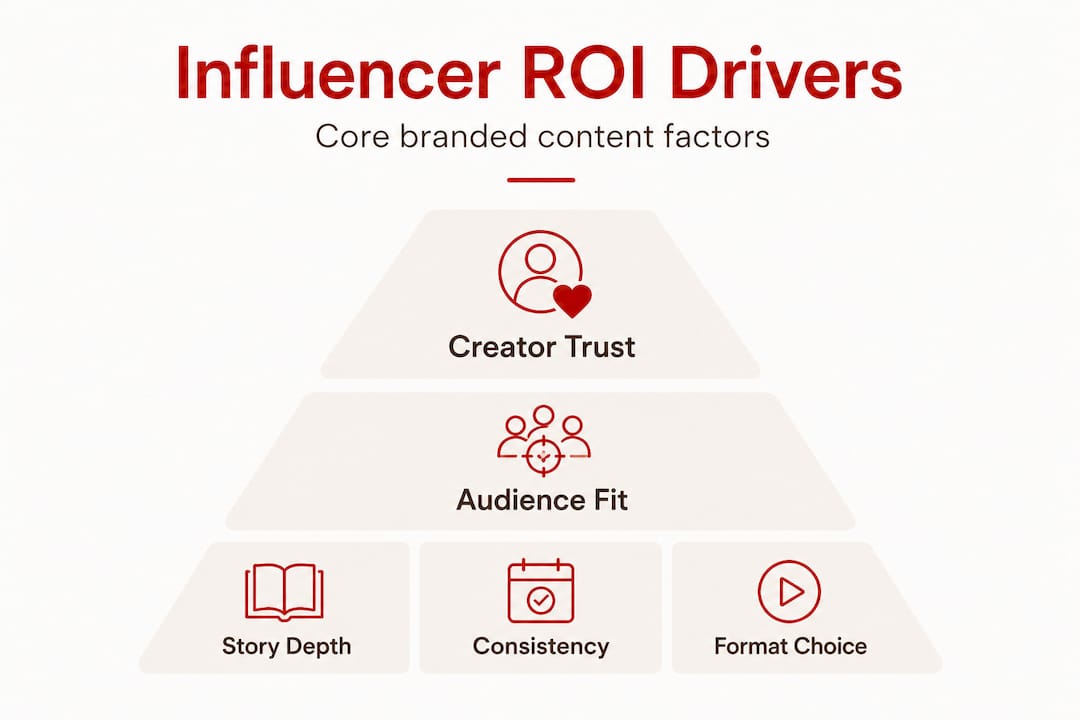
Brands that are hiring UGC creators for product-level content are increasingly integrating those assets into broader branded content frameworks, using user-generated content as social proof layers within larger creator-led narratives. Similarly, CPG brand content strategies that combine macro-creator storytelling with micro-creator amplification are consistently outperforming single-tier approaches in both reach and conversion attribution.

Best practices for collaborating with creators and influencers
With frameworks in hand, here is how to collaborate with creators and influencers to truly realize branded content’s promise. The execution quality of a branded content program is almost entirely determined by the quality of the brand-creator relationship. Structural best practices matter, but the relational dynamics between brand teams and creators are what separate campaigns that feel authentic from those that feel manufactured.
The following checklist represents the operational standards that high-performing branded content collaborations consistently share:
-
Clarify expectations in writing before creative development begins, including deliverable specifications, approval timelines, usage rights, exclusivity clauses, and performance benchmarks
-
Co-create the content story rather than delivering a completed brief for the creator to execute, because creator input during story development produces narratives that resonate more authentically with their specific audience
-
Share relevant performance data with the creator after each content piece, including audience retention curves, comment sentiment analysis, and engagement benchmarks, so they can optimize their approach in subsequent collaborations
-
Allow genuine creative freedom within strategic guardrails, recognizing that the creator’s instinct for their audience is a primary asset, not a variable to be controlled
-
Establish a long-term collaboration structure rather than transactional one-off arrangements, because audience trust in creator-brand relationships compounds over repeated exposures
-
Align on disclosure and transparency standards from the outset, ensuring all branded content is properly labeled in compliance with FTC guidelines and platform-specific requirements
When finding YouTube influencers for branded content programs, the selection criteria should weight audience alignment and content quality above platform metrics. A creator with 80,000 highly engaged subscribers in a relevant sub-niche will typically outperform a creator with 800,000 broadly distributed followers who have minimal connection to the brand’s target audience.
Pro Tip: Let creators adapt the brand story to their audience rather than requiring them to deliver the brand’s version of the story. Creators who are given genuine creative latitude produce content that generates 2 to 3 times more organic shares than those working from rigid scripts.
Short-form creator partnerships in verticals like fashion, beauty, and lifestyle demonstrate this principle clearly. Brands that brief creators with outcome-based objectives (“we want viewers to associate our product with effortless style”) consistently outperform those that brief creators with execution-based scripts (“say these three sentences and show the product at 0:45”).
The publisher-mindset approach to creator collaboration treats each creator as an editorial partner with specialized knowledge of a specific audience segment. This reframing changes the entire dynamic of the brand-creator relationship, shifting it from vendor management to strategic co-creation.
Why most branded content fails (and what actually works)
The most consistent pattern across underperforming branded content programs is not a lack of budget or creative talent. It is a fundamental misunderstanding of what branded content is actually supposed to accomplish. Most brands approach it as a more sophisticated form of advertising, when it is actually a more sophisticated form of publishing.
The “viral video quick fix” myth is particularly damaging. Marketing teams allocate significant resources to producing a single high-production-value piece of content, expecting it to generate outsized returns through organic virality. When it does not go viral (which is statistically the outcome for the vast majority of content), the entire branded content initiative is deemed a failure and abandoned. This is the wrong unit of analysis entirely.
Success requires audience-first planning and consistent output over 12 to 24 months. A single piece of content, regardless of production quality, cannot build the narrative equity that drives long-term brand preference. What builds that equity is a sustained publishing cadence that repeatedly delivers value to a defined audience through trusted creator voices.
Over-branding is the second most common failure mode. When a brand insists on prominent logo placement, repeated product mentions, and messaging that prioritizes brand awareness over audience value, the creator’s audience disengages. The content reads as an advertisement wearing a creator’s clothes, and modern audiences are sophisticated enough to recognize and reject that dynamic immediately.
The B2C short-form content lessons from brands that have built successful long-term creator programs share a common thread: they treat their creator network as an editorial team, not a distribution channel. They invest in creator relationships, share audience data openly, and measure success through brand equity metrics rather than campaign-level conversion rates.
The practical implication is straightforward. Branded content requires a structural commitment to publishing, not just a budget allocation for content production. Brands that build repeatable storytelling systems, maintain flexible brand identities that creators can work with, and commit to multi-channel repurposing are the ones generating compounding returns from their branded content investments.
How Collab Only helps you scale branded content success
Executing a high-performing branded content program at scale requires more than strategic clarity. It requires access to the right creators, efficient collaboration infrastructure, and a matching system that eliminates the friction of traditional outreach.
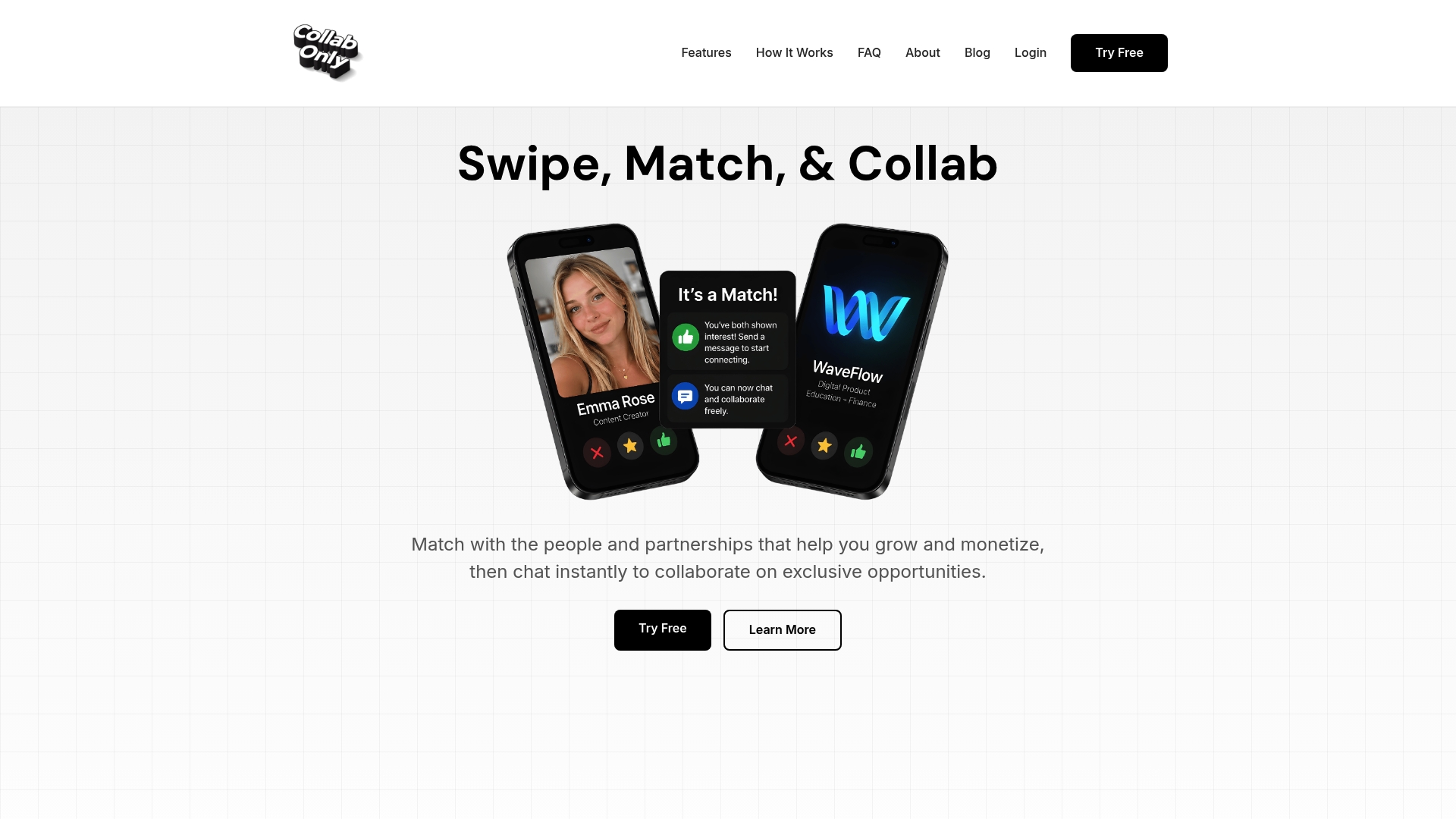
Collab Only is built specifically for this challenge. The platform connects brands with vetted creators across YouTube, Instagram, TikTok, and other major platforms through a swipe-based matching system that surfaces goal-aligned partnerships without the delays of cold outreach, lost DMs, or slow email chains. Once matched, brands and creators move directly into instant chat, accelerating the co-creation process from initial contact to live content. Whether you are scaling an influencer marketplace strategy, sourcing micro influencer brand deals for targeted sub-niche campaigns, or building a long-term creator network, Collab Only provides the infrastructure to manage every stage of the collaboration. Start finding YouTube influencers and other platform-specific creators who are already aligned with your audience and ready to co-create.
Frequently asked questions
What is the main difference between branded content and influencer marketing?
Branded content is focused on storytelling and co-creation, where the brand and creator develop a narrative that delivers genuine audience value, while influencer marketing typically centers on direct product promotion or sponsored messaging. As brands act as publishers, the distinction becomes increasingly important for long-term brand equity building.
What are the most common mistakes brands make with branded content?
The biggest mistakes are being overly promotional, ignoring audience needs, and failing to measure performance properly. Promotional overkill and analytics blindness are the two failure modes most likely to appear together, because brands that over-brand also tend to focus on the wrong metrics.
How long does it take to see results from branded content campaigns?
Branded content typically requires 12 to 24 months of consistent, audience-first output before significant ROI becomes measurable, because the mechanism of value creation is narrative equity accumulation rather than immediate conversion.
How do brands measure the success of branded content?
Most brands measure branded content success through engagement depth metrics such as watch completion rates, comment sentiment, shares, and saves, alongside brand recall lift studies, rather than relying on traditional ad metrics like clicks or impressions.