

Use this fillable influencer brief template to give creators one primary objective, exact deliverables, and clear disclosure requirements, then customize it for each platform. The template covers brand overview, campaign objective, audience, deliverables, timeline, compensation, and FTC-compliant disclosure language in a single page. Copy it into a Google Doc or Notion, fill in the bracketed fields, and send it before your first outreach message.
TL;DR:
- Clear, detailed platform specifications and deadlines minimize the need for reshoots and revisions, saving time and maintaining content consistency.
- Explicit disclosure language must be provided in the brief and checked before and after posting to ensure FTC compliance and avoid legal issues.
- Keeping the brief to a single objective, specific deliverables with exact aspect ratios and deadlines reduces confusion and streamlines creator production.
- Using standardized templates and matching tools accelerates creator outreach, especially for quick-turnaround nano-influencer and UGC campaigns.
- Short, precise briefs under 200 words that focus on essential information produce better content with fewer revision requests.
Table of Contents
- What Goes Into an Influencer Brief Template
- How Do You Fill In Each Section of the Brief?
- Deliverables, Specs, and Approval Timeline
- Writing FTC-Compliant Disclosure Into the Brief
- Common Influencer Brief Mistakes and How to Fix Them
- A Sample Influencer Brief You Can Copy
- How Collabonly Speeds Up the Brief-to-Match Process
- What Actually Matters When You Write a Brief
- Get Templates and Creator Matches in One Place
- Sources
- FAQ
What Goes Into an Influencer Brief Template
A working influencer brief template is not a creative document. It is an operating agreement, structured so a creator can read it once and know exactly what to produce. Sprout Social's influencer marketing brief template frames this well: define expectations, break deliverables out by content format and platform, and give the creator enough inspiration to get the work right on the first attempt, not the third.
The template comes in three usable formats:
- A plain-text version for pasting directly into a DM or email during outreach.
- A Google Doc version for collaborative editing, comments, and version history once a creator is confirmed.
- A Notion template for brands running recurring campaigns who want a reusable record linked to assets and past performance, a format the Notion marketplace listing has made popular among marketing teams.
For a single sponsored post, strip the template to five fields: objective, deliverable, deadline, disclosure line, and payment terms. For a multi-post or multi-platform campaign, keep the full structure and add a content calendar. Either way, hold the brief to one page. Expand only when a section genuinely needs more room, never by default.
How Do You Fill In Each Section of the Brief?
Most influencer briefs fail not because the template is wrong, but because the fields get filled in vaguely. Here is exactly what belongs in each one.
- Brand overview. Write three to five sentences: what you sell, who you serve, and why it matters right now. Include one trust fact (years in business, unit count sold, a certification) and one differentiator that separates you from the obvious competitor. Skip the mission statement. Creators need context, not a pitch deck.
- Campaign objective. Pick one primary KPI and one supporting KPI, never three or four competing goals. Meltwater's guide to writing an influencer brief makes this point directly: a single primary objective measured by a concrete metric produces sharper creative than a list of equally weighted goals. If the primary KPI is link clicks, state the tracking method (UTM parameter, swipe-up link, discount code) in the same line.
- Target audience. Write a short persona, not a demographic slide. "Working parents, ages 28 to 42, who research purchases on Instagram before buying" beats "women 25 to 45" every time. Add one psychographic insight, something about how this audience decides, not just who they are.
- Key messages. List no more than three claims, and write them as concrete statements the creator can paraphrase, not marketing copy to recite verbatim. "Ships in recyclable packaging made from ocean-bound plastic" works. "Sustainable and eco-conscious" does not.
- To include / to avoid. Two short lists: mandatory assets (product shots, a specific hashtag, a link) and off-limits territory (competitor mentions, medical claims, political commentary). Keep both lists short. A brief with fifteen "avoid" items reads like a legal memo, and creators tune it out.
Deliverables, Specs, and Approval Timeline
Scope confusion kills more influencer campaigns than bad creative. The brief needs to specify exactly what gets produced, in what format, and by when, with no room for a creator to guess.

List deliverables as counts and types: "One Instagram Reel (60 to 90 seconds), one Stories set of three frames, cross-posted to TikTok with platform-native captions." Note whether cross-posting content counts as a separate deliverable or a repurposed asset, since this is where budget disputes usually start.
Platform specs belong in the same section:
- Instagram Reels: 9:16 aspect ratio, 60 to 90 seconds, captions burned in or added as text overlay.
- TikTok: 9:16, under 60 seconds performs best for completion rate, native sound preferred over licensed audio.
- YouTube: 16:9 for long-form, 9:16 for Shorts, thumbnail required if the video runs over three minutes.
Build the timeline as a simple calendar: draft due date, a review window of 48 to 72 hours, then the live date. State how many rounds of feedback are included (two is standard) and how feedback gets delivered, comments in the shared doc, not scattered across email and DMs. Specify final file formats required for your own archive: MP4, raw captions file, or a shared Drive folder link.
Pro Tip: Send the platform specs before the creator films anything, not after the first draft lands. A reshoot because of the wrong aspect ratio costs more goodwill than any line item in the brief.
Writing FTC-Compliant Disclosure Into the Brief
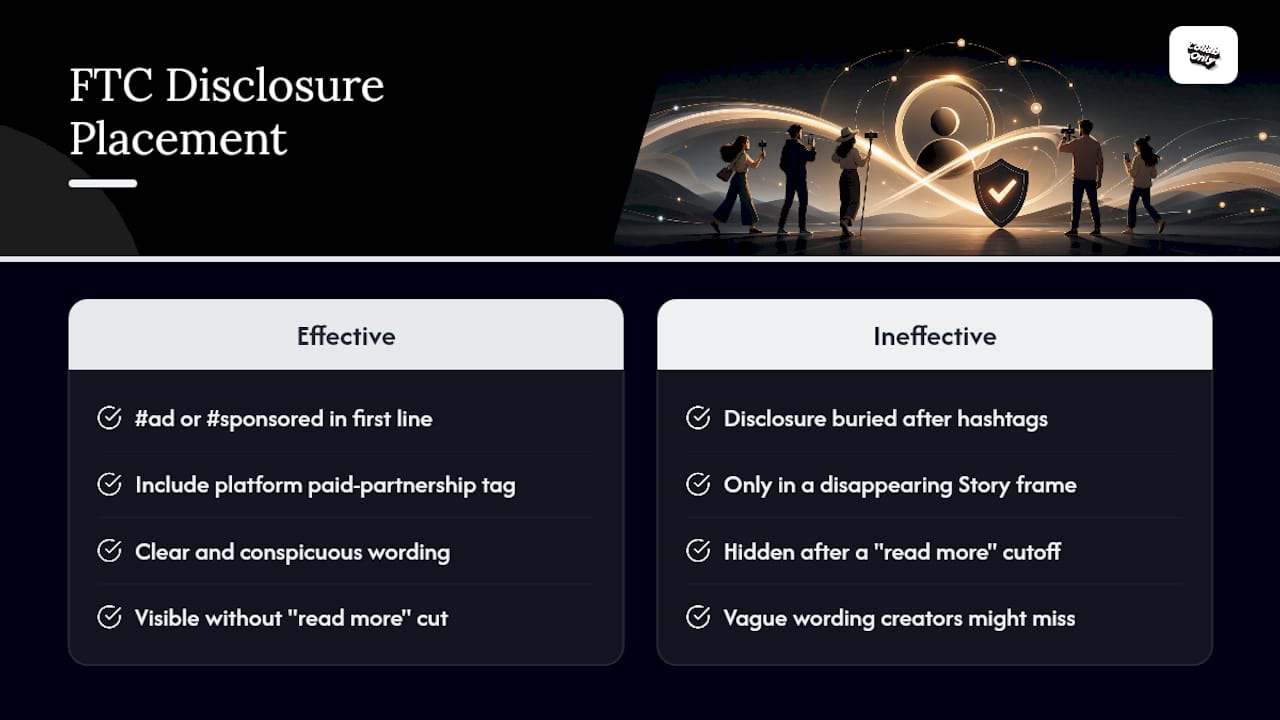
Every brief needs a disclosure clause, and it needs to be specific enough that a creator cannot miss it. The FTC's guidance for social media influencers requires clear and conspicuous disclosure of any paid relationship, which means the disclosure has to be easy to notice and understand, not buried at the bottom of a caption after ten hashtags.
Give the creator exact language to work from: "#ad" or "#sponsored" placed in the first line of the caption, plus the platform's native paid-partnership tag where the platform offers one (Instagram and TikTok both do). A disclosure mentioned only in a Stories frame that disappears in 24 hours does not meet the same bar as one in the caption of a permanent post.
By the numbers: the FTC's own standard is that a disclosure must be understood by the ordinary consumer scrolling quickly, which is why "clear and conspicuous" rules out disclosures hidden after a "read more" cutoff or stacked under unrelated hashtags.
Confirm disclosure in two places: review the draft caption before it goes live, then check the actual published post, since some platforms reformat or truncate captions on posting. If the brief grants your brand usage rights to repost the creator's content on your own channels, state that explicitly and note the usage window (30 days, 90 days, or perpetual).
Common Influencer Brief Mistakes and How to Fix Them
Most bad briefs share the same handful of problems, and all of them are fixable in the drafting stage.
- Over-specifying every line of dialogue. This kills the authenticity that made the creator worth hiring. Fix it with timed beats (what to hit at the 5-second mark, the 20-second mark) instead of a full script, an approach UGC-focused templates recommend specifically to protect creator voice while still hitting required messages.
- Listing three or four "primary" objectives. Creative gets unfocused when nothing is actually prioritized. Fix it by naming one primary KPI and treating everything else as secondary context.
- Vague payment and rights language. "We'll figure out payment after" invites disputes. State the amount, the payment schedule, and exactly what usage rights you're buying, in the brief, not in a follow-up email.
Pro Tip: Keep your mandatory-inclusions list to five items or fewer, ranked by priority. A creator who sees fifteen non-negotiables assumes none of them are actually non-negotiable.
A Sample Influencer Brief You Can Copy
Here is a compact, filled-in influencer campaign brief example at the level of detail that actually works.
- Brand snapshot: "Fernwood makes small-batch ceramic drinkware, hand-thrown in Oregon, sold in over 200 independent shops. Unlike mass-produced competitors, every piece is signed by the potter who made it."
- Objective and KPIs: Primary KPI is link clicks to the seasonal collection page, tracked via a unique UTM link. Supporting KPI is saved posts, tracked through native Instagram analytics.
- Deliverables: One Instagram Reel (75 seconds, 9:16), draft due June 3, feedback returned within 48 hours, live post by June 10.
- Disclosure and measurement: Caption must open with "#ad" before any other text; native paid-partnership tag required. Performance reviewed at day 7 and day 30 against the link-click benchmark.
This example runs under 200 words as a finished brief, proof that a tight document communicates more than a long one.
How Collabonly Speeds Up the Brief-to-Match Process
A template solves the writing problem. Collabonly solves the finding-and-communicating problem that sits right next to it. The platform's luxury lifestyle influencer brief template and brand awareness campaign brief template map directly onto the sections above, brand overview, objective, deliverables, disclosure, so a marketer can start from a category-specific version instead of a blank page.
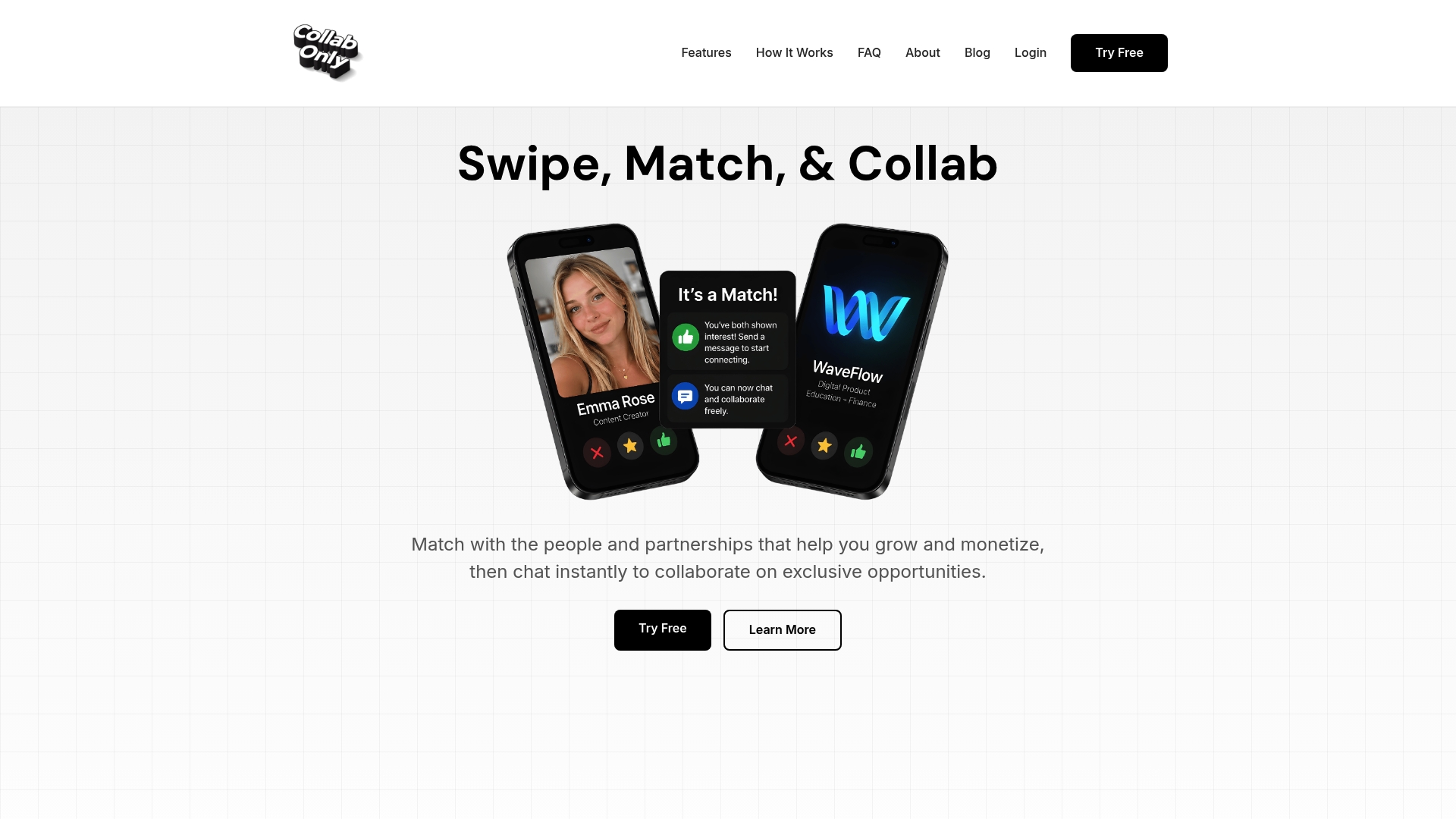
Once the brief is written, Collabonly's swipe-based matching surfaces creators aligned with your campaign category, and instant chat replaces the email threads and lost DMs that typically stall outreach for days. That matters most for nano-influencer activations and UGC-led launches, where speed and volume of creator conversations decide whether a campaign hits its timeline.
Use a Collabonly template as-is for standard single-post campaigns. Build a custom brief only when the campaign involves a regulated category, like the specifics covered in the acne skincare influencer brief template, or a mechanic like a giveaway that needs its own legal language.
What Actually Matters When You Write a Brief
Three things separate a brief that works from one that generates three rounds of confused follow-up questions. First, one objective, stated in the first paragraph, not buried on page two. Second, deliverables specified down to aspect ratio and deadline, because ambiguity there always resolves in the direction that costs you time. Third, disclosure language spelled out verbatim, not left to the creator's judgment about what counts as "clear enough."
A brief that tries to control tone, phrasing, and every camera angle usually produces worse content than one that locks the non-negotiables and lets the creator's voice do the rest. The tightest brief I've seen fill-in-ready ran four short paragraphs and generated no revision requests at all, because everything the creator needed to know was in the first screen they read.
— Samuel
Get Templates and Creator Matches in One Place
Collabonly replaces the slow back-and-forth of email outreach and template hunting with one workflow: pick a brief template built for your campaign type, swipe to match with creators already aligned to your category, and move into instant chat the moment there's a mutual fit. That combination matters most for nano-influencer activations and UGC-led product launches, where the bottleneck is usually finding the right creator fast, not writing the brief itself.
Brands running recurring campaigns can build a saved brief once and reuse it across every new match, cutting the rewrite work down to swapping deliverable dates and product details. If you're staffing a campaign this quarter, the fastest next step is to hire nano influencers through Collabonly and see which creators match your brief before you spend another week on cold outreach.
Sources
- Disclosures 101 for Social Media Influencers
- Influencer Marketing Brief Template | Sprout Social
- How to Write an Influencer Brief + Free Template
- Influencer brief 2026 Template | Notion Marketplace
- UGC Brief Template (Copy-Paste, 2026) | Spark UGC
FAQ
How Do You Write an Influencer Brief?
Start with a one-sentence brand overview, then define a single primary KPI, list exact deliverables with dates and specs, and include verbatim disclosure language, all on one page where possible.
What Are the Core Sections of a Brief?
Most effective briefs cover brand overview, campaign objective, target audience, deliverables and specs, and disclosure and payment terms, the same structure Meltwater's template recommends.
What Does a Filled-In Creative Brief Look Like?
A strong example states the brand's positioning in one paragraph, names one measurable objective, lists exact deliverables with deadlines, and spells out the disclosure requirement, all in under 200 words.
What Makes a Brief Example Effective?
An effective brief example is short, scannable, and specific: it gives the creator one objective, clear deliverable specs, and disclosure language they can copy directly into a caption.
Can Collabonly Templates Replace a Custom Brief?
For standard single-post or nano-influencer campaigns, a Collabonly template covers everything needed. Regulated categories or campaign mechanics like giveaways usually need custom legal language added on top.
Recommended
- Luxury Lifestyle Influencer Brief Template (Instagram Edition) - Collab Only
- Acne Skincare Influencer Brief Template for Instagram Campaigns - Collab Only
- Esports Content Creator Brief Template (What Gaming Brands Send Creators) - Collab Only
- Brand Awareness Campaign Brief Template for Content Creators - Collab Only