

A rate card is a one-page pricing menu that lists your deliverables, base rates, and add-on fees so brands can evaluate your services without a back-and-forth email chain. It is not a contract; a media kit sells your story and audience, while a rate card sells your services and prices. Three line items separate an amateur card from one that gets taken seriously:
- Base rates by platform and content format (static post, Reel, video)
- Usage rights pricing for paid amplification of your content
- Exclusivity terms for category-lock periods
If you update one thing today, add a usage-rights line and date the card. Brands increasingly negotiate based on how they can repurpose your content as paid ads, and an undated card signals stale pricing.
Key Takeaways
A well-built rate card prices usage rights and performance evidence alongside follower count, and gets updated every time your metrics or niche demand shifts.
| Point | Details |
|---|---|
| Separate card from contract | Keep the rate card as a pricing menu; handle kill fees and payment terms in a signed contract. |
| Price usage as its own line | Add 30 to 50% for 30-day paid usage rights instead of folding it into the base rate. |
| Benchmark before quoting | Check platform and tier ranges against a calculator before sending a number to a brand. |
| Package instead of discounting | Bundle multiple posts at a modest reduction rather than cutting your standalone rate. |
| Date every version | An undated card signals stale pricing and weakens your negotiating position. |
Table of Contents
- Influencer Rate Card Benchmarks by Platform and Tier
- How Do You Build a One-Page Influencer Rate Card?
- What Pricing Formula Should You Use for a Rate?
- How Should You Price Usage Rights and Add-Ons?
- How Do You Negotiate Rates Without Underselling Yourself?
- Rate Card Template and Example Line Items
- How Do You Prove Credibility When Sharing a Rate Card?
- Why Most Creators Underprice Their Own Rate Cards
- Sources
- FAQ
Influencer Rate Card Benchmarks by Platform and Tier
Rates swing wildly based on platform, follower tier, and how much of your audience actually engages. Treat the ranges below as starting points, not fixed prices. Nano creators generally charge a low to moderate rate per Instagram post, micro creators higher, mid-tier accounts command a moderate to high rate, and macro or mega creators charge significantly more, depending on niche and production quality.
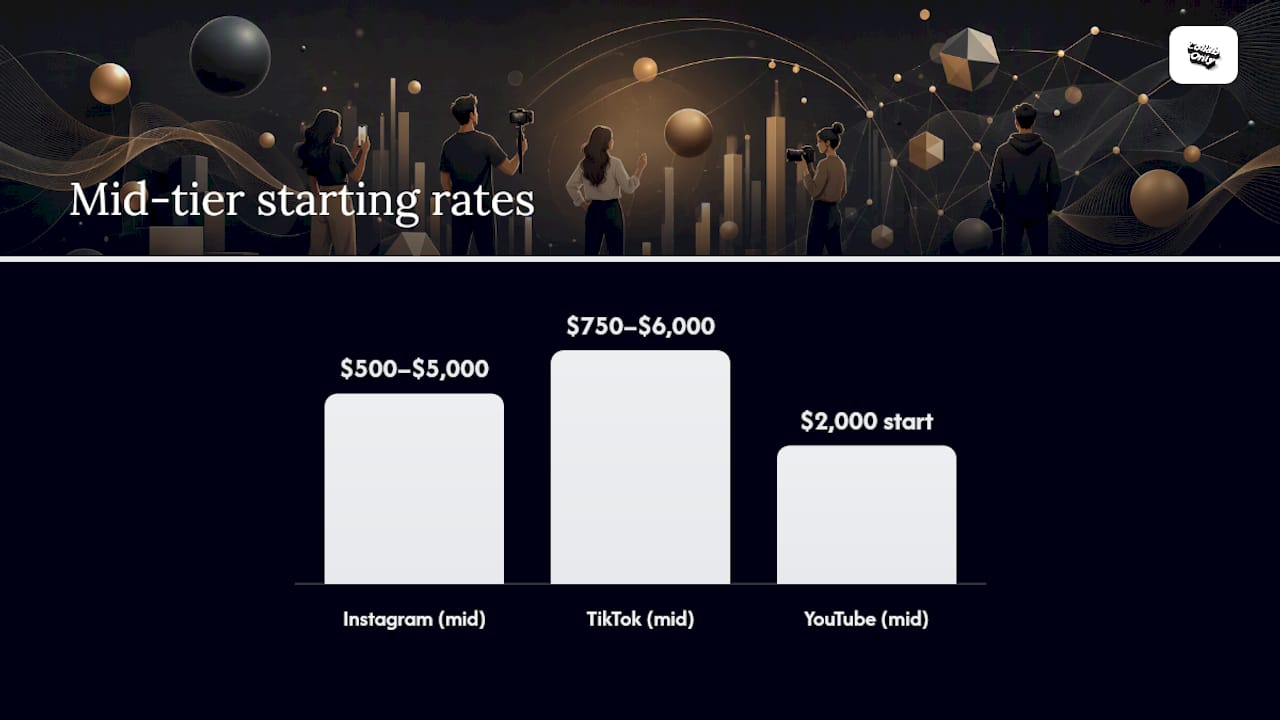
TikTok pricing tends to run slightly lower than Instagram static posts but climbs fast with view count, since platform-specific benchmarks from Statista show per-post pricing scaling with audience size rather than following a flat industry rate. YouTube commands the highest premiums of any platform because of production time and the platform's massive reach. YouTube's monthly user base gives creators leverage to charge dedicated-video rates in the low thousands even at mid-tier follower counts, with integrations often priced two to three times higher than a simple mention.
A quick benchmarking rule: if your quoted rate sits more than 30% above what a rate calculator suggests for your tier, expect brands to push back or ask you to justify it with performance data.
Rough starting points by format and platform:
- Instagram static post: nano $10 to $100, micro $100 to $500, mid $500 to $5,000, macro $5,000+
- Instagram Reel: typically 1.3 to 1.8 times the static post rate due to higher watch-time value
- TikTok video: nano $25 to $125, micro $125 to $750, mid $750 to $6,000, macro $6,000+
- YouTube dedicated video: mid-tier creators often start at $2,000, macro creators well into five figures
- YouTube integration (60 to 90 second mention): roughly 40 to 60% of a dedicated video's rate
- X (Twitter) and Facebook posts: generally the lowest per-post rates of major platforms, often 30 to 50% below equivalent Instagram pricing
- Twitch sponsored streams: usually priced hourly or per-stream rather than per-post, with rates tied to average concurrent viewers
Two variables move you up or down within these bands: engagement rate and niche. An account with a 6% engagement rate should price above the midpoint of its tier; one hovering at 1% should price below it, regardless of follower count. Finance, tech, and B2B niches typically command premiums over lifestyle or entertainment content because brand budgets in those categories are larger and the buyer intent is higher.
How Do You Build a One-Page Influencer Rate Card?
Building a rate card is a checklist exercise, not a design project. Follow these steps in order:
- Add header details. Your name or brand handle, primary platforms, contact email, and a "last updated" date. The date matters because pricing that looks six months old signals you have not adjusted for inflation or growth.
- Build the services grid. List every platform you offer down one axis and every content format (static, carousel, Reel, Story, dedicated video, integration) across the top, then fill in a base rate for each combination you actually sell.
- Add your audience metrics. Total followers, engagement rate, audience age range, top three geographic locations, and gender split if relevant to your niche. Pull these directly from native platform analytics (Instagram Insights, TikTok Analytics, YouTube Studio) rather than estimating.
- List performance proof. Average views, average likes, and if you have run past sponsored content, average click-through or conversion figures from a past campaign.
- Include your add-on menu. Usage rights, whitelisting, exclusivity, rush turnaround, and revision policy, each with its own price adder.
- Export as a static, shareable file. A PDF or a locked Notion page keeps your formatting intact when it lands in a brand's inbox.
Pro Tip: Screenshot your platform analytics dashboard directly into the rate card as a small image. Brands trust a visible number more than a typed one, and it saves you from being asked to "prove" your stats before a deal even starts.
Keep the whole document to one page. A step-by-step approach like this works because it forces you to decide your pricing logic once, rather than improvising a number every time a brand emails you.
What Pricing Formula Should You Use for a Rate?
Three formulas cover almost every negotiation you will face: engagement-based, CPM-based, and performance-based.
Engagement-rate pricing starts with your engagement rate, calculated as (likes + comments + shares) ÷ followers × 100. A common starting formula is: base rate = (average engagement per post × $0.01 to $0.05), adjusted up for niche demand. A creator averaging 5,000 engagements per post might reasonably charge $50 to $250 for a single post before add-ons.

CPM-based pricing treats your content like a media buy. Divide your desired total fee by your average views, then multiply by 1,000 to get your cost per thousand impressions. Brands compare this figure against paid ad CPMs, and a rate calculator that shows CPM equivalents helps you argue that your organic reach is competitively priced against paid media, not just against other creators.
Performance-based pricing ties part or all of your fee to results: a flat base plus a bonus per conversion, code redemption, or affiliate sale.
Two worked examples:
- A micro creator with 30,000 TikTok followers and 8,000 average views per video pricing at a $40 CPM would charge roughly $320 per video.
- A mid-tier creator with 150,000 Instagram followers and a 4% engagement rate (6,000 engagements per post) at $0.03 per engagement would land near $180, before usage and exclusivity add-ons push the real quote higher.
How Should You Price Usage Rights and Add-Ons?
Add-ons are where creators leave the most money on the table, mostly because they never write them down. Every rate card needs a defined menu for the extras brands routinely request.
- Usage rights (paid amplification): add 30 to 50% to your base rate for 30 days of paid usage, scaling up for 60 or 90-day terms or broader whitelisting access, in line with industry premium guidance.
- Whitelisting: typically adds 20 to 30% on top of usage fees, since it hands the brand your ad account access for a boosted campaign window.
- Exclusivity: category-lock periods (blocking competitor brands for 30 to 90 days) commonly add 25 to 75%, depending on category size and lock length.
- Rush fees: a 15 to 25% surcharge for turnaround under 48 hours is standard.
- Revisions: include one round free, then charge a flat fee (often 10 to 20% of the base rate) per additional round.
List each add-on as its own line with a percentage or dollar adder next to the base rate, so a brand can see the full menu at a glance instead of guessing what "usage" costs. Our guide on usage rights pricing breaks down how to structure these terms for longer-term brand relationships.
Pro Tip: Never bundle usage rights into your base rate silently. Naming it as a separate line item is what lets you charge more for it later without renegotiating your whole card.
How Do You Negotiate Rates Without Underselling Yourself?
Packaging and negotiation determine whether your rate card becomes a floor or a ceiling. Use these tactics in sequence:
- Offer bundles, not discounts. A three-post package might run 10 to 15% below the sum of three single posts, framed as a bundle rate rather than a discount off your card.
- Reserve performance bonuses for upside, not downside. Accept a bonus tied to conversions only when your base rate already covers your minimum acceptable payment; never let a bonus replace guaranteed pay.
- Set a minimum guaranteed fee on any hybrid deal. Flat plus commission structures work only when the flat portion alone makes the project worthwhile.
- Watch for red flags in briefs: vague usage terms, no kill fee, unlimited revision language, or payment terms beyond net-30 are all signals to renegotiate before signing.
- Benchmark before you counter. If a brand's offer sits well below calculator ranges for your tier, cite the gap directly rather than simply asking for "more."
A quote landing 30% above typical calculator ranges is also a two-way signal: brands will flag it as high, so be ready to justify it with usage terms or performance history.
Rate Card Template and Example Line Items
A workable one-page template needs five fields per row: platform, format, base rate, usage add-on, and notes. Keep the whole layout to a single page so a brand can read it in under a minute.
| Field | What to Include |
|---|---|
| Header | Name, handle, platforms, contact, "last updated" date |
| Services grid | Platform + format + base rate |
| Metrics | Followers, engagement rate, audience demographics |
| Add-ons | Usage, whitelisting, exclusivity, rush, revisions |
| Terms note | "Rates exclude usage rights unless specified" |
Nano/micro example:
- Instagram static post: $75
- Instagram Reel: $110
- 30-day usage add-on: +$35
Mid-tier example:
- 3-post Instagram package: $2,400 (bundled rate)
- Usage rights (60 days): +$900
- Whitelisting access: +$550
Adapt the structure from a proven rate card format and swap in your own numbers, or see a fuller worked template in our creator rate guide.
How Do You Prove Credibility When Sharing a Rate Card?
Numbers land better with evidence attached. Surface campaign-level metrics whenever you have them, not just audience size.
- Click-through rate from a past sponsored link or swipe-up
- Conversion or code-redemption rate from an affiliate campaign
- Average order value lift when a brand shared post-campaign data with you
- Screenshots of platform analytics dated within the last 30 days
A short, dated one-page rate card increases deal velocity because brands can internalize your numbers in a single read, rather than digging through a lengthy media kit to find the price.
Referencing a past brief format, like our luxury lifestyle influencer brief template, also shows brands you understand how campaigns get structured on their end, not just yours.
Why Most Creators Underprice Their Own Rate Cards
The conventional advice treats a rate card as a follower-count lookup table, and that framing is outdated. The research on 2026 pricing patterns points somewhere else: usage rights and repurposing value now separate mediocre deals from good ones, often more than raw audience size does. A micro creator who prices a paid usage add-on correctly can out-earn a larger account that only sells one-off posts.
What is overrated: obsessing over hitting a specific follower tier before charging real money. What is underrated: dating your card, naming your add-ons individually, and pricing your CPM against paid ads rather than against other creators' guesses. Brands built performance marketing muscles years ago; creators are catching up now.
If you take one action from this piece, make it packaging. Bundles and usage tiers protect your base rate far better than discounting ever will. A platform like Collab Only can also shortcut the outreach side entirely, connecting you directly with brands looking for creators at your tier through instant matching rather than cold pitches sitting unread in an inbox. For a deeper look at where conversion-driven pricing is heading, this analysis of influencer strategies tied to brand growth is worth a read alongside your own numbers.
Sources
- Influencer rates: How to maximize your budget in 2026 | Hootsuite
- Influencer Rate Calculator — Free
- How to create an influencer rate card | Backstage
- Influencer rate card template (Alex Berman)
FAQ
What Is a Rate Card for an Influencer?
A rate card is a one-page pricing document listing your content formats, base rates, and add-on fees like usage rights or exclusivity, so brands can evaluate your services without a lengthy email exchange.
What Are Typical Influencer Rates in 2026?
Rates range from roughly $10 to $100 per Instagram post for nano creators up to $5,000 or more for macro accounts, with YouTube commanding the highest premiums due to production time and platform reach.
How Do You Create an Influencer Rate Card?
List your header details and update date, build a services grid by platform and format, add sourced audience and performance metrics, and list your add-on menu for usage rights, whitelisting, and exclusivity, all kept to one page.
How Many Influencers Make Over $100,000?
Public data on exact income distribution is not widely published, but earnings at that level typically require either a large, highly engaged audience or a mix of brand deals, usage-rights premiums, and performance bonuses layered on top of standard post rates.