

Price usage rights as a separate licensing line item — start from your base creation fee, then apply percentage multipliers for duration, territory, exclusivity, and paid-media use. Before quoting any number, ask the brand for its intended channels, whether the content will run as paid advertising, and how long they plan to use it.
Quick benchmark ranges to anchor your first conversation:
- 30–90 days, organic social only: 15–25% of your base creation fee
- 6–12 months, social + website: 25–60% of base, depending on platform and traffic
- Paid ads or whitelisting: priced separately, often as an additional flat fee or a percentage of ad spend
- Perpetual or buyout: 150–300% of base rate, or a negotiated lump sum
Your immediate next step: send the brand a one-paragraph use-case questionnaire before you quote. Ask for intended duration, specific platforms, whether they plan to run paid ads, and whether they need exclusivity. Every one of those answers changes the number.
Key Takeaways
| Point | Details |
|---|---|
| Price rights separately | Never bundle usage rights into the base creation fee; list them as a distinct line item with its own percentage or flat fee. |
| Duration drives the multiplier | Rates range from 15–25% of base for 30–90 days up to 150–300% for perpetual or buyout licenses. |
| Exclusivity needs its own fee | Price exclusivity as forgone opportunity cost; named-competitor lists cost less than category-wide bans and are easier to negotiate. |
| Paid ads require a separate license | Whitelisting and paid-media use are distinct from organic resharing and should carry an additive fee, not just a usage multiplier. |
| Collabonly | Collabonly's structured brief fields capture duration, channels, and exclusivity upfront, reducing scope disputes before negotiation begins. |
Table of Contents
- What usage rights are and why they matter for every deal
- Common types of usage rights and how each one shifts price
- Key factors that determine how much usage rights cost
- Industry benchmarks and pricing models you can use now
- How to build a usage-rights price from your base fee
- How whitelisting differs from standard usage rights and how to price it
- Essential contract clauses and red flags to watch for
- Exclusivity clauses: pricing the opportunity cost and negotiating smarter
- High-impact negotiation tactics for brands and creators
- Collabonly makes usage-rights negotiations faster and cleaner
- Sources
- FAQ
What usage rights are and why they matter for every deal
Usage rights are a license — a contractual permission — granting a brand the right to use specific content for defined purposes, on defined platforms, in a defined territory, for a defined period. They are not a transfer of ownership. The creator retains copyright unless the contract explicitly states otherwise through a work-for-hire or full copyright assignment clause.
Three terms get conflated constantly, and the distinction carries real financial weight:
- License: the brand may use the content under the agreed conditions; the creator retains copyright and can license the same content to others (unless exclusivity applies).
- Buyout (perpetual license): the brand pays a large premium for unlimited, indefinite use; the creator still technically holds copyright but has no practical restriction on the brand's use.
- Work-for-hire / copyright transfer: the brand owns the copyright outright. This is the most restrictive outcome for a creator and should command the highest fee of all three structures.
For brands, unclear usage terms create operational and legal risk. Running a creator's content in a paid ad campaign without a paid-media license is copyright infringement, regardless of whether the original collaboration agreement existed. For creators, unpaid or underpriced usage is direct revenue loss — the content continues generating value for the brand long after the original deliverable fee was paid.
Pro Tip: Before quoting any deliverable, send the brand a short use-case checklist: intended platforms, paid vs. organic, duration, territory, and whether they need exclusivity. That single step prevents the most common underselling mistake in creator deals.
Common types of usage rights and how each one shifts price
Not all usage is equivalent. A brand resharing a creator's Instagram post to its own feed is a fundamentally different commercial act than running that same post as a targeted paid ad on Meta. The types of content collaborations a brand pursues should map directly to the license type they request.
- Organic social resharing: the brand reposts or embeds the content on its own social channels without paid amplification. Lowest-tier license; typically 10–20% of base rate for 30–90 days.
- Extended social (6–12 months): same organic use but over a longer window. Adds compounding value for the brand; price accordingly at 25–40% of base.
- Paid social advertising / whitelisting: the content runs as a paid ad, either from the brand's account or from the creator's account (whitelisting). Priced separately from the base usage license; see Section 7 for mechanics.
- Website integration: embedding content on a brand's homepage, product page, or landing page. Higher-value placement than social because it drives direct conversion; typically commands a 20–40% premium over organic-social rates.
- Email marketing: content used in branded email campaigns. Moderate premium; often bundled with website rights.
- Packaging and retail: content printed on physical product packaging or used in retail displays. Significant premium — the content becomes part of the product's commercial identity. Creators working with CPG brands should treat packaging use as a separate, high-value license tier.
- Out-of-home (OOH) and broadcast/TV: billboards, transit advertising, or television spots. These placements reach mass audiences and carry the largest premiums outside of a full buyout.
- Perpetual / full buyout: unlimited use across all channels, indefinitely. The brand pays a substantial premium; industry guides report 150–300% of base rate as a common range.
Territory scope compounds every category above. A license for the United States only is worth less than a North American license, which is worth less than a worldwide license.
Key factors that determine how much usage rights cost
Five levers move usage-rights pricing more than any other variables. Understanding each one lets brands and creators negotiate from a shared framework rather than trading arbitrary numbers.
Duration is the most straightforward lever. Longer use means more commercial value extracted from the same creative asset. Pricing heuristics commonly use these duration bands: 3 months at roughly 15–25% of base, 6 months at 25–40%, 12 months at 40–60%, multi-year at 70–100%, and perpetual at 150–300% or a negotiated buyout.
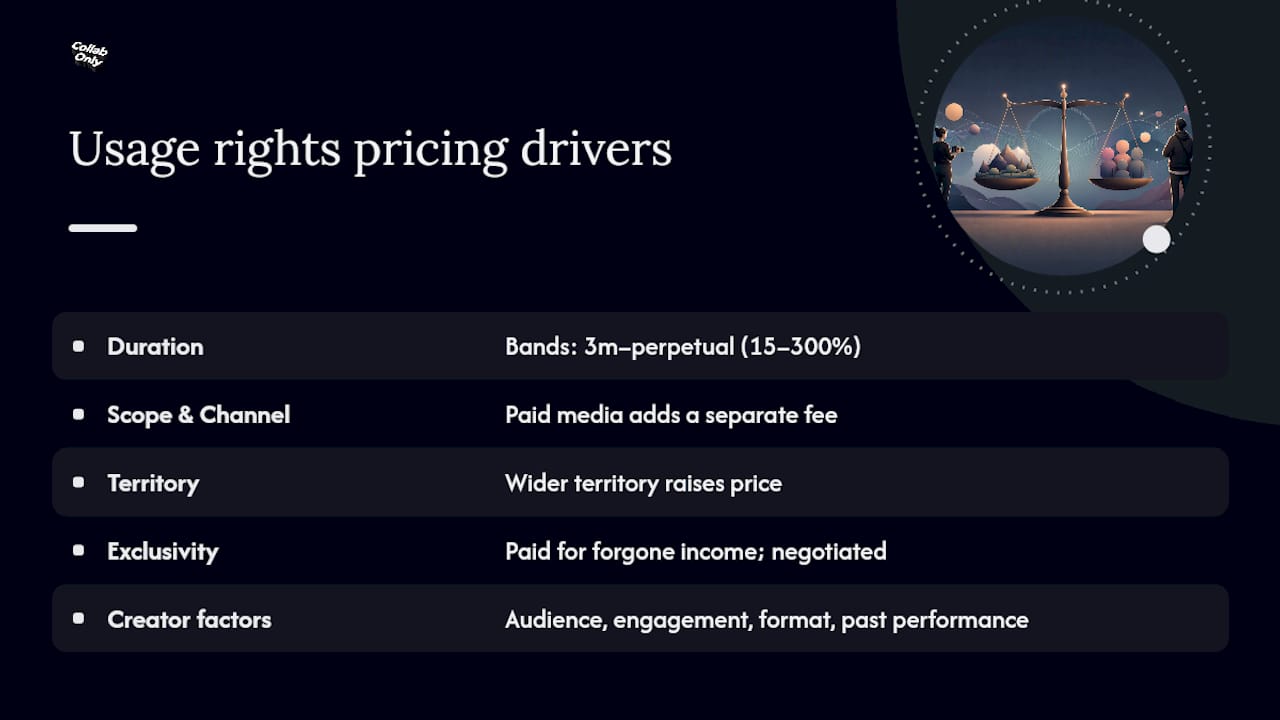
Scope and media channel determine where the content appears and how much commercial leverage it provides. Paid advertising placements generate direct revenue for the brand; organic resharing does not. That distinction justifies a separate, additive fee for paid-media use rather than a simple multiplier on the base license.

Territory adds a geographic premium. A worldwide license should cost more than a U.S.-only license because the brand's potential commercial reach — and therefore the content's commercial value — is larger.
Exclusivity is the most negotiated and most misunderstood lever. When a brand asks for exclusivity, it is asking the creator to forgo other income opportunities in a defined category for a defined period. That forgone pipeline has a dollar value, and the exclusivity fee should reflect it. Section 9 covers this in depth.
Creator-side factors include audience size, engagement rate, content format (a produced video commands more than a static image), and prior performance data. A creator with documented conversion rates on past campaigns can justify higher rates across all license tiers. Micro-influencer rate-setting follows the same percentage logic but from a lower absolute base.
Industry benchmarks and pricing models you can use now
Usage-rights pricing commonly ranges from roughly 20% to 150% of a creator's base rate depending on duration and scope, with perpetual rights requiring 200–300% or a large buyout. For UGC specifically, many single-video deliverables cluster around $100–$250, making usage-rights add-ons a significant multiplier on total deal value.
The two most common licensing models in the U.S. market are:
- Percentage-of-base per duration band: the creator sets a base creation fee, then charges a percentage of that fee for each license tier. Simple to explain, easy to adjust per deal.
- Tiered flat multipliers: the creator publishes a rate card with named tiers (e.g., Tier 1 = organic social 30 days, Tier 5 = perpetual worldwide), each with a fixed dollar add-on. Faster to quote, less flexible.
The ContentCreators pricing calculator provides a tier builder and add-on calculator with percent ranges across short, medium, long, and perpetual durations — a practical starting point for building a rate card.
| License Tier | Duration | % of Base Rate | Example (Base = $500) |
|---|---|---|---|
| Organic social | 30–90 days | 15–25% | $75–$125 |
| Extended social | 6 months | 25–40% | $125–$200 |
| Social + website | 12 months | 40–60% | $200–$300 |
| Multi-year | 12 months | 70–100% | $350–$500 |
| Perpetual buyout | Unlimited | 150–300% | $750–$1,500 |
Add-ons that stack on top of the base license:
- Paid ads / whitelisting: separate fee (see Section 7)
- Email marketing: +10–20% of base
- Packaging / retail: +50–100% of base
- White-label / no-creator-credit: +25–50% of base
- Edits and derivative works: +15–30% per significant edit round
How to build a usage-rights price from your base fee
A replicable formula removes the guesswork from quoting. The structure is:
Total fee = base creation fee + (base × usage % for duration) + territory premium + exclusivity premium + paid-media premium
Work through it in six steps:
- Set your base creation fee. This is the fee for producing the deliverable alone — no rights included. For a produced Instagram Reel, a common range is $300–$800 for mid-tier creators; for UGC video, $100–$250.
- Identify the duration band. Match the brand's requested duration to the percentage table above. If the brand says "as long as we need it," treat that as perpetual and price accordingly.
- Apply the usage percentage. Multiply your base fee by the duration percentage. Round up to the nearest $25 for cleaner invoicing.
- Add territory premium. If the license extends beyond the U.S., add 25–50% of the usage fee for regional expansion, or up to 100% for worldwide rights.
- Add exclusivity premium. Price exclusivity as forgone opportunity cost (see Section 9). A 30-day narrow exclusivity might add 25% of base; a 12-month category-wide exclusivity should add 100% or more.
- Add paid-media premium. If the brand plans to run the content as paid advertising, add a separate paid-media fee. Do not fold this into the usage percentage — it is a distinct commercial use.
Worked examples using a $500 Reel as the base:
- 30-day paid ads only: $500 base + $125 (25% usage for 30 days) + $150 paid-media flat fee = $775 total
- 12-month website + paid social: $500 + $250 (50% for 12 months) + $100 territory (U.S. only, no premium) + $200 paid-media = $1,050 total
- Perpetual worldwide buyout: $500 + $1,000 (200% perpetual) + $500 territory (worldwide) = $2,000 total
Set a minimum license fee — many creators use $150–$200 as a floor regardless of percentage calculation — to avoid giving away rights on low-base deals.
How whitelisting differs from standard usage rights and how to price it
Whitelisting and paid-media licensing are related but mechanically distinct. Understanding the difference protects both parties from misaligned expectations.
Standard paid-media license: the brand takes the creator's content and runs it as an ad from the brand's own ad account. The creator grants permission; the brand controls the ad.
Whitelisting (creator-amplified boosting): the creator grants the brand access to run paid ads directly from the creator's account or handle. The ad appears to come from the creator, which typically improves performance metrics because it carries the creator's social proof. This is a more valuable grant of access and should be priced higher than a standard paid-media license.
Pricing methods for whitelisting:
- Flat monthly licensing fee: a fixed dollar amount per month the brand runs ads from the creator's account. Common for predictable campaign budgets.
- Percentage of ad spend: a small percentage of the total ad spend the brand runs through the creator's account. Aligns the creator's fee with the brand's actual usage intensity.
- Add-on percentage of base rate: treat whitelisting as an additional license tier, priced at 20–50% of the base creation fee per month of access.
Whitelisting is frequently priced separately from the base usage license, and the pricing method varies widely by creator and campaign structure. The operational checklist before granting whitelisting access:
- Confirm which ad account receives access (brand's Business Manager vs. creator's account)
- Define the ad creative the brand may use (original content only, or edited derivatives)
- Agree on reporting: the creator should receive campaign performance data
- Set attribution expectations: who owns the conversion data
- Specify the access duration and revocation process
Bundle whitelisting with a usage license when the brand's primary goal is paid amplification of the creator's content. Price them separately when the brand wants both organic resharing rights and a distinct paid-media window, so each line item is transparent and auditable.
Essential contract clauses and red flags to watch for
A usage-rights agreement without precise language is a liability for both parties. These are the must-have clauses for any licensing arrangement:
- Scope: list every platform and format by name (e.g., "Instagram feed posts, Instagram Stories, Meta paid ads only — excludes TikTok, YouTube, and all print").
- Duration: include explicit start and end dates, not relative language ("for six months" with no anchor date creates disputes).
- Territory: name the geographic scope ("United States only" or "worldwide").
- Paid-media terms: state whether paid advertising is permitted, from which account, and with what spend limits if any.
- Credit and moral rights: specify whether the creator must be credited in paid ads and organic posts.
- Edits and derivatives: define what modifications the brand may make and whether derivative works require separate approval.
- Renewal terms: state the renewal price and notice period. A clause that allows the brand to renew at the original rate indefinitely is a red flag.
- Payment schedule: tie payment milestones to deliverable acceptance and license start date.
Sample clause language creators can propose:
- Limited social use: "Brand is granted a non-exclusive license to repost the Deliverable on Brand's owned social media accounts (Instagram, Facebook) for a period of 90 days from the Effective Date. No paid amplification is permitted under this license."
- Paid ads: "Brand is granted a non-exclusive license to use the Deliverable in paid social advertising on Meta platforms for a period of 30 days from the Effective Date. Creator retains all other rights."
- Website integration: "Brand is granted a non-exclusive license to embed the Deliverable on Brand's website at [URL] for a period of 12 months from the Effective Date. No sublicensing or redistribution is permitted."
Red flags that warrant renegotiation or legal review:
- "Perpetual, irrevocable, worldwide" language with no corresponding premium
- Undefined or open-ended duration ("for the duration of the campaign")
- Category-wide exclusivity with no named-competitor list
- Work-for-hire language that transfers copyright
- No start date specified
- Broad sublicensing rights (the brand can license your content to third parties)
- Missing edit and derivative limits
Rapid contract review checklist: scope defined, dates specified, territory named, paid-media terms explicit, credit terms stated, edit limits set, renewal price locked, payment schedule attached.
Exclusivity clauses: pricing the opportunity cost and negotiating smarter
Exclusivity is the most commercially significant clause in any influencer or creator contract, and it is routinely underpriced. When a brand asks for exclusivity, it is asking the creator to decline competing income for a defined period. That has a calculable dollar value.
Kahn Media Law warns that broad exclusivity restricts creators' income and recommends narrow named-competitor lists and clear definitions to avoid ambiguity. The practical implication: a creator who earns $3,000 per month from brand deals in the beauty category and is asked for 6-month category-wide exclusivity is being asked to forgo up to $18,000 in pipeline. The exclusivity fee should reflect that exposure, not be buried in the base deliverable rate.
Exclusivity should be priced like forgone revenue, not like a courtesy discount. A 30-day narrow-category exclusivity might add 25% of base; a 6-month narrow exclusivity warrants 75–100% of base; an annual broad-category exclusivity should add 100% or more, and often considerably higher depending on the creator's deal volume.
Flag. Contract-risk tools speed up red-flag detection and surface ambiguous exclusivity language before signing.
Negotiation structures that protect creators while giving brands meaningful protection:
- Named-competitor list instead of category-wide ban: the brand names the specific competitors it wants excluded (e.g., "Brand X, Brand Y, Brand Z") rather than banning the entire beauty or fitness category. This is the single most effective concession to request.
- Paid-media-only exclusivity: the creator agrees not to appear in paid advertising for competitors but retains the right to accept organic partnerships. Useful for brands running performance campaigns.
- Short strict window plus longer narrow window: 30 days of full category exclusivity during a launch, followed by 6 months of named-competitor-only exclusivity. Gives the brand launch protection without a year-long income restriction.
- Renewal triggers with fee escalation: if the brand wants to extend exclusivity, the renewal price is pre-agreed at a percentage above the original fee.
Pro Tip: When a brand sends a contract with category-wide exclusivity, respond with a named-competitor list and a revised fee. Most brands accept named competitors because they care about direct competition, not the entire category. That single counter-move often resolves the exclusivity dispute in one exchange.
The role of exclusivity in brand deals extends beyond creator protection — brands that price exclusivity fairly tend to build longer, more productive creator relationships than those that bury it in boilerplate.
Partnership management platforms like Impact help brands track exclusivity windows across multiple creator relationships, reducing the operational risk of accidental overlap. Use tools like Flag.red for contract scanning before any exclusivity clause is signed.
High-impact negotiation tactics for brands and creators
The negotiation table is where pricing theory meets deal reality. These tactics apply whether you are a creator protecting your rate card or a brand managing campaign budgets.
- Ask budget first. Before quoting, ask the brand for its content budget range. A brand with a $5,000 content budget and a $500 deliverable has room for a $1,500 usage license. A brand with a $600 total budget does not. Knowing the budget prevents you from under-quoting or wasting time on a deal that cannot close.
- Request a use-case checklist. Send a short form: intended platforms, paid vs. organic, duration, territory, exclusivity needs. This is not just due diligence — it signals professionalism and reframes the conversation around scope rather than price.
- Propose tiered pricing. Offer three license options (e.g., 30-day organic, 6-month social + website, 12-month full) with clear pricing for each. Brands often upgrade to the middle or top tier when the options are presented transparently. For creator marketing strategies, tiered pricing also helps brand managers justify spend internally.
- Insist on start and end dates. Never accept "for the duration of the campaign" as a duration. Campaigns extend; rights should not extend automatically.
- Price exclusivity explicitly. Never fold exclusivity into the base rate. List it as a separate line item so the brand sees exactly what they are paying for and why.
- Include renewal pricing in the original contract. Propose a renewal at 80–100% of the original license fee. This prevents the brand from assuming renewal is free and gives the creator a clear revenue expectation.
- Propose a 6–12 month license with a renewal option instead of perpetual. When a brand asks for perpetual rights, counter with a 12-month license at 60% of base plus a renewal option at 50% of the original license fee. Most brands accept this structure because it gives them long-term access without the perpetual label triggering creator resistance.
Signals that a brand expects to bundle rights without paying for them: in-house legal sends the contract (not a campaign manager), the brief mentions "all media" or "all channels," or the contract includes work-for-hire language. Counter by returning a redlined version with explicit scope limitations and a separate usage-rights fee schedule. For micro-influencer deals, the same tactics apply — the dollar amounts are smaller but the percentage logic is identical.
A note on fair deals and long-term creator relationships
The creator economy functions best when usage rights are priced transparently and both parties understand what they are exchanging. Brands that pay fair licensing fees get content that performs better — creators who feel fairly compensated produce more carefully and advocate more genuinely. Brands that bury rights in boilerplate or treat perpetual use as a default get short-term content and long-term creator churn.
The practical implication for brand managers: build usage-rights line items into your campaign budgets from the start, not as an afterthought when a creator pushes back. The creator rate guide from Collabonly provides a structured starting point for brands building rate frameworks that account for usage from the first brief.
For creators, the most durable protection is a clear, written scope in every contract — not a verbal agreement about "just social." The contract is the relationship's foundation, and ambiguous language always resolves in the party with more legal resources.
Collabonly's matching platform is designed to reduce the friction that makes these conversations harder than they need to be — standardized brief fields, instant chat on match, and a structured collaboration framework that keeps both sides aligned on scope before the deal is signed.
Collabonly makes usage-rights negotiations faster and cleaner
Negotiating usage rights manually — through email threads, scattered DMs, and generic contract templates — costs brands and creators time and creates scope ambiguity that leads to disputes. Collabonly's collaboration marketplace addresses this directly.
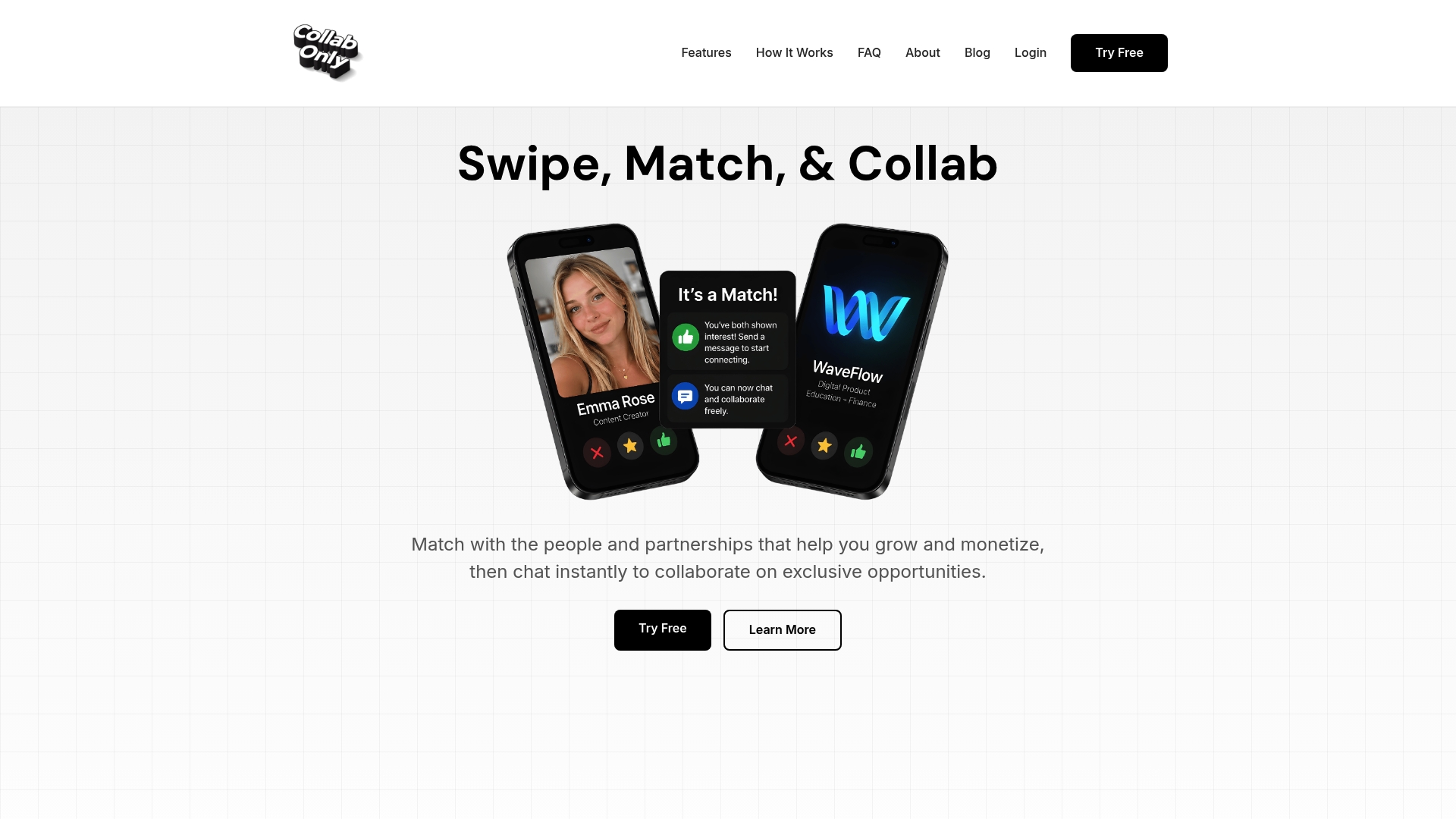
When brands post a campaign brief on Collabonly, they specify duration, channels, paid-media requirements, and exclusivity needs in structured fields — before the first creator conversation begins. Creators see the full scope upfront and quote accordingly, eliminating the back-and-forth that typically inflates negotiation time. Integrated messaging means both parties negotiate in one place, with a clear record of agreed terms.
For brands running app promotion campaigns or hiring across multiple creator tiers, Collabonly's matching system surfaces creators whose rate cards and content formats align with the campaign's usage requirements. The result is faster matching, fewer scope disputes, and contracts that reflect what both parties actually agreed to. Start a campaign brief on Collabonly and bring usage-rights clarity to your next creator deal from day one.
Sources
- Flag
- How exclusivity clauses can affect influencer brand deals — Kahn Media Law
- What usage rights actually cost (and why brands don't explain it) | DealVerdict
This article is general information, not a substitute for advice from a qualified lawyer. Consult a qualified legal professional about your own circumstances before acting on anything here.
FAQ
How much do usage rights cost?
What does "1 month usage rights" mean?
A one-month usage license grants the brand permission to use the creator's content for 30 days from an agreed start date, after which the rights revert to the creator unless renewed. It does not transfer copyright and does not include paid advertising unless explicitly stated.
How much do influencers with 100K followers charge for usage rights?
How much should I charge for whitelisting?
performance-linked income.