

TL;DR:
- Brands should view creator partnerships as strategic market interventions that influence long-term consumer perception and competitive positioning. Surface metrics like impressions and likes are insufficient; authentic, outcome-driven collaborations reduce price sensitivity and build durable market advantages. To maximize value, brands must implement outcome-based measurement, scalable governance, and long-term relationship strategies supported by tools like the Collab Only platform.
Brands have long measured influencer success through likes, impressions, and follower counts, treating each campaign as a short-lived media buy rather than a strategic market intervention. This framing significantly underestimates what creators actually do. Influencer exposure links to Amazon product-level outcomes, including shifts in pricing dynamics and competitive positioning that extend well beyond a single post's engagement rate. The brands gaining the most from creator partnerships are not simply buying reach; they are systematically shaping buyer perception, reducing price sensitivity, and building durable market advantages that compound over time. This guide lays out exactly how that works, what to avoid, and how to build creator partnerships that generate lasting business value.
Table of Contents
- Beyond likes: The real impact of creators on brands
- What most brands get wrong with creators
- The new platform reality: Paid amplification and channel economics
- Governance, compliance, and scaling creator partnerships
- What most brands overlook: The compounding value of creators
- Unlock the full value of creator partnerships with Collab Only
- Frequently asked questions
Key Takeaways
| Point | Details |
|---|---|
| Creators drive market value | Creator partnerships impact pricing power and overall market demand in ways that go beyond likes or awareness. |
| Avoid vanity metric traps | Measuring creator success requires focusing on business outcomes, not just surface-level engagement stats. |
| Amplification changes economics | Paid amplification is now as important as organic reach in ensuring maximum ROI from creator campaigns. |
| Compliance is essential | A robust partnership process means consistent legal, FTC, and brand governance to mitigate risk as you scale. |
Beyond likes: The real impact of creators on brands
Surface metrics have dominated influencer marketing reporting since the channel's earliest days, and many brand teams still use them as primary success indicators. Reach, impressions, and average engagement rates are easy to pull from platform dashboards, but they describe audience behavior during a campaign window rather than the lasting commercial outcomes that justify investment.
"The most strategically significant thing a creator can do for a brand is not generate a spike in impressions. It is alter how an audience values a product category, which changes competitive dynamics well after the campaign ends."
What the research actually shows is more consequential. YouTube campaigns linked to Amazon product outcomes demonstrate that creator exposure can reduce price responsiveness in the marketplace, meaning consumers who have been reached by a relevant creator become less reactive to competitive price-cutting. That is a structural market advantage, not a temporary traffic boost.
Here is what that means in practice for brand strategy:
- Creator campaigns can position a brand's product as a reference point within a category, reducing the leverage that lower-priced competitors have over prospective buyers.
- Repeated, authentic creator endorsements build peer-credibility that paid display advertising cannot replicate, even at significantly higher spend levels.
- Brands that engage with creators across multiple touchpoints over sustained periods show stronger recall and preference metrics than those running high-frequency short-burst campaigns.
- The downstream effect on marketplace behavior, meaning how consumers actually transact after exposure, is measurably different from what surface engagement data predicts.
Reviewing brand partnership examples that drove real commercial results reveals a consistent pattern: the highest-performing collaborations treat creators as market influence assets, not distribution channels. Understanding partnership marketing strategies in this context means reframing the entire objective from "how many people saw this post" to "how has this changed the commercial environment for our brand."
Brand resilience is a related but underappreciated benefit. When a market faces disruption, brands with strong creator relationships tend to retain consumer attention more effectively because they have built genuine category authority through consistent, credible association. A brand that has invested in systematic creator partnerships is not starting from zero when it needs to respond to a competitor's move or a category shift.
What most brands get wrong with creators
Understanding what makes creators influential is only valuable if brands avoid the classic operational mistakes. And those mistakes are both common and costly.
The most prevalent failure mode is treating creators as ad units. This approach extracts content from the creator relationship rather than building it, resulting in material that neither the creator's audience nor the broader market finds compelling. The outputs look like paid placements because they are constructed like paid placements: brand-approved scripts, rigid visual requirements, and performance targets tied exclusively to impressions and clicks.
Brands often want vanity metrics at the expense of genuine business outcomes, and this orientation produces a predictable set of downstream problems. When a creator is constrained to the point where their authentic voice is absent, their audience disengages in ways that surface metrics often fail to capture immediately. A post can generate respectable impressions while simultaneously eroding trust with the exact audience the brand was trying to reach.
Common breakdowns in creator partnerships follow a recognizable sequence:
- Brand issues an overly prescriptive brief that strips out creator voice and creative latitude.
- Creator produces content that technically satisfies the brief but lacks the organic quality that makes creator content effective in the first place.
- Audience engages superficially or not at all, producing low conversion and weak downstream metrics.
- Brand attributes failure to the creator or the channel rather than the process that produced the brief.
- Partnership ends, and the brand repeats the same model with a different creator.
This cycle is preventable, but it requires deliberate structural change in how briefs are written and how creative freedom is extended. Resources focused on finding brand deals consistently note that creators select partnerships based in part on the creative latitude they anticipate receiving. A brand known for rigid briefs will attract fewer high-quality creators over time, constraining the available talent pool precisely when competition for top-tier creators is intensifying.
Outcome-centric measurement is the corrective framework. Rather than optimizing for the inputs that look like success (impressions, follower count, post frequency), brands should define what business change they are trying to produce and work backward from there. Measuring influencer ROI effectively means connecting creator activity to sales velocity, category share, customer acquisition cost, and pricing power over a defined timeframe.
Pro Tip: Build outcome-centric creative briefs that define the desired market or behavioral outcome first, then give the creator latitude to determine how to reach it authentically. Briefs that define the "what" but leave the "how" to the creator consistently outperform those that specify both.
The new platform reality: Paid amplification and channel economics
Having avoided creator engagement pitfalls, brands now face a new reality: platform economics have changed the game in ways that require updating how creator content is valued and deployed.
Organic reach on major social platforms has declined substantially over the past several years. The algorithmic prioritization of paid distribution means that even high-quality creator content reaches a smaller percentage of a creator's own following than it would have three or four years ago. This is not a temporary condition; it reflects the structural revenue models of the platforms themselves.
The forecasted response to this shift is significant. Paid amplification budgets are projected to surpass spending on traditional sponsored creator content as brands recognize that organic distribution alone cannot reliably scale results.
| Distribution model | Primary cost driver | Reach ceiling | Performance optimization |
|---|---|---|---|
| Organic creator content | Creator fees | Algorithm-dependent | Limited post-campaign |
| Sponsored posts (boosted) | Creator fees + media spend | Expandable with spend | Moderate |
| Paid amplification of creator content | Media spend (creator assets) | High, scalable | Extensive, ongoing |
| Creator content as paid ad creative | Media spend | Platform-defined | Full programmatic control |
The strategic implication here is that creator content should increasingly be treated as a high-performance creative asset, not a one-time delivery. A single well-produced creator video can be amplified across multiple platforms, used in paid social campaigns, repurposed for performance ads, and tested against other creative variants to identify the highest-converting executions. This changes the economics of creator investment considerably.
Understanding platform impact on brand growth in this context means recognizing that the platforms themselves are stakeholders in how creator content performs. Paid amplification aligns brand investment with platform revenue models, and platforms reward that alignment with favorable distribution. Brands that resist this model on principle may find their creator content consistently underperforming relative to competitors who have adapted.
YouTube creators partnerships represent one specific area where the combination of organic depth and paid amplification potential is particularly strong. YouTube's longer-form content creates more durable assets that retain search and recommendation visibility well beyond the initial publish date, making the paid amplification calculus different and often more favorable than on short-form platforms.
The brands best positioned to capture value from this shift are those that negotiate content licensing rights upfront, build paid amplification into campaign budgets from the start, and develop processes for testing and iterating creator-originated content across distribution channels.
Governance, compliance, and scaling creator partnerships
With marketplace and channel realities shifting, smart brands also need processes that make scaling creator partnerships sustainable from a legal and operational standpoint. As creator relationships evolve from one-off transactions to long-term strategic arrangements, the governance requirements become substantially more complex.
As partnerships become more sophisticated, ownership of content, FTC compliance obligations, and brand protection requirements all require explicit, documented processes. Brands that treat legal and compliance as afterthoughts in creator partnerships expose themselves to risks that range from regulatory action to content ownership disputes that can disrupt campaign continuity at critical moments.
The comparison between scattered and systematized partnership governance illustrates the operational stakes clearly:
| Governance dimension | Scattered approach | Systematized approach |
|---|---|---|
| Content ownership | Informal, case-by-case | Documented licensing with defined terms |
| FTC compliance | Creator-dependent | Standardized disclosure requirements |
| Brand safety | Reactive, post-publication | Pre-campaign content review protocols |
| Exclusivity and conflict clauses | Negotiated ad hoc | Standard templates with defined categories |
| Performance accountability | Loose, relationship-based | Contract-linked KPIs and reporting |
| Scaling speed | Constrained by renegotiation | Enabled by replicable process |
The FTC disclosure landscape in particular is evolving, and brands bear responsibility for their creators' compliance even when the content originates with the creator. A creator who fails to properly disclose a paid partnership exposes the sponsoring brand to regulatory scrutiny, not just the creator themselves. This requires that compliance training, disclosure templates, and pre-publication review be embedded in the partnership workflow rather than left to individual creator discretion.
Strategies for creator collaboration at scale require moving beyond informal agreements as soon as partnerships involve recurring deliverables, content licensing, or exclusivity provisions. The administrative overhead of systematized governance is significantly lower than the cost of resolving disputes or responding to regulatory inquiries that result from informal arrangements.
Pro Tip: Build a compliance checklist for each partnership that covers content ownership transfer, FTC disclosure language, brand safety review timing, exclusivity category definitions, and performance reporting obligations. This checklist should be completed before any content is produced, not after.
What most brands overlook: The compounding value of creators
Most brands still approach creator partnerships through a campaign-window mentality. A budget is allocated, a deliverable is defined, content is produced and published, and results are measured against a fixed short-term window. When that window closes, the relationship is often archived rather than extended.
This is where significant strategic value is left unrealized. The brands that have built durable market positions through creator relationships did not do so through a series of discrete campaigns. They built compounding advantages through sustained, systematic creator partnerships that accumulate peer-credibility, category authority, and audience trust over time.

The compounding mechanism works as follows: each creator partnership that is executed well adds incrementally to how the brand is perceived within a given audience segment. Over multiple engagements, across multiple creators in adjacent sub-niches, the brand builds a recognition pattern that functions differently from traditional advertising recall. It operates more like social proof accumulated at scale, and modern brand advocacy frameworks reflect this distinction clearly.

The practical implication is that the marginal value of the fifth or sixth creator engagement within a given audience cohort is substantially higher than the first, because cumulative exposure has already established baseline familiarity. Brands that abandon a creator relationship after one campaign lose that accumulated equity and must rebuild from the baseline each time.
Short-term deal orientation also creates a selection problem. The best creators, particularly those with highly engaged audiences in specialized categories, tend to prioritize long-term relationships with brands they find credible and strategically aligned. A brand known for one-off transactions will consistently lose access to those creators over time, creating a quality ceiling in the available creator pool precisely when the competitive pressure to access premium talent is highest.
Building systematic creator partnerships, with documented processes, genuine creative collaboration, and long-term relationship investment, is not merely an operational preference. It is a structural source of competitive advantage that is difficult for competitors to replicate quickly because it is built on trust and consistency rather than budget alone.
Unlock the full value of creator partnerships with Collab Only
Putting these strategic insights into operational practice requires more than internal process change. It requires access to the right creators, efficient matching, and tools that remove the friction that typically slows partnership development.
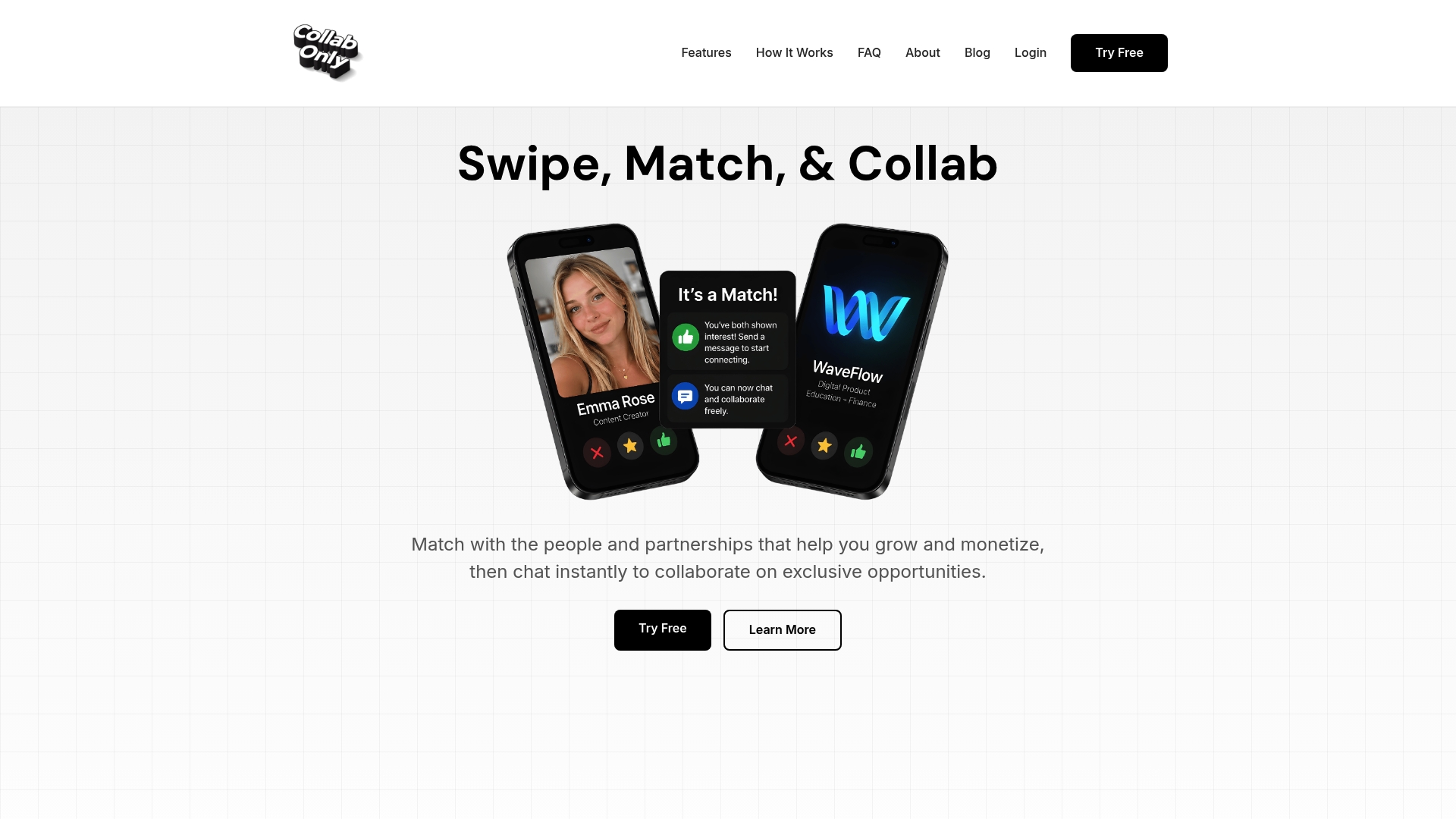
Collab Only is built specifically to address these challenges for brands and marketers who are ready to move beyond one-off influencer transactions. The platform's matching system connects brands with goal-aligned creators across TikTok, Instagram, and YouTube, eliminating the slow back-and-forth of cold outreach and lost DMs. Whether you are building a UGC creator platform strategy, looking to hire micro influencers for geo-concentrated or sub-niche campaigns, or scaling through a full influencer marketplace, Collab Only provides the infrastructure to match, communicate, and activate partnerships with minimal friction and maximum strategic alignment.
Frequently asked questions
How do creator partnerships affect product pricing?
Creator campaigns can reduce competitive price pressure by shifting how audiences value a product relative to alternatives, making demand less sensitive to competitor price-cutting. Products featured in influencer campaigns show measurably lower price responsiveness in marketplace data.
What is paid amplification in influencer marketing?
Paid amplification is when brands allocate media budget to boost the distribution of creator-produced content beyond the creator's organic audience reach. Paid amplification of influencer content is growing rapidly as platforms shift toward pay-to-scale distribution models.
How can I ensure compliance when partnering with creators?
Use clear, documented contracts that define content ownership, require FTC-compliant disclosures, and establish brand safety review protocols before any content is published. Partnership mechanics must include governance considerations as the complexity and scale of creator relationships increases.
Why are vanity metrics not enough for evaluating creator campaigns?
Vanity metrics like likes and impressions measure audience behavior within a short campaign window but do not reflect the commercial outcomes, pricing influence, or category authority that creator partnerships are capable of generating. Treating creators like ad units and over-relying on vanity metrics is a widely documented failure mode that constrains both campaign performance and creator relationship quality.