

TL;DR:
- Treating social media platforms as identical channels leads to costly strategic errors, given significant engagement differences.
- Understanding platform-specific features, niches, and authenticity is essential for designing effective, ROI-driven influencer campaigns.
Treating every social media platform as a functionally equivalent distribution channel is one of the most persistent and costly errors in modern marketing strategy. TikTok currently outperforms all other major platforms with a 4.25% median engagement rate, while X/Twitter trails at just 1.11%, yet brands routinely allocate budget and partnership resources without accounting for this variance. The platforms brands choose, the creators they partner with, and the features they activate all interact in ways that either amplify or undermine campaign ROI. This guide breaks down the actual mechanics behind platform performance, collaboration features, hidden compliance risks, and the business model incentives that determine whether a partnership generates real results or simply generates impressions.
Table of Contents
- Understanding platform differences: Beyond the basics
- How features shape collaboration and partnership success
- Risks, compliance, and the 'architecture layer': Hidden factors shaping strategy
- Platform incentives: Are you optimizing for attention, or connection?
- What most guides miss: The real-world balancing act brands and creators face
- Ready to build smarter social collaborations?
- Frequently asked questions
Key Takeaways
| Point | Details |
|---|---|
| Engagement varies widely | Choose your primary platform based on real engagement data for your tier and niche—not overall user numbers. |
| Native tools matter most | Use platform-specific interactive features to boost reach and clarify them in all partnership agreements. |
| Watch for architecture risks | Factor in platform design risks—like location-sharing and messaging—especially for youth campaigns or regulated industries. |
| Understand platforms’ incentives | Social media increasingly prioritizes time-on-site and retention, often suppressing external links and shaping what audiences see. |
| Balance data with adaptability | Success comes from blending benchmarks with flexibility and careful feature selection—not following generic, rigid playbooks. |
Understanding platform differences: Beyond the basics
With curiosity piqued about engagement variance, it is worth breaking down how each platform actually performs and why these differences matter for brands and creators making strategic decisions.
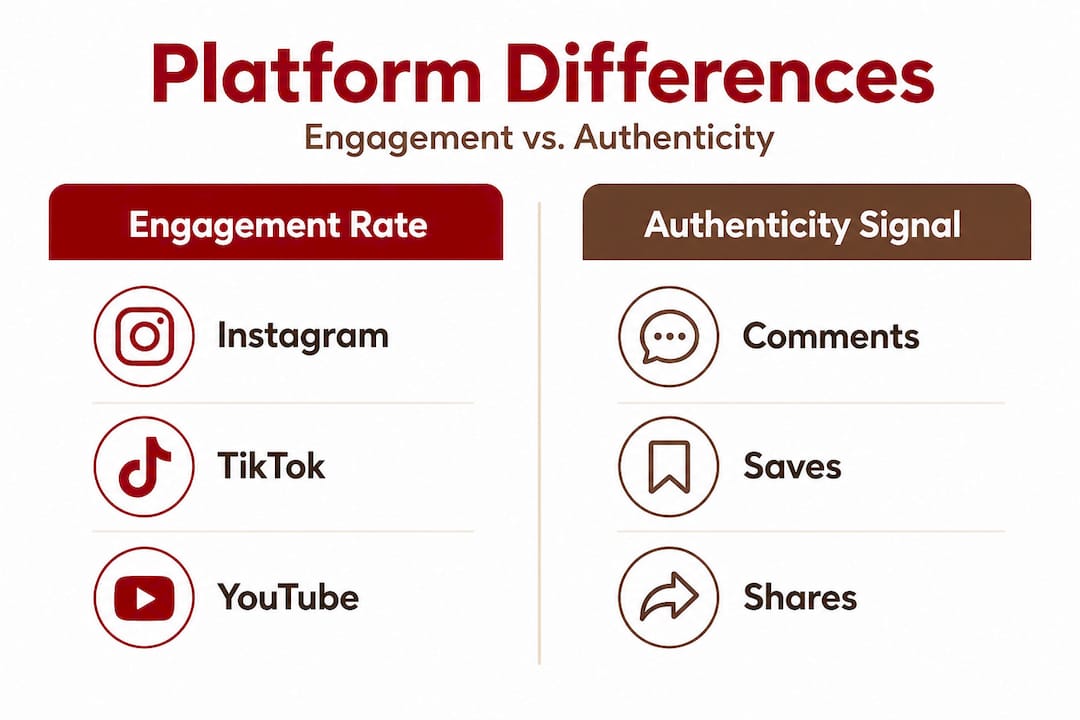
The starting point for any evidence-based platform strategy is recognizing that engagement rates by platform, niche, and follower tier vary significantly enough to invalidate any one-size-fits-all approach. A nano-influencer (typically defined as a creator with 1,000 to 10,000 followers) in the education and how-to niche on TikTok will generate substantially different engagement outcomes than a macro-influencer (100,000 to 1 million followers) in the fashion and style vertical on Instagram. These distinctions are not marginal. They are the difference between a campaign that delivers measurable ROI and one that burns budget on vanity metrics.
| Platform | Median engagement rate | Best-performing niche |
|---|---|---|
| TikTok | 4.25% | Education and how-to |
| 2.18% | Lifestyle and wellness | |
| YouTube | 1.63% | Tech and product reviews |
| X/Twitter | 1.11% | News and commentary |
| 1.89% | B2B and professional services |
Several factors explain the variance shown above:
- Algorithm design: TikTok's discovery algorithm surfaces content to non-followers at a much higher rate than Instagram's, inflating raw engagement figures for smaller creators.
- Audience expectation: LinkedIn audiences expect professional, long-form content, which creates a different engagement pattern than TikTok's entertainment-first environment.
- Creator tier effects: Nano and micro-influencers (10,000 to 100,000 followers) consistently outperform macro-influencers on engagement rate, though macro-influencers deliver superior raw reach.
- Niche specificity: Sub-niches like "sustainable home organization" or "plant-based fitness" generate higher engagement than broad lifestyle categories because audience intent is more concentrated.
One critical caveat applies to all benchmark data: raw engagement figures must be filtered for fraudulent activity. Inflated follower counts, bot-driven likes, and purchased comments distort platform-level averages and make individual creator vetting essential. Brands that rely on platform-level benchmarks without auditing creator-level authenticity risk misallocating significant campaign budgets.
Pro Tip: When evaluating creator performance, prioritize save rates and comment sentiment over raw like counts. Saves indicate intent to return to content, and substantive comments signal genuine audience investment, both of which are harder to fake than passive likes.
Understanding influencer ROI strategies requires this layered approach: platform first, then tier, then niche, then authenticity audit. Only after filtering through all four dimensions does benchmark data become actionable for campaign planning.
How features shape collaboration and partnership success
Now that the numbers are contextualized, it is critical to explore how platform features determine collaboration opportunities and how strategically minded brands harness them for measurable outcomes.
Every major social platform offers a distinct set of native collaboration mechanics, and the choice of which tools to activate directly affects campaign performance. Platform-native engagement tools and interactive features are now central to successful collaborations, and expectations around their use should be formalized in campaign agreements from the outset.
The following comparison illustrates how feature sets differ across the primary platforms brands use for influencer partnerships:
| Platform | Key collaboration feature | Partnership application |
|---|---|---|
| TikTok | Duets, Stitches, Branded Mission | Co-creation, UGC amplification |
| Collab posts, Live, Stories polls | Joint audience reach, real-time engagement | |
| YouTube | Co-hosted videos, Community posts | Long-form storytelling, product deep-dives |
| Collaborative articles, Newsletter co-authorship | Thought leadership, B2B lead generation | |
| Collaborative boards | Visual discovery, evergreen product placement |
Structuring a partnership around the right feature set requires a sequential planning process:
- Define the campaign objective first (brand awareness, direct conversion, community building, or product education) before selecting a platform or creator.
- Map available native features to that objective. A conversion-focused campaign benefits from Instagram's shoppable posts and Stories links, while a community-building campaign may leverage TikTok Duets or YouTube live streams.
- Specify feature use in the partnership agreement. Vague deliverables like "two Instagram posts" leave room for misalignment. Contracts should specify whether posts are standard feed posts, Reels, Collab posts with shared audience reach, or Stories with interactive elements.
- Set engagement benchmarks that correspond to the feature type. A Collab post that reaches two creator audiences will have different baseline metrics than a solo post, and campaign KPIs (key performance indicators) should reflect that distinction.
- Build in a feedback loop. Features like polls, Q&A stickers, and live comment sessions generate qualitative audience data that informs future campaign iterations.
Brands that access an influencer marketplace with platform-specific filtering can match not just on audience size or niche, but on which native features a creator regularly activates and performs well with. This level of specificity significantly reduces the trial-and-error cost typical of traditional outreach-based campaigns.
Pro Tip: If you plan to find YouTube influencers for a product review campaign, prioritize creators who regularly use YouTube's Community tab and post video chapters. Both behaviors signal an audience that is actively engaged across multiple touchpoints, not just passive video viewers.
The interactivity layer matters because it creates compounding engagement. A TikTok Duet that invites audience participation generates a feedback loop: the original creator's audience engages, the brand's content surfaces to new users through the algorithm, and the resulting data informs the next creative iteration. This is qualitatively different from a static sponsored post that generates a one-time impression.
Risks, compliance, and the 'architecture layer': Hidden factors shaping strategy
Successful collaboration is not just about reach or features. The very architecture of social platforms poses strategic risks that brands cannot afford to overlook when planning campaigns.

Most brand risk assessments focus on content moderation: will a creator's past posts create reputational exposure? Will sponsored content be properly disclosed? These are legitimate concerns, but they represent only the surface layer of platform-related risk. A more consequential and less-discussed category of risk involves platform design choices themselves.
Social platform design choices like stranger messaging defaults and location-sharing can lead to product-liability-style harms, independent of the content posted. This framing is significant for brands because it shifts the risk calculus from "what content is on this platform" to "what does this platform's architecture enable or encourage."
Specific architectural features that carry strategic risk include:
- Infinite scroll and autoplay: These design elements maximize time-on-platform but have drawn regulatory scrutiny in multiple jurisdictions, particularly regarding their effect on younger users. Brands running campaigns on platforms with these features should assess whether their target audience includes minors.
- Stranger messaging defaults: Platforms that allow unrestricted direct messaging from unknown accounts create safety risks that have become central to litigation in the United States and Europe. A brand partnership that drives significant traffic to a platform with these defaults may carry indirect reputational exposure.
- Location-sharing features: Geotagging and location-based discovery tools have legitimate marketing applications (geo-concentrated campaigns, local influencer activation) but also create privacy risks that regulators are increasingly scrutinizing.
- Algorithmic amplification of extreme content: Some platform architectures amplify emotionally charged content regardless of its accuracy or safety implications. Brands whose sponsored content appears adjacent to algorithmically amplified harmful content face association risks that are difficult to control through standard brand-safety tools.
"Litigation is increasingly targeting platform architecture itself, not just the content that appears on these platforms. Brands and creators operating within these ecosystems carry indirect exposure that standard content-review processes do not address."
The practical implication for campaign strategy is that platform selection should include an architecture-layer risk assessment, particularly for campaigns targeting younger demographics or operating in regulated industries. Reviewing brand partnership examples from brands that have navigated these risks successfully provides a useful reference framework for structuring compliant, risk-aware campaigns.
Platform incentives: Are you optimizing for attention, or connection?
Understanding platform business models is essential because the incentives operating behind the scenes often determine whether partnerships flourish or produce diminishing returns over successive campaigns.
Social media business models now prioritize keeping users on-site for longer periods, resulting in strategies that suppress external links and algorithmically favor short, retention-focused content. This is not a neutral technical decision. It is a deliberate business model choice with direct consequences for brand-creator partnerships.
The shift from connection-first to retention-first platform design affects campaign strategy in several specific ways:
- External link suppression: Posts containing external URLs (to a brand's website, product page, or campaign landing page) receive reduced algorithmic distribution on most major platforms. This directly undermines campaigns designed to drive traffic off-platform.
- Short-form content prioritization: Algorithms on TikTok, Instagram Reels, and YouTube Shorts favor content that generates high completion rates, which structurally advantages short, punchy content over long-form storytelling. Brands with complex product narratives must adapt their content architecture accordingly.
- Creator monetization tension: Platforms increasingly offer creators direct monetization tools (TikTok Creator Fund, YouTube Partner Program, Instagram Subscriptions) that compete with brand deal income. This creates a subtle incentive misalignment where creators may favor platform-native monetization over branded content that serves the brand's off-platform goals.
- Audience reach fragmentation: As platforms shift toward interest-graph algorithms (showing users content from accounts they do not follow), the traditional value proposition of a creator's follower count diminishes. Reach is increasingly determined by content performance, not audience size.
Brands targeting specific audience segments, such as Instagram mom influencers for baby product campaigns, must account for these algorithmic realities when setting campaign KPIs. A partnership that generates strong in-app engagement but fails to drive measurable off-platform action may reflect platform incentive misalignment rather than creator underperformance.
The strategic response is to design campaigns that work with platform incentives rather than against them. This means building conversion pathways that function within the platform (shoppable posts, native lead forms, link-in-bio tools) while reserving external link strategies for platforms where they carry less algorithmic penalty, such as LinkedIn and Pinterest.
What most guides miss: The real-world balancing act brands and creators face
Taking a step back reveals a consistent pattern in how brands and creators approach platform strategy: most guides treat data, features, and risk as separate considerations to be addressed sequentially, when in practice they must be evaluated simultaneously and weighted against each other.
The conventional approach is to start with engagement benchmarks, select a platform, find a creator, and then address compliance and risk as an afterthought. This sequence is backward. A campaign that selects TikTok based on its superior engagement rate without accounting for the platform's architecture-layer risks, its algorithmic suppression of external links, and the specific feature set the target creator actually uses is optimizing one variable while ignoring three others.
Sustainable, evidence-based social media strategy requires a framework rather than a formula. Frameworks accommodate the reality that platform conditions change, algorithms update, and regulatory environments evolve. Formulas break when any single variable shifts. The brands and creators that consistently generate strong partnership ROI are those that maintain analytical rigor on benchmark data, stay current on platform feature changes, conduct ongoing architecture-layer risk assessments, and design campaigns that align with platform incentive structures rather than fighting them.
This is also where creator selection becomes more nuanced than follower count or niche match. The decision to hire niche influencers should factor in which platform features a creator actively uses, whether their engagement patterns suggest genuine audience connection or algorithmic inflation, and whether their content style is compatible with the platform's current incentive structure.
The brands that adapt most successfully to platform and algorithm changes are those that treat their partnership strategy as a living system, one that requires regular calibration based on new data, not a fixed playbook executed repeatedly until results decline.
Ready to build smarter social collaborations?
Navigating platform differences, feature alignment, compliance risk, and algorithmic incentives simultaneously is precisely the kind of strategic challenge that benefits from purpose-built infrastructure rather than ad-hoc outreach.
Collab Only provides brands and creators with the tools to connect based on genuine goal alignment, not just follower counts or surface-level niche matching. The platform's influencer marketplace enables brands to filter by platform, creator tier, niche, and engagement authenticity, reducing the friction and guesswork typical of traditional partnership sourcing. For brands working with content creators across multiple formats, the UGC creator platform offers specialized matching for user-generated content campaigns. And for brands specifically targeting video audiences, the ability to find YouTube influencers with platform-specific performance data ensures that creator selection is grounded in evidence rather than assumption. Collab Only's swipe-based matching and instant chat upon connection eliminate the slow email cycles and lost DMs that delay campaign launches and erode partnership momentum.
Frequently asked questions
How do I choose the best social media platform for my brand partnerships?
Base your choice on where your target audience is most active, the engagement benchmarks for your niche and creator tier, and which native features best support your specific campaign objective.
Why does engagement vary so much between platforms?
Engagement depends on algorithm design, audience expectations, creator tier, and vertical niche, meaning median engagement rates by platform and niche show significant differences that make platform-level averages insufficient for campaign planning.
What is the role of platform-native features in successful collaborations?
Native tools like interactive polls, live streams, and collaborative posts boost reach and audience depth, and early contracts should formalize expectations around which features will be used and how performance will be measured.
Are there risks to using certain platform features in campaigns?
Some features like location-sharing and unrestricted messaging raise safety and compliance risks, as litigation examines feature architecture and the resulting harms independently of the content posted on those platforms.
Do social platforms suppress external links in favor of keeping users on site?
Most platforms now optimize for retention and limit external link reach to increase user time spent within the app, which requires brands to design conversion pathways that function natively within each platform's ecosystem.
Recommended
- Branded content strategies that drive real influencer ROI
- Find YouTube Influencers – Connect with YouTube Creators - Collab Only
- Blog - Collab Only
- How to find brand deals: a step-by-step guide for creators
- The role of social media in local services: drive growth
- Boost Your Brand & Growth with Social Media Marketing Trends