

TL;DR:
- Partnership marketing is a scalable growth system built on operational discipline, strategic alignment, and systematic execution. It involves long-term collaborations that extend beyond co-promotion into joint development, integrations, and co-branded initiatives, requiring dedicated management infrastructure. Effective brands prioritize operational processes and enablement to build lasting, high-ROI partnerships that foster sustained growth and advocacy.
Partnership marketing is consistently underestimated. Most marketing teams treat it as a secondary tactic, a co-promotion here, a shout-out there, when it is actually one of the most scalable growth systems available to modern brands. The gap between how most organizations practice partnership marketing and how the best-performing teams operate it is not a matter of creativity. It is a matter of operational discipline, strategic alignment, and systematic execution. This article defines partnership marketing precisely, explores its core models, documents its measurable benefits, and provides a step-by-step framework for building scalable partner operations from the ground up.
Table of Contents
- Defining partnership marketing: More than just co-promotion
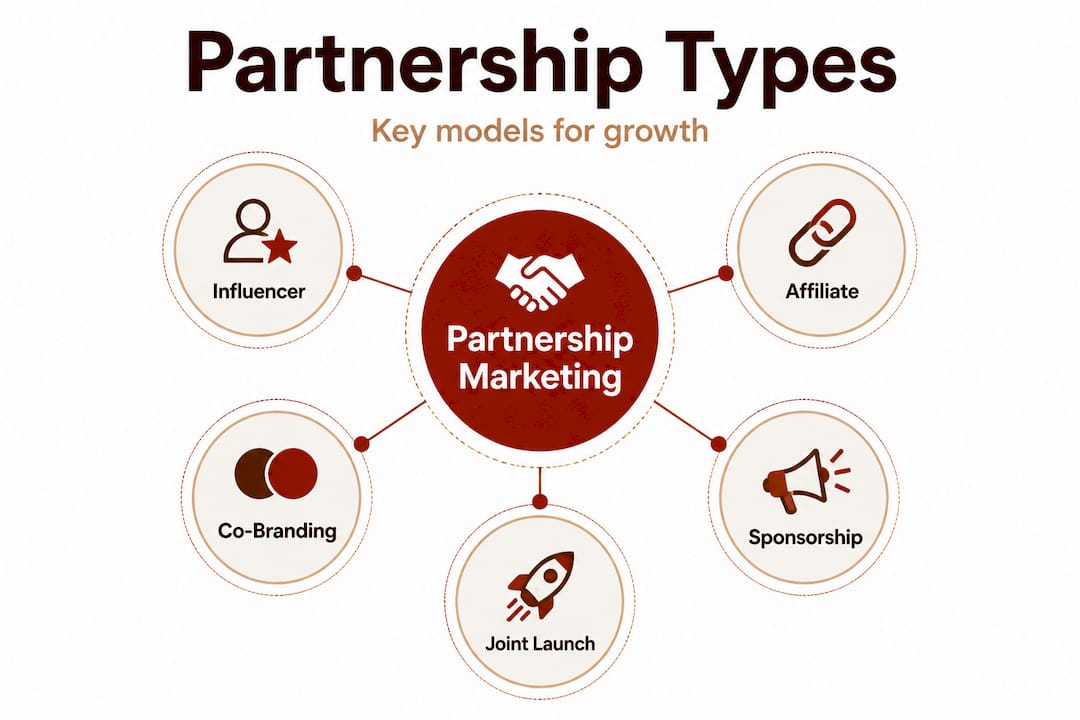
- Types of partnership marketing and how they work
- Why partnership marketing matters for brand growth
- How to build and scale partnership marketing operations
- Our take: The uncomfortable truth about partnership marketing success
- Unlock high-impact partnership marketing with Collab Only
- Frequently asked questions
Key Takeaways
| Point | Details |
|---|---|
| Beyond co-promotion | Partnership marketing is a strategic, multi-layered approach that extends far beyond basic collaborative shout-outs. |
| Ecosystem power | Brands that build robust partner ecosystems enjoy greater reach, trust, and sustainable growth. |
| Operational discipline | Enablement, management, and measurement are critical for partnership marketing that actually scales. |
| Automation advantage | Adoption of automation platforms streamlines and accelerates partnership success, especially at scale. |
Defining partnership marketing: More than just co-promotion
Partnership marketing is a strategic approach in which two or more brands, creators, or organizations align their resources, audiences, and goals to produce outcomes that neither party could achieve as efficiently alone. This definition matters because it immediately separates partnership marketing from its most common surface-level interpretation: the co-promotion.
Co-promotion is one tactic within the broader partnership marketing landscape. But the category itself includes joint product development, integrated technology ecosystems, co-branded content series, affiliate revenue structures, and creator-led distribution channels. Confusing the tactic for the strategy is the most common reason teams underinvest in the operational infrastructure that makes partnership marketing repeatable.
"Partner marketing in B2B often extends beyond co-promotion into partner ecosystems and requires operational enablement and scalable management, often motivating the use of partner marketing automation platforms."
What this means in practice is that as partnerships grow in number and complexity, they demand their own operational stack, not just a few shared social posts managed through email threads. Reviewing real partnership marketing examples reveals that the most effective collaborations share a common architecture: a clear value exchange, defined audience alignment, and measurable shared objectives.
Key misconceptions about partnership marketing that marketers need to shed immediately:
- It is not a one-time campaign tactic. It is a growth system built on repeatable partner relationships.
- Audience size is not the primary criterion for partner selection. Audience relevance and alignment are.
- Organic-feeling content from a creator partnership is not accidental. It is the product of deliberate brand enablement.
- Modern brand partnerships succeed because both parties invest in shared enablement, not just shared promotion.
When you treat partnership marketing as a system rather than a shortcut, the operational requirements become clear, and the returns become predictable.
Types of partnership marketing and how they work
With a clear definition in place, it is vital to explore the various forms partnership marketing can take. Each model has its own mechanics, strengths, and ideal use cases. Choosing the wrong model for a given objective is one of the most common and costly misalignments in partner strategy.
| Partnership type | How it works | Best-fit scenario | Key strength |
|---|---|---|---|
| Influencer partnerships | Brand collaborates with a creator to produce content for a defined audience | Product launches, awareness campaigns | Authentic reach and peer credibility |
| Affiliate programs | Partners earn commissions on trackable referrals or sales | E-commerce, subscription services | Performance-based, low upfront risk |
| Brand-to-brand co-marketing | Two non-competing brands pool audiences for joint campaigns | Market expansion, shared events | Dual audience reach, cost sharing |
| Technology integrations | Products are integrated to deliver combined value | SaaS, platform ecosystems | Stickiness, utility-driven loyalty |
| Content collaborations | Co-produced content series across formats (video, podcast, written) | Thought leadership, community building | Authority amplification |
| Co-branded product launches | Both brands create a new SKU, service, or experience together | Retail, apparel, food and beverage | High visibility, shared distribution |
Each type requires a different management structure. Influencer partnerships demand creative briefing, content approval workflows, and performance tracking at the asset level. Affiliate programs require technical infrastructure for link tracking, commission payout, and fraud prevention. Technology integrations involve product and engineering coordination in addition to marketing alignment.
The operational nuance matters enormously here. As Forrester notes, as partner ecosystems grow, organizations need dedicated partner marketing operations covering enablement, management, and measurement, which drives adoption of automation platforms to handle repeatability across diverse partner types.
This is why organizations investing seriously in partnership marketing in B2B are building internal partner operations roles, not just hiring additional marketing generalists. The work of managing a diverse partner portfolio is specialized, data-intensive, and cross-functional.
Key considerations when selecting a partnership model:
- Audience alignment: Does the partner's audience match your target segment in demographics, interests, and purchase intent?
- Goal compatibility: Are both parties optimizing for similar outcomes (awareness vs. conversion vs. retention)?
- Operational capacity: Does your team have the infrastructure to manage this type of partnership at scale?
- Measurement clarity: Can you attribute results specifically to the partnership rather than other concurrent marketing activity?
Why partnership marketing matters for brand growth
Understanding the types of partnership marketing leads naturally into the value brands gain from these strategies. The business case for partnership marketing is both quantitative and qualitative, and the two dimensions reinforce each other.
From a reach perspective, partnership marketing allows brands to access pre-qualified audiences without the cost of building those audiences from scratch. A well-aligned influencer or brand partner brings their audience's existing trust, which is something that paid media cannot replicate regardless of budget.

| Growth metric | Solo marketing approach | Partnership marketing approach |
|---|---|---|
| Audience reach | Limited to owned channels and paid spend | Expanded through partner's established audience |
| Cost per acquisition | Higher due to solo media spend | Lower through shared distribution costs |
| Trust signals | Relies on brand-generated credibility | Augmented by partner's peer credibility |
| Content production | Fully internal resource requirement | Shared or creator-produced content |
| Market entry speed | Dependent on internal brand building | Accelerated through partner's established presence |
The customer journey impact of partnership marketing is significant across multiple stages:
- Awareness: A co-branded campaign or creator partnership introduces the brand to audiences who have no prior exposure, but who already trust the partner delivering the message.
- Consideration: Affiliate content, reviews, and co-produced educational material give prospects credible third-party perspectives at the point of evaluation.
- Conversion: Co-branded promotions, exclusive bundle offers, and referral incentives reduce friction and increase purchase likelihood.
- Retention: Technology integrations and ecosystem partnerships create product stickiness that reduces churn and increases lifetime value.
- Advocacy: Well-structured creator and community partnerships convert satisfied customers into active brand advocates.
According to research on partner marketing automation platform investment, the scale of partner ecosystems in B2B contexts demands operational enablement as a core competency, reflecting how central partnership marketing has become to sustained growth strategies.
Reviewing partnership marketing case studies across industries reveals that brands achieving the strongest ROI from partnerships consistently outperform on two dimensions: partner selection rigor and enablement investment. Brands that simply reach out to potential partners without a structured enablement plan see collaboration decay quickly. Brands that build proper onboarding, content toolkits, and communication cadences see partnership longevity and compounding returns.
For marketing professionals assessing budget allocation, partnership marketing best practices point consistently toward treating partnership programs as capital investments rather than discretionary line items. The operational infrastructure built in year one continues to generate returns as the partner network grows.
How to build and scale partnership marketing operations
With the benefits clear, marketers need to know how to actually operationalize and scale partnership marketing efforts. The following steps reflect a practical, sequenced approach to launching and growing a functional partner program.
-
Define your partnership objectives with specificity. Vague goals produce vague partnerships. Determine whether you are optimizing for awareness, lead generation, revenue share, content volume, or product distribution. Each goal type implies a different partner profile and management structure.
-
Identify and qualify potential partners. Partner quality matters more than partner quantity. Screen candidates for audience alignment, content quality, engagement authenticity, and values compatibility. A smaller portfolio of high-alignment partners consistently outperforms a large network of loosely relevant ones.
-
Structure the value exchange explicitly. Both parties should understand what they are contributing and what they will receive. This includes creative assets, promotional commitments, compensation structures, exclusivity terms, and performance expectations.
-
Build an enablement framework before launching outreach. Enablement means giving partners the tools, information, and support they need to represent the brand accurately and effectively. This includes brand guidelines, messaging frameworks, content briefs, and approval workflows.
-
Establish measurement infrastructure early. Define which metrics will be tracked, how attribution will be managed, and at what cadence performance will be reviewed. Without measurement clarity from the start, partner ROI becomes impossible to demonstrate and optimize.
-
Implement automation platforms to support scale. Manual management of multiple partnerships across email, spreadsheets, and ad hoc communication becomes unmanageable beyond a small number of active relationships. As partner ecosystems scale, automation platforms become essential infrastructure for repeatability across diverse partner types.
-
Build ongoing communication cadences with active partners. Quarterly business reviews, monthly performance check-ins, and real-time communication channels are not optional. Partners who receive consistent engagement from brand teams consistently outperform those managed reactively.
Building on these proven collaboration strategies requires treating the partner program as a discipline with dedicated ownership, not as a side responsibility distributed across an already stretched marketing team.
For brands newer to the space, resources on finding and managing deals provide a practical starting point for understanding what structured partner management looks like in execution.
Pro Tip: Do not wait until you have 50 active partners to build operational infrastructure. Set up your enablement framework, tracking stack, and communication templates with your first three partnerships. The habits and systems you build early determine whether your program scales or stalls.
Our take: The uncomfortable truth about partnership marketing success
Most brands that struggle with partnership marketing are not failing because they lack creative ideas or the right partners. They are failing because they are running partnerships as one-off campaigns inside an organization that has no operational backbone for collaboration at scale.
The pattern is consistent: a brand lands an exciting influencer or co-marketing deal, generates a spike in engagement or traffic, and then watches the momentum disappear because there is no follow-up framework, no second activation plan, and no institutional knowledge captured from the experience. The next partnership starts from zero. This is not a strategy problem. It is an operations problem.
The brands building genuinely effective brand advocacy partnerships are the ones that have invested in process before platform. They have documented their partner onboarding steps, built reusable content templates, assigned internal ownership to partner success, and created feedback loops that make each subsequent partnership more efficient than the last.
Automation platforms are valuable, but they are enablers of a functioning process, not a replacement for one. An organization that deploys a sophisticated partner management platform on top of an undefined strategy will simply automate its confusion at greater speed and cost.
The most important shift marketing leaders can make is to reframe partnership marketing as an organizational capability rather than a campaign type. Campaigns have end dates. Capabilities compound. Every failed collaboration, when treated as a structured post-mortem, generates the insight needed to improve partner selection criteria, enablement quality, or measurement accuracy for the next cycle.
The brands winning at partnership marketing in 2026 are not necessarily the ones with the largest budgets or the most famous creator partners. They are the ones that have built the operational discipline to source, launch, manage, and learn from partnerships with consistency and rigor.
Unlock high-impact partnership marketing with Collab Only
Scaling partnership marketing from a set of good intentions into a reliable growth engine requires the right infrastructure, and that starts with access to aligned partners.
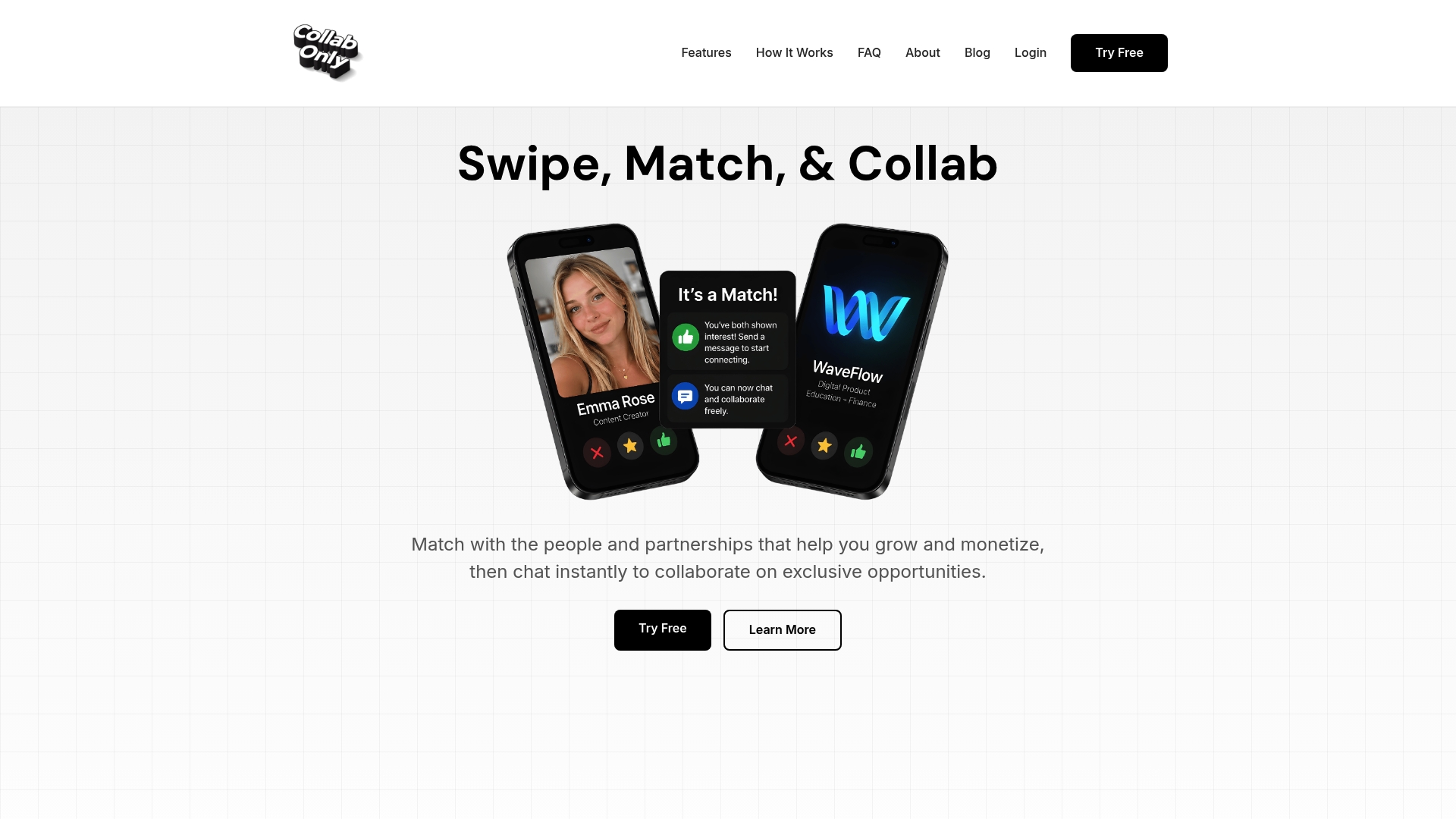
Collab Only is built specifically to remove the friction from that process. Whether you are a brand seeking vetted influencers through the influencer marketplace, a marketing team looking to source authentic content through the UGC creator platform, or a growth team focused on scaling reach through the ability to hire micro influencers, the platform connects you to goal-aligned partners through a structured matching system that replaces slow outreach and lost DMs with instant, intentional collaboration. The operational clarity that effective partnership marketing demands starts with having the right partners in your ecosystem from day one.
Frequently asked questions
What are examples of partnership marketing in action?
Partnership marketing includes co-branded campaigns, influencer collaborations, affiliate programs, and joint product launches between brands or with creators. In B2B contexts, it also includes technology integrations and partner ecosystem initiatives that require operational enablement and scalable management infrastructure.
What is the main difference between partnership marketing and traditional marketing?
Partnership marketing leverages collaboration and shared audiences to generate credibility and reach, while traditional marketing focuses on independent brand messaging delivered through owned or paid media channels.
How do you measure success in partnership marketing?
Success is measured through shared performance metrics including audience reach, engagement rate, lead volume, conversion rate, and partner-attributed revenue, all tracked against objectives defined before the partnership launches.
Why do organizations invest in automation platforms for partnership marketing?
As partner ecosystems scale, automation platforms streamline partner enablement, management, and performance measurement, making it operationally feasible to maintain quality and repeatability across a growing and diverse partner portfolio.