

TL;DR:
- Content collaborations are partnerships where brands or creators co-produce content to boost marketing reach and engagement. Choosing the right format, such as guest posts, takeovers, or case studies, directly impacts measurable outcomes like trust, awareness, or sales. Proper operational workflows and clear contracts are essential for maximizing the effectiveness of recurring collaboration models.
Types of content collaborations are structured partnerships where brands, businesses, or creators co-produce content formats, ranging from guest posts to ambassador programs, that amplify marketing reach and drive measurable engagement. The industry term for this practice is co-marketing or creator partnership marketing, and it spans every major platform from Instagram and TikTok to YouTube and LinkedIn. Influencer Marketing Hub classifies collaboration types as specific campaign deliverables co-produced across formats, meaning the format you choose directly determines the outcome you can measure. Choosing the wrong format wastes budget. Choosing the right one compounds results across every channel you operate.
What are the main types of content collaborations?
Content collaborations include guest posts, interviews, case studies, social media takeovers, giveaways, podcast guest spots, and roundups, with no strict ceiling on formats. Each type serves a distinct marketing function, and the best brands treat format selection as a deliberate decision rather than a default. The sections below map each type to its mechanics, ideal use case, and measurable output.

Guest posts and guest blogging
Guest posts place your brand's expertise on a partner's platform, exposing you to an established audience that already trusts the host. The mechanics are straightforward: you contribute original content, the host publishes it with attribution, and both parties gain SEO authority and audience crossover. This format works best when the partner's readership overlaps with your buyer profile but does not directly compete with your product.
Interviews and expert swaps
Interview collaborations position brand leaders or subject-matter experts as credible voices in a partner's content ecosystem. A leadership swap, where your CEO appears in a partner's podcast and their CMO writes for your blog, creates reciprocal authority signals. This format builds peer-credibility faster than solo content because the host's audience transfers trust to the guest by association.
Case studies as co-created proof
A case study framed as a collaboration features a customer or partner as the central voice, making it a joint content venture rather than a brand monologue. The customer provides real data and outcomes; the brand provides context and production. This format is the highest-trust content type for purchase-stage buyers because it combines third-party validation with specific, verifiable results.
Social media takeovers
A takeover hands your brand's Instagram, TikTok, or YouTube channel to a creator or partner for a defined period, typically 24 to 48 hours. The creator brings their own audience to your channel, and your existing followers get fresh perspective. This format generates above-average engagement because the novelty of a new voice disrupts the scroll pattern your regular content creates.
Giveaways and contests
Giveaways structured as influencer content partnerships require the creator to co-promote the prize, making entry mechanics tied to following both accounts. This doubles the follower acquisition surface without doubling the media spend. The format works best for awareness and list-building goals rather than direct conversion.
Podcast guest spots
Podcast appearances place your brand voice inside a high-attention, low-distraction environment. Listeners complete episodes at rates far above video completion benchmarks, which means your message reaches a more engaged segment. Brands that appear on niche podcasts with audiences of 5,000 to 50,000 listeners often report stronger conversion rates than broad-reach placements because the audience is pre-qualified by topic interest.
Expert roundups
A roundup aggregates quotes or tips from multiple contributors into a single piece of content, giving each contributor a reason to share the final asset. The distribution network effect is the primary value: ten contributors each sharing to their own audiences multiplies your organic reach without paid amplification. Roundups also build relationships with contributors who may become deeper partners later.
Pro Tip: When planning a roundup, ask contributors for one specific data point or counterintuitive opinion rather than general advice. Specific contributions make the final piece more citable and more likely to earn backlinks.
Advanced collaboration formats for sustained engagement
Dataconomy identifies 15 real collaboration formats beyond sponsored posts, with defined durations for recurring partnerships. These formats move beyond one-off content and create compounding returns across campaign cycles.
- Challenge formats (7–30 days). A structured challenge assigns a daily or weekly task to the creator's audience, generating user participation and organic content at scale. The brand provides the framework; the community provides the volume.
- UGC-only deliverables. User-generated content collaborations task creators with producing raw, authentic footage that the brand repurposes across paid and organic channels. The output looks native because it is native.
- Whitelisting and content licensing. Whitelisting grants the brand permission to run paid ads from the creator's account, preserving the creator's voice while giving the brand media targeting control. Rights lifecycle planning must be built into the contract upfront to avoid delays when repurposing assets.
- Live stream shopping and demos. A creator demonstrates a product live, answers audience questions in real time, and links directly to purchase. This format collapses the awareness-to-conversion funnel into a single session.
- Ambassador programs (3–12 months). Ambassador models create recurring touchpoints across a creator's content calendar, building brand familiarity through repeated exposure rather than a single impression. Creator partnership programs with defined deliverables and review cycles outperform one-off placements on nearly every retention metric.
- Co-created products and limited drops. A capsule collection or limited product drop co-designed with a creator gives the collaboration a tangible, purchasable output. The creator's audience buys because they trust the creator's taste, not just the brand's marketing.
Pro Tip: Design whitelisting rights into every creator contract from the start, even if you do not plan to run paid ads immediately. Retrofitting licensing terms after content is published adds weeks to your repurposing timeline.
B2B co-marketing collaboration formats that build authority
B2B co-marketing collaborations center on creating an anchor asset, such as joint research, a webinar, or a co-authored guide, and then distributing derivative content separately on each partner's channels. BuckleyPlanet identifies this anchor-and-derivative model as the most efficient co-marketing structure because it maximizes content output from a single production investment.
| Format | Primary goal | Investment level | Lead capture method |
|---|---|---|---|
| Joint webinar | Lead generation | Medium | Registration form |
| Co-authored ebook or whitepaper | Authority building | High | Gated download |
| Newsletter cameo or guest issue | Audience crossover | Low | Click-through to landing page |
| Co-branded research or survey | Thought leadership | High | Gated report or press coverage |
| Joint landing page with bundled offer | Conversion | Medium | Unified lead routing |
Joint webinars are a workhorse format in B2B co-marketing, typically doubling registration numbers through mutual email list promotion and dual speakers. That registration lift is not accidental. It reflects the compounded trust both brands bring to a shared audience. Co-branded research reports carry similar authority because original data is one of the few content types that earns press coverage, backlinks, and sales team usage simultaneously.
Unified landing pages with single lead routing prevent conversion fragmentation, which is the most common failure point in B2B co-marketing. When two partners each build separate capture pages for the same campaign, leads split, attribution breaks, and neither partner can measure true campaign performance.
How to choose the right collaboration type for your goals
Collaboration models dictate briefing, measurement, and workflow design for creator partnerships, which means the model you select shapes every operational decision that follows. Matching format to goal is the first filter; matching format to channel mechanics is the second.
- Sales goal. Live stream shopping, ambassador programs, and co-created product drops generate direct purchase intent. These formats work because the creator's endorsement is present at the moment of transaction.
- Awareness goal. Takeovers, challenges, and giveaways maximize reach and new audience acquisition. They trade depth of engagement for breadth of exposure.
- Trust and education goal. Case studies, expert interviews, co-authored guides, and podcast appearances build credibility over time. They are slower to convert but produce higher-quality leads.
- UGC and content volume goal. UGC-only deliverables and challenge formats generate large libraries of reusable assets. Brands running paid media at scale benefit most from this format because it reduces creative production costs.
Channel mechanics matter as much as goals. TikTok rewards challenge formats and short-form UGC. Instagram performs best for takeovers, giveaways, and shoppable live streams. YouTube suits long-form reviews, tutorials, and episodic series. Matching the format to the platform's native behavior increases organic distribution without additional spend.
Standardized workflows for sourcing, briefing, approval, and licensing are the primary operational bottleneck in most collaboration programs. Brands that build these workflows before launching a campaign repurpose assets faster and test paid media variations sooner. The content development workflow should include rights lifecycle checkpoints at the brief stage, not the approval stage.
Pro Tip: Map each collaboration type to a single primary metric before briefing the creator. One-off sponsored posts measure reach. Ambassador programs measure repeat purchase rate. UGC deliverables measure cost-per-creative-asset. Mixing metrics across formats makes campaign comparison impossible.
Key takeaways
The most effective content collaboration strategy matches format to goal, builds operational workflows before launch, and treats creator relationships as recurring assets rather than one-time transactions.
| Point | Details |
|---|---|
| Format determines outcome | Select collaboration type based on your primary goal: sales, awareness, trust, or content volume. |
| B2B anchor assets multiply output | One joint research report or webinar generates derivative content across both partners' channels. |
| Operational workflows prevent delays | Build briefing, approval, and licensing checkpoints into the project plan before creator outreach begins. |
| Whitelisting requires upfront contracts | License rights must be agreed at the brief stage to avoid delays when repurposing content for paid media. |
| Recurring models outperform one-offs | Ambassador and episodic series formats compound audience familiarity and outperform single sponsored posts on retention metrics. |
The collaboration format problem most brands ignore
The most common mistake I see brands make is treating collaboration format as an afterthought. They identify a creator they like, agree on a fee, and then ask what content to make. That sequence produces generic sponsored posts that neither party is proud of and that audiences scroll past without registering.
Format-driven collaboration strategy starts from the outcome and works backward to the deliverable. If you need purchase intent, you design a live shopping session or a limited drop. If you need trust signals for a complex product, you build a case study or a co-authored guide. The format is not a container for your message. It is the mechanism that delivers the outcome.
The second pattern I consistently observe is brands underinvesting in operational infrastructure. A well-matched creator with a poorly designed brief produces mediocre content. A moderately matched creator with a clear brief, defined approval stages, and pre-agreed licensing terms produces content you can run in paid media for six months. The operational side of collaboration is where most of the return on investment actually lives, and it is the part most brands skip because it is less exciting than creator discovery.
The brands winning in 2026 are not necessarily working with the biggest creators. They are working with the right formats, the right workflows, and the right measurement frameworks. That combination scales. A roster of unstructured one-off posts does not.
— Samuel
Find and execute the right collaborations with Collabonly
Collabonly connects brands with nano and micro influencers across Instagram, TikTok, and YouTube through a swipe-based matching system that eliminates slow email outreach and lost DMs. Once matched, instant chat opens so you can brief, negotiate, and align on deliverables without switching platforms.
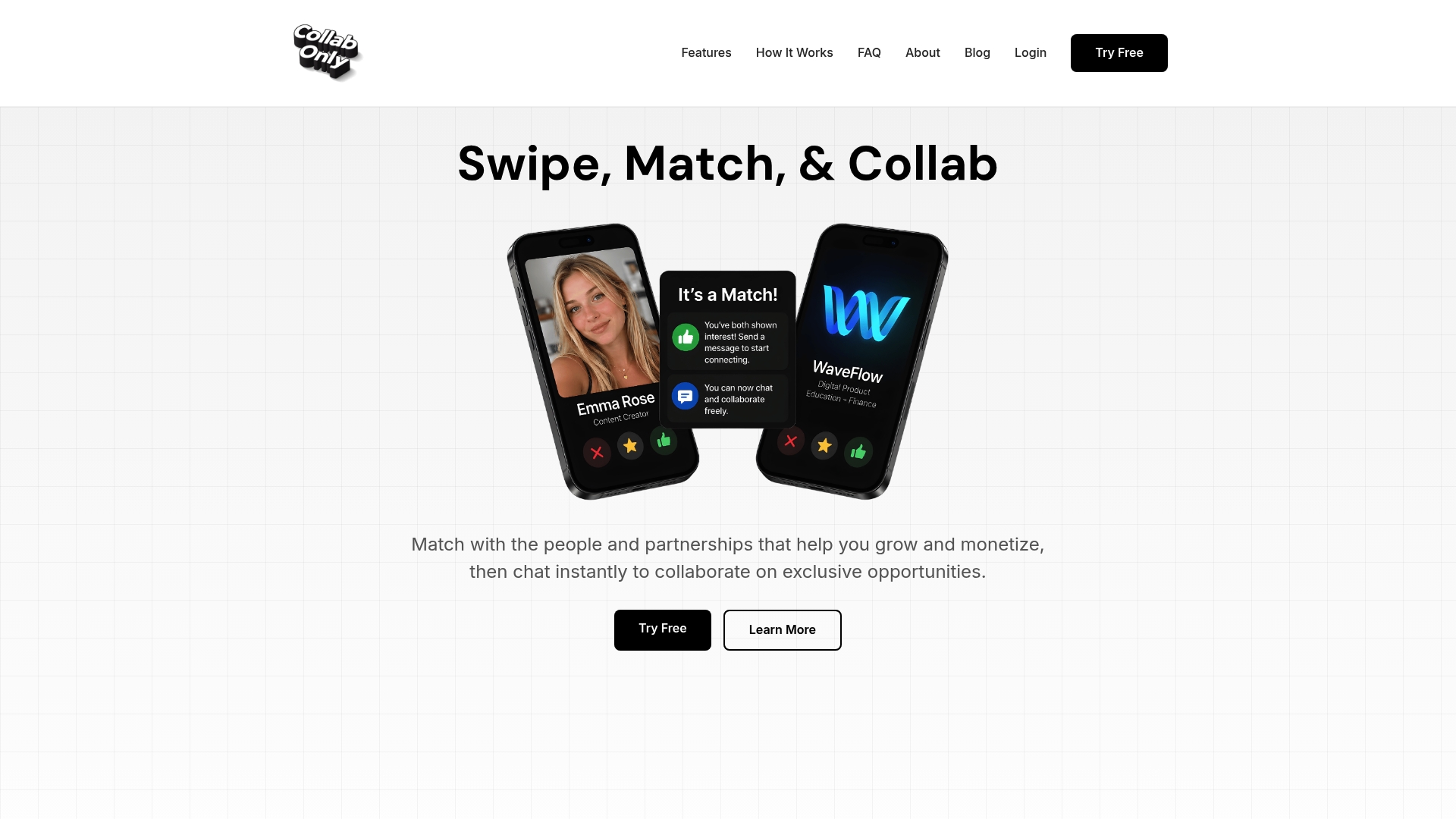
Whether you are running a UGC campaign, building an ambassador program, or sourcing creators for a live shopping series, Collabonly's influencer marketplace gives you access to creators across every platform and follower tier. The platform supports the full range of collaboration types covered in this guide, from one-off giveaways to recurring episodic partnerships. Start matching with creators today and move from strategy to execution without the friction of traditional outreach.
FAQ
What are the most common types of content collaborations?
The most common types include guest posts, social media takeovers, giveaways, podcast guest spots, interviews, and case studies. Each format serves a distinct goal, from audience crossover to trust building and direct conversion.
What is the difference between a sponsored post and an ambassador program?
A sponsored post is a one-off deliverable with a single payment and no ongoing commitment. An ambassador program runs 3–12 months with recurring content deliverables, building brand familiarity through repeated exposure across a creator's full content calendar.
How do B2B content collaborations differ from influencer partnerships?
B2B co-marketing collaborations focus on anchor assets like joint research, webinars, and co-authored guides distributed across both partners' channels. Influencer partnerships prioritize audience reach, trust transfer, and content volume on social platforms.
What is whitelisting in creator collaborations?
Whitelisting is a licensing arrangement where a brand runs paid ads from a creator's social account, preserving the creator's native voice while giving the brand full media targeting control. Rights must be agreed in the original contract to avoid delays.
How do I choose the right collaboration format for my brand?
Match the format to your primary marketing goal: live shopping and ambassador programs for sales, takeovers and challenges for awareness, and case studies or co-authored guides for trust and education. Then align the format with the native mechanics of your target platform.