

TL;DR:
- Effective brand collaborations are built on audience alignment, shared values, and a clear process rather than just partner prestige. Successful formats include co-created products, joint campaigns, giveaways, and influencer partnerships, chosen based on strategic goals and timing. Authentic, strategic alignment and continuous data sharing drive long-term partnership success beyond mere reach metrics.
Most brands understand that collaboration can expand reach, but the ones that actually move the needle are built on something deeper than shared logo placement. Effective brand collaboration ideas require audience alignment, creative fit, and a defined process, not just a well-known partner name. This guide covers the key criteria for selecting partners, the most proven collaboration formats available in 2026, a side-by-side comparison to help you prioritize, and a practical execution workflow to take a concept from idea to measurable results.
Table of Contents
- How to choose the right brand collaboration: essential criteria
- Top brand collaboration formats with creators and other brands
- Comparing brand collaboration formats: advantages, challenges, and best uses
- From idea to launch: executing brand collaborations successfully
- The overlooked truth: why strategic alignment beats flashy campaigns
- Find and hire creators for your brand collaboration campaigns
- Frequently asked questions
Key Takeaways
| Point | Details |
|---|---|
| Select partners for alignment | Choose collaborators whose audiences and brand values naturally complement yours to ensure authentic engagement. |
| Pick fitting formats | Use formats like co-created products or influencer partnerships based on your campaign goals and resources. |
| Plan and communicate | Set clear goals, responsibilities, and approval timelines to prevent missteps during campaign execution. |
| Measure rigorously | Track performance at key intervals and use insights to improve future collaborations and budgets. |
| Prioritize authenticity | Strong, genuine collaborations build trust and drive sustained impact beyond flashy one-offs. |
How to choose the right brand collaboration: essential criteria
The single most common reason brand collaboration ideas underperform is a misalignment in foundational criteria before the campaign even launches. Sprout Social frames collabs as starting well before the public reveal, with clear goals, partner fit, and shared values defined in advance. That framing matters because correcting those gaps mid-campaign is costly.
Before committing to any creative brand partnership, evaluate each potential collaboration against the following criteria:
- Define the collaboration's primary purpose. Whether the goal is audience reach, brand repositioning, a product launch, or revenue growth, the format and partner selection will differ materially.
- Confirm audience overlap with data. A fitness brand partnering with a wellness creator should validate that the creator's audience skews toward active adults, not just general wellness interest.
- Assess brand voice and values compatibility. Mismatched tone, even between otherwise complementary brands, creates messaging friction that audiences detect quickly.
- Establish mutual expectations in writing. KPIs, deliverable timelines, content approval workflows, and each party's promotional commitments should be documented before the first asset is created.
- Set a reporting cadence. Define when performance will be reviewed: at launch, mid-campaign, and at the conclusion, so both parties can act on data rather than assumptions.
When selecting suitable collaborators, the temptation is to default to whoever has the largest reach. Reach is a lagging indicator of fit. The more precise question is whether the partner's community would find value in your product without being told to. That intersection is where brand and creator alignment produces authentic endorsement rather than paid noise.
Pro Tip: Map out the partner's content from the past 90 days before reaching out. If your product would fit organically in that content, the partnership has strong alignment. If it would feel like an interruption, reconsider.
Communication cadence is also a practical selection criterion, not just a soft preference. Brands that set clear approval timelines, typically 48 to 72 hours for content review, report fewer delays and higher-quality final assets. Understanding the range of influencer collaboration formats available will further sharpen which criteria apply most to your campaign type.
Now that you know how to evaluate partners and set criteria, let us explore specific collaboration types that fit different goals.
Top brand collaboration formats with creators and other brands
The most common collaboration formats span co-created products, joint campaigns, giveaways, influencer partnerships, and licensing deals, and each serves distinct strategic purposes. Choosing among them starts with matching the format to both the business objective and the available execution timeline.
Here is a breakdown of the top brand collaboration formats:
- Co-created products: Two brands or a brand and a creator combine expertise to produce a limited-edition or permanent product offering. Think a culinary creator developing a signature sauce line with a food brand, where the creator's culinary identity drives the concept and the brand handles production and distribution. The perceived value is high because neither party could credibly produce the same thing alone.
- Joint marketing campaigns: Synchronized co-branded promotions across both parties' channels, often anchored by a shared visual identity and messaging theme. These campaigns expand reach quickly and are well-suited to product launches or seasonal activations.
- Giveaways: Collaborative contests requiring audience actions such as following both accounts, tagging a friend, or sharing content. Giveaways generate fast engagement spikes and list growth, but the audience acquired tends to be less qualified than organic growth.
- Influencer partnerships: Brands engage creators to produce authentic content endorsing a product or experience through their established channels on TikTok, Instagram, or YouTube. The quality of influencer partnership strategies depends heavily on niche specificity and audience trust, not solely follower count.
- Brand licensing: One party grants another the rights to use intellectual property, such as a character, logo, or design, within a defined product category. Licensing deals generate royalty revenue and expand market presence, but they carry higher legal complexity than most other formats.
- For a new product launch with limited time: Joint campaign or influencer partnership.
- For building community and growing an email list: Giveaway combined with a joint campaign.
- For long-term brand equity and differentiation: Co-created product or brand licensing.
- For content volume and platform coverage: Creator partnership with a multi-platform content brief.
Guidance on executing creator brand deals provides useful context on what creators expect from brand partners, which informs how brands should structure their outreach and contract terms. Additional co-marketing format examples illustrate how these formats play out across different brand categories.
Pro Tip: When running a giveaway collaboration, require that both brands promote the entry mechanics simultaneously and on the same day. Staggered promotion divides attention and dilutes the engagement spike.
Having reviewed these top formats, let us compare their strengths and use cases to help you decide.
Comparing brand collaboration formats: advantages, challenges, and best uses
Success depends on selecting formats aligned with audience overlap and values rather than just shared aesthetics or partner prestige. The table below maps each format against its primary strengths, common challenges, and the scenarios where it performs best.
| Format | Primary advantage | Main challenge | Best use case |
|---|---|---|---|
| Co-created product | High perceived value and differentiation | Long lead time, resource-intensive | Brand repositioning, product expansion |
| Joint marketing campaign | Fast reach expansion, measurable metrics | Requires aligned messaging and assets | Seasonal launches, product announcements |
| Giveaway | Rapid engagement and follower growth | Lower audience quality, short-term impact | Awareness campaigns, list building |
| Influencer partnership | Authentic content, niche audience trust | Requires legal disclosures, variable ROI | Targeted acquisition, brand affinity |
| Brand licensing | Passive revenue, new audience access | Complex contracts, exclusivity risks | IP monetization, category expansion |
Several additional factors influence format selection beyond what a table can capture:
- Co-created products require both parties to align on manufacturing timelines, retail distribution rights, and revenue splits, all of which extend the pre-launch phase by weeks or months.
- Joint campaigns offer the most flexibility in budget allocation because promotional spend can be divided proportionally based on each brand's audience size and reach.
- Influencer partnerships vary from a single sponsored post to a long-term ambassador arrangement, and that range has a direct effect on the level of legal and contractual complexity involved.
- Brand licensing agreements require careful attention to exclusivity clauses, which can prevent a brand from entering a product category with a different partner for the duration of the contract.
Pro Tip: When evaluating co-branding ideas with a new partner, start with a joint campaign before committing to a co-created product. A campaign requires less capital, runs faster, and reveals whether operational compatibility exists before deeper investment.
Reviewing successful brand partnerships across categories will surface patterns in how brands match format to context, which accelerates the decision-making process for teams building their first collaboration framework.
With a clear comparison in hand, you can better match collaboration ideas to your brand's priorities and resources.
From idea to launch: executing brand collaborations successfully
A well-conceived collaboration idea fails at the execution stage more often than it does at the concept stage. The brand collaboration workflow covers partner selection, goal setting, clear communication, strategic planning, and measuring results, and each stage requires deliberate decision-making rather than informal coordination.
The following five-step process reflects best practices across collaborative marketing strategies:
- Choose partners based on audience fit and values, with goals documented in a shared brief. Include target KPIs such as reach, engagement rate, conversion, and revenue impact before the first meeting.
- Agree on responsibilities upfront. Assign who owns content creation, who handles paid promotion, who manages approvals, and what the revision limit is. Vague ownership creates delays and scope disagreements.
- Plan unified campaign assets with consistent messaging that draws on each partner's distinct strengths. A creator with strong short-form video skills should lead on Reels and TikTok; a brand with a large email list should anchor the campaign with a dedicated send.
- Ensure FTC disclosure compliance on every piece of content, across every platform format, before publication. This means placing #ad or #sponsored at the beginning of a caption, not buried after several lines of copy.
- Establish a defined reporting cadence at launch, mid-campaign, and wrap-up to quantify impact and generate insights for the next collaboration.
"The difference between a one-time collaboration and a recurring partnership is almost always the post-campaign debrief. Brands that document what worked and share that data with their partner create the foundation for a second campaign."
Additional considerations for a sound collaboration planning process include:
- Build in a 48-hour content buffer before any scheduled publish date to accommodate last-minute revisions.
- Define the escalation path for disputes, particularly around brand safety and content approval, before signing any agreement.
- For influencer campaign execution, ensure the campaign brief includes both mandatory inclusions (product claims, CTA format) and clear restrictions (competitor mentions, prohibited messaging).
Pro Tip: Use a shared project management tool with both parties as members from day one. A single source of truth for timelines, asset links, and approval status reduces the email volume that typically slows cross-brand campaigns.
Now that you know how to execute collaborations properly, let us explore a perspective on what separates the most successful partnerships from the ones that underperform.
The overlooked truth: why strategic alignment beats flashy campaigns
There is a persistent tendency in brand marketing to conflate scale with strategy. A collaboration with a high-profile creator or a legacy brand generates internal excitement and media coverage, but if the audience overlap is superficial, the campaign produces impressions without conversion. The metric that matters is not reach. It is resonance with a qualified sub-niche.
A forced partnership with mismatched values feels inauthentic to audiences, and modern audiences are precise in detecting it. The brands that build durable collaborative marketing strategies are the ones that prioritize shared mission over shared aesthetics. A DTC brand in the sustainability space that partners with a creator who genuinely practices low-waste living will outperform a campaign pairing that same brand with a lifestyle creator who has never addressed the topic.
Exclusivity terms in brand licensing and long-term creator agreements represent a strategic lever that many brands underestimate. An exclusivity clause that blocks a brand from partnering with a competitor in a specific category for 18 months can limit future opportunities in ways that were not anticipated at the time of signing. Negotiating category-specific exclusivity, rather than broad exclusivity, preserves optionality without reducing the partner's sense of commitment.
The brands that generate repeat collaborations are the ones that make the data visible to both parties. Sharing campaign reporting, including what underperformed, builds the kind of trust that converts a one-off joint campaign into a multi-year partnership structure. Designing collaborations with internal learning loops, rather than treating each campaign as a standalone event, is how brands accumulate partnership intelligence that compounds over time.
Authentic brand advocacy does not emerge from a single well-produced campaign. It is the result of repeated, value-aligned interactions between a creator's audience and a brand's product, compounded across multiple touchpoints.
Find and hire creators for your brand collaboration campaigns
Executing on strong brand collaboration ideas requires access to the right creators, not just a broad pool of candidates. Collab Only gives brands a direct path to vetted creators filtered by niche, audience size, platform, and content style, so the matching process starts with fit rather than guesswork.
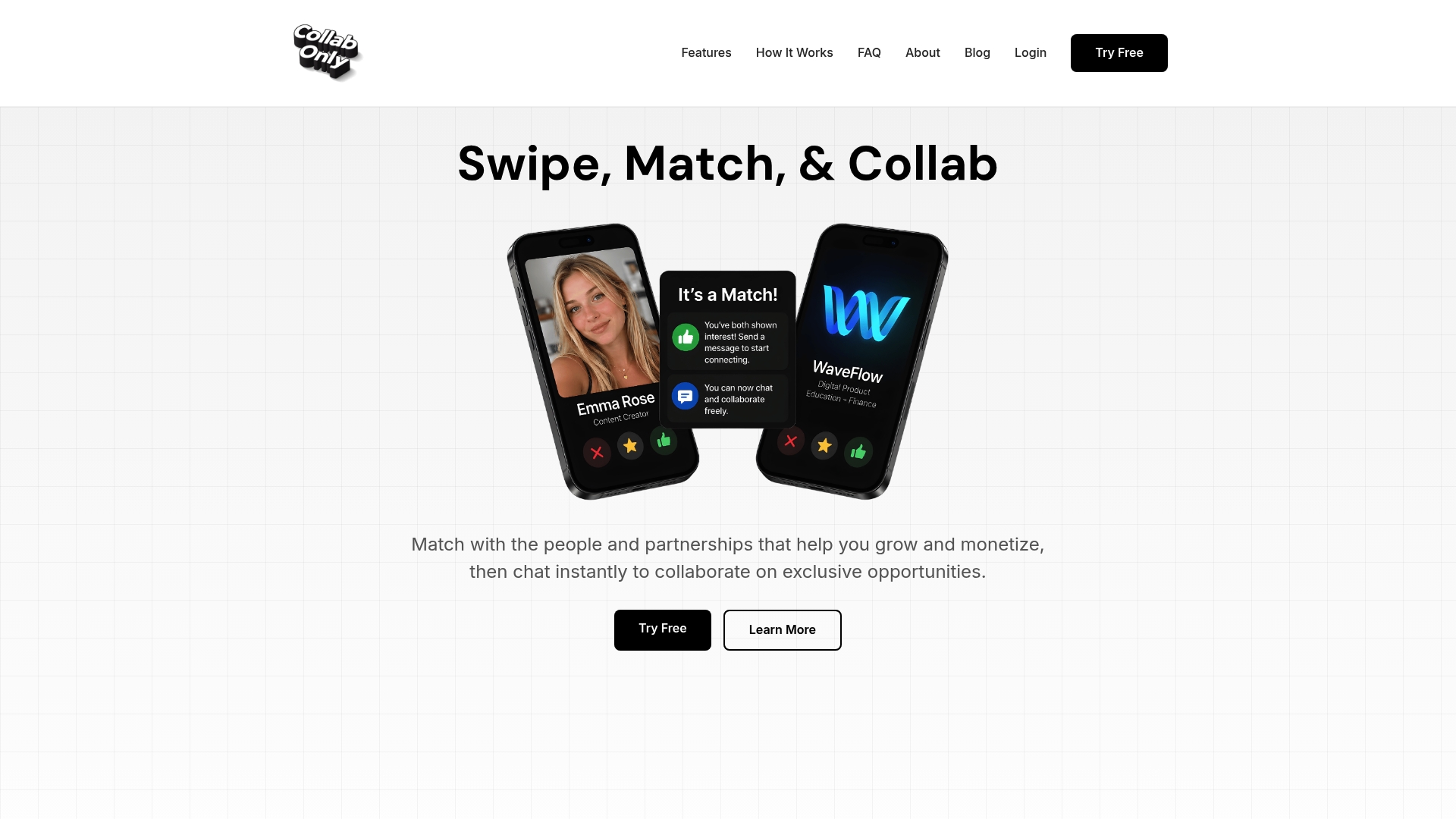
The platform's swipe-based matching system eliminates the slow outreach cycle that typically stalls brand collaboration workflows, connecting brands and creators through instant chat the moment a match is made. Whether you need micro influencers for a targeted campaign, YouTube creators in the productivity space for a B2B launch, or a broader search across the full influencer marketplace, Collab Only centralizes discovery, communication, and campaign coordination in one platform. The result is less time on logistics and more time on building the partnerships that actually perform.
Frequently asked questions
What are some popular types of brand collaboration ideas?
Popular partnership formats include co-created products, joint marketing campaigns, giveaways, influencer partnerships, retail pop-ups, product bundles, and licensing deals, each suited to different audience goals and timelines.
How do I choose the right partner for a brand collaboration?
Prioritize partners with audience and value alignment over those with the largest reach, since mismatched values produce inauthentic campaigns that underperform on conversion and brand trust metrics.
What legal requirements should I be aware of in influencer collaborations?
FTC endorsement guidelines require clear, conspicuous disclosures of material connections at the beginning of captions or visually within the content, such as using #ad or #sponsored in a prominent position.
How can I measure the success of a brand collaboration?
Define KPIs before launch and establish reporting checkpoints at launch, mid-campaign, and wrap-up to quantify impact, identify what underperformed, and build a data foundation for future partnerships.
Are long-term creator collaborations common?
Most brand deals remain one-offs, though YouTube leads in repeat partnerships at a 50.9% repeat rate, which makes campaign-level learning loops an important tool for brands looking to convert single campaigns into sustained creator relationships.