

TL;DR:
- Influencer campaign success depends on a structured operational framework rather than creative quality alone. Establishing clear roles, guidelines, and process steps ensures consistent, compliant, and authentic content production. Regular process audits and short-term metrics tracking enhance long-term partnership performance and brand growth.
Influencer campaigns stall not because of bad creative, but because the operational backbone holding the partnership together is missing. Without a defined sequence of collaboration steps, brand leads and influencers default to informal workflows: scattered DMs, vague revision requests, and approval delays that compress posting windows and erode campaign momentum. Marketing professionals who install a repeatable, structured process gain something far more valuable than a single well-executed post. They build an operational foundation that produces reliable, measurable outcomes across every campaign cycle. This guide delivers exactly that framework, moving from pre-collaboration prerequisites through execution, measurement, and the harder lessons most articles skip entirely.
Table of Contents
- What you need before you start collaborating
- Step-by-step social media collaboration process
- Common pitfalls and how to avoid them
- How to measure and verify collaboration success
- Why conventional collaboration steps often fail and what actually works
- Take your influencer collaborations to the next level with Collab Only
- Frequently asked questions
Key Takeaways
| Point | Details |
|---|---|
| Clear prerequisites matter | Set up roles, guidelines, and approval tools before working with influencers to streamline collaboration. |
| Follow a proven process | Use the 6-step workflow to keep brand and influencer teams aligned from draft to final post. |
| Avoid common errors | Prevent pitfalls like over-editing and unclear feedback to maintain motivation and compliance. |
| Measure results to improve | Establish KPIs, analyze data, and learn from outcomes for increasingly effective campaigns. |
What you need before you start collaborating
After understanding the campaign challenges, the next step is making sure you are equipped with the right essentials for collaboration. Attempting to run a brand-influencer partnership without foundational infrastructure in place is one of the most common and costly mistakes in campaign management. The prerequisites below are non-negotiable for any team expecting consistent output.
Core infrastructure and roles
Every effective collaboration requires a clearly defined tech stack and an assigned human responsible for each function. On the tooling side, the minimum viable setup includes:
- A shared cloud drive (organized by campaign folder structure, not creator name) for assets, briefs, and approved files
- A dedicated communication channel that keeps all campaign dialogue out of personal inboxes and general team chats
- An approval tracker, whether a purpose-built platform or a structured spreadsheet, that logs submission dates, reviewer comments, and final sign-off status
- A disclosure compliance checklist pre-populated with current FTC requirements and platform-specific rules for sponsored content
On the human side, four roles must be assigned before any brief is written:
- Brand lead: owns campaign objectives, budget, and final approval authority
- Influencer or creator: responsible for content production, submission deadlines, and disclosure compliance
- Project manager: coordinates the workflow between parties, manages the timeline, and maintains the approval tracker
- Legal advisor: reviews disclosure language, reviews contract scope, and flags regulatory risk
These roles do not need to be four separate individuals, particularly for smaller teams. However, each function must be explicitly owned by a named person. Ambiguity in role assignment is the single fastest path to missed deadlines and compliance gaps.
Campaign guidelines and FTC compliance
Content review requires guidelines, disclosure compliance, and documentation at every stage. This means that before any creative work begins, the brand must produce a written campaign guideline document that covers brand voice, visual requirements, content restrictions, and the exact disclosure language the influencer is required to use. Vague guidelines produce vague content. When the brief specifies that disclosure must appear as the first line of a caption (not buried in hashtags), the influencer has no ambiguity to default to.

Exploring established collaboration strategies before finalizing these documents is advisable, as well as reviewing partnership marketing tips to align internal stakeholders on scope before the influencer is even briefed.
| Prerequisite element | Responsible party | Output |
|---|---|---|
| Shared drive setup | Project manager | Organized campaign folder |
| Approval tracker | Project manager | Live status log |
| Campaign guidelines | Brand lead | Written brief document |
| Disclosure language | Legal advisor | Pre-approved caption language |
| Role assignment | Brand lead | Signed responsibility matrix |
Pro Tip: Pre-approve disclosure templates and caption language before the influencer writes a single word. This eliminates the most common compliance-related revision cycle entirely and reduces total revision rounds by an average of one to two cycles per campaign.
Step-by-step social media collaboration process
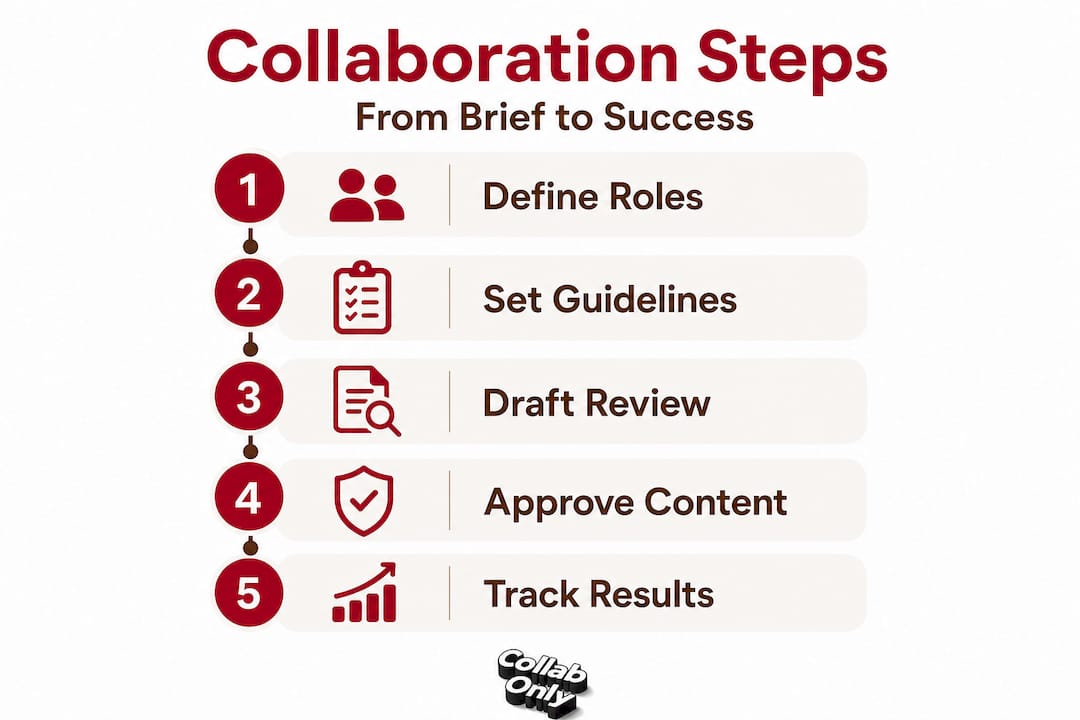
With the right preparation in place, you can now move confidently into a repeatable collaboration workflow. The following six-stage sequence is designed to maintain creative momentum while enforcing the compliance and quality controls that protect brand equity.
-
Kickoff: Schedule a synchronous or asynchronous kickoff session where both the brand lead and influencer align on campaign goals, target audience profile, key performance indicators, and non-negotiable content requirements. Document all decisions in writing and store them in the shared drive. This single step prevents the majority of mid-campaign scope disputes.
-
Creative brief: The brand delivers a concise written brief covering campaign vision, content format (static image, short-form video, story, etc.), posting platform, required mentions, restricted topics, and the pre-approved disclosure language. Brevity matters here. A 12-page brief signals to the influencer that the brand is going to micro-manage the creative, which immediately reduces the quality of the output.
-
Draft submission: The influencer submits draft content 5-7 days before posting, with written feedback and final approval required. This window exists not as a bureaucratic formality but as a practical buffer for compliance review, brand alignment checks, and revision cycles. Compressing this window to 48 hours is a structural error that consistently produces either rushed approvals or delayed posting.
-
Brand review: The brand lead and legal advisor review the submitted draft against the campaign guidelines and compliance checklist. All feedback must be delivered in writing, organized by priority (compliance-critical vs. brand-preference), and transmitted through the designated communication channel. Verbal feedback communicated informally is not reviewable and creates liability.
-
Revisions: Limit revision rounds to a maximum of two. Research on influencer ROI strategies consistently demonstrates that excessive revision cycles degrade content quality by reducing the creator's investment in the final output. If the brief was written clearly and the influencer was properly vetted, two rounds are sufficient to reach compliance and alignment.
-
Final approval: The brand lead issues written final approval and confirms the scheduled post date, time, and platform. The influencer posts per the agreed schedule and delivers post-performance screenshots or platform analytics within 48 hours of the post going live.
| Process type | Characteristics | Outcome |
|---|---|---|
| Linear (sequential) | One-directional, brand dictates each step | Faster but lower creative quality, higher revision rate |
| Iterative (collaborative) | Bidirectional dialogue at brief and review stages | Slightly longer timeline, higher content authenticity |
| Hybrid (recommended) | Structured steps with defined input points for creator | Balances compliance with creative output quality |
The hybrid model is the standard recommended approach for brands operating on social media platforms for brand growth, as it preserves brand control without eliminating the creative latitude that makes influencer content perform.
Pro Tip: Build the revision limit directly into the influencer contract. A contractual cap of two revision rounds prevents open-ended feedback loops and signals to high-quality creators that the brand respects the creative process.
Common pitfalls and how to avoid them
Even with a solid process, collaboration can break down without attention to common traps. The following issues surface repeatedly across brand-influencer campaigns regardless of budget size, platform, or industry vertical.
-
Scope creep: When the brief expands after sign-off (additional posts, format changes, new messaging requirements), the project timeline and influencer compensation both become disputed. Fix this by treating the original brief as a contract addendum and requiring written sign-off from both parties for any scope change.
-
Vague written feedback: Comments like "make it more on-brand" are not actionable. Specific feedback includes the exact timestamp in a video, the specific phrase to be changed, and the preferred alternative. Vague feedback produces repeated revision cycles and erodes the working relationship.
-
Over-editing: Limiting revision cycles and strictly managing FTC and platform rules is critical for both campaign and creator success. Brands that edit influencer content into a press release are dismantling the very authenticity they paid for. If the influencer's voice is replaced by corporate language, the audience recognizes it immediately.
-
FTC and platform compliance gaps: The Federal Trade Commission's disclosure requirements are not optional, and individual platforms enforce their own sponsored content policies on top of federal rules. A single non-compliant post can generate regulatory attention, platform penalties, and reputational damage that far exceeds the media value of the post.
-
Absent documentation: Every stage of the collaboration must be logged. Approval dates, feedback records, final sign-offs, and post confirmations must be stored in a retrievable format. This documentation protects both the brand and the influencer in any post-campaign dispute.
"The most effective collaborations hold a clear structure around compliance while granting the creator genuine latitude within that structure. Authenticity is not a stylistic preference; it is a performance variable. Brands that over-control the creative consistently underperform against those that brief well and then trust the process."
Pro Tip: Document every stage and approval in the shared tracker, even when communication seems informal. Audit trails protect both parties and make post-campaign analysis significantly faster and more accurate.
Reviewing frameworks for brand advocacy partnerships is useful here, as advocacy-oriented collaborations require even tighter documentation practices due to their longer duration and higher content volume.
How to measure and verify collaboration success
To ensure results and keep improving collaboration, measurement and verification must be built into every project from the kickoff stage, not added as an afterthought once the campaign has ended. Many marketing teams invest heavily in the production phase and then apply only cursory analysis to performance, which means they repeat the same structural errors across campaigns.
KPI setup and dashboard tracking
Set KPIs during the kickoff meeting, not after the post goes live. The three primary categories of influencer campaign metrics are:
- Reach and visibility metrics: total impressions, unique reach, story views, video plays
- Engagement metrics: likes, comments, saves, shares, click-through rate on linked content
- Conversion metrics: discount code redemptions, affiliate link clicks, direct sales attributed to the campaign
Use a real-time dashboard connected to the platform analytics or provided by the influencer via screenshot protocols to track these metrics against the benchmarks established at kickoff. Real-time visibility allows the brand team to identify underperformance early enough to adjust amplification spend or repurpose content.
Post-campaign review
Long-term partnerships consistently yield superior engagement, and content similarity deepens audience ties, which means the post-campaign review is also the planning document for the next collaboration. The review should include structured feedback from both the brand and the influencer, covering what worked in the workflow, what slowed the process, and what creative directions drove the strongest performance.
For partnership marketing insights, consistently high-performing brands treat each campaign as a data point in a longitudinal learning model rather than a standalone execution.
| Metric category | Short-term partnership focus | Long-term partnership focus |
|---|---|---|
| Reach | Total impressions per post | Cumulative brand awareness growth |
| Engagement | Likes, comments, shares per post | Audience trust and repeat interaction rate |
| Conversion | Direct campaign attributions | Lifetime customer value from creator audience |
| Qualitative | Content quality score | Brand affinity and influencer audience alignment |
| Process | Timeline adherence | Workflow efficiency improvement over time |
The distinction between short-term and long-term metrics is critical for budget allocation decisions. Brands optimizing exclusively for short-term conversion metrics systematically undervalue the audience trust-building that long-term partnerships generate, which leads to budget decisions that prioritize one-off activations over the partnerships that actually compound in value.
Why conventional collaboration steps often fail and what actually works
Most published collaboration frameworks treat the process as a purely logistical challenge. Get the brief right, hit the deadlines, check the compliance boxes, and the campaign succeeds. The problem is that this framing excludes the human dynamics that actually determine whether a collaboration produces authentic, high-performing content or a technically compliant piece of content that generates no meaningful engagement.
The most common failure mode is not a missed deadline or a disclosure error. It is a creative relationship that deteriorated under the weight of overly prescriptive feedback. When a brand delivers seven rounds of notes on caption wording and color grading, the influencer's investment in the outcome diminishes predictably. The final post meets the brief but lacks the energy that made the influencer's content valuable in the first place. This is not a creative problem. It is an operational one, rooted in a misunderstanding of what influencer partnerships actually produce.
What actually works is a process that treats the brief as a fence rather than a script. The brand defines the boundaries clearly: the required messaging, the compliance non-negotiables, the visual restrictions. Within those boundaries, the influencer operates with genuine creative authority. This is not a soft suggestion about "authenticity." It is a measurable performance dynamic. Content produced within structured-but-flexible frameworks consistently outperforms content that was edited heavily by brand teams, as measured by engagement rate and audience sentiment.
The second consistent failure point is the absence of a post-campaign audit that addresses process rather than only metrics. Most teams review whether the post hit its KPIs. Fewer teams review whether the workflow itself was efficient, whether the feedback was clear, and whether the influencer would accept another brief from the brand. The real brand collaboration experience that generates compounding returns comes from iterating on the process itself, not just the creative output.
The practical implication is straightforward: after every campaign, conduct a 30-minute structured debrief with the influencer. Ask what part of the process created friction, what part of the brief was unclear, and what they would change about the workflow. This data, collected consistently across campaigns, builds an institutional knowledge base that makes every subsequent collaboration faster, cheaper, and more effective.
Structure without flexibility produces compliance. Flexibility without structure produces chaos. The campaigns that consistently outperform are built on a framework that constrains the non-negotiables and liberates everything else.
Take your influencer collaborations to the next level with Collab Only
Marketing teams that have the right process in place still face the challenge of finding goal-aligned creators quickly and managing campaign logistics without excessive manual coordination. That friction point is exactly where the right platform changes outcomes.
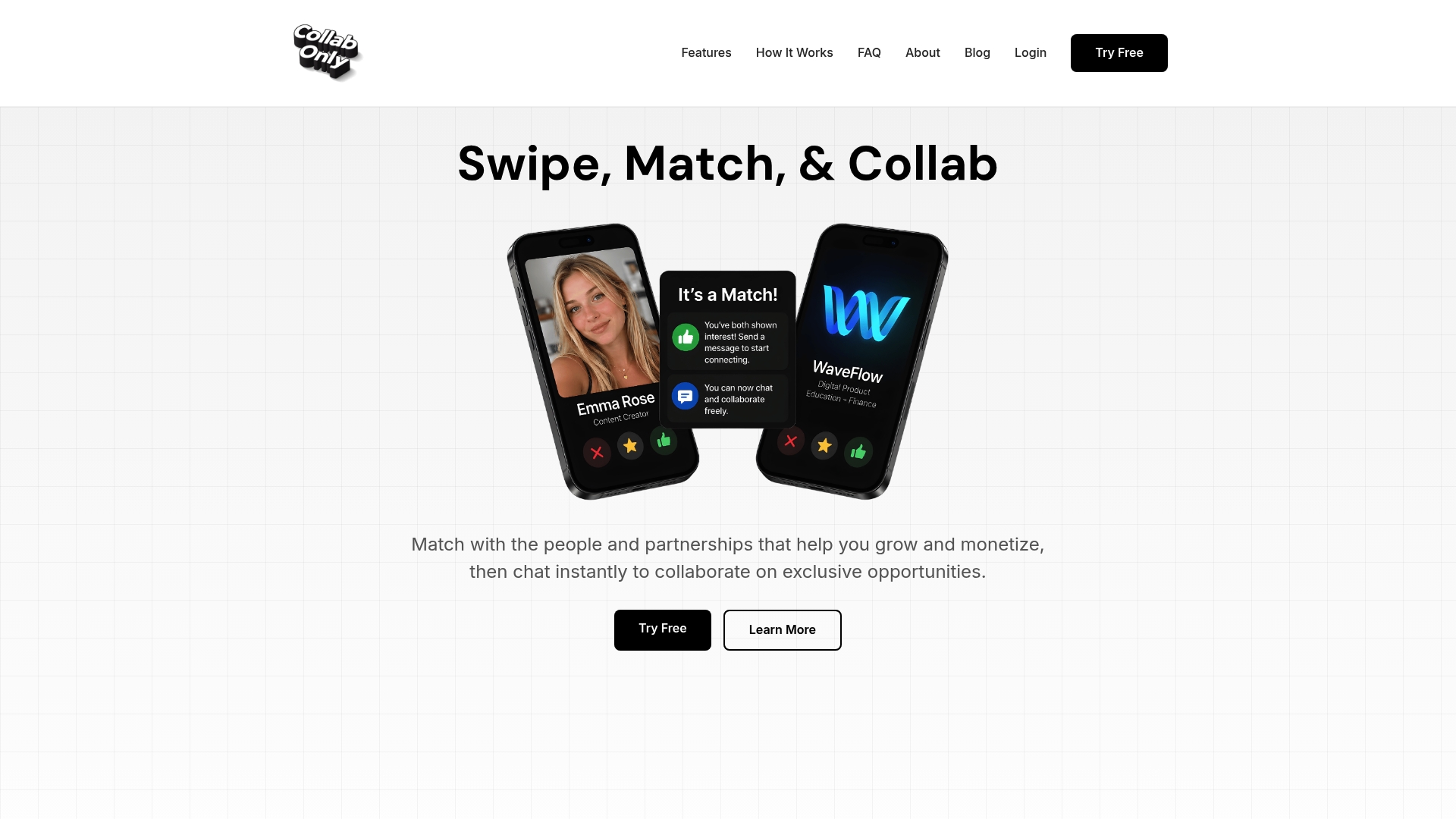
Collab Only is built specifically to eliminate the operational barriers that slow down brand-influencer partnerships. Through its swipe-based matching system, brands connect with creators whose audience profile, content style, and campaign goals align with campaign objectives before a single message is sent. From the influencer marketplace to specialized tools for nano influencer marketing and UGC creators for mobile apps, the platform provides structured pathways for every collaboration type. Instant chat upon matching replaces the slow email cycles and lost DMs that delay campaigns. For marketing leaders ready to build partnerships that scale, Collab Only provides the infrastructure that makes every step of this guide faster to execute.
Frequently asked questions
How far in advance should influencers submit content for approval?
For reliable results, require draft submission at least 5-7 days before the intended post date to allow adequate time for compliance review, written feedback, and any necessary revision rounds.
How can we ensure influencer content follows brand and legal guidelines?
Share a structured brief and checklist that covers brand values, creative rules, and FTC disclosure requirements, since content review requires guidelines and disclosure rules documented at every stage of the approval process.
What are best practices to keep influencers motivated during collaboration?
Limit revisions to a maximum of two rounds, deliver specific and actionable written feedback, and preserve creative latitude within the compliance boundaries established in the brief.
Why do long-term influencer partnerships drive higher ROI?
Long-term partnerships drive superior engagement because consistent collaborations increase content familiarity and build deeper, more trusted connections between the influencer and their audience, which compounds in conversion value over time.