

TL;DR:
- Implementing a structured content development workflow with clear roles and SLA-based approvals reduces delays and enhances quality. Proper governance, role clarity, and integrated tools enable teams to eliminate bottlenecks and maintain consistent publishing schedules. Incremental audits and targeted fixes of the longest cycle stages improve overall efficiency and accountability.
A content development workflow is a structured, end-to-end process that moves content from initial idea through publication and into ongoing measurement, with defined roles, tools, and accountability at every stage. Without this structure, marketing teams face compounding delays, inconsistent quality, and approval cycles that consume more time than the writing itself. Platforms like Adobe Workfront and Screendragon, combined with governance frameworks built around roles such as Content Owner, Creator, Reviewer, and Approver, form the operational backbone of high-performing content programs. For SaaS companies and content-driven organizations, a well-designed workflow is the difference between publishing on schedule and perpetually chasing sign-offs.
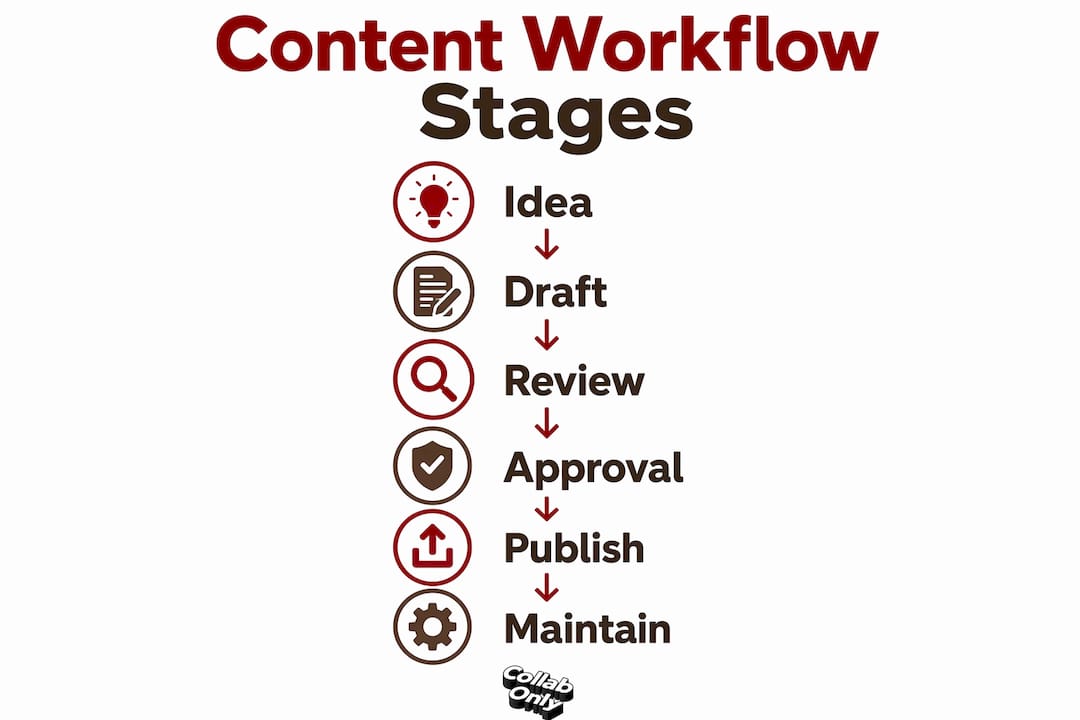
What are the essential stages of a content development workflow?
A complete content workflow covers eight sequential and parallel stages: ideation, creation, review, approval, publication, promotion, measurement, and maintenance. Each stage has a defined output, an accountable owner, and a handoff condition that triggers the next step. Skipping or collapsing stages is the most common cause of rework.
-
Briefing and ideation. Define the content goal, audience segment, distribution channel, and success metric before any writing begins. A brief that specifies word count, tone, keyword targets, and call-to-action removes ambiguity for every downstream contributor.
-
Planning and resourcing. Assign roles, confirm tool access, and set milestone dates. This is where project management platforms like Adobe Workfront or Screendragon earn their value by making timelines and dependencies visible to the full team.
-
Creative development. Writing, design, and asset creation can run in parallel when the brief is clear. Separating copy from visual production and assigning each to a dedicated Creator reduces the single-threaded bottleneck that slows most teams.
-
Review and approval. Structure this stage with explicit service-level agreements (SLAs) for each reviewer type. SEO edits, brand compliance checks, and legal clearances each carry different urgency and expertise requirements, and treating them as one undifferentiated queue is a structural error.
-
Finalization and delivery. Format the content for its target channel, confirm metadata and tagging, and coordinate the publishing handoff. Distribution checklists prevent the common failure of publishing without promotion assets ready.
-
Measurement and maintenance. Track performance against the success metric defined in the brief. Content that underperforms should be updated or retired on a scheduled cadence rather than left to decay organically.
Pro Tip: Treat each stage output as a formal deliverable with an acceptance condition. "Draft complete" means the brief has been met, not that the writer ran out of time.
How to assign roles and responsibilities for smooth collaboration
Clear role definitions across four functions reduce collaboration failures faster than adding review layers. The four roles are:
- Content Owner. Holds strategic accountability for the piece. Sets the brief, approves the final output, and owns the performance result. In agency settings, this role typically sits with the account lead or brand manager.
- Creator. Executes the writing, design, or video production. Responsible for meeting brief specifications, not for interpreting strategic intent independently.
- Reviewer. Provides functional feedback within a defined scope. An SEO reviewer checks keyword alignment; a brand reviewer checks tone and visual compliance. Reviewers do not hold approval authority.
- Approver. Provides binding sign-off. In regulated industries, this may include legal or compliance officers. The Approver role should be held by the fewest people possible to prevent diffusion of accountability.
A RACI matrix (Responsible, Accountable, Consulted, Informed) maps these roles to each workflow stage and makes escalation paths explicit. When a reviewer misses a deadline, the RACI defines whether the workflow auto-progresses or escalates to the Content Owner. In-house teams often assign the Content Owner role to a content strategist, while agencies typically assign it to a project manager or account director.
Pro Tip: Limit the Approver role to one person per content type. Multiple approvers without a defined tiebreaker create circular revision loops that no SLA can fix.
The role of content creation in growth depends directly on how clearly these responsibilities are distributed. Ambiguous ownership is the root cause of most approval delays, not the complexity of the content itself.
What tools and technologies optimize content production?
The most effective content production methods combine project management, collaboration, and AI-powered quality control into a unified ecosystem. Disconnected tools create the same coordination overhead that workflow software is designed to eliminate.

| Category | Tool Examples | Primary Function |
|---|---|---|
| Workflow orchestration | Adobe Workfront, Screendragon | Task assignment, approval routing, progress visibility |
| Quality control | Grammarly, Hemingway Editor | Copy editing, readability scoring |
| Digital asset management | Adobe Experience Manager | Asset storage, version control, publishing integration |
| AI-assisted production | Rankenstein, custom GPT pipelines | Research, outlining, draft generation, feedback summarization |
| Async collaboration | Loom, Notion, Miro | Asynchronous feedback, whiteboarding, documentation |
Enterprise content programs scale most effectively when strategy is centralized, production steps are automated with AI, and governance is enforced programmatically through integrated platforms. Adobe recommends connecting Workfront with Experience Manager so that task completion in the project layer triggers asset availability in the publishing layer automatically.
Key integration principles for a unified workflow ecosystem:
- Connect your project management tool to your DAM so asset handoffs do not require manual file transfers.
- Use content request forms with required fields to enforce brief completeness before a task is created.
- Configure automated deadline reminders at 48 hours and 24 hours before each SLA expires.
- Apply AI tools at discrete stages: research and outlining before drafting, summarization during review, and quality scoring before final approval.
AI-assisted workflows that divide tasks between human judgment and machine execution produce measurably better quality control than either approach alone. The key is assigning AI to stages with clear, verifiable outputs and reserving human review for strategic and tonal decisions.
How can teams implement async reviews and SLA-based approvals?
Asynchronous content operations define a competitive advantage for distributed teams because they decouple review quality from reviewer availability. The structural requirement is that every review stage carries an explicit deadline, a defined scope, and a fallback rule for missed deadlines.
A practical SLA framework for review types:
- SEO review. 24-hour SLA. Scope limited to keyword alignment, internal linking, and metadata. No stylistic feedback permitted at this stage.
- Brand review. 48-hour SLA. Scope covers tone, visual compliance, and messaging alignment. Brand reviewers use a standardized checklist to prevent scope creep.
- Legal review. 72-hour SLA. Reserved as the final review stage. Parallelizing review tasks and reserving legal review as the final step can halve content cycle times by removing sequential bottlenecks.
- Final approval. 24-hour SLA from the Approver after all reviews are complete.
Fallback rules prevent stalled workflows when deadlines are missed. If a reviewer does not respond within the SLA window and no blocking issues have been flagged, the workflow auto-progresses to the next stage. This rule must be documented in the governance plan and communicated to all reviewers before the workflow launches.
Limiting review rounds to two maximum prevents cyclical delays and signals scope or briefing problems when exceeded. If a piece requires a third revision round, the correct response is to escalate to the Content Owner and audit the original brief, not to open another review cycle.
Pro Tip: Use a shared dashboard, such as a Notion board or a Workfront project view, to make every review status visible to the full team in real time. Visibility eliminates the status-chasing emails that consume reviewer attention.
What common pitfalls derail content workflows and how to fix them?
The most damaging workflow failures share a common origin: structural ambiguity at the brief, routing, or tooling layer. Identifying the failure mode precisely determines the correct fix.
Common pitfalls and their remedies:
- Incomplete briefs. Briefs that omit audience, keyword targets, or success metrics generate multiple revision rounds because the Creator is interpreting intent rather than executing specifications. Treating the brief as a contract between client expectations and creative output reduces revision cycles and approval mismatches.
- Approval routing latency. A median 4.7-day manual approval cycle is the norm for teams relying on email-based routing, with 3.7 of those days spent on status chasing rather than actual review. Replacing email threads with automated routing in Adobe Workfront or a comparable platform eliminates this overhead.
- Tool fragmentation. When briefs live in Google Docs, feedback arrives in Slack, and approvals are tracked in spreadsheets, communication is lost and work is duplicated. A unified work management platform consolidates these functions and creates a single audit trail.
| Pitfall | Root Cause | Fix |
|---|---|---|
| Multiple revision rounds | Incomplete or unapproved brief | Require brief sign-off before production starts |
| Approval delays | Manual routing and status chasing | Automate routing with SLA triggers |
| Lost feedback | Fragmented tools | Consolidate to one workflow platform |
| Scope creep in reviews | Undefined reviewer scope | Assign checklist-based review scopes per role |
Pro Tip: Schedule a quarterly workflow audit. Review cycle time data, identify the stage with the longest average duration, and redesign that stage first. Incremental improvement on the highest-friction stage yields faster results than redesigning the entire process at once.
AI-powered workflows with distinct stages and measurable failure modes enable teams to diagnose issues like intent mismatch or voice drift efficiently, rather than discovering them at the approval stage when correction is most expensive.
Key takeaways
A well-governed content development workflow reduces cycle time, improves output quality, and makes collaboration predictable by assigning clear ownership at every stage.
| Point | Details |
|---|---|
| Define all eight workflow stages | Map ideation through maintenance with explicit outputs and handoff conditions at each step. |
| Assign four distinct roles | Content Owner, Creator, Reviewer, and Approver must be named for every content type. |
| Enforce SLA-based reviews | Set 24 to 72-hour review windows by type and configure fallback rules for missed deadlines. |
| Consolidate tooling | Replace email and spreadsheet coordination with a unified platform like Adobe Workfront. |
| Treat the brief as a contract | Require brief approval before production begins to prevent downstream revision cycles. |
Why workflow design is a governance problem, not a process problem
Most teams approach workflow failures as process inefficiencies and respond by adding steps, tools, or review layers. That diagnosis is usually wrong. The underlying issue is almost always a governance failure: unclear ownership, undefined scope, or missing escalation paths. Adding a sixth review round to a piece that already required five does not fix the problem. It compounds it.
The teams that consistently produce high-quality content on schedule share one structural characteristic: every person in the workflow knows exactly what they are responsible for, what they are not responsible for, and what happens if they miss a deadline. That clarity does not come from better software. It comes from documented governance decisions that are communicated, enforced, and reviewed regularly.
Asynchronous collaboration norms matter here as well. Distributed teams that wait for synchronous alignment before progressing a review stage introduce delays that accumulate across every piece in production. Building fallback rules and async review protocols into the governance plan removes the dependency on real-time availability without sacrificing accountability.
The practical starting point is not a full workflow redesign. It is a single audit: identify the stage with the longest average cycle time, document why it stalls, and fix the governance gap at that stage. Pilot the fix on one content type before scaling it. Workflows that are designed incrementally and tested against real production data outperform those built in planning sessions and launched wholesale.
— Samuel
How Collabonly supports your content workflow with creator partnerships
Collabonly connects brands and content strategists with vetted nano and micro influencers who can fill creator roles within an existing workflow without the friction of cold outreach or lost DMs.

The platform's matching system assigns creators based on niche, platform, and campaign goals, which maps directly to the Creator role in a governance-driven workflow. When a content strategist needs TikTok, Instagram, or YouTube assets produced to brief specifications, Collabonly provides instant chat upon match so briefing and feedback happen in one place. Teams looking to hire nano influencers for authentic, cost-effective content or to engage micro influencers at scale can access both through a single platform. Visit Collabonly to explore how creator partnerships fit into your production process.
FAQ
What is a content development workflow?
A content development workflow is a structured process that guides content from ideation through publication and ongoing maintenance, with defined roles, tools, and approval steps at each stage. It provides the operational framework that keeps content production consistent, accountable, and on schedule.
How many review rounds should a content workflow include?
Two review rounds maximum is the recommended standard. Exceeding two rounds signals a briefing or scope problem that requires escalation to the Content Owner rather than additional revision cycles.
What roles are required in a content governance plan?
The four core roles are Content Owner, Creator, Reviewer, and Approver. Each role carries a distinct scope of responsibility, and assigning all four for every content type reduces bottlenecks and duplicate work.
How do SLA-based approvals reduce content cycle time?
SLA-based approvals assign explicit deadlines to each review type, such as 24 hours for SEO and 72 hours for legal, and configure fallback rules that auto-progress the workflow when no blocking issues are flagged. This eliminates the status-chasing overhead that accounts for the majority of manual approval cycle time.
What is the fastest way to fix a slow content workflow?
Audit cycle time data by stage, identify the single highest-friction stage, and redesign the governance at that stage first. Replacing email-based approval routing with automated workflow software like Adobe Workfront typically yields the highest immediate reduction in cycle time.