

TL;DR:
- Content creation drives more cost-effective leads and long-term growth by generating ongoing organic traffic.
- Effective content shapes buyer preferences before purchase, building brand familiarity and future pipeline.
- Mastering content as infrastructure, combined with strategic AI use and creator partnerships, accelerates brand growth.
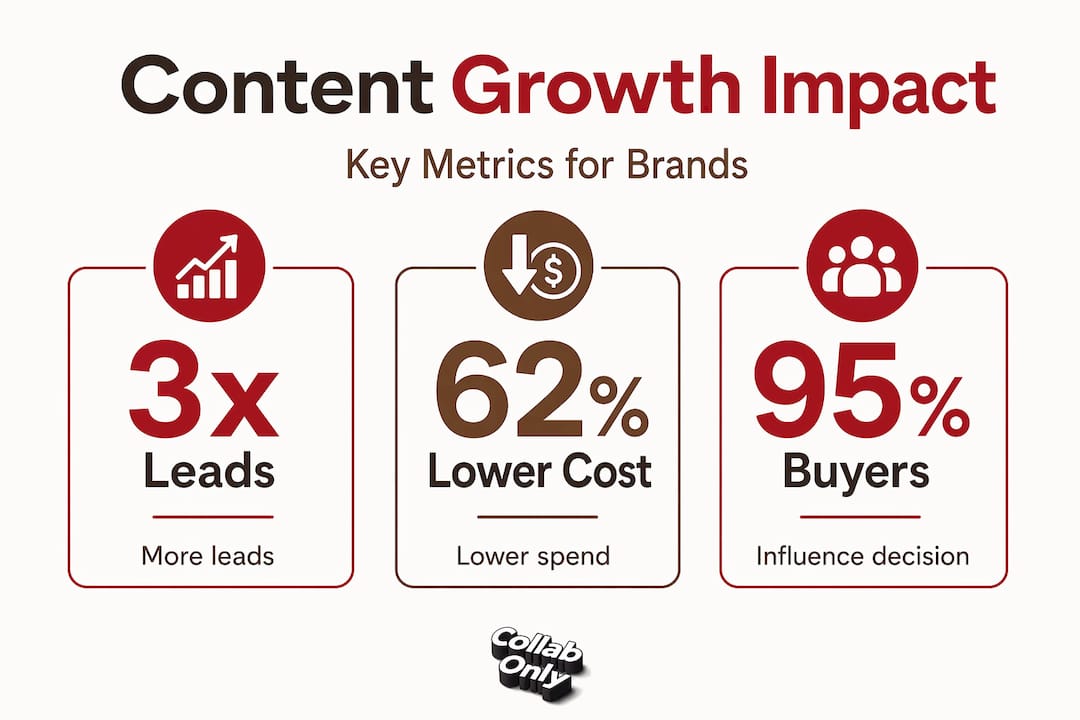
Content creation is frequently dismissed as a brand-awareness exercise, yet the data tells a different story. The role of content creation in growth extends far beyond blog posts and social shares. Content marketing generates 3x more leads than traditional outbound marketing while costing 62% less per lead, a gap that compounds dramatically over time. Despite this, many marketing teams still treat content as a support function rather than a primary growth driver. This guide clarifies content's multiple, measurable roles across the full customer lifecycle and provides marketers with frameworks to act on that understanding immediately.
Table of Contents
- Why content creation drives more cost-effective leads and growth
- How content shapes buyer behavior and builds brand preference before purchase
- Extending content value beyond lead generation to customer retention
- Measuring content marketing impact: closing the measurement gap for growth
- Optimizing content creation for growth in the AI-driven digital landscape
- Why most marketers underestimate content's evolving role and how to master it
- Leverage content creation and partnerships to accelerate your brand growth
- Frequently asked questions
Why content creation drives more cost-effective leads and growth
The economics of content marketing are not ambiguous. Content marketing generates 3x more leads than traditional outbound marketing while costing 62% less per lead. For any brand allocating budget between paid acquisition and content programs, that differential represents a structural cost advantage that accumulates year after year.
The mechanism behind this advantage is compounding. A paid ad stops generating leads the moment the budget is exhausted. A well-constructed article, video series, or podcast episode continues attracting and qualifying prospects for months, sometimes years, after publication. This is why the benefits of content creation are qualitatively different from those of interruptive advertising.
Several factors determine whether a content program actually delivers this advantage:
- Companies with a documented content strategy generate measurably more qualified leads than those producing content reactively or without a formal plan.
- High publishing frequency, maintained consistently over 12 to 24 months, creates a compounding traffic effect where older content continues to generate organic visits alongside new material.
- Content distributed through B2B short-form creators reaches in-market buyers through channels they already trust, improving both reach and conversion probability.
- The content creator economy has expanded the distribution surface for brand content beyond owned channels, multiplying the return on a single piece of content.
For a concrete example, consider a SaaS brand that publishes four in-depth comparison guides per quarter. Each guide targets a bottom-of-funnel keyword, addresses a specific competitor evaluation question, and includes a free assessment tool. Twelve months later, those 16 guides collectively generate qualified demo requests at a cost per lead roughly one-third of the brand's paid search average. That outcome is repeatable across industries when the content strategy for growth is built around documented buyer intent rather than guesswork. Content marketing examples from multiple sectors confirm this pattern consistently.
How content shapes buyer behavior and builds brand preference before purchase
The impact of content marketing on purchasing decisions begins long before a buyer engages a sales team. 95% of B2B buyers are not actively purchasing at any given time, and 83% define their purchase requirements before speaking with sales. That means the window in which content can shape evaluation criteria is wide open, but it closes sharply once a buyer enters active vendor comparison.
This reality reframes what "effective" content looks like. Content that ranks for awareness-stage queries and educates buyers on how to frame their problem is not generating leads today. It is generating shortlist preference for tomorrow. Brands that understand this dynamic invest in content that teaches buyers how to buy, not just what to buy.
Practical implications for content strategy include the following:
- Publish content that defines evaluation frameworks, such as "how to assess [category] vendors" or "what to include in a [product] RFP," so your brand's perspective becomes embedded in the buyer's decision process.
- Use thought leadership formats (original research, executive interviews, technical guides) to establish brand familiarity with buyers who are 6 to 18 months away from purchase.
- Align content topics with B2B lead generation strategies that target buyers at the problem-awareness stage, before competitors are even in the conversation.
- Track branded search volume as a proxy indicator for content-driven preference building, since buyers who have consumed your content are more likely to search for your brand directly when purchase intent activates.
The importance of content in business is most visible at this pre-purchase stage. Brands that cede this territory to competitors sacrifice future pipeline, not just current awareness. B2B buyer behavior data reinforces that preference formed during the latent period is a reliable predictor of eventual vendor selection. Effective brands and creators partnerships amplify this effect by placing educational content in front of in-market audiences through trusted voices.
Extending content value beyond lead generation to customer retention
Most content programs are built for acquisition. The measurement systems, editorial calendars, and creator briefs all orient toward generating new leads. Yet content is most effective during early prospecting but underused post-sale for retention by nearly one-third of sales reps, a structural gap that costs brands measurable lifetime value.
The post-sale content opportunity covers three distinct areas:
- Onboarding content that reduces time-to-value for new customers, directly improving activation rates and early retention metrics.
- Ongoing education content (webinars, feature updates, use-case libraries) that deepens product adoption and reduces churn risk among established accounts.
- Community-building content such as customer spotlights, peer benchmarking reports, and advisory roundups that convert satisfied customers into active brand advocates.
Brands working with CPG content creators for post-purchase campaigns have documented measurable lifts in repeat purchase rates, particularly when the content is personalized to usage patterns and delivered through channels customers already engage with. The compounding effect here mirrors acquisition content: a high-quality tutorial video produced once can reduce support ticket volume and improve renewal rates for years.
Pro Tip: Integrate content planning with your customer success function. Customer success managers hold the richest data on post-sale friction points, FAQs, and upsell triggers. A quarterly content alignment meeting between marketing and customer success typically surfaces 10 to 20 high-value content opportunities that the editorial team would never identify independently.
Modern brand advocacy partnerships extend this logic externally, enabling satisfied customers to create and distribute content that drives both retention signals and new acquisition simultaneously.
Measuring content marketing impact: closing the measurement gap for growth
Does content marketing boost growth? The answer is definitively yes, but most organizations cannot prove it because their measurement frameworks are not built for attribution. Teams that move beyond vanity metrics gain a decisive operational advantage: teams tracking revenue attribution for content receive 3.1x higher budget increases than those relying on page views and MQL counts alone.

The measurement gap is not a technology problem. It is a strategic prioritization problem. Many marketing teams instrument their paid channels with multi-touch attribution models while measuring organic content with last-click or session-level metrics that systematically undercount content's contribution to closed revenue.
The following table illustrates the distinction between measurement maturity levels and their operational consequences:
| Measurement level | Metrics tracked | Budget outcome | Growth signal quality |
|---|---|---|---|
| Level 1: Vanity | Page views, social shares | Flat or declining | Low |
| Level 2: Engagement | Time on page, email opens | Modest increases | Moderate |
| Level 3: Pipeline | MQL volume, demo requests | Incremental growth | Good |
| Level 4: Revenue attribution | Content-influenced ARR, LTV impact | 3.1x budget increase | High |
Moving from Level 2 to Level 4 typically requires connecting content consumption data to CRM records, enabling the marketing team to identify which content assets appear in the histories of closed-won deals. This is not a six-month project. A focused analyst with access to the right data sources can produce an initial content attribution model in four to six weeks.
Branded content ROI strategies offer proven frameworks for connecting influencer and creator content to downstream revenue outcomes, which is particularly relevant for brands running creator-driven campaigns alongside owned content programs.
Pro Tip: Invest in measurement infrastructure before scaling content volume. A larger volume of unmeasured content does not accelerate growth. A smaller volume of well-attributed content, optimized over time with real revenue signal, compounds far more effectively.
Optimizing content creation for growth in the AI-driven digital landscape
AI has fundamentally altered both the production economics and the distribution mechanics of content. Publication velocity is no longer a bottleneck, but quality and strategic structure have become more consequential than ever. Hybrid AI and human content approaches outperform pure AI by 34% on engagement metrics, meaning the human editorial layer is not optional but a performance variable.
The following numbered steps define a practical approach to AI-augmented content creation:
- Use AI to generate research outlines, first drafts, and data summaries. This compresses production time without eliminating human judgment.
- Apply domain expert review to every piece before publication. Subject-matter authority embedded in content is the primary differentiator AI alone cannot replicate.
- Structure each article using the quotable passage technique: write 2 to 3 self-contained, data-backed sentences per major section that directly answer a specific question. These passages increase citation probability in AI-generated search responses.
- Publish at a cadence the editorial team can maintain with quality, rather than at the maximum speed AI tools enable. Search algorithms and AI answer engines both reward consistency and depth over volume.
- Monitor AI-driven search traffic separately from traditional organic traffic. Visitors arriving via AI-generated answers carry conversion value approximately 5x higher than standard organic visitors, based on emerging 2026 behavioral data.
The comparison below summarizes the content creation approaches and their relative performance characteristics:
| Content approach | Production speed | Engagement performance | AI search visibility |
|---|---|---|---|
| Pure AI generation | Very high | Below average | Low |
| Human-only creation | Low | High | Moderate |
| Hybrid AI and human | High | 34% above pure AI | High |
Pro Tip: Structure content for both human readers and AI extraction. Clear headings, direct answers in the first sentence of each section, and specific data points improve performance with both human audiences and AI answer systems simultaneously.
Why most marketers underestimate content's evolving role and how to master it
The conventional framing of content marketing as a lead generation channel is accurate but incomplete, and that incompleteness is costing brands compounding growth they will never recover. Content's role in shaping pre-purchase preference, deepening post-sale loyalty, and building defensible brand authority operates on timescales that most quarterly planning cycles are structurally incapable of rewarding. The result is chronic underinvestment in the phases of the content lifecycle that generate the highest long-term returns.
The brands that master content-driven growth share a specific characteristic: they treat content as an infrastructure investment, not a campaign expense. Infrastructure requires measurement, maintenance, and consistent funding across budget cycles. Campaigns get cut when short-term results disappoint. This distinction explains why two brands with identical content budgets can produce dramatically different growth outcomes over a three-year period.
Content marketing rewards disciplined, measured, AI-augmented programs over high-volume, unmeasured production. The AI dimension adds a new layer of complexity: as AI tools lower the marginal cost of content production to near zero, the competitive differentiation shifts entirely to strategic clarity, measurement sophistication, and human expertise. Brands that treat AI as a replacement for editorial judgment will produce more content that generates less return. Brands that use AI to accelerate their most experienced creators and analysts will compound their advantage rapidly.
The urgency here is real. Brands that partner with creators through goal-aligned relationships, rather than one-off campaigns, are building the kind of audience trust that paid media cannot replicate at any budget level. The compounding advantage of disciplined content is the ultimate growth secret many overlook.
Pro Tip: Audit your current content program against all four customer lifecycle stages (awareness, consideration, purchase, retention) and identify which stages receive less than 20% of content investment. That gap is almost certainly where your highest-return opportunities are concentrated.
Leverage content creation and partnerships to accelerate your brand growth
Mastering the role of content creation in growth requires more than a documented strategy and measurement infrastructure. It requires access to creators who can produce authentic, audience-aligned content at scale across the platforms where your buyers actually spend time.

Collab Only connects brands with nano and micro influencers whose audience trust and sub-niche authority translate directly into content performance. Through nano influencer marketing, brands access peer-credibility that paid media cannot manufacture. The influencer marketplace enables marketing teams to find, evaluate, and match with creators across TikTok, Instagram, and YouTube without the friction of cold outreach and unanswered DMs. For brands prioritizing user-generated content as a trust signal, the UGC creator platform provides a structured environment to source, brief, and activate creators efficiently. These are the practical next steps for marketing professionals ready to translate content strategy into measurable growth.
Frequently asked questions
How does content creation improve lead generation compared to traditional marketing?
Content creation generates three times more leads at 62% lower cost per lead than traditional outbound marketing by attracting and educating buyers earlier in the decision cycle.
Why is measuring revenue attribution important in content marketing?
Teams tracking revenue attribution receive 3.1x higher budget increases than those relying on vanity metrics, because attribution connects content spend directly to closed revenue and justifies larger investments.
How can marketers optimize content for AI search engines?
Marketers should apply the quotable passage technique by writing clear, data-backed answers within structured sections to increase the probability that AI answer engines cite their content.
What role does content play after a sale in customer retention?
Content nurtures post-sale relationships and improves loyalty and lifetime value, yet it is underused post-sale by nearly one-third of sales reps despite its documented effectiveness in retention contexts.
Why combine AI with human expertise in content creation?
Hybrid AI and human content performs 34% better on engagement metrics than pure AI content, balancing the production scale of AI tools with the authenticity and subject-matter authority that only human editors provide.