

TL;DR:
- Fragmented communication and unclear deliverables hinder creator partnerships more than poor content quality. Establishing clear protocols from discovery to measurement streamlines workflows and produces sustainable results. Long-term collaborations and standardized processes build trust, operational efficiency, and measurable ROI, making partnership success more sustainable.
Fragmented communication, undefined deliverables, and permissions bottlenecks kill more creator partnerships than poor content ever will. Brands invest in outreach, creators invest in production, and yet both sides frequently arrive at campaign launch with misaligned expectations and stalled workflows. A well-structured creator partnership process eliminates that friction by establishing clear protocols at every stage, from discovery through performance measurement. This guide breaks down the exact components, execution steps, and measurement frameworks that brands and creators need to run partnerships that produce real, repeatable results.
Table of Contents
- Key takeaways
- The creator partnership process: core prerequisites
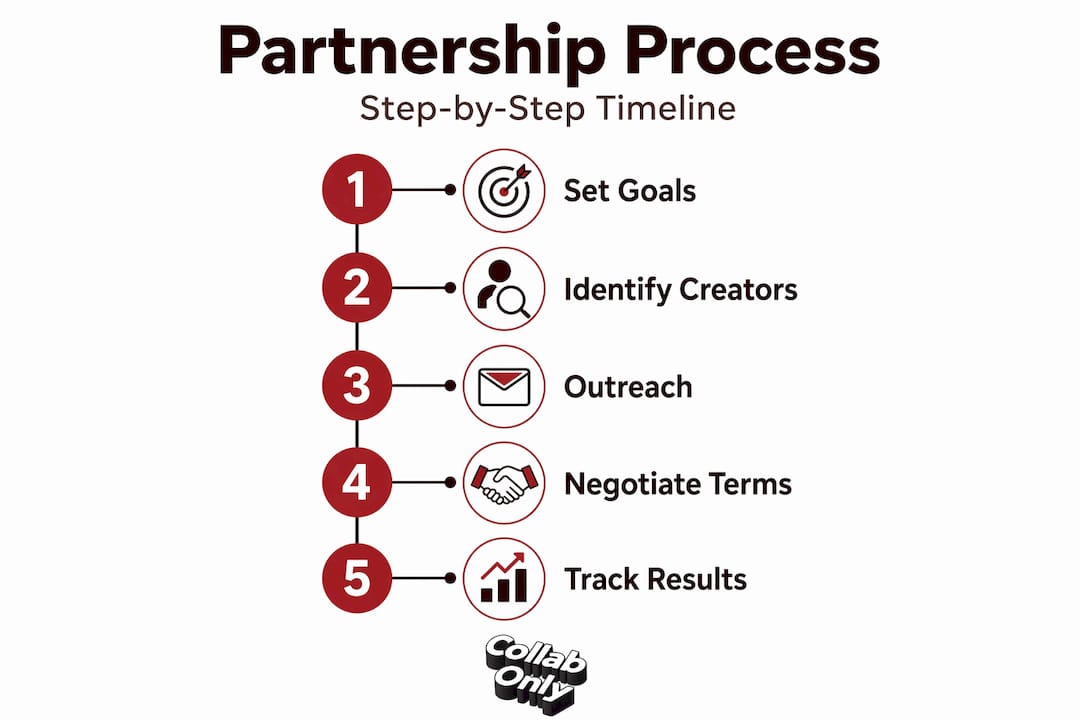
- Executing the process step by step
- Common mistakes that stall partnerships
- Measuring outcomes and verifying ROI
- Samuel's perspective on what actually matters
- How Collabonly supports your creator partnership process
- FAQ
Key takeaways
| Point | Details |
|---|---|
| Define goals before outreach | Align on campaign objectives, collaboration models, and deliverables before contacting any creator. |
| Treat permissions as a critical path item | Secure platform-level permissions early to prevent activation delays on Meta and YouTube campaigns. |
| Standardize contracts and briefs | Templated agreements and briefs reduce negotiation time and allow you to scale beyond a handful of deals. |
| Use integrated deal tracking | A CRM or structured spreadsheet prevents dropped deliverables and payment disputes across multiple active partnerships. |
| Measure lift, not just engagement | Conversion lift and platform-integrated analytics provide ROI clarity that vanity metrics cannot. |
The creator partnership process: core prerequisites
Before the first outreach email or platform search, both brands and creators need to agree on the operational framework that will govern the relationship. Skipping this step is the single most common reason partnerships collapse mid-campaign.
The prerequisites fall into three categories:
- Goal and model alignment. Define whether the collaboration model is a one-off sponsored post, a multi-platform content series, or a long-term ambassador arrangement. Each model carries different expectations for exclusivity, content volume, and payment structure.
- Platform requirements. Different platforms impose specific technical prerequisites. Meta's Partnership Ads require creators to grant content-level or account-level permissions before a brand can activate any paid promotion. YouTube's workflow, detailed below, has its own integration requirements. Failing to account for these steps at the prerequisites stage creates launch delays that could have been avoided.
- Legal and administrative infrastructure. Contract templates, payment terms, usage rights definitions, and revision cycle parameters should all be established before the first brief is sent. Improvising these elements deal by deal creates bottlenecks that compound as your portfolio of active partnerships grows.
The following table outlines the key roles and tools required at this stage:
| Component | Brand responsibility | Creator responsibility |
|---|---|---|
| Campaign brief template | Provide standardized brief with objectives, deliverables, and timelines | Review and confirm feasibility before signing |
| Contract and usage rights | Draft agreement covering exclusivity, payment, and IP terms | Negotiate terms and execute agreement |
| Platform permissions | Initiate permissions request via Meta Ads Manager or Google Ads | Grant account-level or content-level access |
| Payment and invoicing | Define milestone-based or flat-fee payment structure | Provide invoicing details and preferred payment method |
| Feedback and revision cycle | Define number of revision rounds and approval timeline | Deliver content drafts within agreed schedule |
Pro Tip: Build a platform permissions checklist into your standard onboarding document. Collecting the necessary access in week one prevents the most common campaign delay: a fully produced piece of content that cannot be activated because permissions were never set up.
Executing the process step by step
Once prerequisites are in place, execution follows a sequence that keeps all workstreams moving in parallel rather than waiting on each other sequentially. Effective process integration treats creative production, legal and usage rights, and platform permissions as three equally important tracks that run simultaneously, not as a linear handoff.
-
Discovery and outreach. Use platform-native tools for creator identification. YouTube's Creator Partnerships Hub lets brands search creators, link sponsored videos, and access performance metrics directly from Google Ads. The platform, which reaches over 3 million creators and supports bulk outreach, replaced the older BrandConnect system and now integrates directly with YouTube Studio for unified campaign management. Discovery through platform-native tools yields cleaner data on audience composition and prior partnership performance than cold list building does.
-
Brief and contract execution. Send a standardized brief that specifies content format, key messages, deliverable dates, and compliance requirements. Attach the contract simultaneously rather than waiting for brief approval. Running these two documents in parallel cuts the pre-production timeline by several days on each deal.
-
Permissions setup. As soon as the contract is countersigned, initiate the permissions workflow. For Meta campaigns, this means sending the partnership ad request through the creator's professional account. For YouTube, this means linking the sponsored video within the Creator Partnerships Hub. Delaying this step by even a few days can push activation past the campaign window.
-
Content review and approval. Use a centralized platform rather than email threads. A single collaboration hub allows creators to upload drafts, receive structured feedback, and confirm revisions without communication fragmentation. This approach also creates an audit trail that protects both parties.
-
Activation and paid amplification. Once content is approved and permissions are in place, activate paid promotion. On YouTube, the boost feature converts organic creator videos into paid Shorts or in-stream ads. On Meta, the approved partnership ad runs from the brand's ad account using the creator's content and handle.
-
Ongoing tracking. Maintain a deal tracking spreadsheet or CRM throughout the active campaign period. A structured spreadsheet with columns for creator name, outreach date, response status, contract status, delivery date, and payment status allows teams to manage 15 or more active deals without losing visibility on any single partnership.
Pro Tip: When scaling to multiple simultaneous deals, assign each partnership a unique ID in your CRM and tag all communications, contracts, and assets with that ID. Cross-referencing becomes significantly faster when you are managing 10 or more creators in a single campaign cycle.
The following comparison illustrates the difference between an ad-hoc process and a standardized one:
| Process element | Ad-hoc approach | Standardized approach |
|---|---|---|
| Creator discovery | Manual searches and DM outreach | Platform-native tools with integrated metrics |
| Contract management | Negotiated individually each time | Template-based with defined variables |
| Permissions setup | Addressed after content is delivered | Initiated at contract execution |
| Communication | Email threads and scattered DMs | Centralized hub with version history |
| Deal tracking | No formal system | CRM or structured spreadsheet |
Common mistakes that stall partnerships
Most partnership failures are process failures, not creative failures. Understanding the specific breakdown points allows teams to address them before they affect campaign timelines or relationships.
- Delaying permissions setup. Brands frequently treat permissions as a post-production step. Since platform permissions are a bottleneck that requires both parties to act through their respective platform accounts, any delay compounds. A creator who misses a permissions request due to a full inbox can push an entire campaign back by a week.
- Using non-templated contracts. Negotiating contract language from scratch for each deal is a significant time cost. It also introduces inconsistency in usage rights terms that can create legal exposure if a creator reposts content on a platform not covered in the original agreement.
- Skipping metrics alignment. Without agreement on which KPIs matter, brands and creators end up measuring different things. A creator may report strong engagement rate while the brand tracks conversion events, and neither party has a shared definition of success to reference when evaluating the campaign.
- Feedback via fragmented channels. Revisions communicated through three separate channels, such as email, DMs, and a shared document, create version control problems. This is especially damaging when multiple stakeholders contribute notes, because creators receive contradictory direction and must request clarification, extending the revision cycle.
- Underestimating planning timelines for major deals. Long-form and multi-activation partnerships require significantly more lead time than single-post deals.
Mid-campaign course corrections are possible but expensive. If a campaign is underperforming at the midpoint, review whether tracking is set up correctly before attributing the issue to content quality. Misconfigured UTM parameters or missing conversion events account for a meaningful share of apparent underperformance in creator campaigns.
Measuring outcomes and verifying ROI
A creator partnership process that lacks a measurement framework cannot be evaluated, iterated, or defended internally. Setting KPIs at the prerequisites stage, before content is produced, is the structural requirement here.
The following table maps partnership types to their primary and secondary KPIs:
| Partnership type | Primary KPI | Secondary KPIs |
|---|---|---|
| Sponsored YouTube video | View-through rate, conversion lift | Click-through rate, subscriber attribution |
| Meta partnership ad | Cost per acquisition, ROAS | Reach, engagement rate |
| Long-term ambassador | Brand sentiment, repeat purchase rate | Content volume, audience growth |
| YouTube Shorts boost | Conversion lift, incremental reach | Cost per view, watch time |
Boosted content on YouTube Shorts delivers an average 30% lift in conversion compared to unboosted creator content, making paid amplification a high-return component of any YouTube-focused creator marketing strategy. Tracking this through Google Ads performance dashboards, which are natively connected to the Creator Partnerships Hub, provides a direct line between creative investment and measurable outcome.
Long-term partnerships produce compounding returns that single activations cannot replicate. Expedia's year-long deal with IShowSpeed took six or more months to plan and included sponsored livestreams drawing millions of views. That scale of brand collaboration impact is not achievable through one-off transactions. The sustained exposure and audience trust built over multiple content activations produces a qualitatively different result.
Performance should be reviewed at defined intervals, not just at campaign end. Mid-campaign check-ins allow for budget reallocation toward higher-performing creators and early identification of content that is not resonating before it has consumed the full delivery schedule.
Samuel's perspective on what actually matters
I have reviewed enough creator partnerships at various stages of execution to identify one consistent pattern: the teams that succeed are not necessarily the ones with the largest budgets or the most prominent creators. They are the ones that treat the operational infrastructure as a non-negotiable prerequisite rather than an afterthought.
The conventional advice is to focus on finding the right creator. That matters, but it is secondary to having a process that can support the relationship once the deal is signed. I have seen well-matched brand-creator pairings collapse because no one owned the permissions workflow or because the contract language was ambiguous about revision rounds.

What I find underappreciated is the value of treating standardized briefs and contracts as a competitive advantage. When a brand can send a creator a clear, professional brief with a pre-executed contract template within 24 hours of agreeing to a deal, that brand signals operational competence. Creators, particularly those managing multiple partnerships simultaneously, prioritize working with brands that make the process predictable.
The other pattern worth noting is the compounding return on long-term relationships. A single sponsored video is a transaction. A year-long partnership with multiple content activations, deep audience integration, and shared creative development is a structural asset. The data consistently supports this. Sustainable creator-led ROI is built through repeated, trust-anchored engagement, not through rotating through a new creator each quarter.
— Samuel
How Collabonly supports your creator partnership process
Collabonly removes the friction that derails most creator partnerships before they produce results. The platform's match-based discovery system connects brands directly with creators whose audience composition and content focus align with specific campaign objectives, eliminating the cold outreach cycle entirely.
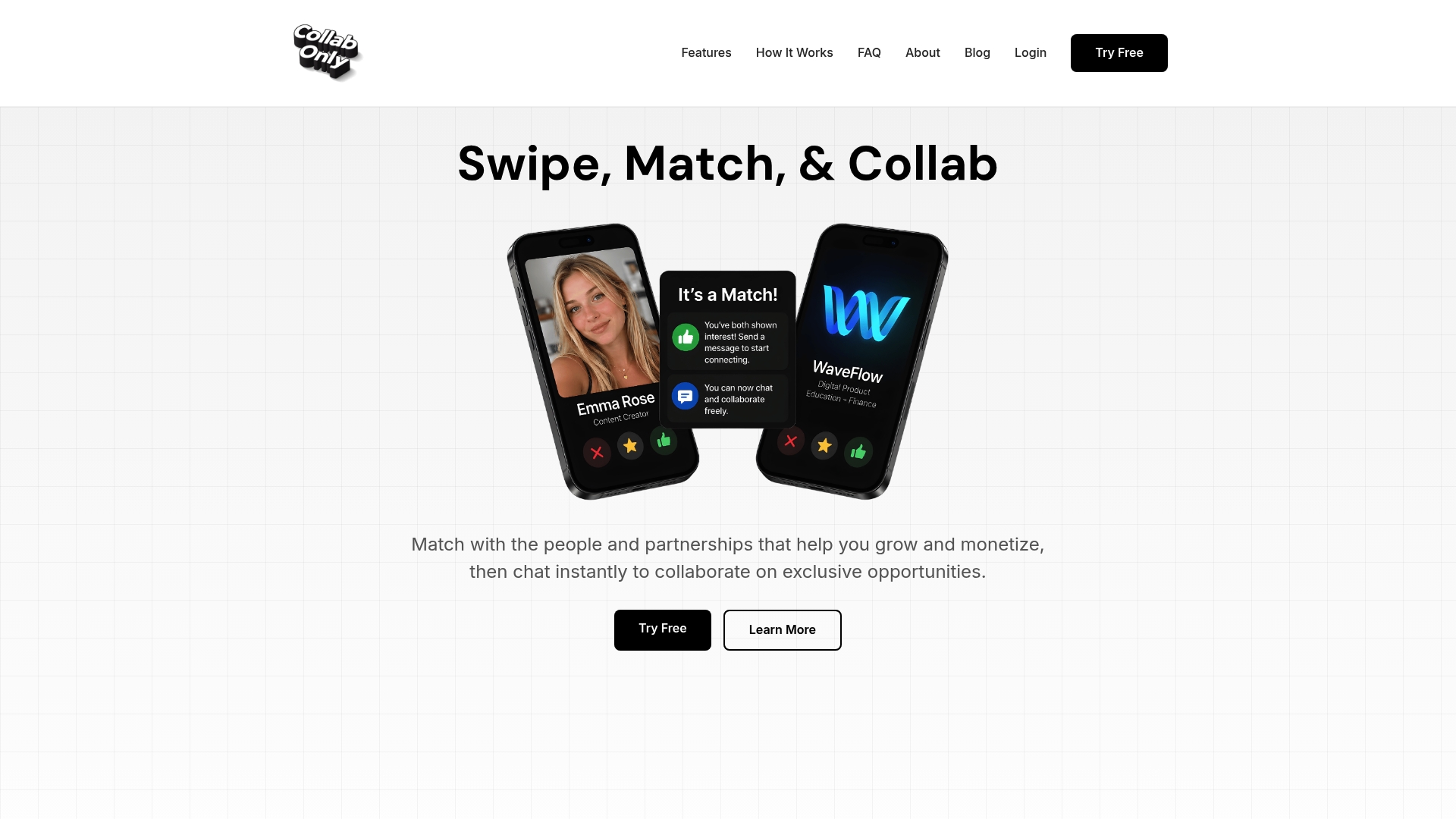
For brands building out their creator marketing strategy on YouTube, Collabonly's curated network lets you find YouTube influencers filtered by niche, platform, and audience demographics, so discovery takes hours rather than weeks. The instant chat feature activates upon match, which means deal conversations start from a point of mutual interest rather than unsolicited contact. Whether you are launching your first creator campaign or scaling a full collaboration platform across multiple creators simultaneously, Collabonly provides the infrastructure to manage partnerships with speed, clarity, and purpose.
FAQ
What is a creator partnership process?
A creator partnership process is the structured workflow that governs how brands and creators identify, negotiate, execute, and measure collaborative campaigns. It covers everything from discovery and contracting to content approval, permissions setup, and performance tracking.
How do you set up partnership ads on Meta?
Meta Partnership Ads require the creator to grant content-level or account-level permissions through their professional account before the brand can activate any paid promotion. This step must be completed after contract execution and before campaign launch.
What KPIs should brands track in creator partnerships?
KPIs depend on partnership type, but conversion lift, cost per acquisition, and return on ad spend are the most reliable indicators of business impact. Engagement rate and reach serve as secondary signals rather than primary success metrics.
How many creator deals can one team manage simultaneously?
With a CRM or structured deal tracking spreadsheet that includes columns for outreach date, contract status, delivery dates, and payment status, a small team can efficiently manage 15 or more active creator deals at once without losing oversight on any individual partnership.
What makes long-term creator partnerships more valuable than one-off deals?
Long-term partnerships build audience trust through repeated exposure, allow for deeper creative development, and generate compounding brand advocacy that single activations cannot replicate. Expedia's multi-activation deal with IShowSpeed is a documented example of this compounding value.