

TL;DR:
- Brands relying on isolated influencer campaigns face escalating costs and limited returns, while community models generate higher ROI and sustained advocacy. Building creator communities involves ongoing relationships, shared purpose, and structured engagement that improve content quality, reduce costs, and enhance brand retention. Effective management requires disciplined processes, clear communication, and balancing creator autonomy with strategic oversight to avoid platform dependency and authenticity erosion.
Brands that still rely on isolated influencer activations to scale awareness are working with a model that compounds costs without compounding returns. Creator content drives more ROI than traditional digital ads for 94% of organizations, with 70% reporting doubled ROI and 40% reporting tripled returns. Yet most brands still treat creator partnerships as transactional line items rather than strategic infrastructure. Creator communities represent the structural shift that moves brands from repeated one-off spend cycles toward sustained, compounding advocacy. This guide outlines what creator communities are, why the data supports them, how leading brands build them, and what risks to manage along the way.
Table of Contents
- What is a creator community and how does it work?
- Proven benefits: why creator communities outperform individual campaigns
- Methodologies: how leading brands actually build creator communities
- Risks, challenges, and how to navigate them
- Our perspective: building for long-term value, not just campaign lift
- Ready to build your brand's creator community?
- Frequently asked questions
Key Takeaways
| Point | Details |
|---|---|
| Community over transactions | Building a creator community yields more sustainable results than hiring influencers for single campaigns. |
| Micro-influencers lead ROI | Brands using micro-influencer communities consistently outperform celebrity-led campaigns on return and engagement. |
| Strategic structure matters | Gamification, direct communication, and clear rituals are essential tools for strong creator communities. |
| Mitigate platform risks | Own your data and relationships for scalability and safety—avoid over-relying on third-party platforms. |
| Long-term investment pays off | Genuine, ongoing relationships drive repeat advocacy and compounding marketing impact. |
What is a creator community and how does it work?
A creator community is a curated, ongoing network of content creators who maintain a structured relationship with a brand over an extended period, rather than completing a single paid post and disengaging. This model differs fundamentally from the traditional influencer pool, which typically involves sourcing creators for individual campaigns, negotiating contracts per activation, onboarding them fresh each cycle, and then parting ways. The creator community model replaces that friction-heavy cycle with a persistent infrastructure built on shared purpose, consistent communication, and collaborative content development.
The structural components that define a functional creator community include:
- A shared brand narrative or mission that creators genuinely align with
- Ongoing communication channels (private groups, brand portals, or direct messaging tools)
- A clear collaboration structure that defines roles, content expectations, and performance criteria
- Tiered engagement, where top-performing creators receive escalating access, compensation, or co-creation opportunities
- Feedback loops that allow creators to influence brand decisions, product development, or campaign direction
These elements matter because they shift the dynamic from vendor-client to partner-advocate. When creators feel invested in a brand's direction, their content reflects that investment. The authenticity is not manufactured. It is structural.
The business case is equally clear. Building a creator community enables compounding performance over one-off campaigns by reducing onboarding costs, improving content quality, and fostering authentic advocacy. Each activation cycle within an established community is cheaper and faster than sourcing and briefing new creators. The content produced is also higher quality because creators know the brand voice, understand the audience, and have a reputational stake in producing strong work.
"The brands seeing the highest returns from creator partnerships are not running more campaigns. They are building better relationships."
This shift from campaign-level thinking to community-level infrastructure is also what distinguishes brands capable of brand advocacy partnerships from those perpetually chasing reach without retention.
Proven benefits: why creator communities outperform individual campaigns
Having defined the concept and structure, let's examine what the numbers and real brand stories reveal about the concrete business impact of creator communities.
The most frequently cited metric in influencer marketing is reach, but reach without resonance does not convert. Creator communities shift the focus toward engagement quality, content consistency, and measurable return. The data across multiple sectors supports this decisively.
| Influencer type | Avg. ROI multiplier | Engagement rate | Onboarding cost per cycle |
|---|---|---|---|
| Macro influencer (1M+ followers) | 1.4x | 1.5% to 3% | High (renegotiation per campaign) |
| Micro influencer (10K to 100K) | 3x to 5x | 3% to 8% | Medium (lower per community model) |
| Nano influencer (1K to 10K) | $7.20 per $1 spent | Up to 60% | Low (community-embedded, high retention) |
| One-off campaign (any tier) | Variable, often 1x to 2x | Baseline | High (full sourcing and brief cycle) |
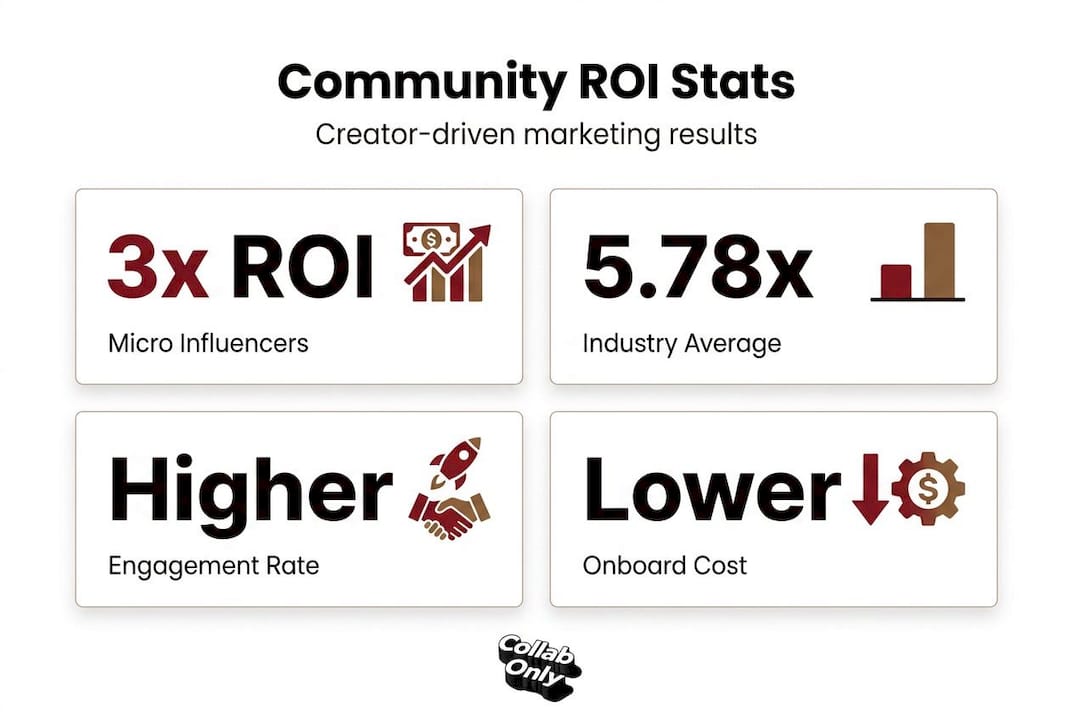
Influencer marketing delivers $5.78 ROI per $1 spent on average, but specific community-led programs dramatically exceed that benchmark. STRIG achieved a 4.6x return and Blueland reached a 13x ROI through sustained creator programs. These results are not anomalies. They reflect what happens when brands invest in relationship depth rather than reach breadth.

MVMT Watches achieved 3x average ROI using only micro-influencers, compared to macro-influencer programs that averaged 1.4x ROI. Their model relied on identifying niche-aligned creators with highly engaged sub-audiences, briefing them with brand narrative rather than rigid scripts, and maintaining ongoing relationships that produced multiple content pieces over time. The result was a consistent, scalable content supply with measurable return on each partnership.
Peloton's creator program reduced subscriber churn by 19% through formalized instructor networks, performance data access, and community feedback loops. This outcome illustrates a dimension of creator community ROI that is often underestimated: retention. When creators are embedded in the brand ecosystem, they bring their audiences with them and keep those audiences engaged over time. The brand benefits not just from new reach but from audience stickiness.
The benefits most brands observe when shifting to community models include:
- Reduced cost-per-piece of content due to lower sourcing and negotiation overhead
- Higher average engagement rates driven by peer-credibility within established creator audiences
- Greater content volume from creators who produce consistently rather than sporadically
- Improved brand-safety compliance because creators internalize guidelines over time
- Stronger conversion data from audiences with sustained exposure to the brand voice
Pro Tip: When structuring micro influencer deals within a community model, prioritize creators whose audience demographics overlap with your brand's customer personas rather than those with the largest raw follower counts. Engagement rate within a tightly defined sub-niche consistently outperforms broad reach at lower cost. Reviewing influencer marketplace benchmarks before setting program tiers helps calibrate expectations across creator categories. For a deeper look at attribution frameworks, strategies for influencer ROI provide actionable guidance on connecting content output to revenue outcomes.
Methodologies: how leading brands actually build creator communities
With the benefits clearly established, it is important to understand the specific tactics that power successful creator communities.
The gap between brands that talk about creator communities and those that actually build them often comes down to process discipline. Community-building is not a campaign launch. It is an ongoing operational function that requires recruiting infrastructure, engagement rituals, and performance systems.
The following table summarizes key engagement tactics used by leading brands versus less structured approaches:
| Tactic | Community model | One-off campaign model |
|---|---|---|
| Onboarding | Structured welcome, brand immersion, tiered access | Single brief document |
| Communication | Private chatrooms, real-time updates, co-creation calls | Email threads, one-directional |
| Gamification | Points, leaderboards, exclusive rewards for top performers | No incentive beyond flat fee |
| Content ownership | Brand retains rights to repurpose UGC | Rights often disputed or limited |
| Feedback integration | Creator input shapes product and campaign direction | No feedback mechanism |
| Retention | Multi-year relationships, ambassador programs | Single activation, no follow-up |
Brands like American Eagle use gamification, direct chatrooms, and micro-influencers in creator communities to achieve scale, authentic content, and content ownership for repurposing across paid and organic channels. The gamification layer is particularly effective because it converts creator participation into a structured motivation system. When creators compete on a leaderboard or earn exclusive brand access through performance milestones, the incentive architecture drives consistent output without requiring constant renegotiation.
A step-by-step process for onboarding and activating creators within a community model typically follows this sequence:
- Define the community's purpose and brand alignment criteria before sourcing any creators
- Identify micro and nano influencers through platform-specific discovery tools, prioritizing audience overlap and engagement quality over follower volume
- Issue a structured onboarding package that includes brand narrative, content guidelines, performance expectations, and communication channel access
- Establish a tiered structure from the outset, with entry-level, mid-tier, and ambassador levels defined by output volume and engagement performance
- Schedule regular communication touchpoints (weekly or biweekly) to share brand updates, collect creator feedback, and distribute new briefs
- Implement a gamification or reward layer that incentivizes consistent participation and top performance
- Build a content repurposing pipeline so that high-performing UGC is captured, licensed, and redistributed across brand-owned channels
- Review performance quarterly and restructure tiers based on output data, not relationship tenure
Pro Tip: Empowering creators with creative autonomy within a defined brand framework produces significantly higher content authenticity scores than rigid script-based briefs. Brands that provide narrative direction rather than word-for-word copy see better audience resonance and lower creator dropout rates over time. Creators interested in learning how to find brand deals within this type of structured community model will find that brands offering this level of creative latitude are increasingly the most sought-after partners.
Content ownership is another structural advantage often overlooked at the outset. When a brand retains usage rights to creator-produced content as part of the community agreement, that content becomes a reusable asset for paid social, email marketing, website testimonials, and product pages. The cost of that content, amortized across its full distribution life, is substantially lower than commissioning equivalent assets through a traditional creative agency.
Risks, challenges, and how to navigate them
No approach is without downside. Addressing the risks upfront allows brands to set up sustainable, healthy community growth rather than discovering structural flaws mid-execution.
The three most operationally significant risks in creator community programs are:
-
Platform dependency: Building a community on a third-party platform (Discord, Slack, or a social media group) means the brand does not own the underlying data or relationship infrastructure. Brands risk platform dependency where tools like Discord provide no guarantee of data portability or relationship continuity if the platform changes its terms, restricts access, or declines in creator adoption.
-
Authenticity erosion: Over-management is a common failure mode. When brands exert excessive control over creator messaging, the output begins to read as scripted rather than genuine. The creator economy faces a trust crisis driven by oversaturation and authenticity loss when brands dictate too much, which erodes the peer-credibility that makes creator content effective in the first place.
-
Community toxicity: Without active moderation, creator communities can develop competitive tensions, off-brand behavior, or public conflicts that damage the brand's reputation by association.
Measuring real community value adds another layer of complexity. Vanity metrics, including follower counts, post impressions, and like volumes, do not adequately reflect the relational depth that distinguishes a functional creator community from a disengaged influencer roster. The measurement challenge requires brands to invest in tracking metrics like repeat collaboration rates, audience retention across content series, and creator-generated conversion data, rather than surface-level reach figures.
Best practices for navigating these risks include maintaining a proprietary CRM layer for creator relationships independent of any third-party platform, establishing clear community guidelines with defined moderation processes from the outset, distributing creative briefs as narrative frameworks rather than prescriptive scripts, and auditing community health quarterly using both quantitative performance data and qualitative creator sentiment analysis.
"Genuine community does not arise from campaign frequency. It comes from consistent, reciprocal investment in relationships that creators find professionally and creatively valuable."
Understanding the real role of social media platforms for brand growth is essential for making platform decisions that do not expose the brand to dependency risk while still leveraging the reach those platforms provide.
Our perspective: building for long-term value, not just campaign lift
Having explored both effective strategies and real risks, here is a candid take on what sets enduring creator communities apart from fleeting influencer networks.
Most brands underinvest in the infrastructure required to make creator communities function over time. The tendency is to allocate the majority of a partnership budget toward creator fees and content production while treating community management, communication tooling, and relationship development as secondary overhead. This prioritization is structurally backwards. The fees without the infrastructure produce one-off results. The infrastructure without adequate creator compensation produces low-quality output. Both components are required at proportional scale.
The pursuit of broad reach is the most persistent distraction in influencer strategy. A brand with 200 loosely connected macro-influencers running quarterly campaigns is almost certainly generating lower compounding value than a brand with 30 highly engaged micro-influencers participating in a structured community with monthly touchpoints, co-creation opportunities, and tiered rewards. The second model costs less per activation, produces more content, and builds audience trust incrementally across repeated exposure cycles.
What leading organizations actually do differently is treat their creator network as a structural extension of the marketing function, not a variable spend line. This means assigning internal ownership of creator relationships, building rituals (weekly briefings, monthly feedback calls, annual summits) that give the community continuity and coherence, and formalizing processes for incorporating creator input into product and campaign decisions. Creators who feel heard and valued stay in programs longer and advocate more credibly.
The ROI of this approach is not linear. It compounds. Modern brand partnerships built on mutual investment and shared narrative generate audience trust that paid media cannot replicate at any budget level. Brands that commit to this model early establish a structural advantage over competitors still cycling through one-off activations.
Ready to build your brand's creator community?
If the frameworks above reflect the direction your brand needs to move, the practical question is where to start. Building a creator community requires both the right partners and the right tools to find, match, and manage them at scale.
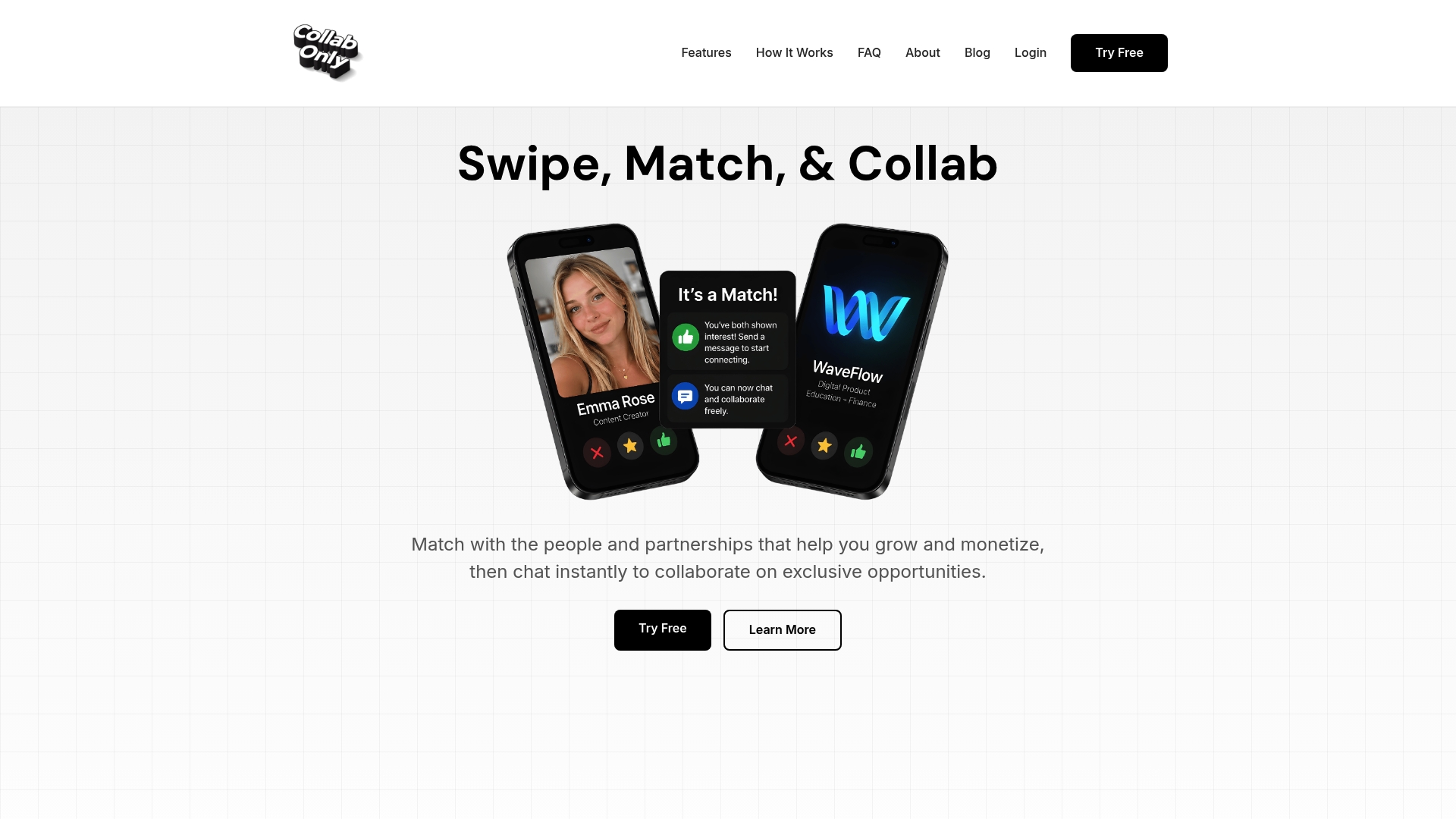
Collab Only is designed precisely for this transition. The platform connects brands with nano and micro-influencers through a matching system that eliminates the sourcing friction of cold outreach, lost DMs, and slow email cycles. Whether you are looking to explore nano influencer marketing for maximum authenticity and engagement or ready to hire micro influencers at scale for a structured community program, Collab Only provides the infrastructure to identify goal-aligned creators, initiate instant communication upon matching, and manage relationships within a single collaborative space. The platform supports TikTok, Instagram, and YouTube, covering the primary channels where creator community programs generate the strongest compounding returns.
Frequently asked questions
How is a creator community different from hiring influencers for one-off campaigns?
A creator community centers on ongoing collaboration and brand advocacy built over time, while one-off campaigns are transactional and lack community-level compounding performance benefits like reduced onboarding costs and content quality improvement.
Do micro-influencers outperform celebrities in creator communities?
Yes. MVMT Watches achieved 3x ROI using only micro-influencers, compared to macro-influencer programs that averaged 1.4x, demonstrating that engagement depth in a defined sub-niche consistently outperforms raw reach.
What tools and tactics help brands manage creator communities?
Brands like American Eagle rely on gamification, private chatrooms, structured onboarding, and content ownership agreements to manage scale, consistency, and authenticity across their creator networks.
What platforms should brands avoid for community building?
Brands should be cautious of high dependency on platforms like Discord, where data and relationship ownership remain with the platform rather than the brand, creating vulnerability to policy changes and loss of community continuity.
How quickly can brands see ROI from creator communities?
Meaningful ROI is often measurable within 12 months. Peloton's creator program reduced subscriber churn by 19% through formalized instructor networks and community feedback loops, demonstrating that retention-based returns can materialize within a single program year.