

Nano influencers deliver higher engagement and niche trust per follower. Micro influencers deliver broader, more measurable reach with cleaner content. Pick nano when authenticity and cost efficiency drive the campaign; pick micro when you need scale, polish, and dependable measurement.
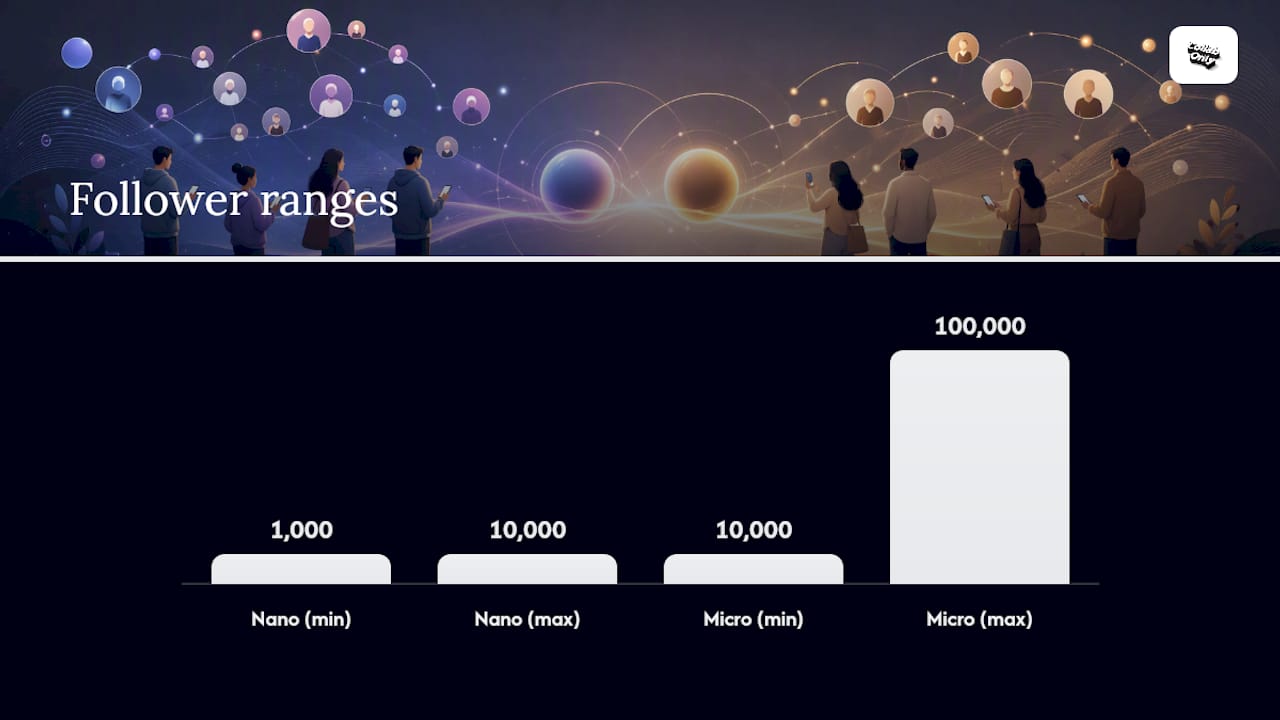
Nano creators (roughly 1,000 to 10,000 followers) post at industry-leading engagement rates, often for gifted product rather than cash. Micro creators (10,000 to 100,000) charge more but produce studio-grade content and cleaner attribution data. On a tight budget, start with a nano gifting wave on Instagram or TikTok. On a launch that needs reach fast, book two or three vetted micro creators on YouTube or Instagram Reels.
Key Takeaways
Nano influencers win on engagement rate and cost per post, while micro influencers win on reach, content polish, and measurement reliability.
| Point | Details |
|---|---|
| Follow tier definitions | Nano runs 1,000 to 10,000 followers; micro runs 10,000 to 100,000. |
| Budget under $2,500 | Favor a nano gifting wave for UGC volume and niche trust. |
| Budget above $5,000 | Blend micro reach with nano UGC volume for balanced results. |
| Vet proportionally | Light checks for gifted nano deals; full contract review for paid micro deals. |
| Measure by objective | Track impressions for awareness, tracked clicks for conversions, asset volume for UGC. |
Table of Contents
- Nano vs Micro Influencers: Definitions and Follower Ranges
- How Do Engagement, Cost, and Reach Compare?
- Which Tier Fits Which Campaign Goal?
- How Do You Vet Nano and Micro Creators?
- Scaling a Mixed Nano and Micro Program
- What Should You Measure for Each Tier?
- The Ops Reality Nobody Puts in the Slide Deck
- Sources
- FAQ
Nano vs Micro Influencers: Definitions and Follower Ranges
The tier boundaries shift depending on who is drawing them, but most brand strategists work from a consistent baseline: nano influencers run from roughly 1,000 to 10,000 followers, and micro influencers pick up from there through about 100,000, per Brandwatch's glossary definition. Some agencies push the nano ceiling to 15,000 or start micro at 15,000; treat these as house rules, not industry law, and confirm before comparing two vendors' rate cards.
Platform behavior changes what those numbers mean in practice. Instagram nanos tend to win on comment-driven engagement inside tight-knit follower bases. TikTok's algorithm can hand a 3,000-follower creator a six-figure view count overnight, decoupling reach from follower count entirely. YouTube nanos rarely get that same algorithmic lift; their advantage is long-tail search traffic, but production effort runs higher for both tiers on that platform.
What to expect at each tier before you negotiate anything:
- Nano: casual, phone-shot content; gifted-product deals are the default; payment (when it happens) is modest and fast to close.
- Micro: scheduled content calendars, usage-rights clauses, and a real negotiation process before anyone hits publish.
- Both: demand a media kit or recent analytics screenshot before committing spend, regardless of tier.
How Do Engagement, Cost, and Reach Compare?
Run the numbers side by side and the trade-off becomes obvious fast: nano creators cost less per post and out-engage every larger tier, but you need volume to match a single micro creator's total reach.
| Metric | Nano influencers | Micro influencers |
|---|---|---|
| Follower range | 1,000–10,000 | 10,000–100,000 |
| Avg. engagement rate | Highest of any tier (Brandwatch) | Solid, but lower per follower than nano |
| Typical cost per post | Often gifted; paid posts around $100–$500 (InfluencerAdvisory) | Several hundred to a few thousand dollars, format-dependent |
| Best for | Authentic UGC, niche trust, local launches | Awareness campaigns, measurable reach, polished creative |
| Content quality | Casual, unscripted | Higher production value, brand-safe |
| Scalability / overhead | Heavy management load per creator recruited | Lower headcount, easier to manage per dollar spent |
| Audience specificity | Very tight, hyper-local or hobbyist | Broader but still segmentable |
| Expected measurement outcome | Strong for UGC volume, noisy for conversion data | Cleaner attribution, better for tracked conversions |
Ten nano posts and one micro post rarely produce comparable outcomes, and that is the point. Nano creators are the most cost-effective source of raw UGC a brand can access, but ten separate creators mean ten separate briefs, ten sets of usage rights, and ten inboxes to manage. A single micro post consolidates that overhead into one relationship and typically delivers more total impressions, at a materially higher per-post cost.
Channel benchmarks reinforce the split. Instagram nano engagement frequently outpaces micro engagement on a percentage basis, while micro creators produce higher-polish assets that hold up better when repurposed into paid ad creative. TikTok narrows the gap somewhat, since its distribution algorithm rewards content quality and hook strength over account size for both tiers.
Which Tier Fits Which Campaign Goal?
Match the objective to the tier before you match the creator to the objective. A brand awareness push and a conversion-driven promo code campaign call for entirely different rosters.
- Brand awareness / local launch: nano wave across Instagram and TikTok, 15 to 30 creators in one geographic or interest cluster.
- Product seeding: nano, gifted product, no cash required.
- UGC pipeline for paid ads: nano for volume, then license the strongest three or four assets.
- Conversion campaign with promo codes: micro, because cleaner audience data supports reliable code tracking.
- Community growth / long-term ambassador program: blend both, converting the best-performing nano creators into paid micro-tier retainers over time.
Sample budgets translate this into real numbers. A $500 budget covers a modest nano gifting wave, maybe eight to twelve creators receiving product with no cash changing hands. A $2,500 budget supports either a larger nano wave (25 to 40 creators, some paid at the $100 to $500 rate band) or two to three micro creators on Instagram. A $5,000 budget is where InfluencerFee's benchmarking recommends splitting spend across both tiers: micro creators for reach and polish, nano creators for authentic UGC volume feeding your broader content strategy.
| Budget | Recommended mix | Expected outcome |
|---|---|---|
| $500 | 8 nano creators, gifted | Product seeding, initial UGC library |
| $2,500 | 25–40 nano OR 2–3 micro | Localized awareness or moderate reach with polish |
| $5,000 | Mixed: micro for reach, nano for UGC | Balanced awareness, content volume, and conversion signal |

How Do You Vet Nano and Micro Creators?
Vetting intensity should scale with dollars at risk. A gifted nano deal warrants a light check; a $3,000 micro contract warrants a real audit.
- Confirm goal alignment first. Does this creator's content style match the campaign KPI, whether that is impressions, clicks, or UGC volume?
- Check engagement quality, not just rate. Scroll actual comments. Generic emoji strings and bot-pattern replies are the clearest fake-follower signal.
- Run a quick authenticity test. Compare follower count against typical view or like counts; a wild mismatch is a red flag regardless of tier.
- Request a sample deliverable or past brand post. This reveals caption quality, disclosure habits, and whether they follow FTC guidance.
- Lock contract essentials in writing. Usage rights, posting window, and payment terms matter more at the micro level, where dollar amounts justify a signed agreement.
Nano vetting can move fast since the downside of a bad match is low. Micro vetting deserves a full discovery and outreach process, including a look at brand-safety history before signing anything.
Pro Tip: Ask every creator, regardless of tier, for their audience geography breakdown before committing spend. A creator with 8,000 followers concentrated in your target city often outperforms one with 40,000 scattered nationally.
Scaling a Mixed Nano and Micro Program
Running both tiers together works best as a funnel, not two separate campaigns. The network effect compounds when top nano performers graduate into paid micro relationships.
- Discovery: source broadly using platform search or a matching tool.
- Gating rules: set minimum engagement rate and audience-location filters before outreach.
- Gifting waves: send product to your nano shortlist, tracking response and content quality.
- Measurement: score each creator on content usability and engagement.
- Conversion: move your top 10 to 15 percent of gifted creators into paid, ongoing deals.
Batch your briefs, standardize a UTM template per wave, and use a shared tracking sheet so nothing falls through email threads.
Pro Tip: A common ops rule: if a gifted nano creator's post outperforms your account average by 2x or more, convert them to paid before your next campaign cycle. Waiting risks losing them to a competing brand.
What Should You Measure for Each Tier?
Match KPIs to objective, not tier. Awareness campaigns track impressions and CPM. Engagement campaigns track engagement rate and comment sentiment. Conversion campaigns track tracked clicks and promo code redemptions. UGC campaigns track content volume and cost per usable asset.
- Nano-level click data is often too small a sample to trust on its own; treat single-creator numbers as directional, not conclusive.
- Aggregate results across the full nano wave before drawing conclusions.
- Micro creators generally produce enough volume per post for reliable single-creator attribution.
Rule of thumb: if fewer than 20 creators contributed data, treat the trend as a signal to test further, not a verdict to scale on.
The Ops Reality Nobody Puts in the Slide Deck
Running fifty nano relationships teaches you something a single micro deal never will: the bottleneck is never finding creators, it is managing the back-and-forth once they say yes. A matching platform with instant chat, like Collabonly, cuts the gap between a gifted post going live and a paid contract getting signed.
Sources
FAQ
Do Nano Influencers Make Money?
Yes, though most nano deals start as gifted product rather than cash. When brands do pay, rates typically fall between $100 and $500 per post, depending on format and platform.
What Are the Four Main Types of Influencers?
The four commonly cited tiers are nano, micro, macro, and mega, distinguished primarily by follower count and, correspondingly, by cost and reach.
How Many Followers Do You Need to Be a Nano Influencer?
Most industry definitions place nano influencers between roughly 1,000 and 10,000 followers, though some brands extend that ceiling to 15,000.
Are There Five Tiers of Influencers?
Some frameworks add a fifth "celebrity" tier above mega influencers, but the four core tiers used by most marketers remain nano, micro, macro, and mega.