

Yes, YouTube Shorts sponsorships are real and increasingly structured, backed by YouTube's Creator Partnerships tools. Eligibility affects which native features you get, but it is not a prerequisite for landing off-platform deals. The first move is practical, not procedural: calculate your average views across your last 10 Shorts and build a Shorts-specific media kit before you pitch anyone, as this reflects the true value for brand deals.
TL;DR:
- Creators with fewer than 1,000 subscribers are still eligible for Shorts sponsorships through direct pitches or agencies, though certain native tools require Creator Partnerships approval.
- Payment rates mainly depend on average views over the last 10 Shorts, with typical sponsorship prices ranging from $50 for nano creators to over $15,000 for top-tier channels.
- A clear, Shorts-specific media kit including recent view counts, demo reels, and past campaign results accelerates deal closing, especially for smaller creators.
- Disclosing sponsorships properly requires verbal or visual mentions within the first few seconds and using YouTube's paid promotion checkbox to meet legal and policy obligations.
- Outsourcing or speed up sponsorship acquisition through platforms like Collab Only helps creators match with relevant brands faster, especially for micro and nano channels seeking smaller, engaged audiences.
Table of Contents
- Who Is Eligible for YouTube Shorts Sponsorships?
- How Do Brands Find Shorts Creators to Sponsor?
- What Do YouTube Shorts Sponsorships Pay in 2026?
- What Should Be in a Shorts Sponsorship Media Kit?
- How Do You Disclose a Sponsored YouTube Short?
- What Should Be in a Shorts Sponsorship Contract?
- How Do You Add a Brand Link to a YouTube Short?
- Ready-to-Send Pitch Templates and a Negotiation Checklist
- What Creators Consistently Get Wrong About Shorts Deals
- Find Shorts Sponsorships Faster With Collab Only
- Sources
- FAQ
Who Is Eligible for YouTube Shorts Sponsorships?
Eligibility determines which tools you get, not whether brands can pay you. A creator with zero YouTube Partner Program status can still land a sponsored Short through a direct email pitch or an agency introduction. What eligibility unlocks is the native infrastructure: inbound brand inquiries, a searchable media kit, and pricing preferences inside YouTube Studio.
YPP has a Shorts-specific path that differs from the traditional route. The standard threshold requires 1,000 subscribers plus either 4,000 watch hours in the past 12 months or 10 million Shorts views in 90 days. That second option matters enormously for creators who post almost exclusively short-form content, since watch hours accumulate slowly on 30-second videos but view counts can spike fast.
Once you clear that bar, Creator Partnerships becomes available inside Studio. It centralizes what used to be scattered across YouTube BrandConnect into one workspace with four practical components:
- Inbound inquiries. Brands searching the partner directory can find and message you directly.
- A media kit. YouTube auto-populates some metrics, but you still control the pitch framing.
- Pricing preferences. You set a baseline rate range, though final terms are negotiated off-platform, and YouTube does not guarantee payment for those deals, per its Creator Partnerships documentation.
- A discovery boost. Creators who share channel insights with the Creator Partnerships system reportedly see a meaningful lift in advertiser discovery compared to those who keep insights sharing off.
One feature is worth flagging before you get excited: the brand-site link for Shorts (the clickable tag that sends viewers to a sponsor's product page) is currently a U.S. pilot, and it only activates after the brand or its authorized agency reports the partnership through Creator Partnerships or the Creator Partnerships API, according to YouTube's own help documentation. If a brand tells you the link will "just work," confirm that reporting step before you upload. Otherwise you'll publish a sponsored Short with no functional link and no easy way to add one retroactively.
How Do Brands Find Shorts Creators to Sponsor?
Brands reach creators through four distinct channels, and knowing which one applies to your channel size changes where you should spend your time.
Inbound outreach starts happening once a channel hits meaningful scale, typically once average Short views land in the tens of thousands and a media kit exists to receive requests. Being discoverable matters more than being aggressive at this stage: a complete Creator Partnerships profile with insights sharing enabled and clear content categories does more work than a dozen cold pitches.
Marketplaces and platform-native discovery (Creator Partnerships itself, along with third-party matchmaking tools) speed up the connection but often compress rates, since brands can compare dozens of creators side by side and negotiate from a position of choice. This is where a platform like Collab Only's influencer discovery tools can help smaller creators get seen without racing to the bottom on price, because matching is based on fit rather than pure scale.
Agencies and talent partners make sense once your deal volume justifies giving up a commission, usually 15 to 20 percent. They handle contract review, rate negotiation, and repeat-brand relationships. For a creator doing one or two deals a month, an agency is often overhead you don't need yet.
Outbound pitching remains the most reliable lever for creators under 50,000 subscribers. The approach that works best is targeted, not broad:
- Research brands already sponsoring creators 2 to 3 times your channel size in your niche, since those brands have budget allocated and a track record of paying for Shorts specifically.
- Build a simple spreadsheet tracking brand name, the sponsored creator you found them through, and a contact if one is listed in the video description.
- Pitch the same brands with a comparable audience angle instead of a generic "I love your product" message.
- Reference a specific sponsorship format you'd use, since specificity signals you understand their marketing needs.
Each channel rewards a different kind of effort. Inbound rewards visibility. Marketplaces reward positioning. Agencies reward volume. Outbound rewards research.
What Do YouTube Shorts Sponsorships Pay in 2026?
Average views per Short, not subscriber count, is the number that actually drives Shorts pricing, and it's the first thing serious brands ask for. Subscriber count reflects history; average views reflect what a sponsor is actually buying, which is impressions on their next campaign. Because Shorts performance swings wildly based on algorithmic distribution, the standard practice is to average your last 10 Shorts rather than cherry-picking your best-performing video, a method rate-benchmark research recommends specifically because of that volatility.
Rate snapshot: Per-Short pricing in 2026 ranges from roughly $50 for nano creators to $15,000 or more for top-tier channels, and Shorts deals commonly land at 20 to 40 percent of an equivalent long-form video rate at the same audience size.
That 20 to 40 percent rule exists because a Short takes less production time and delivers a shorter engagement window than a dedicated long-form video, even when it reaches more people. Here's roughly how that breaks down by tier:
- Nano (1,000 to 10,000 subscribers): $50 to $300 per Short, often paid in product plus a small fee rather than cash alone.
- Micro (10,000 to 100,000 subscribers): $300 to $1,500 per Short, with brands expecting a script review round.
- Mid-tier (100,000 to 500,000 subscribers): $1,500 to $5,000 per Short, usually bundled with usage rights.
- Macro and celebrity (500,000+ subscribers): $5,000 to $15,000+, frequently structured as multi-Short retainers rather than one-off buys.
Two pricing formulas cover most negotiations. The first is CPV based: multiply your average Short views by a cost-per-view rate. Suggested CPV benchmarks for mainstream consumer audiences run about $0.003 to $0.01, so a creator averaging 200,000 views per Short would price a base sponsorship somewhere between $600 and $2,000 before add-ons. The second is a simple multiplier: take your existing long-form rate and apply the 20 to 40 percent Shorts discount, which works well if you already have an established long-form price from prior brand deals.
Add-ons can significantly increase the deal value. Usage rights, allowing the brand to run your Short as a paid ad, often come with an additional fee calculated as a multiple of the base Shorts rate, acknowledging the value of media placement separate from content creation. Exclusivity windows (agreeing not to promote a competitor for a set period) justify a separate line item, usually scaled to the length of the exclusion. Guaranteed delivery dates, especially around a product launch, can also carry a premium if the brand needs the content live on a fixed calendar. For a deeper breakdown of formulas by tier, Collab Only's rate guide walks through the math with worked examples.
What Should Be in a Shorts Sponsorship Media Kit?
A media kit built specifically for Shorts, not repurposed from your long-form deck, closes deals faster because it answers the brand's real question in the first ten seconds: does this creator's format match my campaign?
Four elements are non-negotiable:
- Average views across your last 10 Shorts, presented as a single clear number, not a range that lets a brand assume the low end.
- A short demo reel of two or three of your best-performing sponsored or product-style Shorts, so brands see how integrations look in your existing format.
- Screenshots of top organic Shorts, proving your content resonates without paid promotion boosting it.
- Past campaign outcomes, if you have any, even informal ones like "drove 400 link clicks" or "generated 30 comments requesting the product link."
Package your offers instead of quoting a single flat rate. A brand deciding between a $600 single Short and a $1,500 three-Short bundle with a long-form mention will often choose the bundle, since the perceived value per unit drops even as your total revenue rises. Common package structures include a standalone Short, a three-Short series across a week, a Short-plus-long-form combo, and an affiliate-link-plus-mention arrangement for brands that are testing performance before committing to a bigger buy.
Pro Tip: Attach a one-line creative hook to every pitch ("I'll open on the product's most surprising use case, not a straight review") along with a proposed timeline. Brands respond faster to a pitch that already shows them the content than to one that just lists your stats.
How Do You Disclose a Sponsored YouTube Short?
Disclosure is not optional, and it is not the same thing as checking a box in YouTube Studio. Under Federal Trade Commission guidance for U.S. creators, any material connection to a brand (payment, free product, or an affiliate relationship) requires a disclosure that a viewer can't miss in the first few seconds of a Short, given how quickly viewers swipe past.
YouTube's own compliance layer sits alongside that legal requirement. When you upload a sponsored Short, selecting the "paid promotion" checkbox during upload triggers an on-screen label and flags the video for YouTube's advertiser transparency systems. Skipping that checkbox because a brand asked you to "keep it subtle" puts your channel at risk of a policy strike, and it does nothing to satisfy the FTC's separate legal requirement.
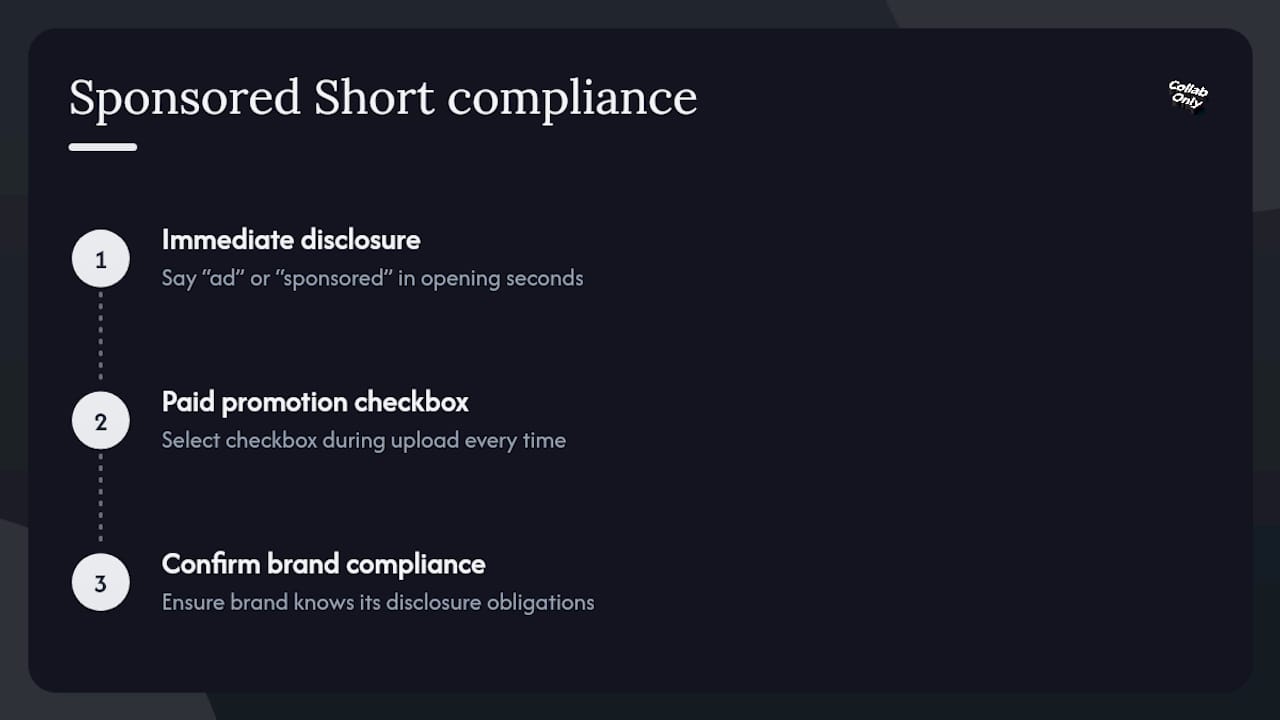
Practical compliance takes three steps. First, say the word "ad" or "sponsored" out loud or on screen within the opening seconds, not buried in the description. Second, check the paid promotion box every time money, product, or an affiliate link changes hands, regardless of how the brand frames the relationship. Third, confirm the brand understands its own disclosure obligations too. The FTC holds both parties responsible, and a brand that skips its side of compliance can drag your channel into the same scrutiny.
What Should Be in a Shorts Sponsorship Contract?
Every Shorts deal, no matter how small, benefits from a short written agreement covering five points before you film anything.
- Deliverables and approval rounds. Specify exactly how many Shorts, the posting window, and how many rounds of brand feedback you'll accept before locking the edit.
- Payment terms. Net 30 is standard; Net 60 favors the brand and should come with a partial upfront deposit in exchange. Include a kill fee (commonly 50 percent of the agreed rate) if the brand cancels after you've started production.
- Usage and repurposing rights. Define the specific platforms, geographic regions, and duration the brand can reuse your content as paid media, and charge separately for it rather than bundling it into the base rate for free.
- Exclusivity windows. If a brand wants you to avoid competitor promotions, put a start and end date on that restriction and price it accordingly.
- Minimum live duration. Require the Short to stay published for a set period, commonly six months, so a brand can't demand removal the moment a campaign wraps, and attach a kill fee if they ask for early takedown.
The "sign before you post" checklist boils down to this: payment terms confirmed in writing, deliverables listed with exact counts, disclosure responsibility assigned to both parties, usage rights priced separately, and a live-duration clause included. If any one of those five is missing from the brand's email thread, don't upload yet.
How Do You Add a Brand Link to a YouTube Short?
Adding a brand deal link works only after the brand side has completed its own reporting step, so sequence matters here more than almost anywhere else in the process.
- Confirm with the brand or its agency that they've reported the partnership through Creator Partnerships or the Creator Partnerships API. This has to happen before you touch the upload flow, since the link tool won't recognize an unreported deal.
- During upload or while editing a published Short, open the "Paid promotion & brands" section in YouTube Studio.
- Select "Find your brand partner" and search for the reporting brand's name in the list that appears.
- Accept the partnership connection, which activates the clickable brand link on the Short.
- Verify the link displays correctly once the video goes live, since the feature remains a U.S. pilot with rolling availability.
Before any of this, ask the brand directly whether they've used Creator Partnerships reporting before. Brands new to the tool sometimes assume a verbal agreement or an invoice is enough. It isn't. Confirming this upfront avoids publishing a sponsored Short with a dead link and no easy fix after the fact.
Ready-to-Send Pitch Templates and a Negotiation Checklist
A cold pitch to a brand already sponsoring creators near your size should open with a specific reference to their past sponsorship, state your average Shorts views plainly, and propose one concrete content idea rather than asking "would you be interested in working together?"
For inbound requests, reply with your average view count from your last 10 Shorts, a suggested package (single Short versus a bundle), and your standard turnaround time. This keeps the conversation moving instead of stalling on vague back-and-forth about "what did you have in mind?"
Before any contract goes out, run through this micro-checklist:
- Payment terms and amount confirmed in writing.
- Deliverable count and posting window specified.
- Disclosure responsibility assigned to both creator and brand.
- Usage rights and repurposing fees priced separately from the base rate.
- Timeline for approval rounds and final publish date agreed upon.
What Creators Consistently Get Wrong About Shorts Deals
Chasing your one viral Short as proof of value is a mistake I see constantly. Brands buy consistency, so average views across your last 10 Shorts matters more than a single 5-million-view outlier that won't repeat. Bundle a Short with long-form or an affiliate mention whenever you can, since total deal value rises faster than the extra production effort. And never let a brand talk you out of the paid promotion checkbox. Clear disclosure protects your monetization standing more than any single deal is worth.
— Samuel
Find Shorts Sponsorships Faster With Collab Only
Cold pitching works, but it's slow, and marketplaces built for long-form deals often bury Shorts creators under channels optimized for a different format entirely. Collab Only is built around a swipe-based matching system instead, connecting creators directly with brands actively looking for short-form partners, with instant chat replacing the email threads that go unanswered for weeks.
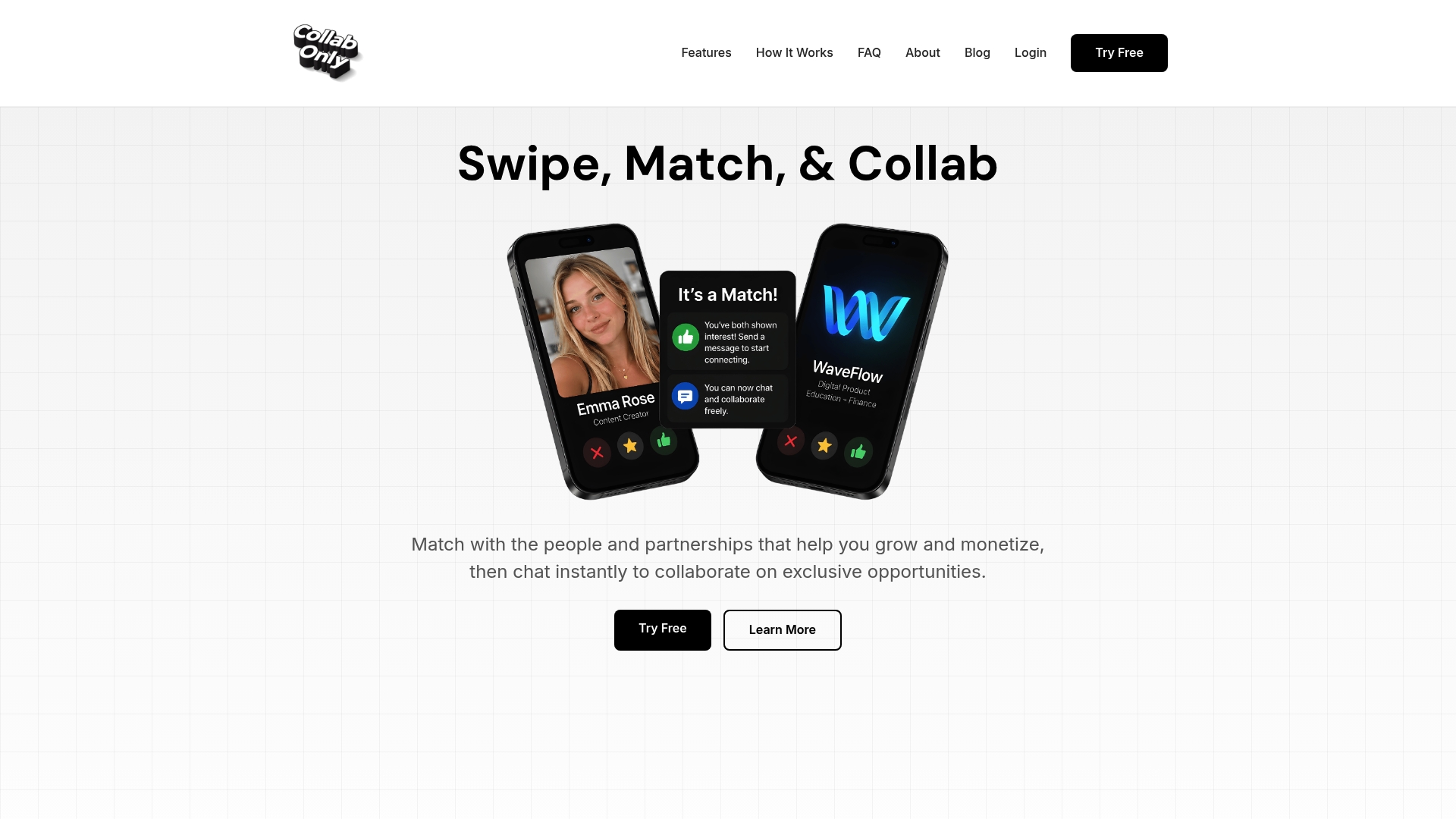
The platform's influencer discovery tools let you build a profile centered on your Shorts metrics rather than your total subscriber count, which matters given how much this guide has stressed average views over vanity numbers. Nano and micro creators in particular benefit from Collab Only's nano-influencer matching, since it's built around brands specifically seeking smaller, engaged channels rather than mega-creators with mega-rates. If your channel has a launch-ready audience, brands running product launch campaigns use the same matching system to find creators fast. Build your profile, list your average Shorts views, and start swiping through active brand campaigns today.
Sources
- YouTube help: Branded content & paid promotion
- YouTube help: Brand Partnerships: External Links on Shorts
- YouTube Shorts Sponsorship Rates 2026: $25–$30K Per Short by Tier
- YouTube Shorts Mention Sponsorship Rates (2026) + Free Calculator
FAQ
Can YouTube Shorts Be Sponsored?
Yes. Brands sponsor Shorts through direct outreach, YouTube's Creator Partnerships tools, or agencies, and pricing typically runs at 20 to 40 percent of an equivalent long-form rate.
How Many Views Do You Need on Shorts to Make $10,000?
There's no fixed view count, since pricing depends on your CPV rate and package structure, but at a CPV in the lower thousandths of a dollar range, a single high-tier Short averaging over a million views can approach five figures once usage rights and exclusivity fees are added.
How Much Money Is 1,000 Views on YouTube Shorts Worth in a Sponsorship?
Using a typical CPV range of $0.003 to $0.01 for mainstream consumer audiences, 1,000 views translate to roughly $3 to $10 in sponsorship value, before any add-ons for usage rights or exclusivity.
How Many Shorts Views Do I Need to Make $2,000 a Month From Sponsorships?
At cost-per-view rates cited for mainstream consumer audiences, a creator would need several hundred thousand total views across sponsored Shorts in a month, which could come from one or two mid-tier deals rather than dozens of small ones. Bundling Shorts with long-form or affiliate mentions, as many brands prefer, often reaches that figure faster than single-Short deals alone.
Do I Need YPP to Land a Shorts Sponsorship?
No. YPP and Creator Partnerships unlock native discovery tools and the brand-link feature, but off-platform deals through direct pitching, agencies, or a matchmaking platform like Collab Only don't require YPP status.