

Sponsorship CPM in 2026 typically ranges within bands for lifestyle and entertainment channels, tech and education, and finance, and B2B niches. Calculate a base fee with one formula: (average views over the last 90 days × chosen CPM) ÷ 1,000. For example, a 50,000-view lifestyle channel at a mid-range CPM nets around $1,000; a 50,000-view finance channel at a higher CPM nets proportionally more.
TL;DR:
- Higher CPM ranges in finance and B2B niches reflect strong advertiser demand, especially for sectors like AI and machine learning.
- Actual sponsorship fees depend heavily on channel size, with nano channels earning under $200 for basic integrations and mega channels moving into five or six-figure deals.
- Calculating a base fee requires recent 90-day average views, multiplying by niche CPM, and adjusting for engagement, geographic audience, and format multipliers.
- Effective negotiation relies on a thorough media kit with recent metrics, and separating deal extras like usage rights or exclusivity into individual line items improves clarity and pricing.
Table of Contents
- What Are Typical YouTube Sponsorship CPM Rates by Niche?
- How Do You Calculate a YouTube Sponsorship Fee?
- Do Video Format and Length Change Your CPM?
- How Do You Negotiate a YouTube Sponsorship Deal?
- Three Worked Examples: How Much Should You Charge?
- How Does Collab Only Help Creators Land Sponsorship Deals?
- What Should Creators Prioritize Right Now?
- Ready to Turn Your CPM Numbers Into Actual Deals?
- Sources
- FAQ
What Are Typical YouTube Sponsorship CPM Rates by Niche?
The gap between a lifestyle vlog and a finance channel isn't subscriber count. It's purchase intent. Brands pay more when the audience watching is close to a buying decision, which is why B2B SaaS and finance content commands multiples of what a gaming or entertainment channel earns at the same view count.
The 2026 rate card breaks down by content category, and every creator pricing a deal should know where their niche lands before a brand names a number first.
- Finance and B2B SaaS channels have higher CPM ranges due to advertiser demand, with some subcategories like AI and machine learning trending toward the higher end.
- Tech and education channels have medium-range CPM reflecting engaged audiences.
- Fitness and beauty channels generally have stronger CPMs than pure entertainment because of product-purchase overlap.
- Gaming channels attract lower CPMs because of younger, lower-spending audiences despite high watch time.
- Lifestyle and entertainment channels commonly have the most competitive CPM ranges on the lower end.
Channel tier matters as much as niche. A nano channel (1,000 to 10,000 subscribers) in tech might see $200 to $800 per dedicated integration, while a mid-tier channel (100,000 to 500,000 subscribers) in the same niche can command $3,000 to $15,000, and a mega channel (over 1 million) often moves into five and six figures per placement. These bands assume a US-heavy audience; a channel skewing toward lower-CPM markets should expect offers toward the bottom of its tier regardless of niche.
Two modifiers shift a quote up or down before you even touch format. A US-majority audience commands a premium because American consumer spending drives most sponsorship budgets, and engagement rate above 4 or 5 percent gives a creator room to quote above the niche midpoint rather than the floor.
How Do You Calculate a YouTube Sponsorship Fee?
The formula is short enough to memorize: average views over the last 90 days, multiplied by your chosen CPM, divided by 1,000. That number is your base fee before format and audience modifiers get applied.
Why 90 days and not lifetime average? A viral video from two years ago inflates your numbers and sets an expectation you can't currently deliver. Brands increasingly ask for recent average views specifically because it reflects the audience they're actually buying access to today, not the audience you had during a growth spike.
Here's the process, step by step:
- Pull your last 90 days of published videos and calculate the average view count across them, excluding any outlier that's wildly above your typical performance.
- Select a CPM from the rate card for your niche, then adjust up for strong engagement or a US-heavy audience, or down if your geography skews toward lower-value markets.
- Run the math: average views × CPM ÷ 1,000 = your base fee for a standard integration.
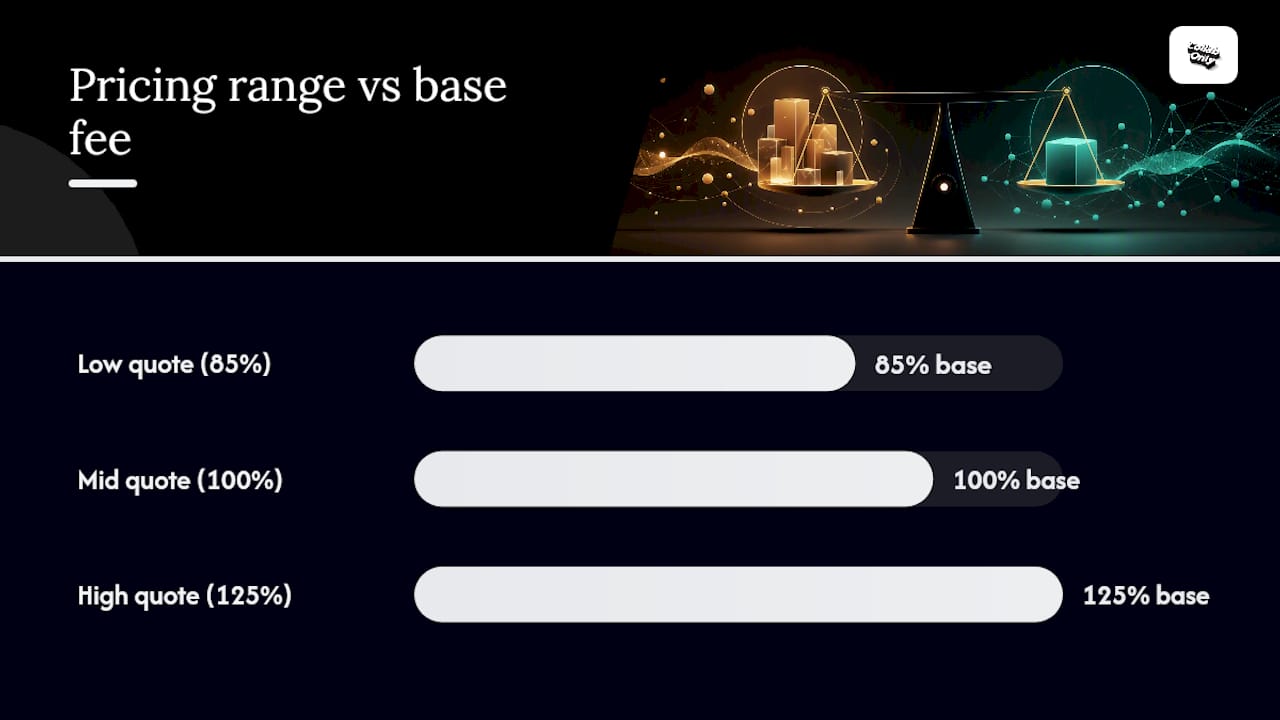
- Build a range, not a single number: quote a low figure at roughly 85 percent of base, a mid figure at base, and a high figure at 120 to 130 percent to leave negotiating room.
Pro Tip: Show your 90-day average, not your best month, when a brand asks for view numbers. Quoting a peak makes your CPM math indefensible the moment they check your channel's recent uploads.
Present the range with a short rationale. Tell the brand your base fee reflects your niche's typical CPM band, then note that the high end applies if they want usage rights, exclusivity, or a faster turnaround.
Do Video Format and Length Change Your CPM?
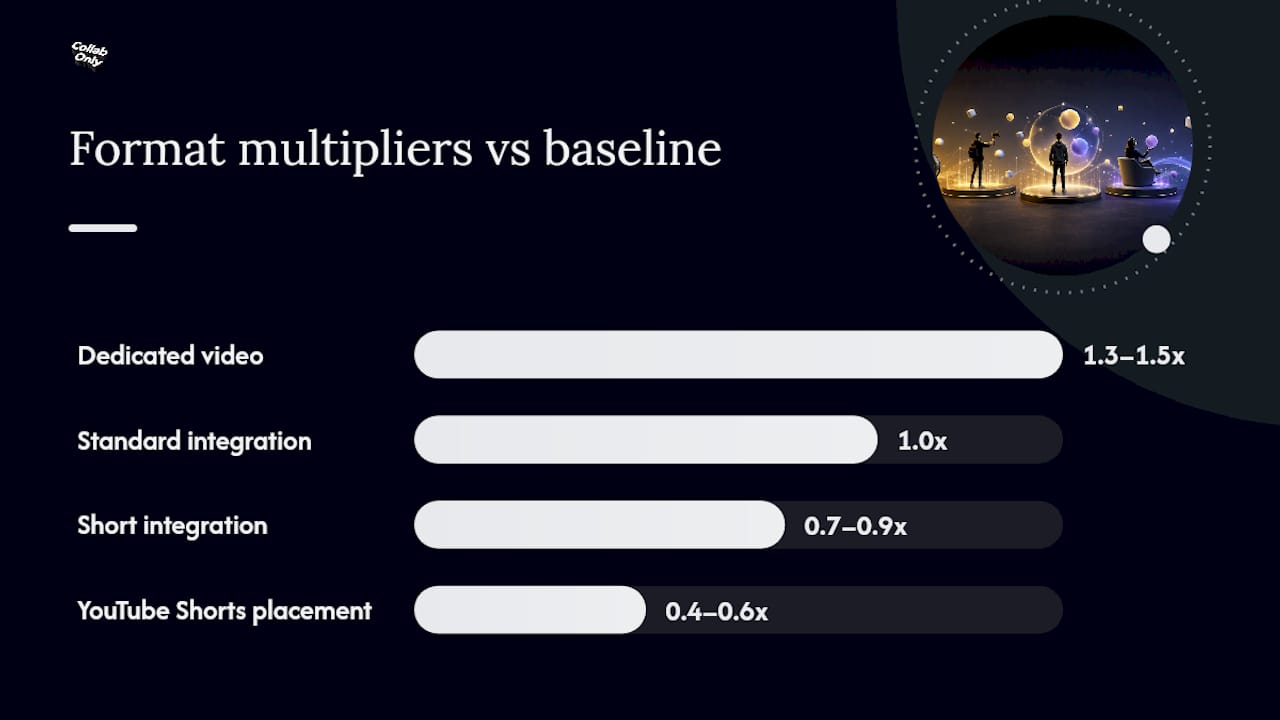
Format changes your effective CPM more than almost any other variable. A dedicated video and a 15-second Shorts mention are not the same product, and pricing them identically is the single most common mistake newer creators make.
Use these multipliers against your base fee:
- Dedicated video: 1.3x to 1.5x baseline, since the entire runtime centers the brand and allows real storytelling.
- Standard integration (60 to 90 seconds mid-roll): 1.0x, the reference point every other format multiplies against.
- Short integration (15 to 30 seconds): 0.7x to 0.9x, reflecting reduced message depth.
- YouTube Shorts placement: 0.4x to 0.6x, priced lower because Shorts CPM benchmarks run below long-form across the industry.
Stack premiums on top of format when the deal asks for more than a single post. Usage rights (letting the brand repurpose your content in their own ads) typically add 20 to 50 percent. Exclusivity clauses that block you from competing brands for a set window justify a similar bump. Multi-video retainers should price per video close to your standard rate, not at a steep discount. Recurring revenue is worth something to the brand too.
How Do You Negotiate a YouTube Sponsorship Deal?
Negotiation starts before the call, with a media kit that answers a brand's questions before they ask. Skip vanity metrics and lead with the numbers that actually predict campaign performance.
Your media kit needs five things front and center:
- 90-day average views across your last 10 to 15 uploads, not your channel's all-time high.
- Average watch time and retention on recent videos, since brands increasingly weight this above raw views.
- Audience geography breakdown, highlighting your US or other high-CPM market percentage.
- Engagement rate (likes plus comments divided by views), ideally above 3 to 4 percent.
- Your top three performing videos in the last quarter, with view counts and a one-line note on why each resonated.
Once numbers are on the table, price the extras separately instead of folding them into one flat fee. Usage rights, exclusivity windows, whitelisting or paid amplification access, and any additional deliverable (an Instagram post, a pinned comment, a follow-up video) each carry their own line item. A brand that wants all four should pay for all four.
On terms, ask for a deposit of 50 percent before filming and the balance on net 15 or net 30 after delivery, never net 60 or net 90 for a single-video deal. Watch for red flags: vague scope language, "we'll pay after we see results," or a contract that claims perpetual usage rights for a one-time fee. The FTC requires clear, conspicuous disclosure on every sponsored post, and building that requirement into your contract template up front avoids a scramble later.
Pro Tip: When a brand counters low, respond with your 90-day view data and ask which deliverable they'd like to cut to hit their budget, rather than dropping your rate outright. It reframes the conversation around scope instead of price.
Three Worked Examples: How Much Should You Charge?
Numbers land better than ranges. Here's how the formula plays out across three real scenarios.
- Nano lifestyle channel, standard integration. 90-day average views: 8,000. Niche CPM: $20. Base fee: (8,000 × 20) ÷ 1,000 = $160. Quote a range of $135 to $210 depending on deliverable specifics.
- Mid-tier tech channel, dedicated video with strong engagement. 90-day average views: 60,000. Niche CPM: $40. Engagement modifier (5 percent engagement, US-heavy audience): +15 percent. Base: (60,000 × 40) ÷ 1,000 = $2,400. Adjusted for engagement: $2,760. Dedicated format multiplier (1.4x): final quote around $3,864.
- Finance channel, dedicated video with usage and exclusivity. 90-day average views: 45,000. Niche CPM: $85. Base: (45,000 × 85) ÷ 1,000 = $3,825. Dedicated multiplier (1.4x): $5,355. Add 30 percent for usage rights plus exclusivity: final quote around $6,962.
Building this into a spreadsheet takes six columns: total views over 90 days, videos published in that window, computed average, chosen CPM, engagement and geo modifier, and format multiplier. The formula chains automatically. Update your view total monthly, and your rate card stays current without redoing the math by hand every time a brand reaches out.
How Does Collab Only Help Creators Land Sponsorship Deals?
Knowing your numbers only gets you halfway. The other half is finding brands willing to pay them, and that's typically where creators lose the most time. Collab Only connects creators, brands, and marketers through a swipe-based matching system built specifically to skip the outreach bottleneck.
- Instant chat opens the moment brand and creator match, cutting out the slow email threads and buried DMs that stall most sponsorship outreach.
- The platform supports collaboration across major social channels, so a creator's media kit and pricing structure work across every channel they run.
- Matching aims to align goals: brands searching for a specific niche or audience geography find creators who already fit, rather than sending generic pitches at scale.
For creators building a case study library or refining rate-card positioning, Collab Only's blog resources cover deal structures and packaging strategies drawn from real marketplace activity.
What Should Creators Prioritize Right Now?
Chasing views without improving audience value is the trap. A channel with 40,000 loyal, high-engagement US viewers often out-earns one with 200,000 scattered global views, because CPM tracks buying intent, not raw reach.
Nano and micro creators should prioritize niche clarity and a clean media kit. Mid-tier channels should focus on engagement rate and geography data. Larger channels should push toward retainers and usage-rights premiums instead of one-off deals.
Pick one 30-day action: build your 90-day average view spreadsheet and price your next pitch with real numbers instead of a guess in line with influencer marketing strategies that drive real brand growth.
— Samuel
Ready to Turn Your CPM Numbers Into Actual Deals?
Some platforms offer alternatives to cold outreach for creators who've done the CPM math and now need brands to actually see it. Instead of sending pitches into inboxes that never respond, you build a profile with your rate card and media kit metrics already in place, and matching surfaces brands looking for exactly your niche and audience geography.
Such platforms often work well alongside direct outreach rather than replacing it entirely: use them to surface inbound interest from brands actively browsing for creators, while you keep pursuing your own target list on the side. Product-launch campaigns are a particularly strong fit, since brands running launches are often moving fast and prioritize creators who respond quickly through instant chat. Nano and micro creators looking for smaller, more frequent deals can also start with nano-influencer campaigns built for that tier specifically.
If you're ready to put your CPM range in front of brands actively looking for your niche, check out Collab Only's product-launch creator matching and set up your profile with the rate card you just built.
Sources
- What Is a Good CPM for YouTube Sponsorships? (2026 Benchmarks)
- YouTube Sponsorship Rates 2026: What to Charge by Niche, Subs, and CPM
- Disclosures 101 for social media influencers — FTC
- How Much Do YouTubers Charge for Sponsorships in 2026? | InfluencerFee
FAQ
How Much Do YouTubers Get Paid Per Sponsorship?
Fees vary widely by tier and niche, ranging from roughly $135 for a nano lifestyle creator's integration to amounts in the several thousands for a mid-tier finance channel's dedicated video, calculated from average views multiplied by niche CPM.
How Much Does a YouTube Sponsorship Cost Per 1,000 Views?
Sponsorship CPM typically runs $15 to $25 for lifestyle and entertainment content, $25 to $50 for tech and education, and $40 to $100 for finance and B2B, compared to standard AdSense CPM which sits far lower.
How Many Views Do I Need to Make $10,000 a Month From Sponsorships?
At a $40 CPM (typical for tech or education), a channel would need a substantial number of views per sponsored video, or several smaller deals combined, to reach high monthly sponsorship income.
How Many Views Do I Need to Make $2,000 a Month?
At a $30 CPM, tens of thousands of average views per sponsored video help a creator approach around $2,000, though this depends heavily on niche CPM and how many sponsored videos are published that month.
Should I Use My Lifetime Average Views or Recent Views to Set My CPM Rate?
Use your last 90 days of average views, since that reflects your current audience size and reduces the risk of quoting a rate you can no longer deliver on if your channel has slowed down or grown since a past peak.