

Brand ambassador programs deliver a concrete set of advantages on both sides of the partnership: creators gain steady income streams, product access, peer-credibility, and career-building visibility, while brands gain trust-driven social proof, scalable content, extended reach, and measurable reductions in customer acquisition cost. The structure of these programs, and how well each party negotiates the terms, determines how much of that value actually materializes.
Key immediate wins at a glance:
- Creators can earn through retainers, affiliate commissions, flat fees, or product compensation, often in combination.
- Brands access authentic, repurposable content that performs better than company-generated ads in trust metrics.
- Ambassador relationships are longer-term than one-off influencer posts, which compounds both reach and SEO value over time.
- FTC disclosure requirements and exclusivity clauses are the two most consequential contractual factors for creators to evaluate before signing.
- Measurement tools (UTM links, unique discount codes) make ambassador ROI trackable in ways that broad awareness campaigns often are not.
The sections below cover benefits for individuals, common downsides, brand-side gains, compensation models, a program evaluation checklist, and research-backed context on why ambassadors tend to outperform traditional advertising.
Key Takeaways
Brand ambassador programs deliver measurable value for both creators and brands when compensation, measurement, and exclusivity terms are clearly defined before the relationship begins.
| Point | Details |
|---|---|
| Dual-side value | Creators gain income, visibility, and networking; brands gain trust-driven content and lower CAC. |
| Compensation structure | Programs typically combine free products, affiliate commissions, flat fees, or retainers; retainers offer the most income stability. |
| FTC and contract risks | Disclosure requirements and exclusivity clauses are the two highest-stakes contractual factors for creators to negotiate carefully. |
| Trust drives performance | Edelman research shows peer recommendations outperform company ads in consumer trust, which is the core mechanism behind ambassador ROI. |
| Collabonly | Collabonly's matching platform connects creators and brands for ambassador programs across TikTok, Instagram, and YouTube with instant chat upon match. |
Table of Contents
- What is a brand ambassador and what types exist?
- What are the top brand ambassador benefits for creators?
- Common downsides creators should weigh before committing
- Why brands run ambassador programs and what they gain
- How ambassadors are typically paid in the U.S.
- How to evaluate an ambassador program before you commit
- Why ambassadors often outperform traditional ads
- What Collabonly sees in high-performing ambassador partnerships
- Collabonly connects creators and brands without the friction
- Sources
- FAQ
What is a brand ambassador and what types exist?
A brand ambassador is an individual who represents and promotes a brand on an ongoing basis, typically under a formal agreement, in exchange for compensation, products, or both. Unlike a one-off sponsored post, the relationship is sustained: ambassadors integrate the brand into their regular content, conversations, or professional presence over weeks or months, which is what separates the role from standard influencer campaigns.
Common ambassador types include:
- Influencer/creator ambassadors: Social media creators on TikTok, Instagram, or YouTube who produce content featuring the brand across a defined campaign period.
- Employee ambassadors: Staff members who share brand content and thought leadership through their own professional networks, amplifying reach without additional media spend.
- Customer advocates: Loyal customers who promote the brand organically, often incentivized through referral programs, exclusive discounts, or early product access.
- Celebrity or specialist ambassadors: High-profile individuals or credentialed experts (athletes, dermatologists, chefs) whose association adds authority in a specific sub-niche.
The commitment length varies by program structure, but most formal ambassador roles run three to twelve months, with deliverables tied to a posting cadence rather than a single deliverable. That duration is what makes the role meaningfully different from a one-time collaboration. For a detailed breakdown of how the ambassador role compares to a standard influencer engagement, ambassador vs. influencer distinctions are worth reviewing before evaluating any offer.
What are the top brand ambassador benefits for creators?
The primary brand ambassador benefits for individuals fall into six categories: income, product access, visibility, networking, skills development, and event or experiential opportunities. How those benefits are weighted depends heavily on niche and program structure.
- Income: Retainers provide predictable monthly cash flow, which is the most financially stable model for creators. Affiliate commissions add performance-based upside on top of a base fee.
- Free products and discounts: Common in beauty, wellness, and consumer tech, where product seeding is a standard entry point. The value is real but should not substitute for cash compensation in long-term arrangements.
- Visibility: Brands frequently feature ambassadors in co-branded campaigns, email newsletters, or paid social ads, which exposes the creator to audiences they would not otherwise reach.
- Networking: Ambassador programs often connect creators with brand marketing teams, agency contacts, and peer creators, which accelerates professional relationship-building.
- Skills development: Managing deliverables, tracking performance metrics, and negotiating contracts builds practical business competency that compounds over a creator's career.
- Events and sponsorships: Travel, product launches, and brand activations are common perks in travel, fashion, and sports niches, where experiential rewards keep ambassadors engaged alongside monetary compensation.
Niche shapes the benefit mix considerably. Beauty ambassadors often receive a product-heavy compensation package with affiliate commissions tied to discount codes. Tech ambassadors tend to receive flat fees or retainers with fewer product perks. Travel ambassadors frequently receive sponsored trips as a core component of the arrangement. Available ambassador roles across industries illustrate how these structures vary in practice.
Pro Tip: When evaluating offers, prioritize programs that combine a baseline retainer with performance-based commission. Pure product-only deals rarely justify the time investment for creators with established audiences, and the lasting career value of an ambassadorship comes from credibility and network growth, not short-term swag.
Common downsides creators should weigh before committing
The advantages of brand ambassadors are well-documented, but the trade-offs are equally real. Most creators who report dissatisfaction with ambassador programs cite one of five recurring issues.
- Time commitment: Ongoing deliverables (weekly posts, monthly reports, event appearances) consume more time than a single sponsored post. Underestimating this is the most common source of creator burnout in ambassador roles.
- Inconsistent pay: Performance-based models (affiliate commissions, cost-per-acquisition structures) produce variable monthly income. Without a retainer floor, earnings can swing significantly based on seasonal demand or algorithm changes.
- Exclusivity clauses: Many programs prohibit ambassadors from working with competing brands, sometimes broadly defined. A clause that bars work with any brand in the same product category can materially limit income diversification.
- FTC disclosure requirements: The Federal Trade Commission requires clear, conspicuous disclosure of material connections between creators and brands. Failure to disclose properly exposes both the creator and the brand to enforcement risk. The FTC's guidance applies to all forms of compensation, including free products.
- Brand misalignment risk: Associating with a brand whose values or quality later come under scrutiny can damage a creator's credibility with their own audience. Audience trust is the creator's primary asset, and it is difficult to rebuild once eroded.
Pro Tip: Before signing, negotiate a narrowly scoped exclusivity clause. Request that the exclusion apply only to direct product competitors rather than the entire category. Also confirm the payment cadence in writing: net-30 is standard; anything beyond net-60 should prompt further negotiation or a larger upfront fee.
Why brands run ambassador programs and what they gain
From the brand side, ambassador programs address three structural limitations of traditional advertising: low trust, high cost, and content scarcity. Business, brand ambassadors increase credibility, awareness, and revenue, and employee ambassadors specifically improve social reach and lead quality while reducing reliance on paid media.
The core brand-side benefits:
- Trust and social proof: Ambassador content is perceived as peer recommendation rather than advertising, which consistently outperforms brand-generated content in engagement and conversion metrics.
- Content scale: A network of ambassadors produces a continuous stream of authentic, repurposable assets across formats (short-form video, static posts, stories, long-form reviews) without the production overhead of an in-house team.
- Extended reach: Each ambassador's audience is additive. A program with fifty micro-ambassadors can aggregate more total impressions than a single macro-influencer campaign, with better geo-concentration and sub-niche targeting.
- Lower customer acquisition cost: Ambassador-driven referrals and affiliate conversions typically carry lower CAC than paid search or display, particularly when the program is structured around performance incentives. Authentic partnerships consistently support retention and CAC reduction over time.
- SEO and organic visibility: Steady ambassador content generates keyword-rich, indexed assets across social platforms and blogs, supporting organic search visibility in ways that paid campaigns do not.
eMarketer notes that ambassadors integrate brands organically, sustain narratives over time, and make measurement more precise when given proper tracking infrastructure. That combination of organic integration and measurability is what makes ambassador programs a preferred channel for performance-oriented marketing teams.
How ambassadors are typically paid in the U.S.
Shopify's ambassador compensation guide identifies six primary models: free products, discounts, affiliate commissions, flat campaign fees, monthly retainers, and hourly or event-based pay. Most structured programs combine two or more of these.
- Free products/perks: Standard entry point for nano creators (under 10,000 followers). Low financial risk for brands; limited income value for creators unless the product has high retail value.
- Discount codes and store credit: Common in DTC e-commerce. Provides ongoing value but is not a substitute for cash compensation in longer engagements.
- Affiliate commissions: Performance-based; typically 5%–20% of referred sales depending on category. Beauty and wellness programs tend to offer higher affiliate rates; B2B software programs often use flat referral fees instead.
- Flat campaign fees: One-time or per-deliverable payments. Predictable for both parties but do not incentivize sustained performance beyond the contracted deliverable.
- Monthly retainers: The most stable model for creators and the most commitment-intensive for brands. Retainers typically range from a few hundred to several thousand dollars per month depending on audience size, niche, and deliverable volume.
- Hourly or event pay: Used for in-person activations, trade shows, and experiential campaigns. Common in retail, hospitality, and consumer packaged goods.
Benchmark context: Affiliate commission rates in beauty tend to run higher than in tech or B2B categories. Travel programs frequently substitute sponsored experiences for cash, which inflates the perceived value of the package without increasing liquid compensation.
ReferralRock's analysis of ambassador incentive structures supports combining performance-based commissions with experiential rewards and recognition to sustain engagement over the program lifecycle.
Pro Tip: Request a performance uplift clause: a base retainer plus a bonus tier triggered at specific revenue or engagement thresholds. This aligns incentives for both parties and gives the creator upside without requiring the brand to commit to uncapped spend. Always ask for UTM links or unique discount codes from day one so attribution is clean from the start.
How to evaluate an ambassador program before you commit
Evaluate any program offer across five dimensions: compensation clarity, measurement infrastructure, exclusivity scope, content rights, and program support. A strong offer is transparent on all five before the contract is signed.
- What is the exact compensation structure, and is there a guaranteed minimum payment regardless of performance?
- How are results measured, and will you receive UTM links, unique discount codes, or a dedicated tracking dashboard?
- What does the exclusivity clause cover, and how broadly is "competing brand" defined?
- Who owns the content you create, and can the brand repurpose it in paid ads without additional compensation?
- What is the required posting cadence, and are there penalties for missing a deliverable?
- What is the payment timing (net-15, net-30, net-60), and is there a late-payment clause?
- What happens at the end of the contract term: does it auto-renew, and what are the exit conditions?
- Is there an audience overlap concern (does the brand already work with creators whose audiences substantially overlap yours)?
- What brand support is provided: creative briefs, product briefings, dedicated account contacts?
- How are disputes handled, and which state's law governs the contract?
Pro Tip: If the brand cannot answer questions 2, 3, and 4 before you sign, treat that as a program maturity signal. Programs that lack tracking infrastructure or have vague exclusivity language tend to produce the most post-contract disputes. Tracking ROI accurately from the start protects both parties; methods for tracking advertising ROI provide a practical framework for what good measurement looks like.
Why ambassadors often outperform traditional ads
The performance advantage of ambassador programs over traditional advertising is grounded in peer-credibility dynamics. The Edelman Trust Barometer consistently shows that consumers place high trust in recommendations from "people like me," at a level comparable to credentialed experts and substantially above trust in company-generated advertising. That trust differential is the mechanism behind ambassador-driven conversion rates.
"People like me" consistently rank among the most trusted sources of information about products and companies, outperforming both CEO communications and advertising in Edelman's annual global trust research.
Peak Digital Pro's 2026 program analysis cites a reported 6.5x ROI benchmark for well-structured long-term ambassador programs, though that figure reflects a specific case context rather than a universal average. The underlying drivers are consistent across programs: sustained authentic content, compounding SEO value from indexed creator assets, and the social proof effect of repeated peer endorsement over time.
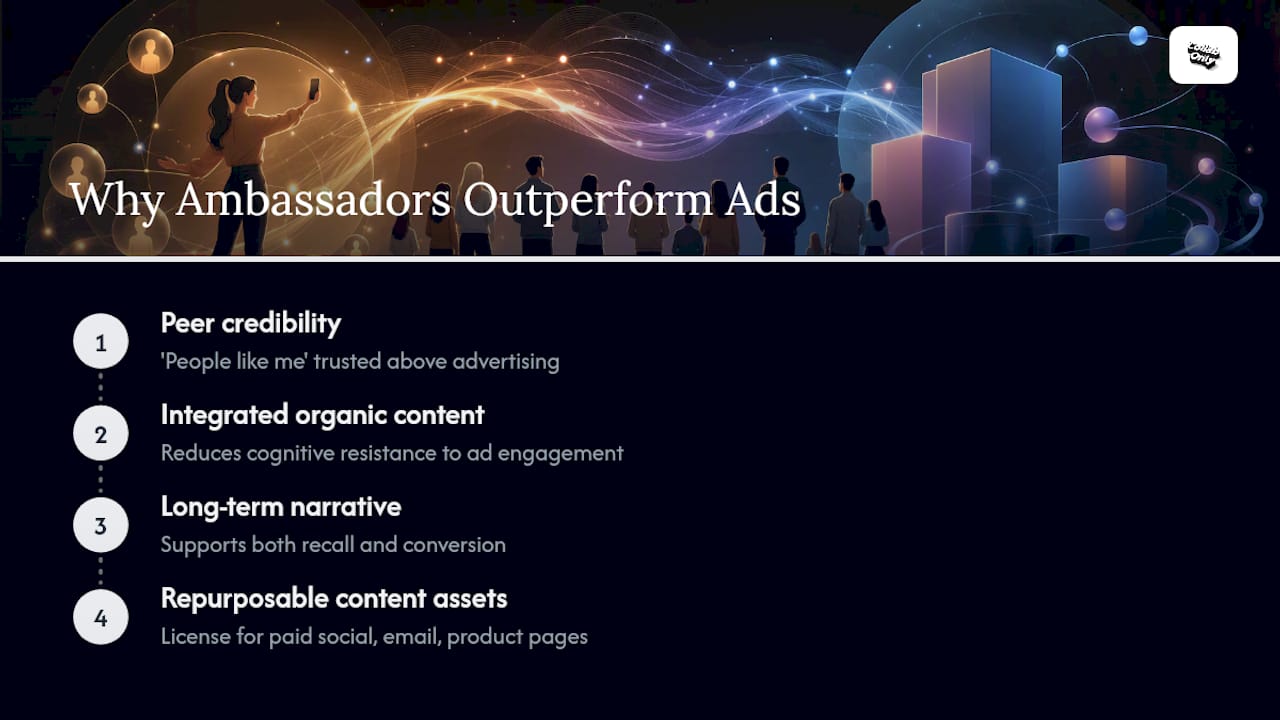
Three mechanisms explain the outperformance. First, ambassador content is integrated into the creator's organic feed rather than appearing as an interruption, which reduces the cognitive resistance that suppresses ad engagement. Second, long-term programs generate a sustained narrative around the brand rather than a single exposure, which supports both recall and conversion at different stages of the purchase funnel. Third, the content assets ambassadors produce are repurposable: brands can license ambassador-created video and photography for paid social, email, and product pages, multiplying the value of the original creator fee. Creator communities that drive sustainable ROI illustrate how that compounding effect scales across a structured program.
What Collabonly sees in high-performing ambassador partnerships
The most successful ambassador relationships share three observable characteristics: a clear mutual-fit selection process, consistent posting cadence maintained throughout the program term, and tracking infrastructure in place from day one. Programs that skip the fit-assessment step, accepting any creator willing to post, tend to produce lower engagement rates and higher churn among ambassadors.

From a platform perspective, the creators who generate the strongest long-term results are not always those with the largest audiences. Nano and micro-creators with geo-concentrated or sub-niche audiences frequently deliver higher engagement rates and more qualified referral traffic than macro-influencers whose audiences are broad and diffuse. The implication for brands is that program scale should be measured in audience quality and conversion attribution, not raw follower count.
Collabonly connects creators and brands without the friction
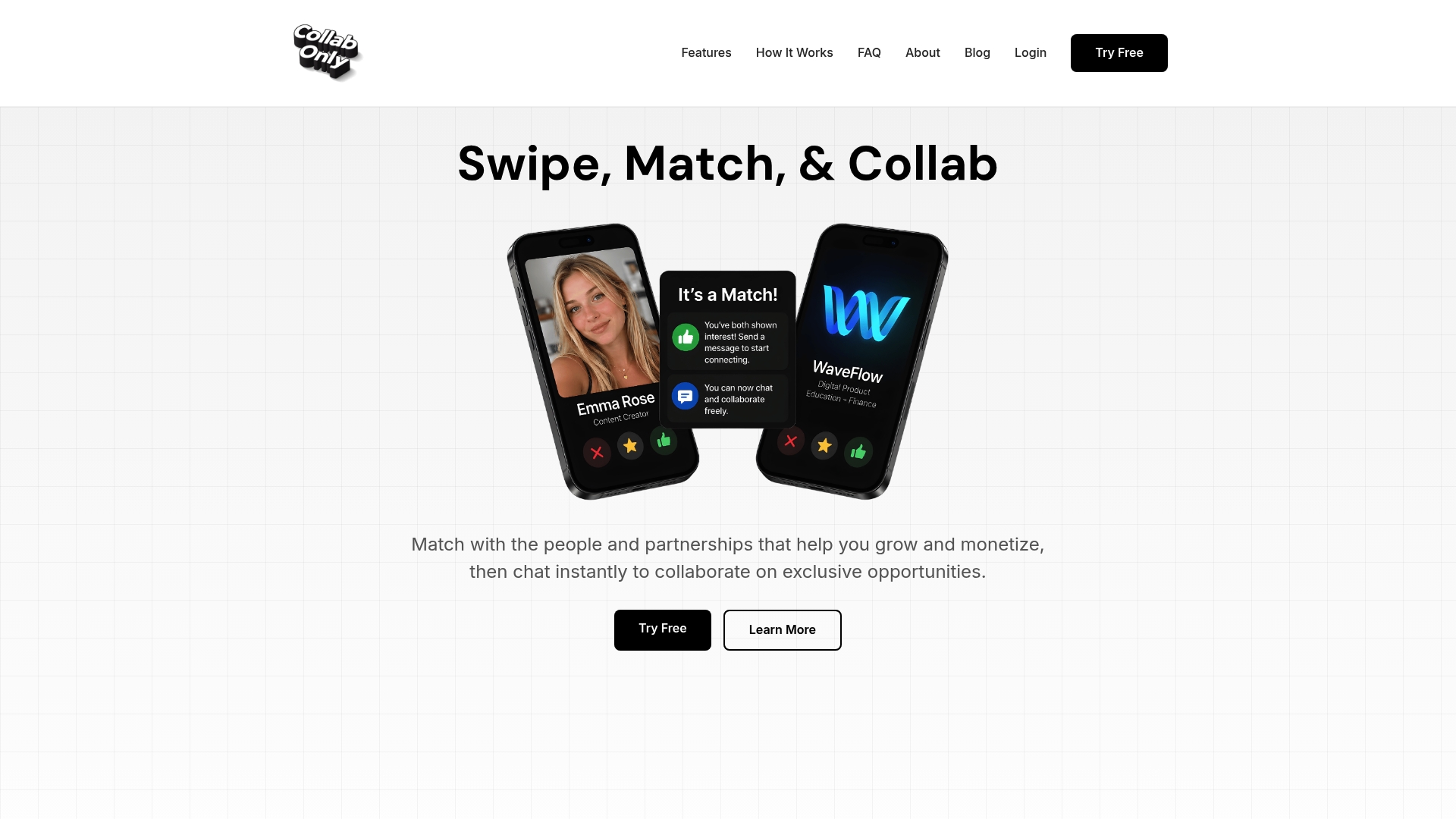
Finding the right ambassador match, whether you are a creator evaluating programs or a brand building one, is where most programs lose time and momentum. Collabonly's matching platform cuts that friction by connecting brands and creators through a swipe-based interface with instant chat upon match, eliminating the slow email cycles and unanswered DMs that delay program launches.
For brands ready to source ambassadors for a product launch, Collabonly's influencer matching for product launches connects you with vetted creators across TikTok, Instagram, and YouTube, with campaign support built into the platform. Creators looking for structured ambassador opportunities can browse active programs and apply directly, with compensation terms and deliverable expectations visible before any commitment is made. If nano-creator programs fit your scale, nano-influencer sourcing is available as a dedicated pathway. Start by creating a profile on Collabonly to access matched opportunities aligned to your niche, audience size, and campaign goals.
Sources
- Brand Ambassadors Matter in Marketing
- Edelman Trust Barometer (2024)
- How to Become a Brand Ambassador: 2026 Guide - Shopify India
- 3 reasons marketers should work with brand ambassadors
- What is a brand ambassador? A 2026 guide with 6.5x ROI - Peak Digital Pro
FAQ
Do brand ambassadors get paid?
Yes. Most formal ambassador programs include some form of monetary compensation, whether a flat fee, monthly retainer, affiliate commission, or event-based pay. Free products alone are more common at the nano-creator level and in early-stage program structures.
Does a brand ambassador get free stuff?
Product seeding is a standard component of most ambassador programs, particularly in beauty, wellness, and consumer tech. In longer-term arrangements, free products typically supplement rather than replace cash compensation.
What benefits do you get as a brand ambassador?
Creators gain income (retainers, commissions, flat fees), free products, brand-sponsored visibility, professional networking, skills development, and access to events or experiential opportunities. The specific mix depends on niche, audience size, and program structure.
Is being a brand ambassador a significant career opportunity?
For creators with a defined niche and consistent posting cadence, ambassador roles can provide stable income, credibility signals, and network access that compound over time. The lasting career value comes from peer-credibility and professional relationships rather than short-term product perks alone.