

TL;DR:
- Authentic partnerships are genuine collaborations based on transparency, shared goals, and mutual trust. They lead to higher consumer trust, better engagement, and increased revenue compared to transactional efforts. Building these partnerships requires clear communication, shared accountability, and ongoing relationship management.
Authentic partnerships are defined as genuine, equitable collaborations built on transparency, aligned goals, and mutual trust. The role of authentic partnerships in modern marketing goes far beyond co-branded logos or sponsored posts. Collaboration-led content drives up to 11x higher ROI compared to traditional digital advertising. That gap exists because audiences now distinguish between brands that share values and brands that simply share ad budgets. For business leaders and marketers, understanding what makes a partnership authentic is no longer optional. It is a commercial requirement.
How do authentic partnerships enhance consumer trust and brand performance?
Consumer trust is the primary mechanism through which genuine partnerships generate revenue. 82% of consumers are more likely to purchase when a trusted brand partners authentically with another. That figure reflects a fundamental shift in buyer psychology: social proof from a credible partner carries more weight than any direct brand claim.

The financial case is equally clear. Co-branded campaigns deliver 20–30% better sales performance than standalone efforts, and partnerships aligned with consumer values produce 25–30% higher engagement rates. These are not marginal gains. They represent a structural advantage for brands that prioritize alignment over reach.
The psychology behind this performance is rooted in audience overlap and storytelling. When two brands or a brand and a creator share a genuine narrative, audiences experience that story as an extension of their own identity. 90% of consumers report higher trust in creator recommendations versus direct brand messaging. That trust transfers directly to purchase intent.
- Shared values between partners signal authenticity to audiences before a single piece of content is published.
- Intentional audience overlap amplifies reach without diluting credibility.
- Consistent storytelling across both partners' channels reinforces brand identity over time.
- Creator-driven content generates 3–5x higher engagement when audiences overlap intentionally.
Pro Tip: Prioritize value alignment over follower count when evaluating potential partners. A creator with 20,000 highly engaged followers who share your brand's values will consistently outperform a celebrity placement with no genuine connection to your product.
What are the key components of building authentic partnerships?
Authentic partnerships are built on four operational principles: transparent communication, equitable resource distribution, regular co-creation, and intentional relationship management. Each principle functions as a load-bearing element. Remove one, and the structure weakens.
Transparent communication means disclosing both alignment and misalignment early. Honest recognition of misalignment and the willingness to walk away protects long-term relationship value. Brands that force partnerships past obvious incompatibilities damage their credibility with both the partner and the audience watching.
Equitable distribution of power, resources, and leadership is the second principle. The most effective partnerships function as operating assets with shared co-leadership and mutual accountability. This is distinct from a vendor relationship where one party holds all decision-making authority. Shared accountability produces resilience when campaigns face challenges.
The third and fourth principles operate at the daily level. Partnership health shows up in qualitative signals such as advocacy and ease of collaboration, not just revenue. The practical steps that build this health include:
- Share regular updates, sneak peeks, and campaign progress with your partner before publishing externally.
- Create joint content that reflects both parties' brand voices, not just one dominant narrative.
- Conduct quarterly alignment reviews to assess whether shared goals remain current.
- Advocate for your partner internally within your own organization, not just in public-facing content.
- Define roles explicitly at the outset so each party knows where their creative authority begins and ends.
Pro Tip: Recognize misalignment early and address it directly. A partnership that feels forced at the three-month mark rarely improves. Exiting cleanly preserves credibility for both parties and protects your brand's long-term reputation.
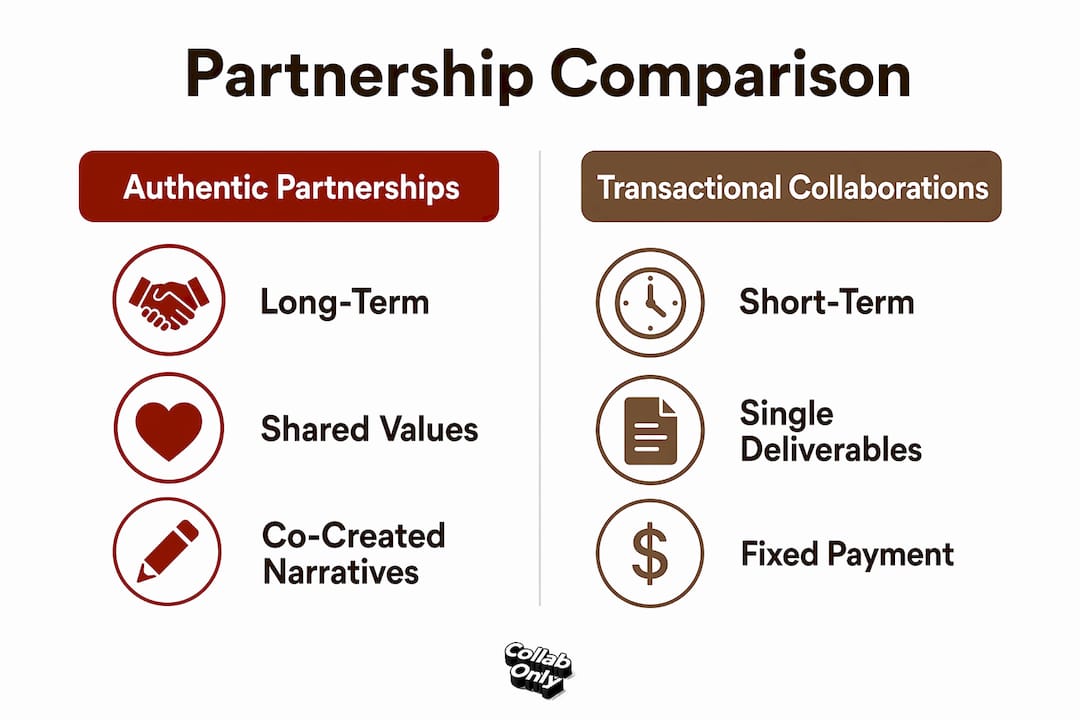
Authentic partnerships vs. transactional collaborations: what sets them apart?
Transactional collaborations focus on short-term deliverables: a fixed number of posts, a defined payment, and a contract end date. Authentic partnerships treat the collaboration as an ongoing brand relationship with shared identity and mutual investment in outcomes. The distinction matters because audiences recognize the difference immediately.
The global sports sponsorship market illustrates this shift at scale. Valued at $103.92 billion in 2026, the market has moved from logo-centric placements to narrative-driven integrated partnerships where brand and sport heritage align for deeper audience resonance. Success is now measured by community engagement, not impressions. That same logic applies to every brand-creator relationship.
Short-term transactional campaigns are deemed inauthentic by sophisticated audiences. Creators treated as temporary channels produce content that reads as advertising. Creators treated as brand extensions produce content that reads as genuine recommendation.
| Marker | Authentic partnership | Transactional collaboration |
|---|---|---|
| Duration | Long-term, ongoing | Short-term, campaign-specific |
| Success metric | Engagement, sentiment, loyalty | Impressions, post count, reach |
| Brand integration | Co-created narrative and identity | Logo placement, sponsored mention |
| Partner role | Brand extension and co-leader | Vendor or channel |
| Audience perception | Credible recommendation | Paid advertisement |
| Communication | Regular, bilateral, candid | Contractual, transactional |
The table above shows that the difference between authentic and transactional partnerships is not a matter of budget. It is a matter of intent and structure. Brands that shift from the right column to the left column consistently report stronger audience loyalty and higher content performance.
How can marketers implement effective authentic partnership strategies?
Effective authentic partnership strategies begin with a values and audience audit before any outreach occurs. Identify partners whose audience demographics, content tone, and stated brand values overlap with yours. This audit prevents the most common failure mode: selecting partners based on follower count rather than fit.
Once potential partners are identified, the engagement process should reflect the partnership you want to build. Engaging with creators authentically requires a different approach than standard influencer outreach. Personalized, specific communication that references the creator's actual content signals genuine interest and sets the tone for the relationship.
Sustaining partnerships requires structured communication habits, not just goodwill. Partnership success depends on daily exchange practices: sharing updates, offering early access to campaigns, and actively engaging with your partner's content outside of formal deliverables. These habits build the relational capital that makes partnerships resilient.
Measurement is where many brands lose discipline. Tracking vanity metrics such as the number of active agreements misses the point entirely. Quality over quantity in partnerships leads to better outcomes. The KPIs that matter include:
- Engagement rate on co-created content versus brand-only content.
- Audience sentiment analysis across both partners' channels.
- Repeat collaboration rate as a proxy for partner satisfaction.
- Revenue attribution from partnership-driven content.
- Qualitative feedback from partners on communication and creative freedom.
Reviewing brand partnership best practices annually keeps your strategy current as platform algorithms and audience expectations shift.
Pro Tip: Limit your active authentic partnerships to a number your team can genuinely manage. Three deeply invested partnerships will outperform fifteen superficial ones every time. Role clarity and creative investment require bandwidth.
Key takeaways
Authentic partnerships outperform transactional collaborations because they align shared values, distribute accountability equitably, and build the audience trust that directly drives engagement and revenue.
| Point | Details |
|---|---|
| Authenticity drives ROI | Co-branded campaigns aligned with shared values deliver 20–30% better sales performance than standalone efforts. |
| Trust is the core mechanism | 90% of consumers trust creator recommendations over direct brand messaging, making partner credibility a revenue driver. |
| Daily habits sustain partnerships | Sharing updates, early access, and co-created content builds relational capital that contracts alone cannot create. |
| Quality beats quantity | Fewer, well-defined partnerships with explicit roles produce stronger brand advocacy than large volumes of shallow agreements. |
| Measurement must go beyond impressions | Track engagement rate, sentiment, and repeat collaboration rate to assess genuine partnership health. |
Why authenticity is the commercial edge brands can no longer ignore
Authenticity is not a creative preference. It is a commercial advantage, and the brands that treat it as optional are already losing ground.
I have watched brands invest significant budgets in partnerships that looked impressive on paper but produced almost no measurable loyalty. The pattern is consistent: when a brand selects a partner for reach rather than resonance, the audience senses the disconnect within the first piece of content. Audiences reject forced, transactional placements in favor of credibility and cultural relevance. That rejection is not always visible in impression counts, which is exactly why so many brands miss it.
The brands that are winning in 2026 treat their creator and brand partners as extensions of their own identity. They share information early, give creative latitude, and measure success by whether the audience believes the story being told. Creators treated as long-term brand extensions sustain storytelling and audience engagement in ways that one-off deals simply cannot replicate.
The uncomfortable truth is that most brands are still optimizing for the wrong metrics. Counting agreements, tracking post volume, and measuring gross impressions are all proxies for activity, not outcomes. The leaders who shift their attention to engagement quality, partner retention, and audience sentiment will build the kind of brand equity that compounds over time.
Invest in the partnership experience, not just the partnership contract.
— Samuel
How Collabonly connects brands with authentic creator partners
Collabonly is built for the exact challenge this article addresses: finding partners whose values, audience, and creative direction genuinely align with your brand.
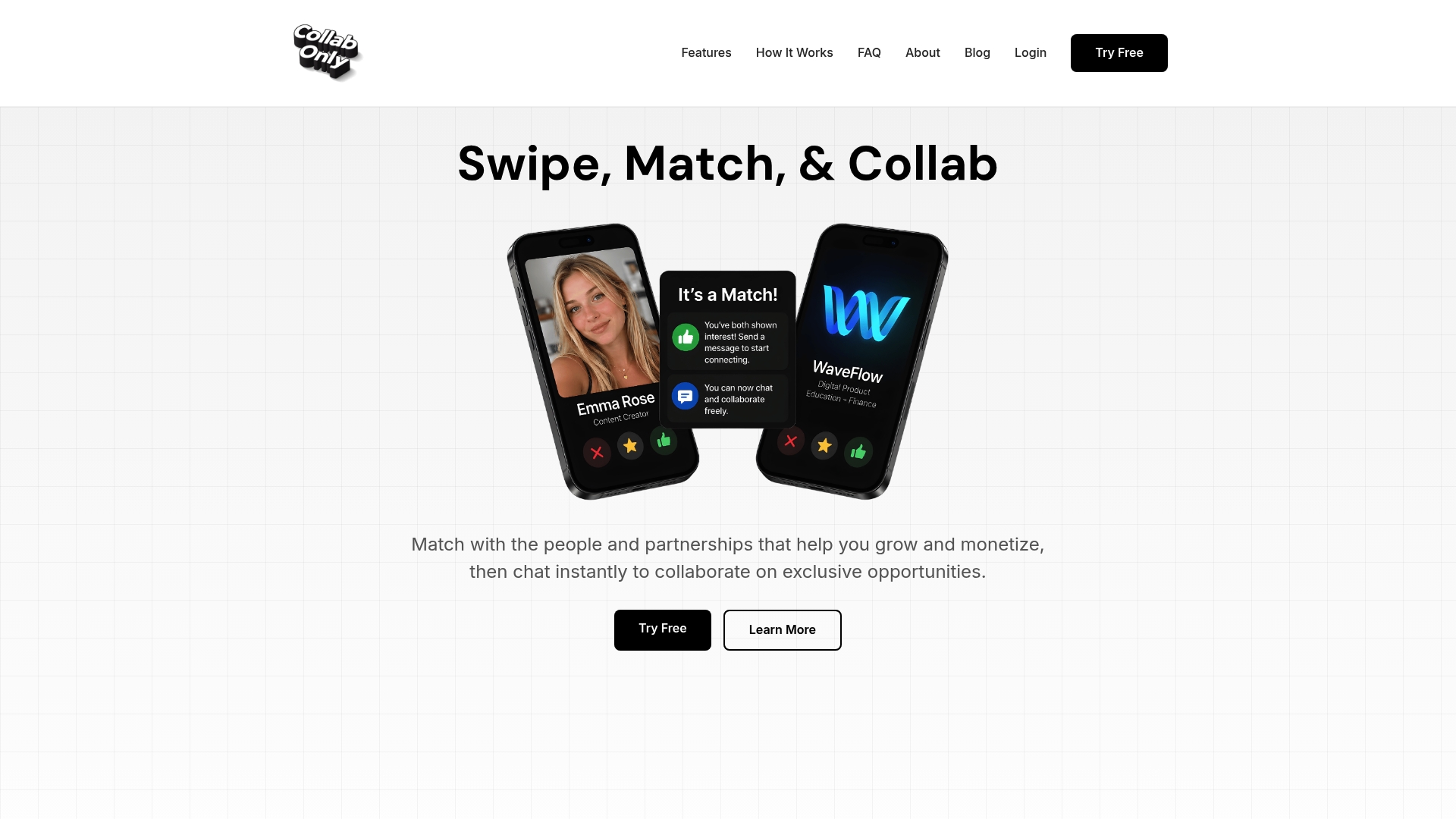
The platform's swipe-based matching system filters for goal alignment, not just follower count, so brands connect with creators who are already positioned to deliver authentic content. Instant chat upon matching removes the friction of cold outreach and lost DMs, replacing it with direct communication from the first moment of contact. For brands ready to move beyond transactional placements, Collabonly's nano influencer marketplace and micro influencer network provide access to creators with high peer-credibility and deeply engaged sub-niche audiences. The influencer marketplace spans TikTok, Instagram, and YouTube, giving marketers a single platform to manage value-driven partnerships at scale.
FAQ
What is the role of authentic partnerships in brand growth?
Authentic partnerships build consumer trust, increase engagement rates, and drive measurable revenue gains. Brands using genuine, value-aligned collaborations see up to 11x higher ROI compared to traditional digital advertising.
What makes a partnership authentic versus transactional?
An authentic partnership is defined by shared values, co-created narratives, equitable accountability, and long-term commitment. A transactional collaboration is defined by fixed deliverables, short duration, and a vendor-client power structure.
How do you build trust in a brand partnership?
Trust in partnerships is built through transparent communication, regular bilateral engagement, and honest acknowledgment of misalignment when it exists. Daily habits such as sharing updates and co-creating content matter more than contract terms.
What are the benefits of authentic collaborations for marketers?
Authentic collaborations produce 25–30% higher engagement rates, stronger audience loyalty, and better sales performance than standalone campaigns. They also generate qualitative benefits such as partner advocacy and sustained storytelling.
How many partnerships should a brand actively manage?
The most effective approach prioritizes quality over quantity. A small number of deeply invested, clearly defined partnerships consistently outperforms a large volume of superficial agreements in both engagement and brand impact.