

TL;DR:
- Effective brand partnerships rely on audience overlap, brand perception alignment, and co-creating authentic assets. They require formal agreements, pre-launch tracking infrastructure, and models tailored to product complexity and growth objectives. Authentic collaborations that leverage genuine connection and cognitive tension outperform superficial, manufactured campaigns.
Brand partnership best practices are the structured criteria, operational frameworks, and measurement systems marketing professionals use to build collaborations that generate measurable business value. The industry term for this discipline is co-branding strategy, though partnership marketing covers the full operational scope. When executed correctly, these practices separate revenue-driving alliances from logo swaps that drain budget and dilute brand equity. Authentic collaborations consistently outperform manufactured campaigns, and the frameworks below explain exactly why and how.
1. What criteria define the best brand partners?
The threshold criterion for any partnership is audience intersection. Without meaningful overlap between each brand's customer base, the collaboration delivers reach without relevance. That distinction matters because relevance drives conversion, while reach alone drives impressions.
Brand perception compatibility is the second filter. Two brands can share an audience but occupy incompatible positions in that audience's mind. A premium skincare brand partnering with a discount retailer creates cognitive dissonance, not synergy. The pairing must reinforce, not contradict, what each brand already means to its customers.
The third criterion is the ability to co-create a unique asset. Effective brand collaborations succeed when they produce something neither brand could deliver alone, whether that is a co-branded product, a joint content series, or an exclusive experience. According to research from Taylor Sicard, 67% of consumers in 2025 reported that collaborations are most effective when they feel honest and unbiased. That finding confirms that perceived authenticity is not a soft metric. It is a direct driver of consumer response.
Key selection criteria to evaluate before committing:
- Audience demographic and psychographic overlap (minimum 30% shared segment)
- Brand perception scores in shared market segments
- Complementary product or service positioning (not competitive)
- Shared or compatible values at the organizational level
- Capacity to co-create a distinct joint asset
Pro Tip: Use a structured partner scorecard with weighted criteria before entering any partnership conversation. Scorecards eliminate selection bias driven by enthusiasm or brand name recognition, neither of which predicts revenue performance.
2. How to structure brand partnerships operationally
A formal, written agreement is non-negotiable. The agreement must cover deliverables, timelines, payment terms, content approval workflows, and exit conditions. BCG research on partnership failures identifies failure to outline exit paths as a primary cause of premature alliance collapse. Brands that skip this step typically discover the gap when economics shift and neither party has a clear path forward.
Operational structuring follows this sequence:
- Courtship phase. Before any contract is signed, conduct structured pre-contract communication. BCG confirms that pre-contract assessment reduces expectation misalignment and improves collaboration quality. This phase includes joint goal-setting sessions, audience data sharing under NDA, and a pilot activation if feasible.
- Agreement drafting. Define deliverables with specific outputs, not vague intentions. "Three co-branded Instagram posts per month" is a deliverable. "Social media support" is not.
- Governance documentation. Create a partner standard operating procedure (SOP) that survives personnel changes. When a key contact leaves either organization, the SOP keeps the partnership on track without renegotiation.
- Launch readiness review. Confirm that tracking infrastructure, content approvals, and communication channels are operational before the first public activation.
- Scheduled performance reviews. Set quarterly review cadences at the agreement stage, not after problems arise.
Pro Tip: Treat the courtship phase as a structured due diligence process. Request audience analytics, past collaboration performance data, and brand sentiment reports before signing. The brands that skip this step are the ones that learn from partnership failures rather than from partnership successes.
3. What are the most effective collaboration models?

Choosing the right collaboration model is as important as choosing the right partner. The model determines how value flows between brands, how revenue is attributed, and how deeply the two organizations must integrate. The four primary models in B2B and B2C contexts are referral, co-sell, channel, and integration partnerships.
According to the strategic partnership playbook for B2B SaaS growth, referral partnerships work best for simple value exchange, while integration partnerships suit workflow improvements and product connection. That distinction maps directly to product complexity and deal cycle length.
| Model | Best for | Revenue flow | Integration depth |
|---|---|---|---|
| Referral | Simple products, short sales cycles | Commission per lead or sale | Low |
| Co-sell | Mid-market deals, complementary products | Shared deal revenue | Medium |
| Channel | Scaling distribution, new geographies | Margin on resold product | Medium to high |
| Integration | SaaS, workflow tools, platform ecosystems | Retained customers, upsell | High |
For consumer brand partnerships, the referral and co-sell models translate into affiliate arrangements and joint product launches. Channel partnerships map to retail distribution agreements. Integration partnerships appear in co-branded digital products, app partnerships, and platform bundles. Matching the model to your growth goal prevents the common mistake of over-engineering a simple collaboration or under-structuring a complex one.
4. How to manage and scale brand partnerships for maximum impact
Scaling a partnership program requires segmenting partners by maturity stage and applying governance proportionally. Early-stage partnerships below $1M ARR should avoid heavy formal governance. Excessive process at this stage creates friction that kills momentum before the partnership proves its value.
Governance scales as partnerships mature:
- Emerging partnerships (pre-revenue): Lightweight check-ins, shared Slack or Teams channel, monthly email updates
- Growth-stage partnerships ($1M–$10M ARR): Structured scorecards, quarterly business reviews, dedicated partner manager
- Strategic partnerships (above $10M ARR): Executive alignment, joint go-to-market planning, shared KPI dashboards
Tracking infrastructure is the most commonly neglected element of partnership management. Building attribution tools after launch leads to inaccurate data and false perceptions of partnership failure. CRM integration and UTM tagging must be configured before the first activation goes live. Salesforce's partner ecosystem documentation confirms this directly. Retrofitting measurement after the fact produces data gaps that make it impossible to distinguish genuine underperformance from tracking errors.
Managing partnership tiers requires different resource allocations. High-touch strategic partners receive dedicated account management and executive sponsorship. Long-tail partners are managed through automation, self-serve portals, and templated communication sequences. Both tiers contribute to market presence. Conflating them under a single management approach wastes resources on low-yield partners and under-serves high-value ones.
5. What role does authenticity and cognitive tension play?
Cognitive tension is the psychological mechanism that makes certain brand partnerships immediately compelling. It occurs when two brands that seem unexpected together are revealed to share a deep, logical connection. Cognitive tension triggers audience surprise and instant recognition simultaneously, which is the combination that drives organic sharing and earned media.
The practical implication is direct: partnerships that require a lengthy explanation to justify will not generate impact. If your brand team needs three slides to explain why the collaboration makes sense, the audience will not feel it intuitively. The best co-branding partnerships communicate their logic in a single image or headline.
"Partnerships requiring long explanation to justify often fail to generate impact." — Cross-Category Brand Collaboration Strategies, JL Agency
Authenticity operates at a different level. It is not about whether the collaboration looks polished. It is about whether the partnership is earned. The Chili's and Lizzo collaboration is a documented example. Lizzo was a public fan of the brand before the partnership was formalized. That prior relationship made the collaboration a natural extension of an existing truth rather than a manufactured marketing moment. The result was measurably higher trust and audience connection than a comparable paid celebrity placement would have generated.
Cross-category partnerships aligned at the psychographic level consistently outperform obvious same-category pairings. The criteria for psychographic alignment include:
- Shared audience values (not just demographics)
- Compatible brand personality attributes
- Complementary emotional associations in the consumer's mind
- A collaboration concept that produces genuine surprise without confusion
6. How to measure partnership success accurately
Measuring partnership success requires defining metrics before the partnership launches, not after. The metrics must connect directly to the business objective the partnership was designed to address. A partnership built to acquire new customers requires different KPIs than one built to increase average order value or improve retention.
The core measurement framework covers three layers. The first layer is activity metrics: content published, events executed, leads generated. The second layer is performance metrics: conversion rate from partner-sourced leads, revenue attributed to the partnership, customer acquisition cost compared to non-partnership channels. The third layer is strategic metrics: brand perception shift in the shared audience segment, net promoter score among co-acquired customers, and partner satisfaction scores.
Audience engagement strategies that incorporate partnership-specific tracking segments produce the most reliable ROI data. Without segmentation, partnership-driven engagement blends into organic traffic and becomes invisible in aggregate reporting. UTM parameters, dedicated landing pages, and CRM source tagging are the minimum infrastructure required to isolate partnership performance from baseline brand activity.
Pro Tip: Set a 90-day measurement review at the agreement stage. This forces both parties to evaluate early data before the partnership scales, allowing course corrections before significant budget is committed.
Key takeaways
Successful brand partnerships require audience alignment, formal operational structure, and pre-launch tracking infrastructure to generate measurable and repeatable results.
| Point | Details |
|---|---|
| Partner selection criteria | Evaluate audience overlap, brand perception compatibility, and co-creation potential before committing. |
| Operational structure | Formal agreements with deliverables, timelines, and exit paths prevent premature partnership collapse. |
| Collaboration model fit | Match the partnership model (referral, co-sell, channel, integration) to product complexity and growth goals. |
| Pre-launch tracking | Configure CRM integration and UTM tagging before launch to produce valid ROI attribution data. |
| Authenticity drives performance | Partnerships rooted in genuine brand affinity, like Chili's and Lizzo, outperform manufactured placements. |
My perspective on what actually separates good partnerships from costly ones
The single most consistent mistake I observe in partnership programs is selecting partners based on enthusiasm rather than evidence. A brand with a large following and a willing team is appealing. It is not, by itself, a qualified partner. The structured scorecard approach exists precisely to counteract this bias. When you weight criteria like audience overlap, brand perception compatibility, and co-creation capacity before the first conversation, you remove the social pressure that causes teams to advance partnerships that should have been declined at the screening stage.
The second pattern worth addressing is the governance timing error. Teams that apply heavy process to early-stage partnerships kill them with friction. Teams that avoid governance in mature partnerships lose control of attribution, messaging, and resource allocation. The $1M–$10M ARR threshold described in the partnership strategy frameworks research is a useful proxy for when to formalize. Before that threshold, keep it lean and move fast. After it, build the infrastructure that protects the investment.
The third observation is about attribution. I have seen partnerships declared failures because the tracking was not in place to capture their actual contribution. The partnership did not fail. The measurement did. Building attribution tracking before launch is not a technical detail. It is a strategic requirement that determines whether you can defend the partnership's value to leadership when it matters.
Focus on complementarity over size. A mid-tier partner whose audience perfectly mirrors your growth segment will outperform a large partner whose audience only partially overlaps. The math on conversion rates makes this clear every time.
— Samuel
How Collabonly supports your partnership strategy
Collabonly is built for marketing professionals who need to move from partner identification to active collaboration without the friction of cold outreach and unanswered DMs. The platform's matching system connects brands with creators and co-brand partners based on audience fit and stated campaign goals, not follower count alone.
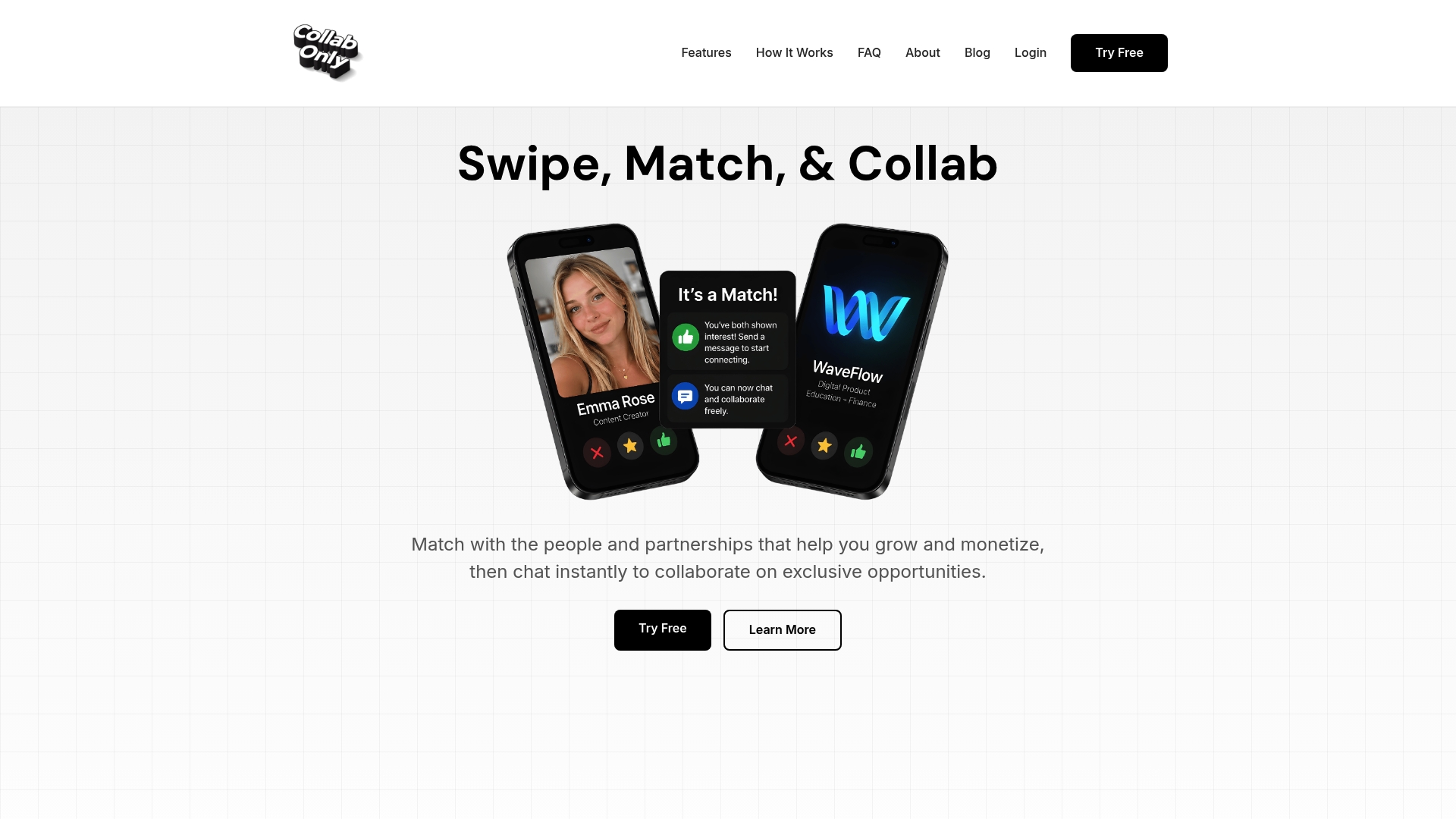
For brands running influencer-led partnership campaigns, Collabonly's Instagram pet influencer network demonstrates how niche, psychographically aligned partnerships generate higher engagement than broad-reach placements. The platform supports TikTok, Instagram, and YouTube campaigns, with instant chat upon match to keep momentum from the first connection. If you are building a partnership program and need qualified partners faster, Collabonly removes the sourcing bottleneck that slows most teams down.
FAQ
What are the core brand partnership best practices?
The core practices are partner selection based on audience overlap and brand perception compatibility, formal operational agreements with exit clauses, pre-launch attribution tracking, and governance scaled to partnership maturity. Each practice addresses a distinct failure mode in partnership programs.
How do you measure the success of a brand partnership?
Measure partnership success across three layers: activity metrics (leads, content), performance metrics (conversion rate, revenue attribution), and strategic metrics (brand perception shift, NPS among co-acquired customers). Attribution requires CRM integration and UTM tagging configured before launch.
What is cognitive tension in brand partnerships?
Cognitive tension is the psychological effect produced when two unexpected brands share a deep, logical connection. It triggers audience surprise and immediate recognition simultaneously, which drives organic sharing. Partnerships that require lengthy explanation to justify typically fail to produce this effect.
When should a brand formalize partnership governance?
Formal governance, including structured scorecards and quarterly business reviews, becomes critical between $1M and $10M ARR in partnership-sourced revenue. Below that threshold, lightweight check-ins and shared communication channels are sufficient and less likely to create friction.
What is the difference between a referral and an integration partnership?
A referral partnership involves a simple commission-based value exchange suited to short sales cycles and low-complexity products. An integration partnership connects products or workflows at a technical level, suited to SaaS platforms and ecosystem-driven growth strategies where retention and upsell are the primary revenue drivers.