

Every collaborative giveaway needs seven published fields before launch: eligibility requirements (age, geography), a precise prize description and value, the number of winners, the exact entry steps, start and end dates with time zone, the winner selection method, and an explicit statement that Instagram or TikTok is not affiliated with the promotion. Platforms like Instagram and TikTok both mandate these disclosures, and skipping even one field is the most common reason a co-hosted giveaway gets flagged or disputed. Prizes may trigger IRS 1099 reporting obligations, so it is advisable to check before finalizing a prize budget.
Sample rules snippet: "Open to legal residents of the contiguous U.S., 18+. One entry per person. Winner selected at random on [date] at 11:59 PM ET. This promotion is in no way sponsored, endorsed, administered by, or associated with Instagram or TikTok."
- Eligibility (age, geography)
- Prize description and value
- Number of winners
- Entry steps
- Start/end dates with time zone
- Winner selection method
- Platform non-affiliation statement
Key Takeaways
A compliant collaborative giveaway requires seven published rule fields, one signed contract assigning fulfillment and liability, and a single shared entry list owned by a designated lead host.
| Point | Details |
|---|---|
| Publish the seven mandatory fields | Eligibility, prize value, winner count, entry steps, dates with time zone, selection method, and platform non-affiliation. |
| Vet partners on audience fit | Match partners to your KPI (leads, email, engagement) instead of follower count alone. |
| Sign a one-page contract first | Assign fulfillment, shipping, customs, and liability before any creative work starts. |
| Follow platform-specific limits | TikTok Shop caps prize value under $500 and bans cash prizes; Instagram Collab posts restrict ad control to the post owner. |
| Use Collab Only for partner discovery | Its matching and shared-brief workflow helps brands align on rules and roles before launch. |
Table of Contents
- Quick Giveaway Collaboration Rules Checklist
- How Do You Choose the Right Giveaway Partner?
- What Official Rules and Logistics Should You Publish?
- What Contract Terms Should Partners Sign Before Launch?
- What Do Instagram, TikTok, and TikTok Shop Require?
- How Should You Plan Co-Branded Promotion?
- How Do You Pick a Winner Fairly?
- What Should You Measure After the Giveaway?
- What Belongs in a Partnership Agreement?
- How Do You Handle Disputes and Ineligible Entries?
- What Does the Giveaway Timeline Actually Look Like?
- How Do You Vet an Influencer's Compliance History?
- How Collab Only Helps You Run Compliant Giveaways
- Sources
- FAQ
Quick Giveaway Collaboration Rules Checklist
Paste this checklist into your caption drafting doc or rules page template before any co-branded post goes live. Every collaborative giveaway rule needs these fields stated plainly, not implied:
- Eligibility: "18+, contiguous U.S. residents only, void where prohibited."
- Prize and value: Name the item and its approximate retail value (ARV). Vague prize language is the top trigger for entrant disputes.
- Number of winners: State it as a number, not "winners" plural with no count.
- Entry actions: List every required step (follow both accounts, like, tag friends, comment).
- Start/end timestamps: Include the time zone. "Ends March 12" is not enough.
- Selection method: Random draw, judged, or a hybrid.
- Contact and claim window: How winners get notified and how long they have to respond.
- Non-affiliation line: The platform disclosure language that neither platform sponsors the promotion.
Watch for compliance triggers: prizes over roughly $600 can create 1099 tax reporting obligations, and some states require sweepstakes registration or bonding above certain prize thresholds. When in doubt, exclude those states explicitly in your eligibility line rather than risk running an unregistered promotion there.
How Do You Choose the Right Giveaway Partner?
Pick a partner for audience alignment, not follower count. Before you contact anyone, decide the one metric that defines success: email capture, engagement lift, or lead generation. That single decision should drive every partner conversation that follows, because the strongest brand collaborations align on audience demographics, brand values, and industry relevance rather than chasing the account with the biggest number attached to its bio.
Run every prospective partner through a short evaluation before you pitch:
- Audience overlap: Does their follower base actually match your customer profile?
- Engagement rate: Comments and saves matter more than raw likes.
- Giveaway history: Have they run compliant promotions before, or left messy comment threads and unclaimed prizes behind?
- Disclosure habits: Do their sponsored posts already carry proper FTC-compliant tags?
- Fulfillment capability: Can they actually ship, or will you own that leg entirely?
- Reputation: A quick search for past brand disputes saves you from inheriting someone else's PR problem.
Your outreach message should include an audience breakdown, the specific KPI you're chasing, a proposed timeline, and what each side delivers. A platform like Collab Only's discovery tools can shortcut the vetting step by surfacing partners already sorted by audience fit rather than follower count.
Pro Tip: Split compensation into two buckets in your first message: a flat fee for the creator's time and a separate prize-cost split. Blending the two into one number almost always leads to a renegotiation mid-campaign.
What Official Rules and Logistics Should You Publish?
Publish full official rules on a dedicated page, not buried in a caption. Each clause should answer one specific question a participant or regulator could raise.
Eligibility: State age, residency, and any exclusions plainly. "Open to legal residents of the 50 United States and D.C., 18 years or older" leaves no ambiguity.

Prize description and value: Name the exact item, model, or gift card denomination, and its ARV. "A skincare bundle" invites disputes; "One (1) Brand X Hydration Set, ARV $85" does not.
Entry steps: Number them. "1. Follow @brandA and @brandB. 2. Like this post. 3. Tag one friend in the comments."
Dates and time zone: "Begins March 3, 2026 at 9:00 AM ET and ends March 10, 2026 at 11:59 PM ET."
Winner selection and notification: State the method and the notification window, typically 24 to 48 hours by direct message.
Substitution and void clauses:
That single line, drawn from standard sweepstakes practice, protects both brands if a listed prize becomes unavailable.
Fulfillment assignment: State plainly who ships, who covers customs on international entries, and who handles a damaged or lost prize claim. This single sentence prevents the most common post-campaign argument between co-hosts.
Data privacy line: "By entering, participants consent to their name and email being collected by [Lead Brand] for winner verification and are not added to marketing lists without separate opt-in consent."
What Contract Terms Should Partners Sign Before Launch?
A signed one-page agreement before creative work begins removes most of the friction that surfaces after launch. At minimum, the contract should define:
- Deliverables: Exact post count, format (Reel, Story, static post), and caption approval rights.
- Timelines: Content due dates, review windows, and the live posting date.
- Payment terms: Flat fee, prize-cost split, or a hybrid, with payment triggers.
- Approval SLAs: How many business days each side has to approve draft content.
- Usage rights: Whether either brand can repurpose the content in paid ads later.
- Indemnities and force majeure: Who's liable if a prize ships late or a vendor cancels.
A short responsibility matrix keeps everyone honest:
| Task | Owner |
|---|---|
| Winner notification | Lead host |
| Shipping and customs | Prize-providing brand |
| Returns/damaged goods | Prize-providing brand |
| Entry list ownership | Lead host |
Designating one brand as the lead host who owns the master entry list and shared rules page resolves most list-ownership disputes before they start. That same contract should specify who can email winners afterward and whether the list requires a fresh opt-in for future marketing.
What Do Instagram, TikTok, and TikTok Shop Require?
Every major platform demands visible, on-post rules and a clear non-affiliation statement, but the specifics diverge enough to trip up brands running their first cross-platform giveaway.
TikTok and TikTok Shop: Shop giveaways cap prize value under $500 USD and ban cash or gift cards outright. TikTok also requires terms to appear on the video itself, meaning a caption alone doesn't satisfy the rule; overlay text covering prize, eligibility, entry steps, and end date is the safer standard.
Instagram: Disclosure needs to sit in the first line of a caption, not buried after hashtags. Only the account that owns a Collab post can run paid ads on it, so decide who owns the post before creative work starts.
Randomizers: Tools like Random.org and Rafflecopter (and Gleam for multi-step entries) give you a verifiable, timestamped selection log that both brands can point to if a winner disputes the outcome.
How Should You Plan Co-Branded Promotion?
Map your content to a simple five-stage calendar: teaser, launch, reminder, last call, winner announcement. Match each stage to the channel that fits it best, feed posts for launch and announcement, Stories for reminders, email for last-call urgency.
- Post matrix: Assign who posts what format, where disclosure language sits (first line, not hashtag block), and shared visual branding elements that don't erase either brand's identity.
- Amplification: Cross-post across owned channels and route everyone to a single shared rules page rather than two competing versions.
- Paid boosts: On an Instagram Collab post, only the account that owns the underlying post can run ads on it, so lock that decision in during contract negotiation, not the week of launch.
How Do You Pick a Winner Fairly?
Choose a genuinely random draw using Random.org or a documented script when the goal is pure entry-count fairness. Choose a judged format, with published criteria, when creativity or content quality matters more than raw participation.
- Log selection with a screenshot, a randomizer output, or a timestamped recording so results are defensible if challenged.
- Verify the winner meets every eligibility field before announcing.
- Give winners a claim window, 48 to 72 hours is standard, and name a backup winner in your rules if they don't respond.
- Announce publicly, either as a post or a short live draw, to show entrants the process was real.
What Should You Measure After the Giveaway?
Track KPIs tied directly to your original objective, not vanity metrics. Follower growth matters less than email leads captured, engagement lift on the collaborating accounts, conversion rate from the new list, and cost-per-acquisition once you factor in prize cost and any paid promotion.
- Send a thank-you message to every entrant, winner or not, within 48 hours of the draw.
- Build a simple onboarding flow for new subscribers so the list doesn't go cold immediately.
- Run a partner debrief comparing shared KPIs against the pre-launch goal.
- Keep entrant data only as long as needed for fulfillment and consented marketing; a short cool-down before the first marketing send respects entrants who joined only for the prize.
What Belongs in a Partnership Agreement?
A partnership agreement should assign three things explicitly: roles, responsibilities, and liability. Roles define who is the "lead host" versus "co-host," which matters legally since the lead host typically owns the rules page and entry list. Responsibilities break down into pre-launch (creative approval, prize sourcing), mid-campaign (posting schedule, comment moderation), and post-campaign (winner notification, fulfillment, reporting).
Liability clauses need more specificity than most first-draft contracts include. State who is liable if a prize is lost in shipping, if a winner never responds, or if one brand's audience triggers a platform violation the other brand didn't cause. Without this, a dispute over a damaged shipment can stall the entire partnership's future collaborations.
Usage rights deserve their own line item. If either brand wants to repurpose giveaway content in paid ads or a future campaign deck, that permission needs to be written into the original agreement, not negotiated after the fact when leverage has shifted.
Finally, include a cancellation and force majeure clause. Prize delays from a manufacturer, a platform outage during launch week, or a partner's account getting temporarily restricted are common enough that a plan for "what happens if this breaks mid-campaign" belongs in the contract, not left to a panicked group chat when it actually happens.
How Do You Handle Disputes and Ineligible Entries?
Every rules page needs a dispute clause before launch, not after the first complaint arrives. State plainly that the sponsor's decision on eligibility and winner selection is final, and that entrants agree to this by participating.
Common ineligibility triggers include: fake accounts, entries from excluded states or countries, missed entry steps (didn't follow both accounts, didn't tag a friend as required), and multiple entries where only one is permitted. Build a verification step into your winner-selection process that checks each of these before you publicly announce anyone.
When a dispute does arise, resolve it against the published rules, not against social pressure in the comments. If your rules stated "one entry per person" and someone entered five times, disqualifying the extra entries is defensible precisely because you wrote the rule down first. This is why vague rules create more disputes: there's nothing concrete to point to when someone pushes back.
For co-hosted giveaways, decide in your contract which brand has final say on disputed entries, usually the lead host, since they own the entry list and rules page. Document every disqualification with a reason, even briefly, in case a participant escalates the complaint publicly.
What Does the Giveaway Timeline Actually Look Like?
A realistic collaborative giveaway runs on a five-phase timeline. Phase one, planning and contract signing, typically takes one to two weeks and includes partner vetting, KPI agreement, and the signed one-page responsibility summary. Phase two, creative production, needs another week for content drafts, disclosure language placement, and mutual approval.
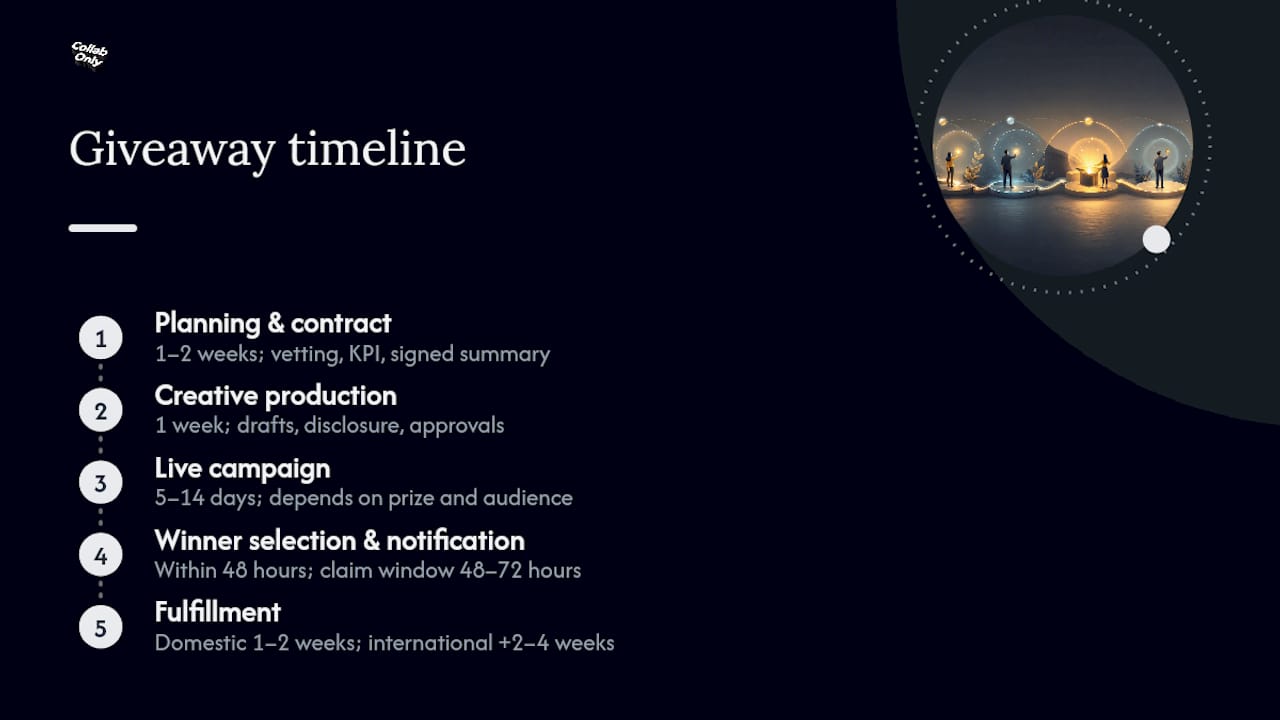
Phase three is the live campaign itself, usually five to fourteen days depending on the prize value and audience size; shorter windows work for lower-value prizes, longer ones for high-value giveaways that need more entry volume to justify the cost. Phase four, winner selection and notification, should happen within 48 hours of the giveaway's stated end time, with a claim window of another 48 to 72 hours built in.
Phase five, fulfillment, is where timelines most often slip. Domestic shipping typically resolves within one to two weeks; international entries with customs can add two to four weeks beyond that. Building this fulfillment buffer into your public rules, rather than promising an unrealistic delivery date, prevents the most common post-giveaway complaint: a winner who feels forgotten.
How Do You Vet an Influencer's Compliance History?
Before signing anyone, run a compliance check that goes beyond follower count and engagement rate. Look for these specific signals:
- Past disclosure habits: Search their sponsored post history for consistent FTC-compliant tagging, not occasional or buried disclosures.
- Prior giveaway conduct: Check comment threads on their past giveaways for unresolved winner complaints or accusations of fake draws.
- Platform standing: Confirm the account isn't currently restricted or under a known policy strike, which can jeopardize a co-hosted post's visibility.
- Audience authenticity: A sudden follower spike with flat engagement is a common sign of purchased followers.
- Response consistency: Do they answer DMs and comments promptly, or does their audience regularly complain about being ignored?
This vetting step matters more than most brands budget time for, and it's exactly the kind of due diligence that a structured discovery platform can speed up rather than replace.
Why Contracts Beat Good Intentions Every Time
Handshake agreements fail giveaways more often than bad luck does. Every dispute we've walked through here, unclear fulfillment, disputed winners, ownership fights over the entry list, traces back to a role nobody wrote down before launch. Agreeing on responsibilities in writing before creative work begins costs an afternoon. Untangling them after a prize goes missing costs a partnership. A platform built around templated briefs and shared workflows, the kind Collab Only offers, exists precisely because that upfront clarity is the highest-leverage move in the entire process.
How Collab Only Helps You Run Compliant Giveaways
Running a co-hosted giveaway well means solving two problems at once: finding a partner worth trusting, and keeping every rule, deliverable, and deadline in one place both sides can see. Collab Only is built around that second problem as much as the first.
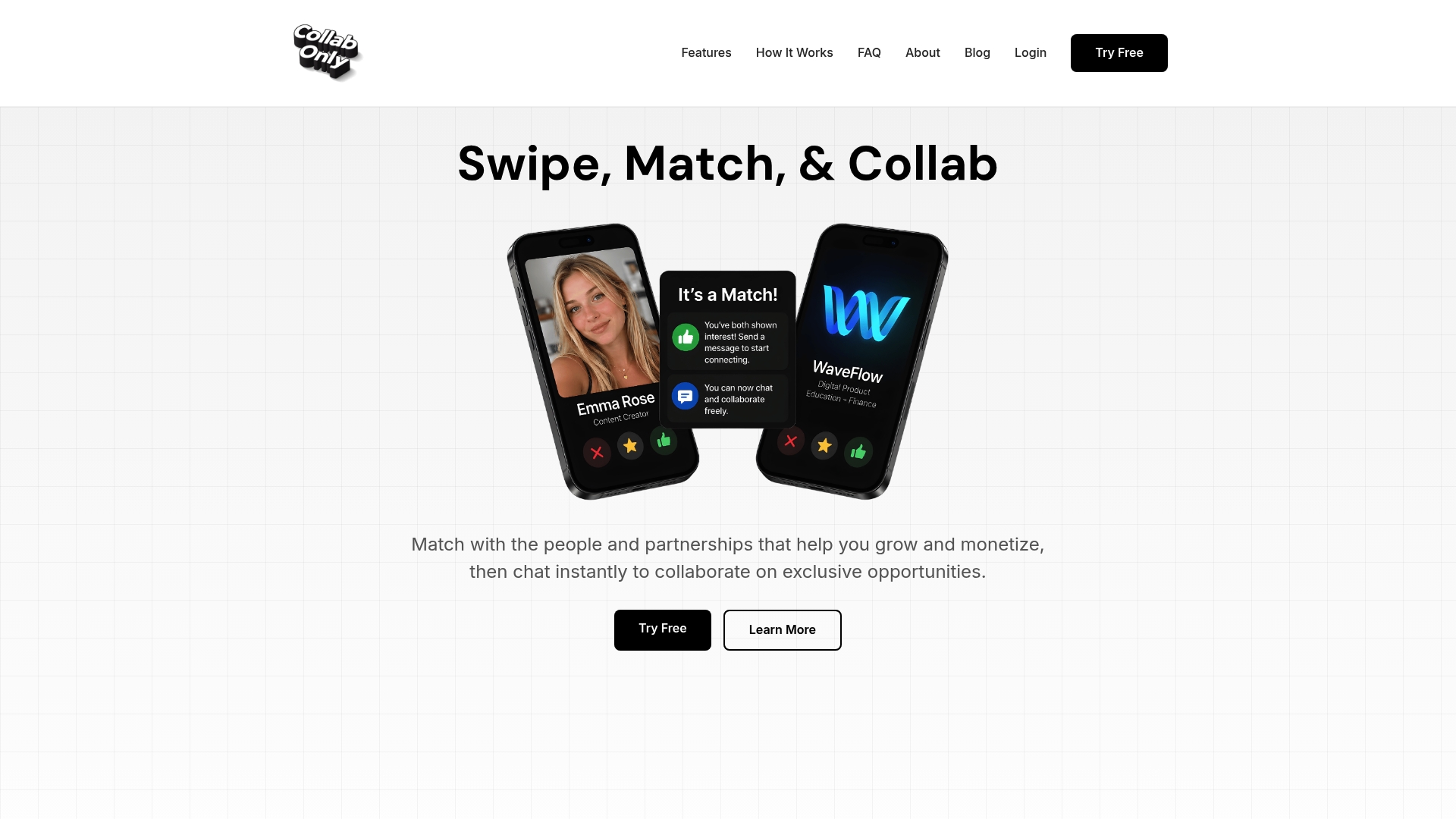
The platform's swipe-based matching surfaces creators and brands already filtered by audience fit rather than raw follower count, which is exactly the selection criterion this guide recommends. Once you match, instant chat replaces the DM-and-email back-and-forth that usually delays a giveaway launch by days. Campaign briefs live in one shared space, so entry-list ownership, fulfillment responsibilities, and shared rules language are agreed on before anyone posts a single Reel. If you're staffing a giveaway fast and want vetted partners without building an outreach list from scratch, Collab Only's nano-influencer hiring page is the fastest place to start, or explore the full matching platform to see how the workflow fits your next campaign.
Sources
- Social media rules for giveaways
- Giveaways, promotions and more on TikTok Shop
- Handling 1099 reporting for prizes, awards and promotional giveaways
- Brand collab giveaways: Co-hosted Instagram DM automation
FAQ
What Fields Must a Giveaway Rules Page Include?
Eligibility, prize description and value, number of winners, entry steps, start and end dates with time zone, the winner selection method, and a platform non-affiliation statement.
Does TikTok Shop Allow Cash or Gift Card Prizes?
No. TikTok Shop giveaways prohibit cash and gift cards outright and cap prize value under $500 USD.
Who Should Own the Entry List in a Co-Hosted Giveaway?
One brand should be designated the lead host who owns the master entry list and the shared rules page, which both sides agree to in the contract before launch.
How Do I Find a Compliant Giveaway Partner?
Vet partners on audience overlap, engagement rate, disclosure history, and past giveaway conduct rather than follower count; platforms like Collab Only surface candidates already filtered by audience fit.
Do Giveaway Prizes Trigger Tax Reporting?
High-value prizes can trigger IRS 1099 reporting requirements, and some states require sweepstakes registration above certain prize thresholds.