

An effective influencer outreach email opens with a specific, personalized hook, states the brand fit in one line, makes a clear ask with a compensation signal, and closes with a single call to action, all in under 150 words. Everything else, subject lines, follow-ups, and platform matching, exists to support that core structure. Skip straight to the templates below if you need copy today; read the surrounding sections if you want to know why each element earns its place.
TL;DR:
- Personalization and a clear value proposition are essential for increasing reply rates, with emails that are concise and under 150 words performing best.
- Including a specific ask with a deliverable and timeline, along with transparent compensation or rate range, significantly shortens negotiation and response time.
- Top-performing subject lines name the creator and specific deliverables, and sending emails on Tuesday to Thursday mornings yields higher open and reply rates.
- Follow-up sequences should be limited to one or two touchpoints, spaced five to seven days apart, and then cease after a polite closure if there's no response.
- Using platforms like Collabonly can streamline creator matching, reducing uncertainty and response time by connecting brands with creators already interested in collaborations.
Table of Contents
- What Makes an Influencer Outreach Email Actually Work?
- Ready-to-Use Templates for Common Outreach Scenarios
- How Do You Personalize a Template in Under Three Minutes?
- What Subject Line and Timing Get the Most Replies?
- What's the Right Follow-Up Cadence Before You Stop?
- How Do You Measure Whether Your Outreach Is Working?
- When Does Platform Matching Beat Cold Outreach?
- What I've Learned Writing Hundreds of These Emails
- Try Collabonly for Faster Creator Connections
- Sources
- FAQ
What Makes an Influencer Outreach Email Actually Work?
Creators filter every inbound message through three questions in roughly ten seconds: is this brand credible, does it fit my content, and is the ask worth my time? Messages that fail any of those three tests get archived or ignored, according to Influencer Marketing Hub's direct outreach analysis, which recommends keeping first-contact messages under 150 words specifically because longer emails bury the answers to those questions.
Six elements consistently separate emails that get replies from ones that get deleted:
- Personalization hook: reference one specific post, video, or theme in the creator's recent content. Generic compliments ("love your feed!") signal a mass blast.
- One-line brand intro: state what the brand does and why it fits this creator's audience, not a paragraph of company history.
- Value proposition: name the benefit, whether it is a flat fee, product plus commission, affiliate revenue share, or exposure through a specific channel.
- Specific ask: spell out the deliverable (one Reel, a three-post series, a YouTube integration) and a rough timeline.
- Compensation signal: a dollar range or a direct request for their rate card. Including a budget indicator in the first message shortens the negotiation cycle and filters out mismatched expectations early.
- Single CTA: one question, one next step. Asking a creator to "check out our website, reply with thoughts, and let us know your rates" gives them three tasks and an easy excuse to do none of them.
Brevity matters because most creators triage email on a phone between shoots or shows. A message that requires scrolling past three paragraphs before reaching the ask rarely survives that triage. Pro Tip: Write your ask first, then build the rest of the email around it. Emails drafted intro-first tend to bury the actual request under three sentences of throat-clearing.
Ready-to-Use Templates for Common Outreach Scenarios
These five templates cover the scenarios brand teams hit most often. Copy the structure, replace every bracketed placeholder, and keep the word count where it lands, don't pad it back up.
-
Cold paid partnership email. Subject: "Paid collab for [Creator Name]? $[X]–$[Y] budget." Body: "Hi [Name], your [specific video/post] on [topic] is exactly the kind of content [Brand] wants to be part of. We're [Brand], a [one-line description], and we'd love to send you [product/brief] for a [deliverable, e.g., one Reel] with a budget of $[X]–$[Y]. Would you be open to a quick reply with your rate for something like this?"
-
Product gifting or seeding email. Subject: "A gift from [Brand] for [Creator Name]?" Body: "Hi [Name], I've been following your [content type] for a while, especially [specific example]. We think [Product] would genuinely fit your audience, and we'd love to send you one, no strings attached. If you end up loving it and want to talk about a paid partnership down the line, we're open to that too. Want me to ship one your way?"
-
DM gifting variant (same offer, condensed for nano creators): "Hey [Name]! Loved your [post/video] on [topic], very [Brand]-coded. Can I send you [Product] as a gift, no pressure to post? Happy to talk paid work later if it's a fit."
-
Polite follow-up. Subject: "Following up, [Creator Name]" Body: "Hi [Name], following up on my note from last week about [deliverable]. No pressure at all, just wanted to check if it landed in a busy inbox. Still happy to send over our budget range and brief if you're interested."
-
DM-to-email warm intro / affiliate invite. "Thanks for the reply here! Easier to send details by email, mind sharing yours? Alternatively, if you'd rather start with affiliate revenue share instead of a flat fee, we run a program at [X]% commission, happy to set that up whichever way works for you."
Never touch the compensation range once you commit to it in writing across a campaign, creators compare notes, and inconsistent offers erode trust faster than a slow reply ever will. Do edit the deliverable line and the specific content reference for every single send; a template with a generic hook is just spam with better formatting.
How Do You Personalize a Template in Under Three Minutes?
Personalization is not the same as customization from scratch. A 60 to 180 second scan of a creator's last three posts and their bio usually surfaces enough material for a genuine hook, you're looking for a recurring theme, a recent brand mention, or a comment thread that reveals what they actually care about.
- Scan the last three posts for a topic, aesthetic, or product category your brand connects to naturally.
- Read the bio line for stated niches, locations, or "collab" indicators that tell you how open they already are to pitches.
- Match tone to tier: nano creators (under 10,000 followers) respond well to a warm, casual DM; macro creators expect a more formal email with a clear budget stated upfront, since email tends to outperform DMs for micro and larger creators, while DMs work better for nano-level outreach.
- Check for a manager or agency contact in the bio link or a "for business" email; pitching a manager directly with a slightly more formal tone often moves faster once a creator has representation.
- Verify the email address against the bio link, media kit, or a recent collaboration post before sending. Bounced emails from guessed addresses (first-name formats rarely work for larger accounts) hurt your domain's sender reputation over time.
Pro Tip: Keep a simple spreadsheet log of which personalization angle you used per creator. When you eventually follow up or pitch again next quarter, that one line saves you from rereading their entire feed.
What Subject Line and Timing Get the Most Replies?
Subject lines that name the creator, the deliverable, and the word "paid" outperform vague openers like "Collaboration opportunity" by giving the recipient enough information to triage in a glance. Personalized subject lines that reference specific content consistently earn faster responses than generic templates, according to outreach benchmarking from Conversion.Studio.
Keep every subject line under 50 characters so it doesn't truncate on mobile, where most creators read email first.
- "Paid collab for [Name]? Quick ask inside"
- "[Brand] x [Name]: budget attached"
- "Loved your [topic] post, got a proposal"
Tuesday through Thursday mornings tend to see the highest open rates for business email generally, and creators are no exception, weekend sends often get buried under personal correspondence by Monday. Run small-batch A/B tests, ten to twenty sends per variant, changing only the subject line, and track reply rate, not open rate, as your real signal. A high open rate with zero replies usually means your subject line worked but your first line didn't.
What's the Right Follow-Up Cadence Before You Stop?
A short, predictable sequence protects your sender reputation and your relationship with the creator, even when they never respond.
- Send the initial outreach and wait it out. Resist the urge to follow up within 48 hours.
- Follow up once, five to seven business days later, adding something new: a deadline, a slightly sweetened offer, or a clarification of the ask rather than a bare "just checking in."
- Send a polite closure roughly seven days after that, letting them know the door stays open. A cadence of one or two follow-ups with an optional channel switch, moving from email to a DM or vice versa, is standard practice without tipping into pestering.
- Stop after the closure message. No response after two touches usually means timing, not interest, so revisit in two to three months rather than pushing a third email.
How Do You Measure Whether Your Outreach Is Working?
Four numbers tell you almost everything: open rate, response rate, time-to-response, and conversion to a signed deliverable. Response rate matters more than open rate for diagnosing your email's actual content, and conversion rate tells you whether your compensation and ask are realistic for the tier you're targeting.
- Track response rate by subject line variant to find your best-performing hook.
- Track it separately by personalization depth (generic vs. specific content reference) to confirm the extra research time is paying off.
- Track it by compensation transparency (range stated vs. "let's discuss rate") since testing compensation transparency alongside subject and personalization tends to surface measurable differences in reply speed.
- Run these as small cohorts of 15 to 25 sends rather than waiting for a full campaign's data, then fold what wins into your next batch of templates.
When Does Platform Matching Beat Cold Outreach?
Cold email works, but it assumes you can find the right creator, guess their email correctly, and wait through a five-to-seven-day response window before knowing if there's mutual interest. A matching platform collapses that uncertainty into a single swipe.
Collabonly connects brands with creators through a swipe-based matching system, so both sides already show interest before a conversation starts, no guessing whether a cold pitch will land.
- Instant chat replaces the inbox wait. Once a brand and creator match, conversation opens immediately instead of sitting in a follow-up queue, which directly addresses the slow-response problem that cold email struggles with structurally.
- Cross-platform support covers TikTok, Instagram, and YouTube creators in one place, rather than tracking down separate contact methods per platform.
- Guaranteed baseline interest means every match has already cleared the "is this worth my time" filter that kills most cold pitches before they're even opened.
The two approaches complement each other well: use your templates for creators you've already identified as a strong fit, and use matching to surface creators actively open to collaboration you'd never have found through a hashtag search. Combining both usually shortens the time between first contact and signed deliverable, since matched creators skip the credibility-check phase entirely.
What I've Learned Writing Hundreds of These Emails
Three rules hold up across nearly every successful outreach flow: be specific about what you noticed in their content, respect their time by naming a budget instead of dangling "exposure," and ask for one small next step rather than a full commitment. A creator who agrees to "send me your rate" is far more likely to convert than one asked to "let's hop on a call to discuss a potential long-term partnership."
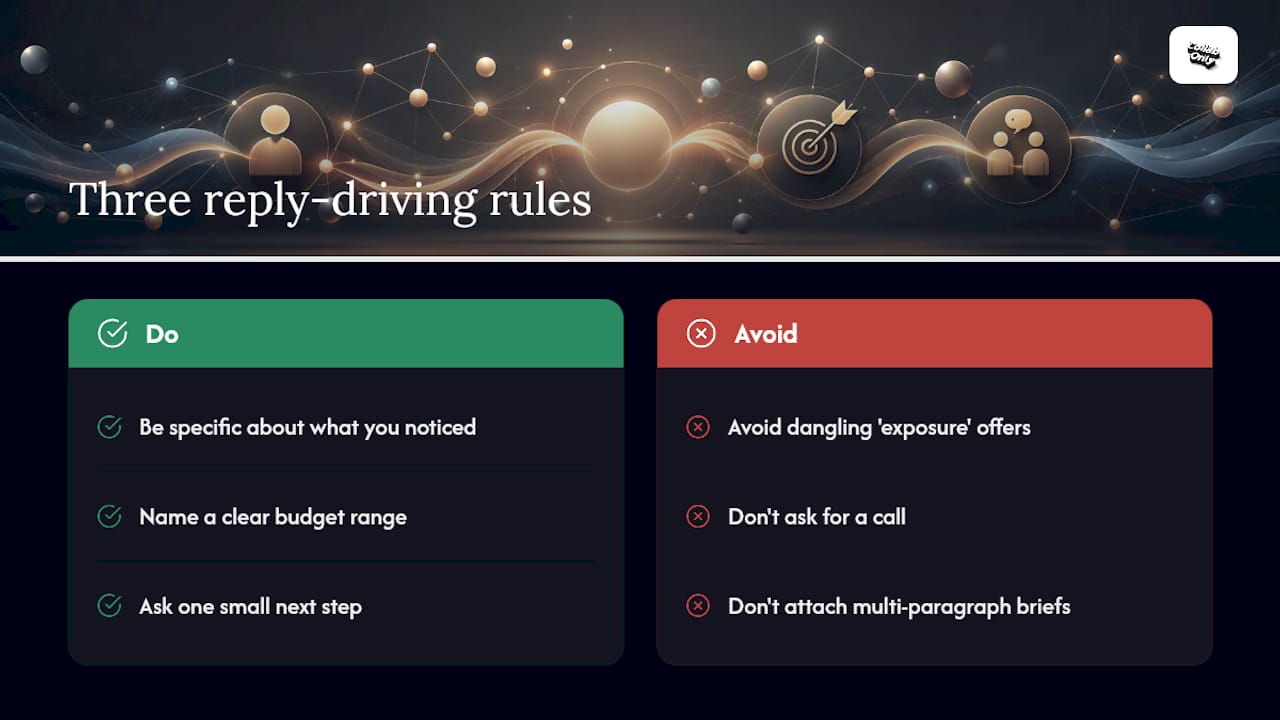
The pattern that works best in practice looks something like this: a brand references a creator's recent series, states a $200 to $400 range for a single Reel, and asks only whether the creator is interested at that range. No call request, no multi-paragraph brief attached. Replies tend to come within two days when the ask is that narrow, and the negotiation that follows moves faster because both sides already know the ballpark.
Templates are a starting point, not a script to follow forever. Keep notes on what wording earned replies and what got ignored; that log becomes more valuable than any template after your third campaign.
— Samuel
Try Collabonly for Faster Creator Connections
Collabonly gets you past the guesswork of finding an email address, writing the perfect cold pitch, and waiting a week to learn if a creator is even interested. Instead of drafting outreach into the void, you swipe through creators who are already looking for brand deals, match with the ones whose profile fits your campaign, and start chatting instantly.
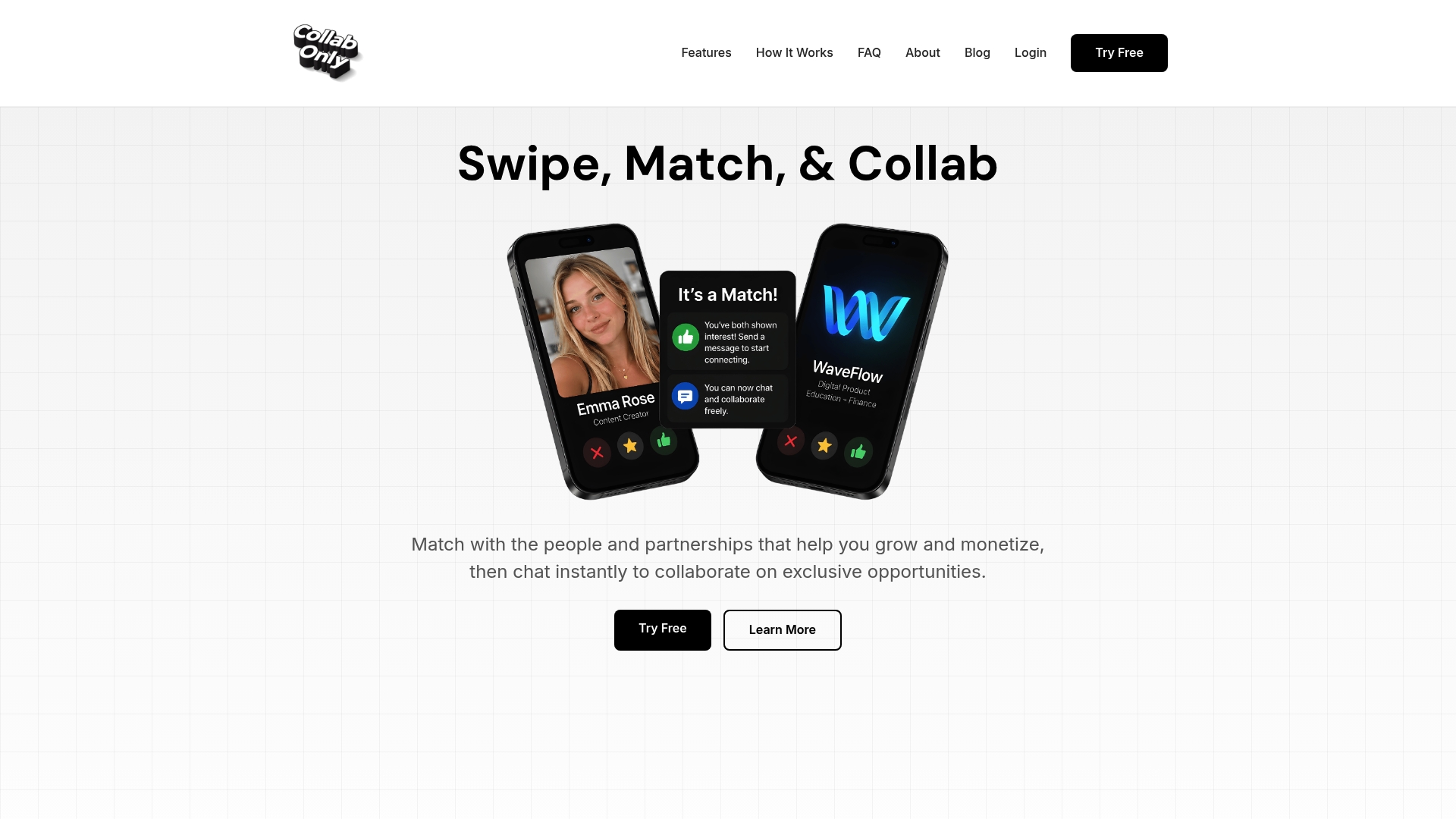
The templates in this article still matter here: once you match with a creator on Collabonly, you can drop the same compensation-transparent, deliverable-specific language straight into the instant chat instead of a cold inbox, since the credibility question is already answered by the match itself. For brands specifically looking to build volume with smaller, highly engaged accounts, Collabonly's nano influencer marketing page is the place to start browsing and get your first match moving today.
Sources
For deeper template libraries and benchmark data behind the guidance above, see Sprout Social's outreach templates and pre-send checklist, Modash's tiered outreach framework, and Influencer Marketing Hub's direct-contact guide. For broader creator-growth strategy that pairs well with outreach copy, Baby Love Growth's influencer guide is worth a read.
- How to Find and Contact Influencers Directly in 2026 (Without Paying Agency Fees) — Influencer Marketing Hub
- How To Do Influencer Outreach: An Actionable Guide For Brands — Modash
FAQ
What Is Influencer Outreach?
Influencer outreach is the process of contacting creators directly, by email or DM, to propose a paid partnership, product gifting arrangement, or affiliate deal, rather than routing the request through an agency or platform.
What Emails Do Influencers Use?
Most creators list a business or "for collabs" email in their bio or link-in-bio page; larger creators often route that address to a manager, so verifying it against a recent post or media kit before sending avoids bounced messages.
What Is the 30/30/50 Rule for Cold Emails?
This isn't a standardized framework in influencer outreach specifically; if you've seen it referenced, it likely refers to general cold-email time allocation (research, writing, follow-up) rather than a rule unique to creator pitches, so treat any specific breakdown with caution.
What Companies Send PR Packages?
Beauty, fashion, food, and consumer tech brands most commonly send PR packages as a lower-cost alternative to paid deals, often through gifting or seeding templates that offer the product with no obligation to post.
How Long Should a First Outreach Email Be?
Keep it under 150 words. Creators triage inbound pitches in seconds, and a message that requires scrolling past several paragraphs before the ask usually gets skipped.