

TL;DR:
- Cross-platform collaboration connects diverse software systems and teams for real-time data exchange and coordinated work. It enhances efficiency by reducing manual processes, lowering costs, and improving decision-making across departments. Effective governance and native integrations are essential for successful, scalable implementation.
Cross-platform collaboration is defined as the practice of connecting disparate software systems, teams, and communication channels so they can exchange data and coordinate work in real time, regardless of which tools each party uses. For businesses managing digital marketing campaigns, influencer partnerships, or distributed product teams, this capability determines whether workflows accelerate or stall. Tools like Slack, Zoom, Jira, and Salesforce each serve distinct functions, yet cross-platform integration allows them to operate as a unified system rather than isolated silos. The market for these integrations is projected to grow from $90.09 billion in 2024 to $187.62 billion by 2029, reflecting how central this capability has become to modern business operations.
What is cross-platform collaboration and how does it work?
Cross-platform collaboration works by enabling software systems that were not originally designed to communicate with each other to share data, trigger actions, and synchronize updates through three primary technical mechanisms: API-based synchronization, federation, and gateway interoperability. Each mechanism serves a different integration scenario, and most enterprise deployments use a combination of all three.

API-based synchronization is the most common method. When a sales team updates a customer record in Salesforce, an API call can automatically create or update a corresponding ticket in Jira or ServiceNow, keeping both teams aligned without manual data entry. APIs and middleware act as translators between tools, preserving data integrity and enabling real-time synchronization across platforms that otherwise speak different technical languages.
Federation addresses a different problem: external partner communication. Collaboration federation allows external partners to securely share communication channels without exposing internal platforms, which is particularly relevant for marketing agencies coordinating with brand clients across different messaging systems. Gateway interoperability extends this further by supporting meetings between platforms, such as connecting Zoom calls with SIP-based conference room devices.
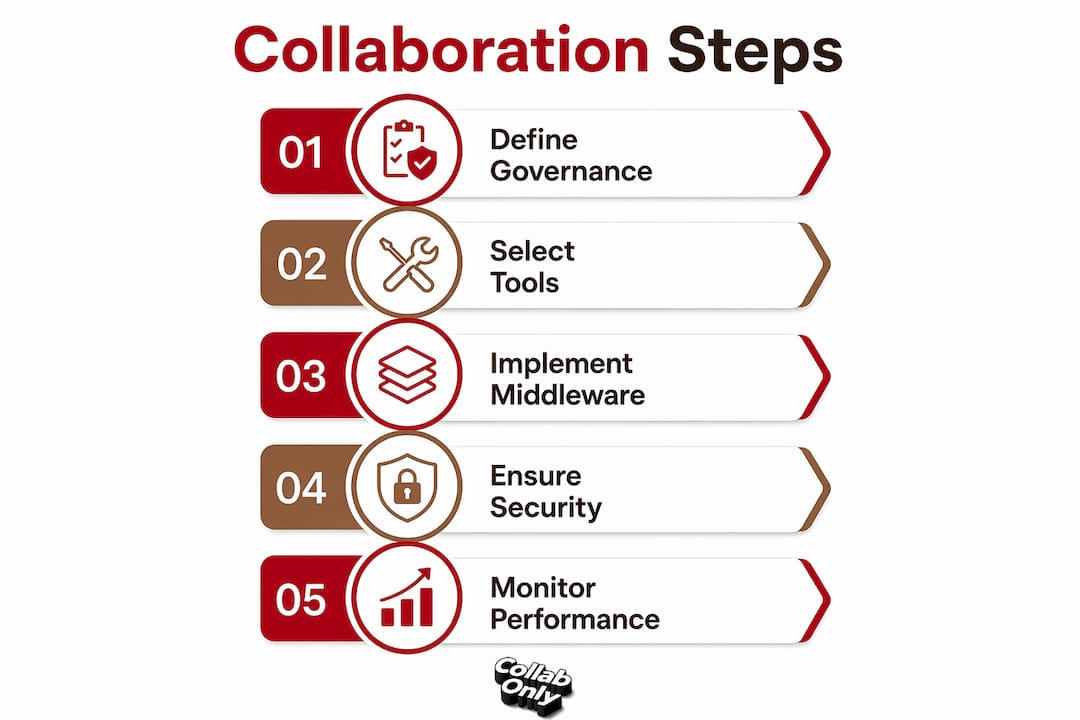
Successful implementation follows four distinct phases:
- Establish a single source of truth. Designate one system as the authoritative record for each data type. For example, Salesforce owns customer data while Jira owns project status.
- Select the integration method. Choose between direct API connectors, middleware platforms like MuleSoft or Zapier, or federation protocols based on security requirements and data volume.
- Map data fields and transformation rules. Define exactly which fields sync, in which direction, and how conflicts are resolved when both systems update simultaneously.
- Test continuously with real data. Validate sync accuracy, latency, and failure recovery before full deployment, then monitor ongoing performance.
Security is non-negotiable at every phase. Successful implementations rely on encryption and multi-factor authentication to protect data in transit between platforms, particularly when external partners are involved.
Pro Tip: When selecting an integration method, prioritize middleware platforms that offer pre-built connectors for your existing tools. Building custom API integrations from scratch multiplies maintenance overhead every time a vendor updates their API version.
What are the key benefits of cross-platform collaboration for businesses?
The measurable advantages of cross-platform collaboration extend well beyond convenience. Organizations that implement it effectively report up to 64% cost savings by reducing manual processes and eliminating redundant software subscriptions. That figure reflects the compounded effect of fewer duplicate data entry tasks, reduced error correction cycles, and consolidated tooling costs across departments.
The productivity case is equally compelling. Employees spend up to 58% of their time switching between apps, a figure that represents lost focus and context-switching overhead rather than productive work. Cross-platform tools that reduce this friction directly reclaim hours that compound across teams and quarters.
The specific benefits for marketing and partnership teams include:
- Faster decision-making. When campaign data from a platform like HubSpot automatically surfaces in a project management tool, marketing leads can act on performance signals without waiting for manual reports.
- Reduced "us vs. them" dynamics. Cross-functional collaboration reduces departmental friction, enabling stakeholders from product, sales, and marketing to make real-time tradeoff decisions using shared data.
- Improved customer experience. When support data in Zendesk syncs with marketing records in Salesforce, customer-facing teams operate from a complete picture rather than fragmented histories.
- Elimination of manual handoffs. Automated data flows between platforms like Jira and Salesforce remove the email chains and spreadsheet updates that slow cross-team coordination.
For digital marketing teams managing influencer campaigns across TikTok, Instagram, and YouTube, these benefits translate directly into faster campaign execution and more accurate performance attribution. Explore how marketing platforms drive brand growth to see how these integrations apply in practice.
Pro Tip: Select cross-platform tools based on the number of native integrations they support out of the box. Every custom integration you build is a maintenance liability. Tools with broad native connector libraries reduce both setup time and long-term technical debt.
How do common cross-platform collaboration tools compare?
Cross-platform collaboration tools vary significantly in their real-time messaging capabilities, API flexibility, security protocols, and integration depth. The right choice depends on team size, use case, and the existing software stack.
| Tool | Primary use case | API availability | Key integration strength |
|---|---|---|---|
| Slack | Team messaging and notifications | Extensive REST API | Connects with Jira, Salesforce, GitHub, and 2,600+ apps |
| Microsoft Teams | Enterprise communication and video | Graph API | Deep integration with Microsoft 365 and Azure AD |
| Zoom | Video conferencing and webinars | REST API with webhooks | Gateway interoperability with SIP and H.323 devices |
| Jira | Project and issue tracking | Comprehensive REST API | Native sync with Confluence, Salesforce, and ServiceNow |
| Salesforce | CRM and sales pipeline | Salesforce Connect and REST API | Bidirectional sync with marketing, support, and ERP tools |
| ServiceNow | IT service management | REST and SOAP APIs | Enterprise workflow automation across departments |
Slack is the default choice for marketing and creative teams because its channel structure maps naturally to campaign workflows, and its app directory covers most marketing tools without custom development. Microsoft Teams suits organizations already standardized on Microsoft 365, where the native integration with SharePoint, Outlook, and Power Automate eliminates the need for third-party connectors.
Jira and Salesforce are the most common pairing for marketing operations teams. A marketing campaign tracked in Jira can automatically update opportunity stages in Salesforce, giving sales teams visibility into campaign progress without requiring access to the project management environment. This is precisely the kind of platform-based collaboration that reduces coordination overhead between revenue-generating departments.
Pro Tip: Avoid evaluating tools in isolation. Map your existing stack first, then identify which tool has the most pre-built connectors to your current systems. A tool with fewer features but stronger native integrations will outperform a feature-rich tool that requires custom API work to connect.
How can businesses successfully implement cross-platform collaboration?
Effective implementation of cross-platform collaboration requires more than connecting APIs. The organizations that sustain long-term success treat it as a governance challenge as much as a technical one. Defining rules of engagement for data ownership and conflict resolution is more important than the technical connection itself.
The four implementation phases that consistently produce stable, scalable integrations are:
- Define data governance before writing a single line of code. Establish which system owns each data type, who has permission to modify shared fields, and how conflicts are resolved when two systems update the same record simultaneously. Without this foundation, integrations create data inconsistencies that erode trust in both systems.
- Choose integration methods based on data sensitivity and volume. High-volume, low-sensitivity data like project status updates suits event-driven API connectors. Sensitive customer or financial data requires middleware with built-in encryption, audit logging, and role-based access controls.
- Map data flows with a "minimum necessary" principle. Only the minimum necessary information should be shared between platforms to maintain security and reduce risk. Syncing every available field between Salesforce and Jira, for example, creates noise and increases the attack surface. Sync ticket status, priority, and assignee. Leave internal notes and financial data in their source systems.
- Build continuous testing into operations, not just deployment. Integration failures are often silent. A sync that worked during testing can break when a vendor updates their API schema. Automated monitoring with alerting on sync failures prevents data drift from accumulating undetected.
Common pitfalls to avoid include integration bloat, where teams attempt to achieve 100% feature parity between tools, and manual handoffs that persist alongside automated integrations, creating duplicate data entry rather than eliminating it. Both problems stem from insufficient governance planning before technical implementation begins.
What are the challenges and risks of cross-platform teamwork?
Cross-platform collaboration introduces specific risks that organizations must address proactively. The most significant challenges fall into three categories: interoperability failures, security vulnerabilities, and governance complexity.
- Interoperability failures. Not all tools support the same API standards or data formats. A marketing automation platform built on REST APIs may not communicate cleanly with a legacy ERP system using SOAP protocols, requiring middleware translation layers that add latency and failure points.
- Data leakage and identity confusion. When multiple platforms share user identity data, inconsistencies in how each system handles roles and permissions can expose sensitive records to unauthorized users. This risk increases when external partners are granted access to shared channels or project boards.
- Governance complexity at scale. As the number of integrated tools grows, so does the complexity of maintaining consistent data ownership rules. Integration bloat and manual handoffs are common pitfalls, often caused by unclear data ownership policies and the temptation to sync more data than necessary.
Mitigation strategies that consistently reduce these risks include:
- Implementing collaboration federation for external partner communication, which provides controlled access without merging platform internals.
- Enforcing granular, role-based permissions at the integration layer rather than relying on each tool's native access controls.
- Conducting quarterly integration audits to identify unused connectors, stale data flows, and permission drift.
- Documenting a clear escalation path for integration failures so that data inconsistencies are caught and corrected before they affect downstream decisions.
For marketing teams managing influencer campaign collaborations across multiple platforms, these governance practices determine whether cross-platform workflows accelerate campaigns or create compliance exposure.
Key takeaways
Cross-platform collaboration succeeds when governance, integration architecture, and tool selection are treated as interdependent decisions rather than sequential ones.
| Point | Details |
|---|---|
| Define governance first | Establish data ownership and conflict resolution rules before connecting any systems. |
| Use the minimum data principle | Sync only critical fields like status and priority to reduce security risk and integration complexity. |
| Choose tools by connector depth | Prioritize platforms with native integrations over feature-rich tools requiring custom API builds. |
| Apply collaboration federation | Use federation for external partner access to avoid exposing internal platform environments. |
| Monitor continuously | Automated sync monitoring prevents silent failures from creating data drift across connected systems. |
Cross-platform collaboration is reshaping how marketing partnerships get built
From my perspective, the most underappreciated shift in cross-platform collaboration is not technical. It is organizational. Teams that invest in governance frameworks before they connect their first API consistently outperform those that treat integration as a purely technical exercise. I have seen marketing operations teams spend months untangling data conflicts in Salesforce and Jira because no one defined which system owned the campaign record at the outset.
The second shift worth noting is the move away from tool consolidation as the default strategy. For years, the conventional advice was to standardize on one platform and force every team onto it. The evidence now points in the opposite direction. Keeping teams in their preferred tools while syncing only the data they need to share produces better adoption, fewer workarounds, and more accurate data than mandated platform migrations. This is particularly true in marketing, where creative teams, performance analysts, and partnership managers each have legitimate reasons to work in different environments.
The future of this space belongs to organizations that treat cross-platform collaboration as a strategic capability rather than an IT project. That means investing in integration literacy across marketing and operations roles, not just in engineering.
— Samuel
How Collabonly makes cross-platform partnership management practical
Collabonly is built for exactly the kind of multi-platform partnership work this article describes. The platform connects brands, creators, and marketing teams across TikTok, Instagram, and YouTube through a match-based system that eliminates the slow email chains and lost DMs that typically delay campaign launches.
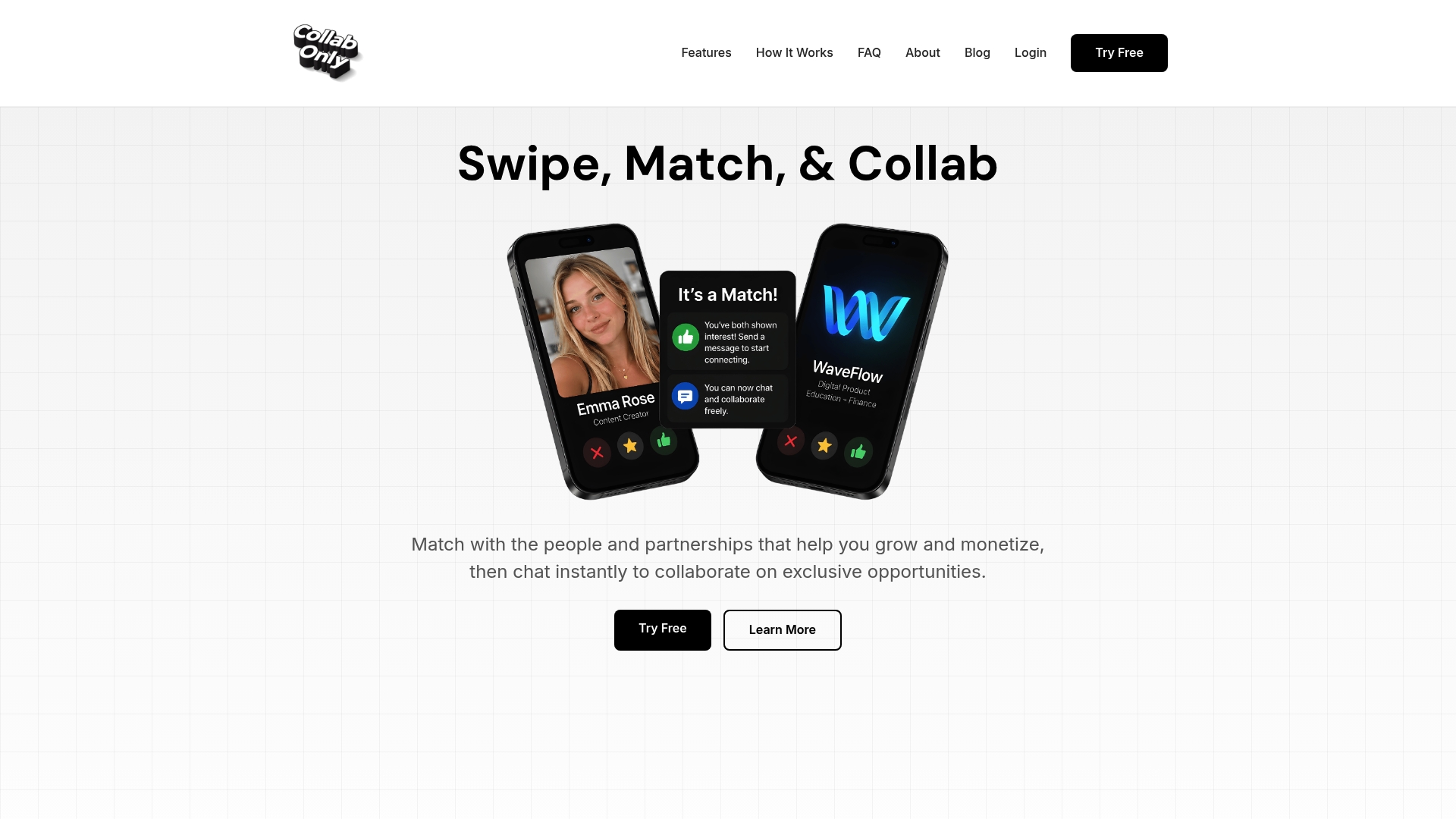
For brands running influencer campaigns, Collabonly provides a centralized space to identify, match, and communicate with creators without rebuilding existing workflows. Whether you are looking to hire nano influencers for geo-targeted campaigns or hire micro influencers for broader reach, the platform handles the outreach and matching layer so your team can focus on campaign strategy rather than logistics. Instant chat upon match removes the coordination friction that makes cross-platform influencer management slow and inconsistent.
FAQ
What is cross-platform collaboration in simple terms?
Cross-platform collaboration is the practice of connecting different software tools and teams so they can share data and communicate in real time, regardless of which platform each party uses. It eliminates the need for manual data transfers between systems like Slack, Jira, and Salesforce.
What are the most common cross-platform collaboration tools?
Slack, Microsoft Teams, Zoom, Jira, Salesforce, and ServiceNow are the most widely used tools, each serving distinct functions across communication, project management, and CRM. The best choice depends on your existing software stack and the depth of native integrations each tool offers.
How does cross-platform collaboration reduce costs?
Organizations using cross-platform integration report up to 64% cost savings by eliminating redundant manual processes and consolidating overlapping software subscriptions. The savings compound as automation replaces repetitive data entry across connected systems.
What is the biggest risk in cross-platform collaboration?
The most significant risk is governance failure, specifically the absence of clear data ownership rules and conflict resolution policies before systems are connected. Without governance, integrations create data inconsistencies that undermine trust in both the source and destination systems.
How does cross-platform collaboration support influencer marketing?
Cross-platform collaboration enables marketing teams to coordinate campaign data across CRM, project management, and social platforms simultaneously, reducing the manual reporting cycles that slow influencer campaign execution. Platforms like Collabonly extend this by centralizing creator discovery and communication across TikTok, Instagram, and YouTube in one interface.