

TL;DR:
- Using generic platforms like Slack for influencer marketing can hinder campaign coordination due to limited discovery and analytics features.
- Purpose-built tools such as Awin and Collab Only integrate creator discovery, payment, and tracking, improving operational efficiency and results.
Selecting the wrong collaboration platform costs brands more than time. It disrupts campaign momentum, creates communication gaps between marketing teams and creators, and leaves influencer relationships unstructured at precisely the moments when alignment matters most. With influencer marketing spending projected to exceed $32 billion globally in 2025, the tools brands choose to manage creator partnerships directly shape their return on investment and their ability to scale. This article evaluates the most relevant collaboration platforms available, establishes the criteria brands should apply when making a selection, and presents a side-by-side comparison to support a well-informed decision.
Table of Contents
- Key criteria for choosing a collaboration platform
- Slack: Channel-driven team communication
- Awin: Influencer marketing platform with campaign execution
- Collab Only: Marketplace for brand-creator matching
- Comparison of top collaboration platforms
- Our take: Why purpose-built platforms deliver more impact
- Connect with creators using Collab Only
- Frequently asked questions
Key Takeaways
| Point | Details |
|---|---|
| Platform selection matters | Choosing the right collaboration platform can significantly improve influencer campaign efficiency and results. |
| Specialized vs. general tools | Purpose-built platforms offer more for influencer partnerships than generic communication apps. |
| Compare core features | Brands should compare discovery, payment, campaign management, and tracking features when evaluating platforms. |
| Marketplace advantages | Marketplaces like Collab Only simplify matching, workflow automation, and payment management for both brands and creators. |
| Strategic use | Deploying the right platform empowers brands to build lasting creator partnerships and run more effective campaigns. |
Key criteria for choosing a collaboration platform
To make an informed choice, it is essential to clarify the most important selection criteria before comparing specific platforms. Not every platform is built with influencer partnerships in mind, and a tool optimized for internal team communication will perform differently from one designed around the creator discovery and campaign lifecycle.
The following criteria define what a high-functioning collaboration platform should offer brands operating in the influencer marketing space:
- Creator discovery and vetting: The platform should enable brands to search for creators based on audience demographics, content category, engagement rate, and channel presence across TikTok, Instagram, and YouTube.
- Campaign execution support: Brands need structured workflows for briefing creators, managing content approvals, and tracking deliverables from the initial outreach through final publication.
- Payment management: Transparent, flexible payment models reduce friction in creator relationships and ensure timely compensation tied to content milestones or performance benchmarks.
- Communication infrastructure: Whether channel-based or thread-based, the messaging architecture must support focused, organized conversations that do not get lost in general team noise.
- Full-funnel tracking and analytics: Attribution tools that measure clicks, conversions, and reach allow brands to calculate campaign ROI rather than relying on vanity metrics.
- Integration capability: The platform should connect with existing marketing stacks, including CRM tools, social listening platforms, and e-commerce dashboards.
Effective brand collaboration strategies consistently emphasize the need for structured communication infrastructure alongside discovery and payment tools. A platform that covers only one or two of these dimensions forces brands to stitch together multiple tools, which increases coordination costs and introduces error at handoff points.
As Slack notes regarding modern collaboration mechanics, platforms built around channel-based organization, threaded conversations, and integrated messaging and document collaboration provide teams with the structural clarity needed to coordinate complex work. This standard applies equally to influencer campaign management, where multiple stakeholders, including brand managers, creative directors, legal reviewers, and creators themselves, must coordinate under shared context.
Pro Tip: Before evaluating any platform, map out your current influencer workflow from discovery to payment. Identify the specific steps where communication breaks down or delays occur. This exercise will clarify which criteria matter most for your team's actual needs rather than theoretical feature lists.
Slack: Channel-driven team communication
Now that we have outlined core criteria, let us examine Slack as a widely used platform in digital marketing teams. Slack is not an influencer marketing platform in the purpose-built sense, but many brands use it as the communication backbone for campaigns involving multiple internal stakeholders and external creator partners.
Key features relevant to influencer campaign coordination include:
- Channels by campaign or creator: Teams can create dedicated channels for each influencer partnership, keeping conversations separated and searchable rather than buried in a general thread.
- Threaded replies: Threads allow teams to respond to specific messages without interrupting the main channel feed, which is particularly useful when reviewing creative briefs or content drafts from multiple creators simultaneously.
- Document and file sharing: Content assets, brand guidelines, contracts, and campaign briefs can be shared directly within channels, reducing the dependency on external file storage systems.
- Integrations with project management tools: Slack connects with platforms like Asana, Notion, and Google Drive, allowing teams to receive task updates and deadline reminders without leaving the communication environment.
"Slack provides collaboration mechanics centered on channel-based organization, threaded conversations, and integrated messaging, document, and file collaboration for teams coordinating work." Slack Blog
Where Slack falls short in influencer marketing contexts is in the absence of creator discovery, payment processing, and campaign analytics. It functions as a communication layer, not a partnership management system. Brands that use Slack for influencer coordination must supplement it with additional tools for creator sourcing, contract management, and performance tracking, which increases operational complexity.
Understanding the structured influencer collaboration steps required to run a successful campaign makes clear why Slack alone is insufficient for brands managing more than a handful of creator relationships at a time. The platform excels at keeping internal teams aligned but lacks the outward-facing infrastructure that creator partnerships require.
Awin: Influencer marketing platform with campaign execution
While Slack serves general team communication, platforms like Awin directly address the influencer collaboration process from creator discovery through to post-campaign measurement. Awin operates as a performance marketing network with dedicated influencer partnership tools layered on top of its affiliate infrastructure.
Features that distinguish Awin in the influencer marketing space include:
- Creator discovery tools: Brands can search Awin's publisher network to identify content creators whose audience demographics and content categories align with campaign objectives, reducing the time spent on manual outreach.
- Integrated payment and commission management: Awin supports multiple payment models, including flat fees, cost-per-action structures, and revenue-share arrangements, giving brands the flexibility to align compensation with campaign goals.
- Full-funnel measurement: Awin tracks performance from awareness-level content through to conversion events, enabling brands to calculate attributable ROI on each creator partnership rather than relying solely on reach or impression metrics.
- Campaign workflow tools: Brands can manage briefs, track deliverables, and monitor content performance within the platform, consolidating the operational work of campaign execution.
As Awin outlines, the platform supports influencer partnerships by enabling brands to discover creators, execute influencer campaigns, offer flexible creator payment models, and track full-funnel success. This positions Awin as a materially more complete solution than general communication tools for brands whose primary objective is measurable creator-driven growth.
Pro Tip: When using affiliate-based influencer platforms, negotiate performance thresholds upfront. Define what a qualifying conversion looks like, whether a purchase, a sign-up, or an app install, before the campaign launches. Ambiguity in attribution criteria is one of the most common sources of post-campaign disputes between brands and creators.

For creators exploring finding brand deals through performance networks, Awin provides a structured pathway to connect with brand advertisers without relying on unsolicited outreach. The platform's network effect also means that brands reviewing brand partnership examples can benchmark their own collaboration structures against established advertiser-publisher relationships already operating on the network.
Awin's primary limitation is its affiliate network heritage. The platform's creator ecosystem skews toward performance-focused publishers and bloggers rather than short-form video creators on TikTok or Instagram, which may limit its reach for brands targeting younger consumer demographics through social-first campaigns.
Collab Only: Marketplace for brand-creator matching
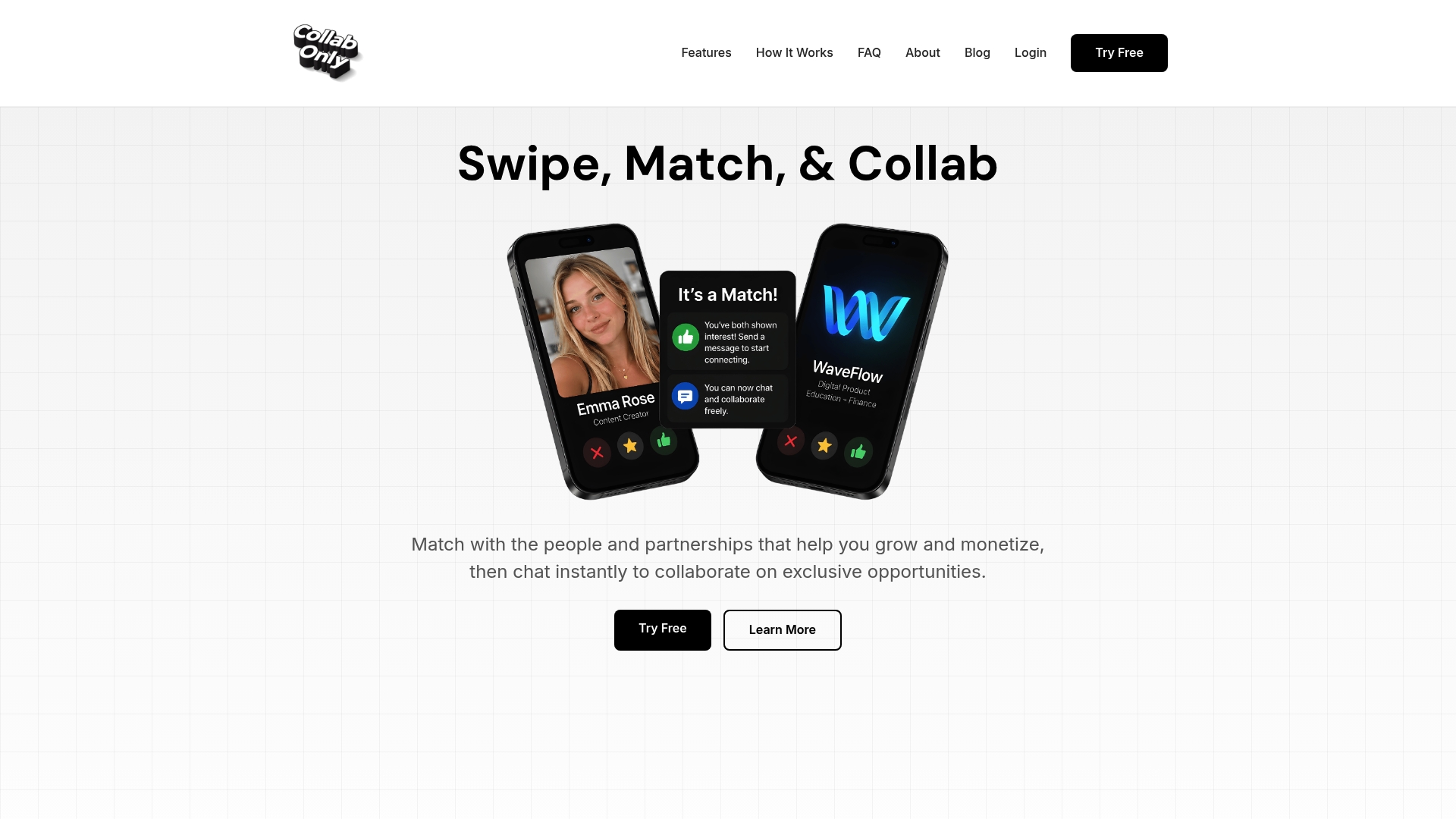
For brands looking for an all-in-one approach, dedicated marketplaces like Collab Only streamline every phase of the partnership, from initial discovery through content delivery and payment. Collab Only is purpose-built for the brand-creator economy and operates through a swipe-based matching interface that removes the friction of cold outreach and unanswered DMs.
Core features of the Collab Only platform include:
- Swipe-based brand-creator matching: Brands and creators indicate mutual interest through a matching mechanism, ensuring that every conversation starts from a position of aligned intent rather than unsolicited contact.
- Instant chat on match: Once a match is confirmed, both parties gain immediate access to a direct messaging channel, eliminating the delays associated with email outreach or platform DMs that go unread.
- Support for nano and micro influencer discovery: The platform makes it structurally simple for brands to identify smaller creators whose audiences may deliver higher engagement rates and more targeted reach than macro-level influencers.
- Cross-platform creator coverage: Collab Only spans TikTok, Instagram, and YouTube, giving brands access to creators across the channels most relevant to modern digital marketing campaigns.
| Feature | Slack | Awin | Collab Only |
|---|---|---|---|
| Creator discovery | No | Yes | Yes |
| Campaign workflow | Partial | Yes | Yes |
| Payment management | No | Yes | Yes |
| Instant creator messaging | No | Limited | Yes |
| Swipe-based matching | No | No | Yes |
| Nano/micro influencer focus | No | Partial | Yes |
| TikTok/Instagram/YouTube coverage | No | Partial | Yes |
The marketplace model Collab Only uses reflects a structural shift in how brands approach advocacy-driven partnerships. Rather than sourcing creators through talent agencies or manual database searches, the matching system creates a self-organizing discovery layer where brand objectives and creator profiles are assessed for compatibility before any communication begins.
For brands building a partnership marketing strategies framework that accounts for scale, Collab Only's model reduces the per-partnership operational overhead significantly. The time saved on discovery and initial outreach alone can be redirected toward creative strategy and campaign optimization.
Comparison of top collaboration platforms
To bring clarity to the decision process, here is a concise side-by-side comparison of the top collaboration platforms reviewed in this article.
| Evaluation dimension | Slack | Awin | Collab Only |
|---|---|---|---|
| Primary use case | Team communication | Affiliate and influencer marketing | Brand-creator matchmaking |
| Creator discovery | Not supported | Network-based search | Swipe-based matching |
| Campaign execution | Partial (via integrations) | Full workflow management | Full workflow management |
| Payment tools | Not supported | Flexible commission models | Transparent payment system |
| Analytics and tracking | Limited (via integrations) | Full-funnel attribution | Campaign performance tracking |
| Social platform focus | Platform-agnostic | Affiliate-oriented | TikTok, Instagram, YouTube |
| Best suited for | Internal team coordination | Performance-focused influencer campaigns | End-to-end brand-creator partnerships |
Three situational recommendations emerge from this comparison:
- Use Slack when your primary need is coordinating a large internal marketing team across multiple campaigns, and you already have dedicated influencer discovery and payment tools in place.
- Use Awin when your influencer strategy is performance-driven, you require robust affiliate tracking, and your creator mix includes publishers, bloggers, and content sites alongside social media influencers.
- Use Collab Only when you want a single platform to handle creator discovery, matching, communication, and campaign management, particularly if your strategy centers on nano and micro influencers across TikTok, Instagram, and YouTube.
Research on creator communities for ROI consistently shows that brands achieving sustainable influencer program performance are those investing in purpose-built infrastructure rather than adapting generic communication or affiliate tools to fit creator relationship management. The platform architecture shapes the relationship quality as much as the individual creators selected.
As Slack documents, channel-based conversations and integrated messaging provide structural communication clarity, but this architecture is designed for internal teams rather than external creator partnerships. Equally, Awin positions its offering around creator discovery, campaign execution, flexible payment models, and full-funnel tracking, which addresses the operational core of influencer marketing while remaining rooted in affiliate network logic.
Our take: Why purpose-built platforms deliver more impact
After analyzing these platforms, the clearest pattern that emerges is the gap between tools adapted for influencer marketing and tools built specifically for it. That distinction matters more than most brand strategists initially recognize.
Generic communication platforms like Slack solve a real problem for marketing teams, but they were designed to coordinate employees, not to facilitate commercial partnerships between brands and independent creators. When brands attempt to manage creator relationships through internal team tools, they introduce structural misalignments: creators do not belong in company Slack workspaces in the same way employees do, and the communication norms of a team chat channel do not map cleanly onto the negotiation and briefing dynamics of a brand-creator deal.
The role that social media platforms play in brand growth has shifted the influencer marketing function from a peripheral tactic to a primary channel in many brand budgets. Yet the tooling many brands use to manage that channel has not kept pace. A significant number of marketing teams still route creator communications through personal email inboxes, shared spreadsheets, and general team messaging channels, none of which provide the visibility, accountability, or workflow structure that the modern influencer partnership lifecycle demands.
Purpose-built platforms succeed precisely because they encode the specific logic of creator relationships into their architecture. Matching systems that assess brand-creator alignment before conversation begins. Payment frameworks that connect compensation to deliverables. Analytics that attribute outcomes to specific creator activations rather than general campaign periods. These are not features that can be replicated through integrations or workarounds in a general communication tool.
The brands that consistently outperform their competitors in influencer marketing are not necessarily the ones with the largest creator budgets. They are the ones with the tightest operational infrastructure around creator discovery, briefing, communication, and measurement. Platform selection is one of the highest-leverage decisions in building that infrastructure.
Connect with creators using Collab Only
Ready to apply the insights from this guide? Collab Only provides brands with the matching infrastructure, campaign tools, and creator access needed to move from platform evaluation to active partnership execution without unnecessary friction.
Whether you are building your first influencer program or scaling an existing one, Collab Only's UGC creator platform connects your brand with content creators whose audience profiles and content styles align with your campaign objectives. For brands prioritizing high-engagement, cost-efficient campaigns, the nano influencer marketing tools on Collab Only provide structured access to a creator segment that consistently outperforms macro influencers on audience trust metrics. Start your first match today and convert strategy into measurable creator-driven results.
Frequently asked questions
What features should a collaboration platform have for influencer partnerships?
The best platforms offer creator discovery, campaign management, secure payments, and tracking for full-funnel results. As Awin confirms, supporting influencer partnerships requires tools that enable creator discovery, campaign execution, flexible payment models, and full-funnel success measurement.
Why is channel-based organization important for collaboration?
Channel-based structure keeps conversations focused and organized so teams can manage campaigns more efficiently without losing critical context. Slack's analysis of messaging platforms confirms that channel-based organization, threaded conversations, and integrated document collaboration form the foundation of effective team coordination.
How do payment models differ across influencer platforms?
Platforms like Awin offer flexible payment models so brands can match compensation to campaign goals and creator needs, whether through flat fees, cost-per-action, or revenue share. Awin's platform positions its offering around flexible creator payment models alongside discovery, campaign execution, and full-funnel tracking.
What is the main advantage of collaboration marketplaces like Collab Only?
They streamline brand-creator matching, automate campaign workflows, and provide transparent influencer payments, consolidating the entire partnership lifecycle into a single operational environment rather than requiring brands to manage multiple disconnected tools.