

AI influencer discovery uses natural-language search and content analytics to surface creators who match a campaign brief, replacing manual scrolling with ranked shortlists built around audience fit and performance data. The main benefit is speed paired with precision: instead of a researcher spending days cross-referencing follower counts, the system scores authenticity, audience overlap, and engagement quality against KPIs like conversion rate and ROAS. Platforms including Collab Only apply this logic to matching rather than search alone.
TL;DR:
- AI influencer discovery tools can generate highly precise shortlists by analyzing authenticity, engagement quality, and audience overlap to reduce vetting time from days to hours.
- Most platforms combine natural-language search with audience and content analysis, but authentication scoring and database freshness remain key limitations for emerging creators.
- Choosing a tool should focus on integration, transparency of authenticity metrics, and alignment with business KPIs like conversion rate and ROAS, rather than just feature sets.
- Running a small, KPI-specific pilot campaign with a clear success threshold helps validate platform effectiveness before large-scale investment.
- Some platforms improve workflow by offering direct match-and-chat interfaces, removing the slow process of exporting lists and cold outreach when working with smaller or niche creators.
Table of Contents
- What Modern AI Influencer Discovery Tools Actually Do
- How Does AI Evaluate and Rank Creators?
- How Do You Choose the Right AI Discovery Approach?
- How Do You Integrate AI Discovery Into a Campaign Workflow?
- Why Collab Only Fits Into a Modern Discovery Workflow
- What Are the Privacy and Ethics Concerns With AI Discovery?
- What Do Successful AI-Driven Influencer Campaigns Look Like?
- What Marketers Consistently Get Wrong About AI Shortlists
- Find Your Next Creator Match Without the Cold Outreach Grind
- Sources
- FAQ
What Modern AI Influencer Discovery Tools Actually Do
Most platforms marketed under this category perform three linked jobs: discovery, vetting, and contact enrichment. Understanding where one ends and the next begins helps you separate genuine capability from marketing copy.
Discovery is the search layer. Vendors typically maintain cross-platform databases spanning TikTok, Instagram, and YouTube, and many advertise natural-language query support, so a brand manager can type something like "mid-size food creators in the Pacific Northwest with a home-cooking focus" instead of building a filter stack manually. This intent-based search is one of the clearer improvements AI brings over legacy directories, which relied on rigid category tags that rarely matched how brands actually think about fit.
Vetting is where the real differentiation happens. A capable tool scores authenticity and fraud risk, flags suspicious follower growth patterns, and estimates audience overlap with your target demographic. Vendor product pages commonly promote large creator databases, cross-platform coverage, and enriched contact data as core features, and that pattern holds across most tools in the category.
Contact enrichment closes the loop by pulling verified email addresses, agency contacts, or platform-specific messaging details into export formats your team can push into a CRM or spreadsheet.
Expect the following feature set from a serious AI influencer discovery tool:
- Cross-platform search covering at minimum Instagram, TikTok, and YouTube, with database sizes vendors typically cite in the hundreds of thousands or millions of profiles.
- Natural-language and intent-based search, letting you describe a campaign brief instead of stacking Boolean filters.
- Audience demographic and interest filters, including age bands, geography, and topic affinity.
- Authenticity and fraud detection scoring, usually expressed as a composite score or percentage.
- Engagement-quality metrics that separate genuine interaction from bot activity or engagement pods.
- Match or brand-fit scoring that ranks creators against your specific brief rather than generic popularity.
- Contact enrichment and export options, typically CSV or CRM-ready formats for outreach teams.
The gap between tools that check every box and tools that check most of them shows up fast once you run a real brief. A platform that nails discovery scale but skips authenticity scoring will hand you a long list you still have to manually vet, which erases the time savings that justified the tool in the first place. Reported case examples suggest AI discovery workflows can cut manual search and vetting time from days to hours, but that gain only materializes when the vetting layer is genuinely automated, not just search.
How Does AI Evaluate and Rank Creators?
Behind the search bar, most platforms run a pipeline that converts a plain-English brief into a set of structured filters, then scores every matching profile against those filters. Natural-language parsing extracts the intent (niche, geography, tone, audience size) and maps it to database fields; this is the step that lets a marketer skip manual tag-hunting.
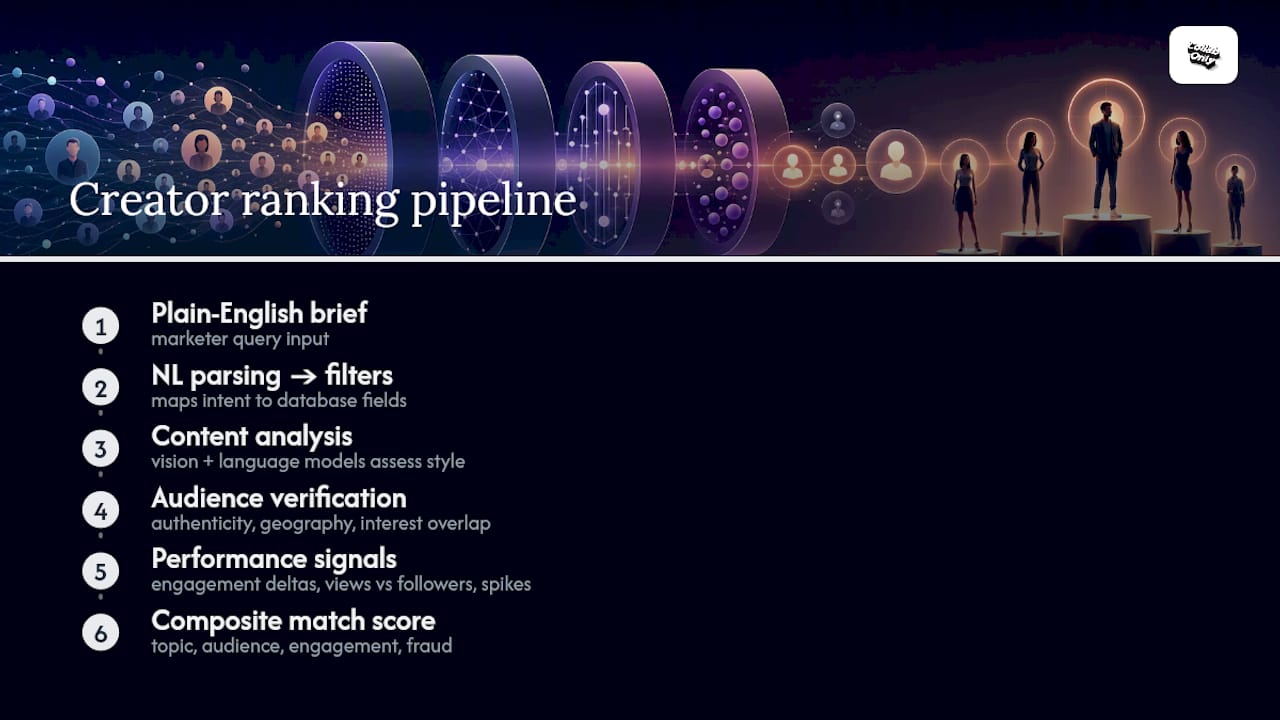
Content analysis handles the qualitative side. Computer vision models assess a creator's visual style, color palette, and production quality, while language models parse captions and video transcripts for topic focus and tone. This is how a tool distinguishes a creator who genuinely reviews skincare products from one who posted a single sponsored mention three years ago and never returned to the category.
Audience verification is the layer that protects you from vanity metrics. The system samples a creator's follower base for authenticity signals, geographic distribution, and interest overlap with your buyer persona. Because authenticity now drives influencer performance more than raw reach, tools that skip this step and rank purely on follower count tend to surface creators who look impressive on paper and underperform on conversion.
Performance signals round out the scoring: engagement-rate deltas over time, average view counts relative to follower size, and trend detection that flags creators experiencing a recent growth spike (often a sign of a viral moment worth capitalizing on quickly).
Match scores themselves are usually composite numbers. A single score can blend content-topic fit, audience overlap, engagement velocity, and fraud probability into one figure, which is convenient but also opaque if you cannot see the components underneath it.
Pro Tip: Ask any vendor to show you the individual components behind a match score, not just the final number. A 92% match built mostly on audience overlap tells a very different story than one built mostly on engagement velocity, and you want to know which lever moved the needle.
Two limitations recur across the category. First, databases lag reality; a creator who pivoted niches six months ago may still be tagged under their old category. Second, engagement-quality models struggle with emerging creators who have thin historical data, which is exactly where social listening tools fill the gap, since roughly 60% of organizations working with influencers already use social listening to catch niche talent before it shows up in mainstream databases.
How Do You Choose the Right AI Discovery Approach?
Choosing a tool starts with the metric you're actually trying to move, not the feature list on a pricing page. Industry guidance for 2026 recommends anchoring influencer measurement to outcome KPIs like conversion rate, ROAS, and cost per acquisition, rather than follower count or reach. If your platform selection doesn't tie back to one of those numbers, you're optimizing for a vanity metric that AI happens to make easier to collect.
Statistic Callout: Marketing teams are told to shift 2026 influencer measurement away from vanity metrics toward business-outcome KPIs, using AI specifically to track ROAS, conversion rate, and CAC rather than follower growth. Source
Run any platform, including your current shortlist candidates, through this checklist before committing budget:
- Audience fit precision. Does the tool show overlap percentage with your actual buyer persona, or just broad demographic buckets?
- Authenticity scoring transparency. Can you see the components of a fraud or authenticity score, or is it a single unexplained number?
- Integration and API availability. Does it connect to your CRM, ad platform, or reporting stack, or does it require manual export every time?
- Pricing model clarity. Is the subscription tiered by search volume, seat count, or creator database access, and does it include pricing-estimate guidance for negotiating creator rates?
- Data freshness. How often is the creator database refreshed, and does it flag stale profiles?
- Support and onboarding. Is there a human you can reach when a match score looks wrong, or is it self-serve only?
Smart questions to put directly to a vendor include: "What data sources feed your authenticity score, and how often are they refreshed?" and "Can I export a sample match distribution before I commit to a paid tier?" A vendor who can't answer either question in specifics is a red flag worth taking seriously.
The lowest-risk way to validate any of this is a short pilot rather than an annual contract. Expert guidance favors pairing AI discovery with a small paid test and measurable KPIs over a large upfront commitment. A workable pilot recipe: write a one-page brief defining audience and tone, generate a shortlist of 15 to 20 creators, run a paid test with three to five of them, and set a two to four week measurement window with a predefined success threshold (a specific conversion rate or CAC target, not "see how it goes"). If the platform can't produce a usable shortlist within that structure, it isn't ready for a larger commitment. For a deeper look at structuring the brief itself, a practical guide to matching creators and brands walks through the criteria that make a brief specific enough for AI tools to act on.
How Do You Integrate AI Discovery Into a Campaign Workflow?
Discovery only pays off when it's built into a repeatable sequence, not treated as a one-off search session. Using an AI Content Marketing Platform | Scale Marketing with Artificial Intelligence can help integrate these discovery feeds seamlessly into content and measurement workflows.
- Write an intent-driven brief first. Specify audience demographics, content tone, platform priority, and the business KPI you're targeting before opening any tool.
- Run AI queries and build a shortlist. Use natural-language search to generate an initial pool, then apply demographic and authenticity filters to cut it to a manageable size, typically 20 to 30 names.
- Vet manually before outreach. Spot-check five to ten posts per creator, sample their audience comments for authenticity, and confirm the AI's topic-fit assessment matches what you see with your own eyes.
- Send outreach with pricing context. Use the platform's fair-price estimates as a negotiation anchor, and reference specific content the creator has posted, not a generic pitch. Guidance on engaging creators for brand partnerships covers message structure that gets response rates up.
- Measure and feed results back. Track which shortlisted creators actually converted, and use that data to refine your brief and filters for the next cycle.
This loop is what separates teams that treat AI discovery as a search engine from teams that treat it as a system. The second group gets faster with every campaign; the first group re-learns the same lessons every quarter.
Why Collab Only Fits Into a Modern Discovery Workflow
Some platforms approach discovery as a matching problem rather than a search problem. Instead of returning a static list you then have to chase over email, they may use a swipe-based interface that surfaces creators aligned with your brief, and open instant chat at match, which removes the slow back-and-forth of cold outreach and DMs that go unanswered.
The practical benefits stack up quickly:
- Faster shortlists can result from matching through mutual interest rather than one-sided prospecting.
- Reduced outreach friction can occur when a match unlocks direct chat instead of a cold email queue.
- Multi-platform support often includes TikTok, Instagram, and YouTube, so a search may cover where your audience is active.
The article publisher describes a platform here.
What Are the Privacy and Ethics Concerns With AI Discovery?
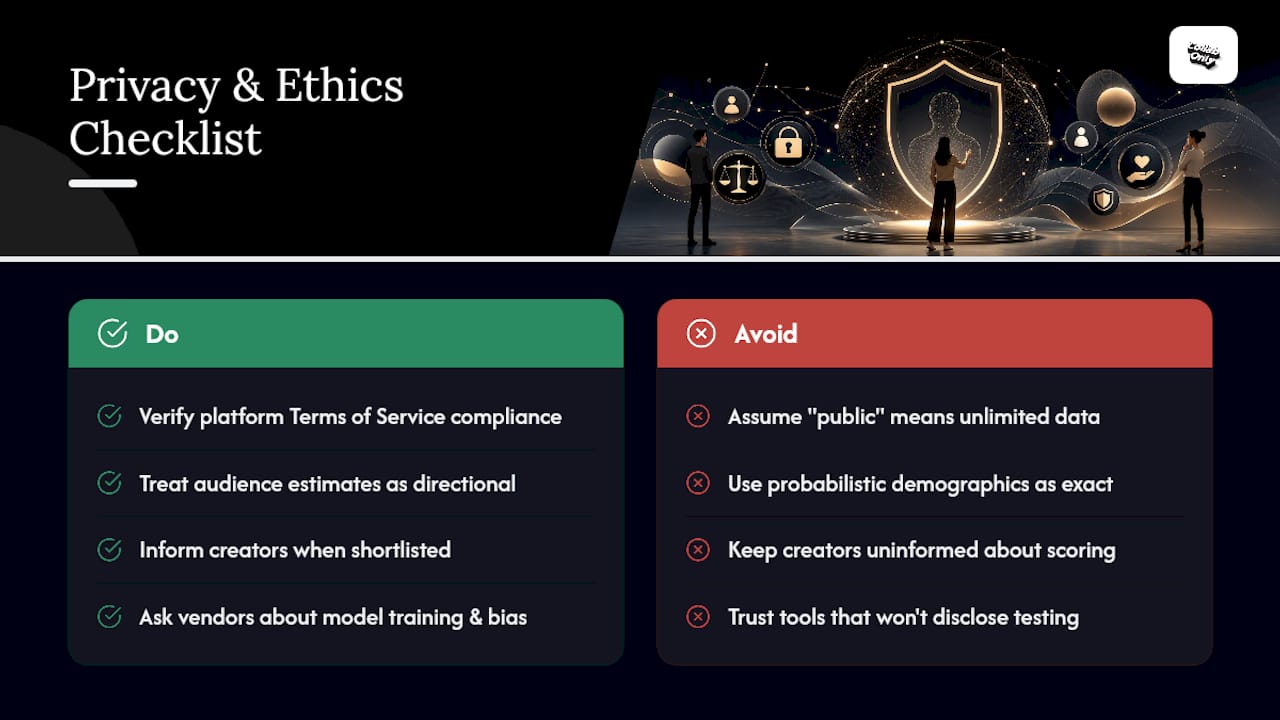
Scraping and analyzing creator content at scale raises real questions that marketing teams should not skip past. Most AI discovery tools pull data from public profiles, but "public" doesn't mean unlimited. Platform terms of service govern how much data a third-party tool can extract and store, and violations can put both the vendor and the brand using it at legal risk depending on jurisdiction.
Audience data adds another layer of sensitivity. Estimating a creator's follower demographics often relies on modeling rather than confirmed data, which means brands are making targeting decisions based on probabilistic guesses about real people's age, location, or interests. Treat these estimates as directional, not exact, especially for campaigns targeting sensitive categories like health or finance.
Consent matters on the creator side too. A creator whose content gets algorithmically scored, ranked, and shared with a brand they've never interacted with may not know their profile is being evaluated this way. Ethical practice suggests informing creators when they've been shortlisted through automated discovery, rather than treating the process as invisible.
Bias in training data is a quieter risk. If a tool's authenticity or engagement models were trained predominantly on creators from a narrow demographic or platform history, they may systematically undervalue creators outside that pattern, including emerging voices in underrepresented niches. Ask vendors directly how their models were trained and whether they've tested for demographic skew in match scoring. A tool that can't answer that question hasn't tested for it.
What Do Successful AI-Driven Influencer Campaigns Look Like?
The clearest industry signal of AI discovery's real-world traction comes from agency-side adoption rather than isolated brand experiments. Reporting on agency workflows describes teams using AI agent systems to suggest creators based on trend data and profile factors, a shift that signals AI-assisted casting is moving from experimental to standard practice at scale, not just a novelty a handful of brands tried once.
What makes these workflows work is the combination, not the AI alone. Agencies running AI-assisted casting still layer manual review on top of automated suggestions, treating the algorithm as a fast first pass rather than a final decision-maker. That pattern shows up consistently: AI compresses the search phase from days to hours, and humans still make the final call on brand fit and creative direction.
A useful pattern for any brand piloting this approach: run the AI shortlist against a live campaign with a defined KPI (conversion rate or CAC), keep the test small (three to five creators), and compare results against your historical baseline from manual sourcing. The campaigns that report the strongest lift tend to be the ones where the brief was written with the outcome KPI defined upfront, not added as an afterthought during reporting.
What Marketers Consistently Get Wrong About AI Shortlists
AI shortlists are reliable enough to trust for volume decisions, like narrowing 500 candidates to 30, but they still need a human pass before money moves. Treat the algorithm as a fast filter, not a final judge. When speed matters more than certainty, trust the shortlist; when budget size matters more, verify it yourself.
— Samuel
Find Your Next Creator Match Without the Cold Outreach Grind
If the workflow above sounds right but building a full search-and-vet pipeline feels like more infrastructure than your team needs, some platforms skip straight to the matching step. Instead of exporting a shortlist and then chasing creators through email, users swipe through profiles built for mutual fit, and a match opens instant chat immediately, no waiting on a reply that never comes.
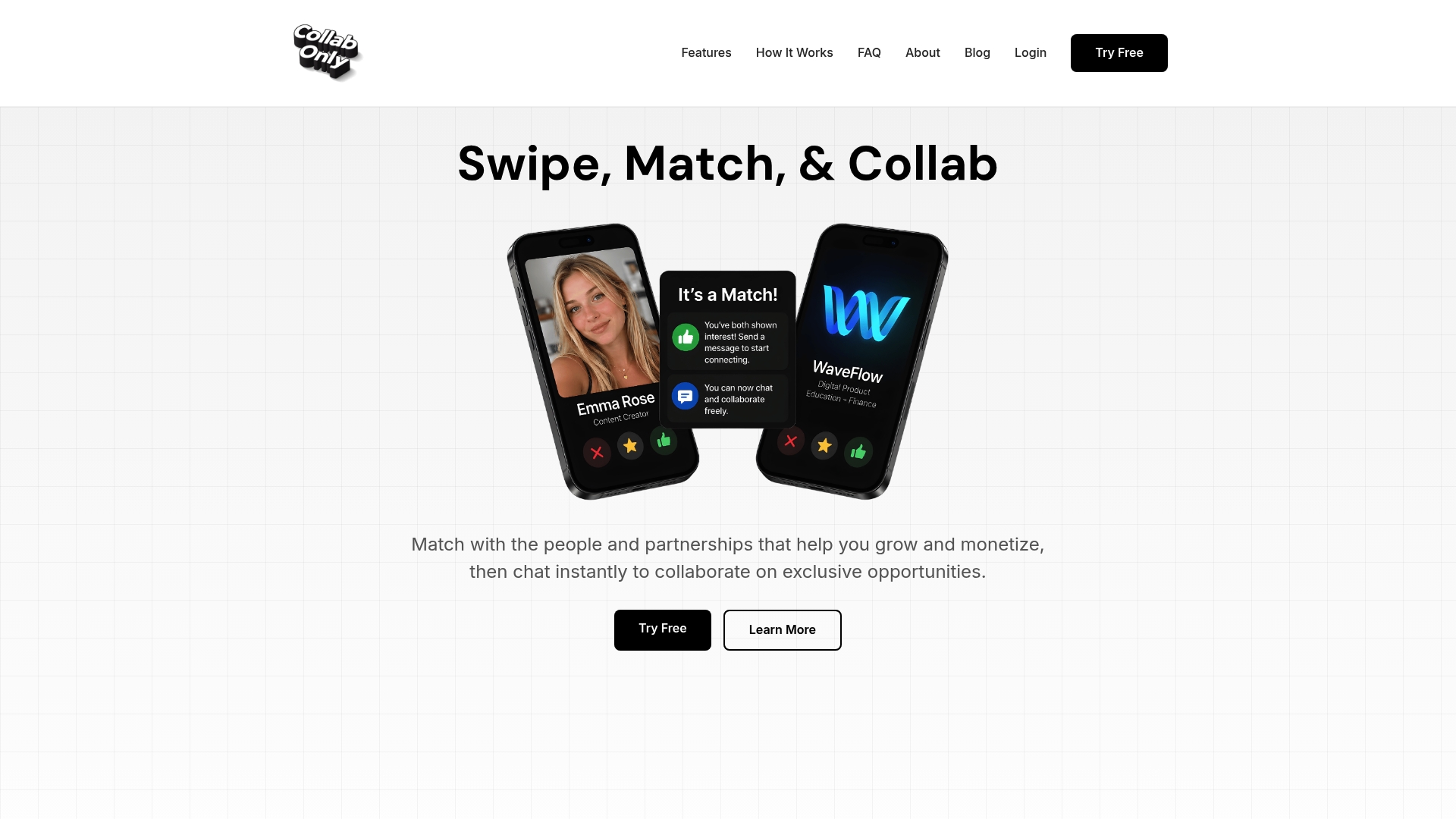
For brands running smaller budgets or testing a new niche, the nano-influencer hire page is built specifically for finding creators with smaller, highly engaged audiences at rates that make a pilot campaign realistic. Set up a profile, define your campaign brief, and start swiping through creators who match on audience and content style. If nano influencers aren't your current focus, the main platform covers the same swipe-and-chat matching across broader creator tiers.
Sources
FAQ
What Is AI Influencer Discovery?
AI influencer discovery is the use of natural-language search, content analysis, and audience modeling to identify and rank creators who match a specific campaign brief, replacing manual research with data-driven shortlists.
How Accurate Are Authenticity Scores From AI Tools?
Authenticity scores are composite estimates built from engagement patterns, follower growth history, and audience quality signals; they're a strong first filter but should be paired with a manual spot check before you commit budget.
Can AI Discovery Tools Replace Manual Vetting Entirely?
No. AI tools compress the search and initial screening phase from days to hours, but manual review of content quality, brand tone, and creator responsiveness still catches issues automated scoring misses.
What KPIs Should I Use to Judge a Discovery Platform?
Anchor your evaluation to business-outcome metrics like conversion rate, ROAS, and cost per acquisition rather than follower count or reach, since those are the metrics 2026 industry guidance recommends tracking.