

Disclosure is required whenever a material connection exists between a creator and a brand, whether that connection is payment, free product, an affiliate commission, or a family tie. The disclosure must be clear and conspicuous: visible or audible within the content itself, in the same language as the endorsement, and impossible to miss on a scroll or a swipe. Skipping it, burying it, or relying on a platform tag alone exposes both the creator and the advertiser to FTC enforcement under Section 5 of the FTC Act.
TL;DR:
- Creators must disclose any material connection, including free products, discounts, family ties, or affiliate links, whenever a significant minority of the audience would be surprised to learn about it.
- Disclosures must be clear and placed inside the content, using plain language like "ad," "paid partnership," or spoken explicitly at normal volume and pace.
- Platform tools like Instagram's paid partnership tag are helpful but not sufficient; disclosures should be added directly into captions, on-screen text, or spoken words for full compliance.
- For affiliate links and referral codes, disclosures must be placed close to the link itself and repeated for each separate post or platform, not only in bios or blanket statements.
- Brands and creators should embed disclosure instructions into content workflows and contracts before publishing, ensuring proof and monitoring to prevent unintentional violations.
Table of Contents
- What Counts as a Material Connection Under FTC Disclosure Rules
- What "Clear and Conspicuous" Actually Means
- How to Disclose on Instagram, TikTok, YouTube, and Live Streams
- Affiliate Links and Referral Codes Are Material Connections Too
- Enforcement Risk and Who Actually Gets Penalized
- A Step-by-Step Compliance Checklist for Creators and Brands
- Templates and Tools Collab Only Provides for Compliant Campaigns
- Historical Context and Evolution of FTC Disclosure Rules
- FTC Rules Versus FCC Regulations and State Advertising Laws
- Common Myths About FTC Disclosure Rules
- Disclosure Rules for Podcasts, Virtual Influencers, and Emerging Platforms
- Product Placements, Unboxings, and Other Non-Traditional Formats
- Handling Disclosures in Collaborations and Co-Created Content
- Why the Real Compliance Gap Isn't Knowledge, It's Follow-Through
- Sources
- FAQ
What Counts as a Material Connection Under FTC Disclosure Rules
A material connection is any relationship between an endorser and a brand that could affect how much weight a consumer gives to that endorsement. The FTC's guidance on influencer disclosures defines it broadly on purpose: cash payment is the obvious case, but it is far from the only one.
The list of arrangements that qualify includes:
- Direct payment or a flat sponsorship fee for a post, video, or mention
- Free or discounted products, services, or experiences (including press trips)
- Employment, an ownership stake, or a formal brand ambassador role
- Affiliate commissions, referral codes, or revenue-share arrangements
- Family or personal relationships with someone at the company
- Early access to a product, exclusive previews, or "gifted" items sent unsolicited but kept and featured
The legal test is not whether the creator thinks the connection matters. It's whether a "significant minority" of the audience would be surprised to learn about it. That standard, drawn directly from FTC guidance, is deliberately conservative. It doesn't ask whether most viewers already assume every post is sponsored. It asks whether even a meaningful slice of them would feel misled if they learned the truth.
Consider a skincare creator who receives a serum for free, tries it for three weeks, and posts a glowing review without mentioning the gift. Even if the review is completely honest, the omission is the violation. The audience has no way to weigh the incentive behind the praise. The same logic applies to a fitness influencer promoting an app through a referral link that pays them per signup, or a parenting account run by someone whose spouse works in product development at the brand being featured.
Family relationships trip up more creators than people expect. If you're reviewing your sibling's company's product, or your partner works in marketing for a brand you're featuring, that counts, even if no money changed hands. The material connection standard covers influence, not just income.
What "Clear and Conspicuous" Actually Means
The FTC updated its official standard in 2023, and the language is worth quoting directly because it replaces vague intuition with a concrete test. The 2023 Endorsement Guides define "clear and conspicuous" as difficult to miss, easily understandable by ordinary consumers, and delivered in the same language as the endorsement itself.
That definition breaks down into channel-specific attributes:
- Visual content: the disclosure text must be large enough to read, contrast against the background, sit in a location viewers actually look at, and stay on screen long enough to be read at normal scroll speed.
- Audio content: the disclosure must be spoken at a normal volume and pace, not rushed or mumbled at the end of a clip.
- Interactive and online media: the disclosure should be unavoidable, not something a viewer has to click "more," expand a caption, or scroll past a wall of hashtags to find.
Pro Tip: If a viewer watching with the sound off would miss your disclosure entirely, it doesn't meet the standard. The safest approach layers disclosure into both the visual and audio track, since some viewers scroll silently and others listen without watching.
The Guides intentionally avoid rigid formatting rules like "must be 12-point font" or "must appear in the first three seconds." Instead, the standard is performance-based: does the actual net impression left on an ordinary consumer communicate the connection? That flexibility cuts both ways. It gives creators room to disclose in a way that fits their format, but it also means a disclosure technically present but functionally invisible, gray text on a white background, disclosure spoken over loud music, still fails.
FTC guidance on Dot Com Disclosures adds a specific warning about hyperlinks. A disclosure buried behind a link, or placed only in a bio, is often insufficient because the claim it qualifies appears immediately in the content while the disclosure requires an extra step to find. The agency's own research-backed approach recommends creators test their disclosures the way a real viewer would encounter them: watch the post without sound, scroll past it at normal speed, or view it on a small phone screen, and ask whether the connection is still obvious.
How to Disclose on Instagram, TikTok, YouTube, and Live Streams
Every platform has its own rhythm, and a disclosure that works on YouTube can fail completely on TikTok. Here's how to adapt the same underlying standard, clear and conspicuous, to the format your audience actually consumes.
- Instagram. Use the platform's "Paid partnership" tag, but never rely on it alone. FTC guidance on endorsements and influencer reviews makes clear that platform tools are a supplement, not a substitute, because that label isn't visible in every viewing context. Add "Ad" or "Paid partnership with [Brand]" directly in the caption's first line, or superimpose it as on-image text that stays visible for the full duration of a Reel or Story.
- TikTok. Put on-screen text disclosing the relationship within the first few seconds, and say it out loud as well. TikTok's built-in branded content toggle helps, but a spoken "this video is sponsored by" line covers viewers who watch with captions off and sound on, or vice versa.
- YouTube. Disclose verbally, on camera, near the start of the video, and repeat the disclosure in the video description. A pinned comment alone doesn't meet the standard since many viewers never open the comment section at all.
- Twitter/X. Lead with plain language like "Ad:" or "#ad" at the start of the tweet, not buried after a string of unrelated hashtags or tacked onto the end of a long thread.
- Live streams and Stories. Repeat the disclosure periodically throughout the stream, not just once at the start, since viewers join and leave at different times. For Stories, make sure the text disclosure stays on screen long enough for a normal viewer to actually read it before swiping.
Brands running Instagram partnership ad campaigns should build disclosure placement into the creative brief before content is even filmed, rather than asking creators to retrofit it after the fact. The same applies to brands sourcing YouTube product review partnerships: specify exactly where the spoken disclosure and description notice need to appear.
Affiliate Links and Referral Codes Are Material Connections Too
Affiliate marketing runs on commission, and commission is exactly the kind of financial incentive that influencer marketing unveiled rules were built to surface. Every affiliate link, referral code, or "use my code for 10% off" arrangement creates a material connection that needs disclosure, regardless of whether the creator was paid up front or only earns money if someone clicks through and buys.
The disclosure needs to sit near the link itself, not just somewhere on the page. A single blanket disclosure on a blog's "About" page or a creator's Linktree bio usually isn't enough if the affiliate link appears in a completely different post with no reminder attached.
Some situations do allow a lighter touch:
- A single, clearly labeled disclosure at the top of a long product roundup post can cover multiple affiliate links throughout that same post, as long as it's impossible to miss before reaching the first link.
- A recurring disclosure is required when affiliate links appear across separate posts, videos, or platforms, since a reader landing on one piece of content has no way of seeing a disclosure made somewhere else entirely.
- Short-form content (a single tweet, a TikTok caption) generally needs its own inline disclosure every time, since there's no persistent "top of page" for a viewer to have already scrolled past.
Workable phrasing includes "This post contains affiliate links, which means I earn a commission if you purchase through them," or shorter inline text like "Affiliate link" placed directly next to the URL. A fitness app affiliate brief template is a useful reference for how brands can pre-write this language into the content requirements before a campaign launches, rather than leaving wording to chance.
Enforcement Risk and Who Actually Gets Penalized
Section 5 of the FTC Act prohibits unfair or deceptive acts in commerce, and undisclosed material connections fall squarely under that authority. The Endorsement Guides themselves are technically advisory, but the FTC has made clear it treats violations of the principles behind them as actionable deception, and the agency has issued formal penalty offense notices specifically naming endorsement violations.
Enforcement can reach both the creator and the brand that hired them:
- Corrective orders requiring specific disclosure practices going forward, often with ongoing compliance monitoring.
- Consumer redress, where the FTC seeks restitution for consumers harmed by the deceptive practice.
- Civil penalties, adjusted periodically for inflation, that can scale sharply for companies that received a prior warning and continued the same conduct.
Brands carry more exposure than many assume. The FTC's own guidance states that advertisers are expected to actively monitor the influencers they work with, not simply hand over free product and hope for compliance. A brand that never checks whether its creators are disclosing correctly can be held liable right alongside the creator who failed to disclose.
The most common enforcement triggers involve undisclosed paid health or wellness claims, hidden affiliate arrangements dressed up as organic recommendations, and campaigns where a platform's automated tag was used as the sole disclosure with no accompanying on-content language. Contracts that require creators to submit proof of disclosure, screenshots, timestamps, and direct links, give brands a defensible paper trail if a campaign is ever questioned.
A Step-by-Step Compliance Checklist for Creators and Brands
Building disclosure into the workflow, rather than treating it as an afterthought, is what separates campaigns that hold up under scrutiny from ones that don't.
- Before you publish, identify every material connection tied to the content: payment, free product, affiliate revenue, employment, or personal relationship, and decide the exact wording and placement before filming or writing begins.
- Write the disclosure into the brief, not just the caption. Specify where it appears (first line of caption, on-screen text, spoken line) and how long it needs to stay visible or audible.
- Publish with the disclosure inside the content itself. Simple, direct language, "Ad," "Paid partnership," "This video is sponsored by [Brand]", works better than vague shorthand like "sp" or "collab," which many consumers don't recognize as a disclosure at all.
- Place link disclosures next to the link, not in a separate bio or a one-time blanket statement disconnected from where the click actually happens.
- After publishing, archive proof. Screenshot the live post, note the timestamp, and confirm the disclosure is visible in the format consumers will actually see, not just in the editing draft.
- Monitor and remediate. If a disclosure is missing or unclear after the fact, request an edit or a repost rather than leaving it live and hoping no one notices.
Pro Tip: Build a disclosure clause directly into influencer contracts requiring screenshot proof and a specific wording standard. It's far easier to fix a missing disclosure before a campaign goes live than to explain it to a regulator afterward.
Templates and Tools Collab Only Provides for Compliant Campaigns
Matching platforms connect brands and creators, but the deals that hold up long-term are the ones where disclosure expectations are written down before content goes live, not negotiated after a post is already public.
Ready-to-use disclosure phrases that work across formats include:
- Caption text: "Ad" or "Paid partnership with [Brand]" as the first line, before any other copy
- On-screen text overlay: "#ad" or "Sponsored," sized to match the surrounding caption text and left visible for the full clip
- Spoken line for video: "This video is sponsored by [Brand]," delivered near the start at normal speaking volume
The influencer brief template that Collab Only provides to brands includes a dedicated disclosure section specifying exact placement, required wording, and a verification step where the creator confirms the disclosure is live before the brand releases final payment. That verification step matters more than most brands realize. It turns disclosure from a vague expectation into a contractual checkpoint.
A basic monitoring clause for brand agreements should require the creator to submit a screenshot of the live post with a visible timestamp within 24 hours of publishing, along with a direct link to the content. Brands running review campaigns can pair this with a YouTube product review brief template that specifies both the spoken disclosure requirement and the description-box language expected in the final video.
None of this requires legal expertise to implement. It requires deciding the wording and placement before the camera starts rolling, then holding both sides of the partnership to that standard.
Historical Context and Evolution of FTC Disclosure Rules
The FTC's Endorsement Guides date back to 1980, but they were written for an advertising world built around television commercials and print ads, where the sponsor was almost always obvious. Social media broke that assumption. A sponsored Instagram post looks identical to an organic one unless the creator says otherwise.
The agency issued its first influencer-specific guidance in the early 2010s as blogging and early social platforms grew, then significantly expanded that guidance through the 2017 wave of warning letters sent to dozens of celebrities and influencers who had failed to disclose brand relationships clearly. The 2023 update to the Guides marked the most substantial revision in decades, formally defining "clear and conspicuous" for the first time and adding explicit language addressing fake reviews, review-buying schemes, and undisclosed incentivized reviews.
That evolution reflects a consistent pattern: the underlying principle, don't hide financial relationships that could sway consumer trust, has never changed. What's changed is the format the FTC expects creators to apply it to, from magazine ads to Stories that vanish in 24 hours.
FTC Rules Versus FCC Regulations and State Advertising Laws
FTC disclosure rules govern deceptive advertising and endorsement practices nationally, but they aren't the only regulatory layer creators and brands need to track. The FCC regulates broadcast media, licensed radio and television stations, and has its own sponsorship identification rules for paid content aired on those platforms. A podcast distributed purely online typically falls under FTC jurisdiction rather than FCC rules, but a segment that airs on terrestrial radio may trigger both.
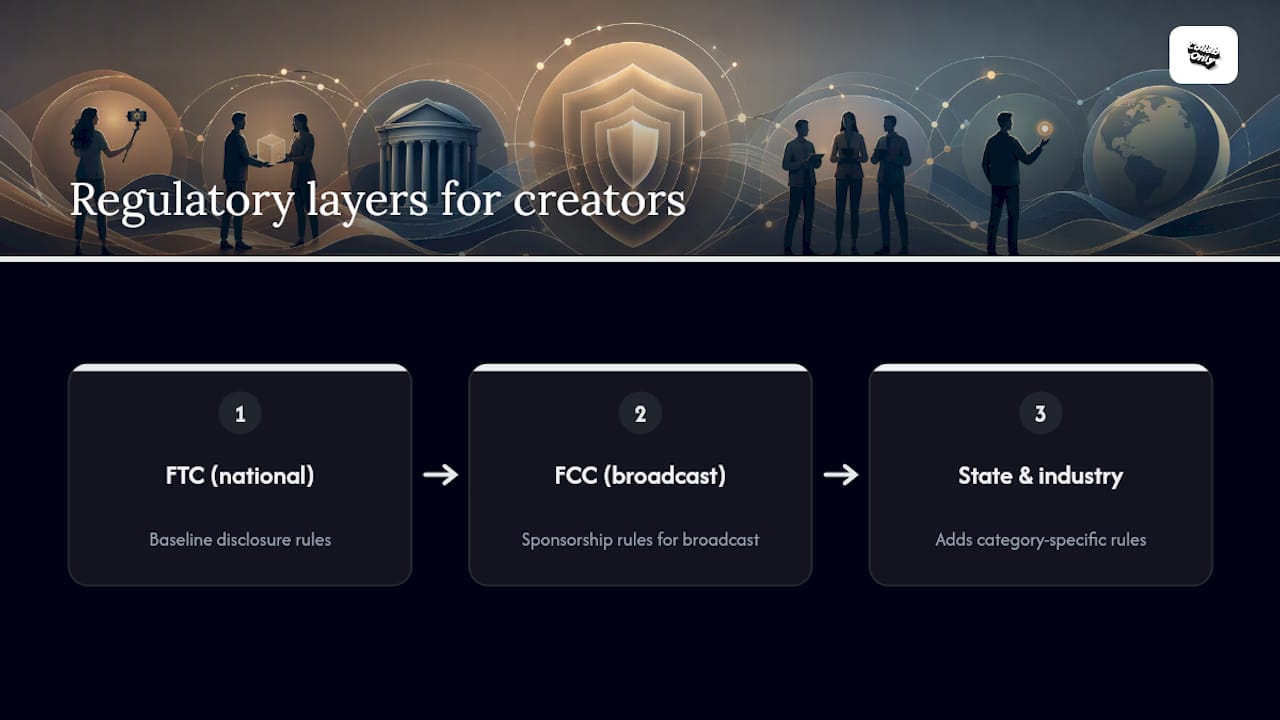
State laws add another layer. Some states have their own consumer protection statutes that mirror or extend federal disclosure requirements, particularly around health claims, financial products, and endorsements tied to regulated industries like alcohol or gambling. These state rules don't replace FTC disclosure rules; they typically stack on top of them, meaning a creator can be compliant with the FTC and still run afoul of a state-specific advertising statute depending on the product category and the state where the audience is located.
The practical takeaway for most creators and brands operating primarily on social media: FTC disclosure rules are the baseline that applies everywhere, and additional state or industry-specific rules become relevant mainly when the content touches regulated categories like healthcare, finance, or alcohol.
Common Myths About FTC Disclosure Rules
The biggest myth is that a platform's built-in tag, Instagram's "Paid partnership" label or TikTok's branded content toggle, satisfies the disclosure requirement on its own. It doesn't. FTC guidance on endorsements and reviews treats those tools as helpful additions, not replacements for a disclosure inside the actual content.
A second common misconception: disclosure is only required when a creator is paid in cash. Free products, discounts, early access, and family ties all count, even when no invoice was ever issued.
Third, many creators believe a disclosure buried in a bio link or a pinned comment counts as sufficient. It generally doesn't, because the standard asks whether an ordinary viewer encountering the content would see the disclosure without extra effort, and most viewers never click through to a bio while scrolling.
Finally, some assume that being "obviously" sponsored, wearing branded merchandise or filming inside a brand's store, eliminates the need for a verbal or written disclosure. It doesn't. The FTC standard focuses on what an ordinary consumer would understand from the content itself, not what an experienced marketer might infer from context clues.
Disclosure Rules for Podcasts, Virtual Influencers, and Emerging Platforms
Podcasts fall under the same FTC disclosure rules as any other content format. A host reading a sponsored segment needs to say so clearly, near the start of that segment, rather than relying on a single "this episode is sponsored by" line buried in show notes that most listeners never open. Audio-only content makes the audio disclosure requirement, spoken clearly, at normal volume and pace, the only channel available, so there's no visual backup to lean on.
Virtual influencers and AI-generated personas raise a newer question: who bears responsibility when the "creator" isn't a real person? The answer under current guidance is straightforward. The company or team operating the virtual influencer account is treated as the advertiser and endorser, and the same material connection and clear-and-conspicuous standards apply to anything that account promotes. The format of the endorser doesn't change the underlying obligation.
Livestream shopping platforms and shoppable video formats present similar challenges to live streams generally: viewers tune in and out throughout, so a single disclosure at the start of a two-hour stream isn't enough. Repeating the disclosure at regular intervals, every time a new sponsored segment or product begins, keeps the standard met regardless of when a viewer joins.
Product Placements, Unboxings, and Other Non-Traditional Formats
Unboxing videos sit in a gray area many creators misjudge. If a brand sent the product specifically for that unboxing, even without a formal payment, that's a material connection requiring disclosure, since the audience would reasonably want to know the item wasn't purchased independently.
Organic product placement, a brand's product appearing in the background of a vlog with no arrangement between the creator and the company, generally doesn't require disclosure because there's no material connection at all. The moment a brand sends the product, pays for placement, or coordinates the appearance in any way, that changes.
Gifting programs deserve particular caution. A brand that sends unsolicited free products with no explicit request for coverage still creates a material connection if the creator chooses to feature that product. The disclosure obligation doesn't depend on whether the brand asked for a post. It depends on whether the connection existed and whether the audience would want to know about it.
Handling Disclosures in Collaborations and Co-Created Content
Multi-creator collaborations complicate disclosure because more than one material connection can exist in a single piece of content. If two creators co-produce a video and only one of them has a paid relationship with the featured brand, both creators need the disclosure visible in the content, since viewers can't tell which creator's endorsement is tied to compensation and which isn't.
Brand ambassador arrangements, which run longer and cover multiple pieces of content over time, require disclosure on every individual post or video, not just the first one when the partnership began. The distinction between a one-off sponsored post and an ongoing ambassador relationship matters here mainly for how brands structure contracts, not for the disclosure obligation itself, which applies consistently across the full length of the relationship.
For duets, stitches, and remix content built on top of someone else's original sponsored post, the disclosure needs to carry forward into the new version too. A viewer encountering the remix has no visibility into the original post's caption, so the material connection has to be restated in the new content for the standard to hold.
Why the Real Compliance Gap Isn't Knowledge, It's Follow-Through
Most creators already know disclosure is required. What breaks down is execution: the wording gets shortened to save characters, the on-screen text disappears half a second too early, the brief never specified placement in the first place. The FTC's 2023 shift toward a performance-based standard actually raises the bar here, since "technically present" no longer protects anyone if an ordinary viewer would still miss the disclosure.
Where conventional advice falls short is treating disclosure as a caption-writing afterthought rather than a production requirement decided before filming starts. Brands that build disclosure wording and placement into the brief, and require proof before releasing payment, eliminate most of their exposure before a single post goes live. Creators who default to plain terms like "Ad" instead of vague shorthand protect themselves with almost no extra effort.
Prioritize the brief, not the caption edit. Getting the wording agreed before content is made prevents nearly every disclosure failure covered above.
— Samuel
Sources
Four documents form the backbone of everything covered here, and they're worth bookmarking directly rather than relying on secondhand summaries.
The Disclosures 101 for Social Media Influencers brochure is the FTC's own plain-language starting point, built specifically for creators rather than lawyers. The Guides Concerning the Use of Endorsements and Testimonials in Advertising, the 2023 final rule published in the Federal Register, is the actual regulatory text defining "clear and conspicuous" and material connections under 16 CFR Part 255. The Dot Com Disclosures guidance applies the same principles specifically to online and interactive advertising, including when hyperlinks are and aren't acceptable. Finally, the FTC's blog post on material connection disclosures walks through real examples of what does and doesn't meet the standard in practice.
- Influencers: Are your material connection disclosures clear and conspicuous? | FTC
- Guides Concerning the Use of Endorsements and Testimonials in Advertising (Federal Register, final Guides)
FAQ
What Are the New FTC Rules on Endorsement Disclosure?
The 2023 update to the Endorsement Guides formally defined "clear and conspicuous" for the first time and added explicit provisions addressing fake or incentivized reviews and undisclosed review-buying schemes.
What Are the Basic Requirements for a Compliant Disclosure?
A disclosure must appear inside the content itself (not hidden behind a link or hashtag string), use plain language like "Ad" or "Paid partnership," and stay visible or audible long enough for an ordinary viewer to notice it without extra effort, according to FTC guidance.
What Do the FTC Rules Actually Cover?
They cover any endorsement with a material connection, payment, free product, affiliate revenue, employment, or family ties, and require that connection be disclosed clearly whenever a significant minority of the audience wouldn't otherwise expect it, per the FTC's material connection guidance.
What Are the FTC's Guidelines for Affiliate Marketing Disclosure?
Affiliate links need disclosure placed near the link itself, not just once on a separate page, and vague language like "sp" or "collab" generally isn't specific enough since ordinary consumers may not recognize it as a paid relationship.