

For Instagram collab posts, use marketplace-powered discovery paired with a short human vetting process. Define the campaign goal and budget first, match with candidates second, and brief creators third. That sequence, not the tools alone, determines whether a collaboration performs.
Two facts shape everything downstream. Creator tiers behave differently, so a nano creator with 4,000 followers and a mega creator with 2 million solve different problems. And collab posts share reach between brand and creator profiles, which is why they tend to outperform standard sponsored content without extra ad spend.
Here is what to do in the next hour:
- Set one primary campaign goal (awareness, consideration, or conversion) and attach a budget band to it.
- Open a marketplace like Collab Only and search or swipe against that goal.
- Shortlist 5 to 10 candidates before you message anyone.
Key Takeaways
Marketplace-powered discovery combined with a short human vetting step, applied against a defined goal and budget, consistently produces stronger Instagram collab post results than cold outreach alone.
| Point | Details |
|---|---|
| Set goal before matching | Define one primary objective and budget band before searching for creators. |
| Match tier to goal | Use nano and micro creators for conversion, macro and mega for awareness reach. |
| Vet beyond follower count | Check engagement rate, comment quality, and Reels view averages before shortlisting. |
| Lock terms before content | Confirm usage rights, disclosure language, and payment milestones ahead of production. |
| Use Collab Only to match faster | Swipe-match-chat and category filters cut outreach delays for niche and app-launch campaigns. |
Table of Contents
- How Do You Find and Match Creators for Instagram Collab Posts?
- What Should You Check Before Shortlisting a Creator?
- How Do You Write a Brief for an Instagram Collab Post?
- Negotiating Pay, Usage Rights, and Disclosure for Collab Posts
- How Do You Launch and Measure an Instagram Collab Post?
- Common Challenges When Running Instagram Collab Posts
- Sources
- FAQ
How Do You Find and Match Creators for Instagram Collab Posts?
Marketplaces exist because outreach the old way is slow. A brand emails a creator, waits three days, gets no reply, and starts over. A swipe-match-chat model, the kind Collab Only runs, flips that: both sides express interest first, and chat opens only after a match, which cuts dead-end outreach substantially.
Beyond marketplaces, you have two other discovery paths, and each solves a different problem.
- AI-assisted discovery analyzes large creator datasets across audience demographics, engagement trends, and content themes to surface matches at scale. It is fast and works well for building a wide candidate pool quickly, but it cannot judge whether a creator's tone fits your brand.
- Manual search through hashtags, creator bio links, and competitor partnership scans takes longer but surfaces creative fit that algorithms miss. Use it when your product needs a specific aesthetic or subject-matter credibility.
- Referrals from existing creator partners or agency contacts tend to convert fastest, since trust is already established.
Whichever channel you start with, apply the same filters: audience demographics that match your buyer, content formats that suit your campaign (Reels for reach, Stories for urgency, feed posts for permanence), and engagement quality over raw follower count.
Pro Tip: Run AI-assisted discovery to build your first 30 to 50 candidates, then manually review the top 10 before reaching out. The best workflow moves from AI shortlist to human vet to brief, not straight from algorithm to inbox.
If you're building a niche vertical campaign, browsing a specialized page like Instagram creators for a specific product category shows how narrowing by category speeds up matching considerably.
What Should You Check Before Shortlisting a Creator?
Follower count tells you scale, not fit. Nano creators (1,000 to 10,000 followers) and micro creators (10,000 to 50,000) typically post higher engagement rates and work well for conversion-focused campaigns and product trials. Mid-tier creators (50,000 to 500,000) and macro creators (500,000 to 1 million) trade some of that intimacy for broader reach, making them a better fit for awareness pushes. Mega creators (1 million-plus) buy you scale but usually the lowest engagement rate per follower, so reserve them for brand-launch moments where visibility matters more than conversion.
Once you know which tier suits your goal, run two layers of checks.
Quantitative:
- Engagement rate relative to follower count, not in isolation.
- Comment quality: genuine replies versus emoji spam.
- Recent Reels view averages, since Instagram's algorithm rewards video disproportionately.
Qualitative:
- Does the creator's voice match your brand's tone, or would a partnership feel forced?
- Do past sponsored posts read as authentic, or does the audience call out obvious ad copy in comments?
- How professional is their communication so far? Slow, vague replies during vetting often predict a rocky production process.
Brands commonly weigh reputation, audience alignment, content quality, and past performance together rather than any single metric in isolation.
A compact shortlist template keeps this organized: Platform | Follower tier | Engagement rate | Ask | Contact method | Risk notes. Five columns, one row per candidate, and you can compare 10 creators on one screen instead of ten open tabs.
How Do You Write a Brief for an Instagram Collab Post?
A brief prevents the single most common collab failure: a finished post that technically fulfills the deal but misses the point. Structure it around six sections.
- Goal — the one outcome this post needs to drive.
- Audience — who the creator's content needs to speak to.
- Message — the two or three points that must come through.
- Formats — Reel, Stories, or feed collab post, and why that format serves the goal.
- Timeline — draft date, revision window, and publish date.
- Approval steps — who signs off, and how many revision rounds are included.
Deliverables vary by format. A Reel with caption usually anchors awareness campaigns because it earns the strongest organic reach. Stories with a link sticker work for time-sensitive offers. A true collab post, published jointly to both feeds, suits product launches where you want the creator's audience to see it appear natively on their profile.
Guardrails matter, but so does restraint. Specify what must appear (a product shot, a claim, a hashtag) without scripting every sentence. Creators who are forced into a brand's exact phrasing tend to produce content their own audience recognizes as scripted, which undercuts the entire reason to run a collaboration in the first place.
Pro Tip: Attach three items to every brief: one example of creative you like, your required hashtags and tags, and the exact disclosure language you expect (like "#ad" or "Paid partnership with"). Creators who receive this upfront submit fewer off-brief drafts.
Negotiating Pay, Usage Rights, and Disclosure for Collab Posts
Budget bands should track tier and objective, not gut feel. Awareness campaigns using macro or mega creators typically command higher flat fees since you're paying for reach. Conversion campaigns using nano or micro creators often work better on lower base fees plus performance incentives, since smaller creators can deliver stronger conversion per dollar in niche categories.
Before you agree on price, settle these four items:
- Usage rights: organic-only usage (the creator's own post) costs less than paid usage rights that let you run the content as an ad through your own account.
- Disclosure language: contracts should require FTC-compliant disclosure such as "#ad" or "Paid partnership with [brand]" placed in the first line of the caption, not buried in hashtags.
- Payment structure: a deposit on signing, a milestone payment on draft approval, and a final payment on publish keeps both sides accountable.
- Deal type: flat fee, product-for-post, affiliate commission, or a hybrid, chosen based on whether you're prioritizing awareness or measurable sales.
Effective outreach and negotiation both depend on pre-defining the creator profile, deliverables, pay range, and usage rights before you make first contact, not after a creator has already said yes.
| Point | Details |
|---|---|
| Budget by tier | Match flat fees to reach goals and performance incentives to conversion goals. |
| Usage rights cost more | Paid-usage rights for ads cost more than organic-only usage. |
| Disclosure is non-optional | Require FTC disclosure language in the first line of the caption. |
How Do You Launch and Measure an Instagram Collab Post?
Before anything publishes, run through a short checklist: UTM-tagged tracking links or per-creator links, a confirmed posting schedule, final caption approval, and correct partnership tagging so the collab post attributes to both accounts.
KPIs should map directly to your stated goal when leveraging influencers for organic growth.
- Awareness campaigns: track reach and impressions first.
- Consideration campaigns: track saves, saves relative to reach, and comment volume.
- Conversion campaigns: track link clicks and attributed sales through your tracking links.
Comparing creators fairly means normalizing results, not just stacking raw numbers. Per-creator tracking links and normalizing by follower size or impressions let you see which creator actually converted best relative to their audience, not just which one has the biggest following.
After the campaign, build a one-page report per creator and scale spend toward whoever produced the strongest normalized result.
Common Challenges When Running Instagram Collab Posts
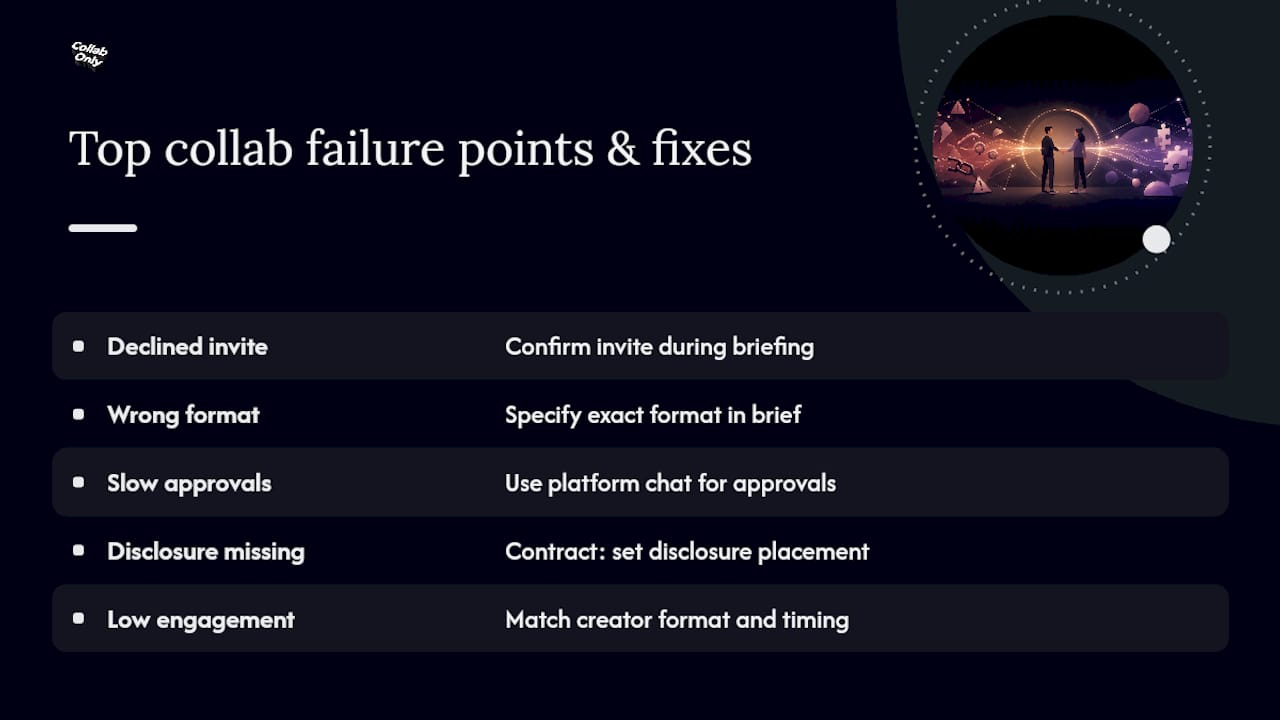
Most collab post problems trace back to one of four failure points, and each has a straightforward fix.
The creator declines the collab invite. Instagram's native collab feature requires the tagged creator to accept before the post shows on both profiles. If a creator ignores or declines the invite, confirm the arrangement and invite mechanics during briefing, not after the content is filmed.
Mismatched expectations on format. A creator delivers a Reel when the brief implied a feed collab post. This usually happens when briefs describe outcomes without naming the exact format, so specify the format explicitly every time.
Slow approval cycles kill momentum. Deals stall because messages sit unanswered in a personal inbox mixed with hundreds of fan DMs. This is precisely the friction a matching platform's instant chat is built to remove, since both parties are already confirmed and expecting to talk.
Disclosure gets buried or dropped. Creators sometimes place required disclosure language in overflow hashtags where it is functionally invisible. Contracts should specify placement, not just presence.
Engagement looks weaker than expected. Before assuming the creator underperformed, check whether the content actually matches the creator's usual format and posting time. A Reel posted as a static feed image, or a Story posted at an off-peak hour, will read as a weak result even from a strong creator.
Samuel's Take on What Actually Slows Collabs Down
Working with brands and creators on the Collab Only blog, the recurring bottleneck is never a shortage of good creators. It is response time. A brand finds a great match, sends a DM, and loses momentum waiting three days for a reply buried under fan messages. Instant chat on a confirmed match removes that entirely, since both sides already opted in before the conversation starts. One recurring pattern worth flagging: campaigns that set their KPI and budget band before matching consistently move from brief to published post faster than ones that shop for creators first and figure out goals later.
— Samuel
Run Your Next Collab Post Through Collab Only
Collab Only replaces slow, one-off outreach with a swipe-match-chat model built specifically for brands, creators, and marketers running Instagram, TikTok, and YouTube partnerships.
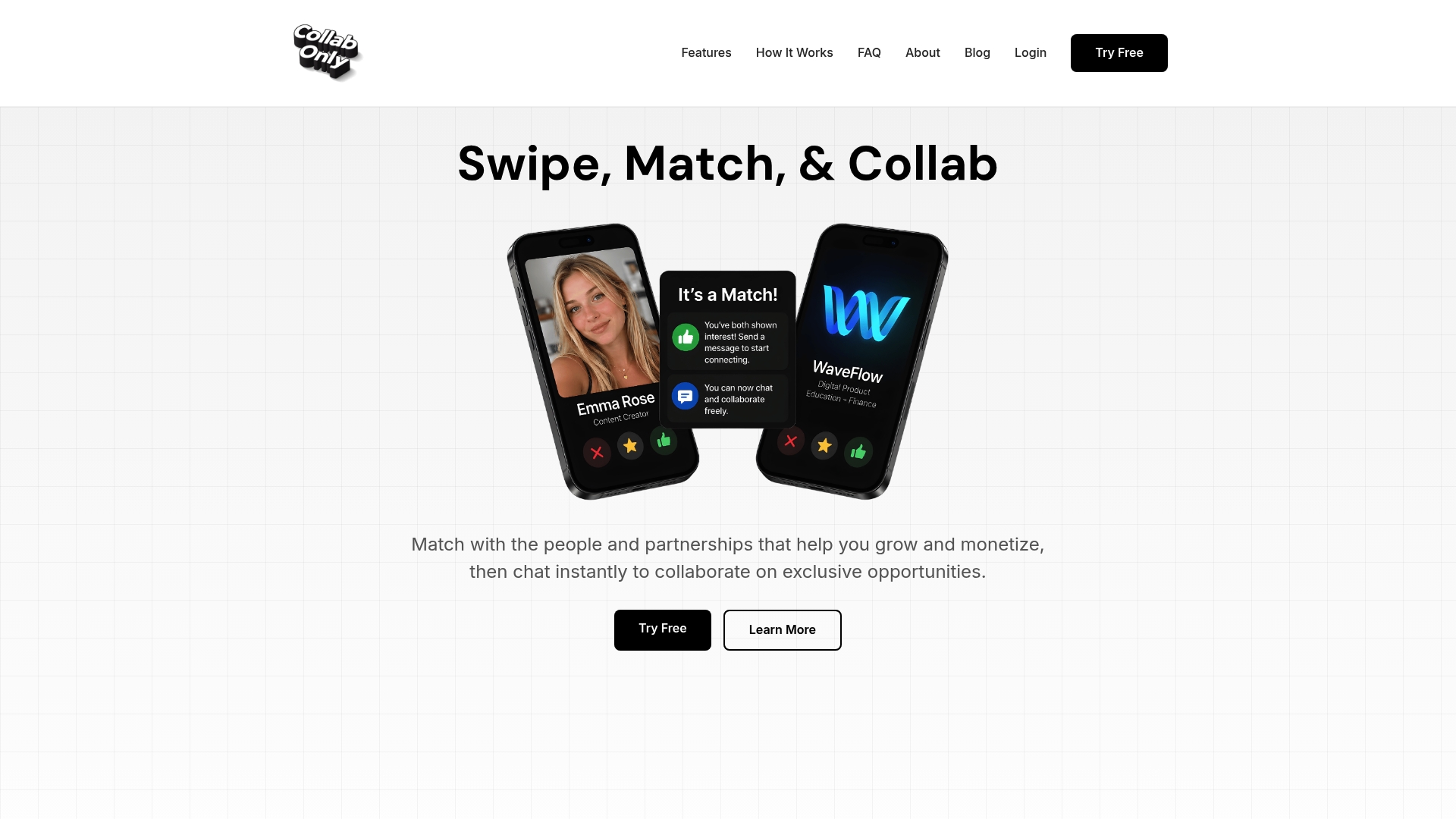
The platform organizes creators by category and campaign type, so a micro-campaign for a niche product, an app launch, or a full product-launch push each pulls from a relevant, filtered creator pool instead of one undifferentiated list. That focus is what makes it a strong fit for niche brands and lean marketing teams who cannot afford to sift through hundreds of irrelevant profiles per campaign. Filters for follower tier, engagement, and content category do the narrowing for you before you ever open a chat.
Getting started takes three steps: build your campaign brief inside the platform, filter for creators matching your tier and category, and swipe to match. Once matched, chat opens immediately, no inbox digging required. If you're launching an app, the dedicated app promotion creator page filters specifically for creators experienced with install-driven campaigns. For general collaboration needs, start browsing the influencer marketplace and set up your first brief today.
Sources
For deeper detail on discovery methods, formats, and creator tiers, consult SocialPilot's Instagram influencer marketing guide, Influencer Marketing Hub on AI versus manual discovery, and Superdeal's outreach templates. For platform features, browse Collab Only's platform comparison.
- A Guide to Instagram Influencer Marketing in 2026
- AI Influencer Discovery vs Manual Influencer Research
- Influencer Outreach: 5-Step Process + Email Templates (2026) | Superdeal
- How to Collaborate With Influencers: End-to-End Guide (2026)
FAQ
What Is a Good Engagement Rate for a Collab Post Creator?
There's no single universal benchmark, but nano and micro creators typically post higher engagement rates than macro or mega creators, so compare candidates within their own tier rather than against the whole market.
Should I Use DMs or Email to Contact Creators?
Instagram DMs work best for nano and micro creators, while email or manager contact gets faster, more reliable responses from mid-tier and macro creators.
Do I Need a Written Contract for a Collab Post?
Yes. A contract should specify deliverables, usage rights, disclosure language, payment milestones, and revision limits before any content gets filmed.
How Do I Compare Results Across Creators of Different Sizes?
Normalize results by follower size or impressions using per-creator tracking links, rather than comparing raw click or sale totals directly.
Is a Marketplace Better Than Manual Outreach for Finding Creators?
A marketplace like Collab Only speeds up discovery and removes outreach friction through instant chat on matches, while manual search still adds value for niche creative fit that algorithms can miss.