

TL;DR:
- A matching platform connects distinct user groups by analyzing needs and applying criteria to create valuable matches. These platforms rely on search, authentication, and compatibility counseling to facilitate high-quality, efficient collaborations. They significantly reduce search costs, build network effects, and improve campaign outcomes in digital marketing.
A matching platform is defined as an intermediary system that connects two or more distinct user groups by analyzing their needs and characteristics to create valuable, criteria-based matches. These systems operate as two-sided markets, meaning growth on one side directly increases the value for the other. The three core service pillars that define a true matching platform are search, authentication, and compatibility counseling. Without all three working together, a platform becomes little more than a directory. For brands, creators, and marketers, understanding how these systems work is the first step toward choosing the right one for collaboration and partnership goals.
What is a matching platform and how does it work?
A matching platform functions as a structured intermediary, not a passive listing service. Matching platforms connect distinct groups by applying predefined criteria or AI algorithms to reduce search costs and improve market efficiency. The distinction matters because a simple database of profiles does not constitute a matching platform. The system must actively evaluate compatibility and facilitate introductions.
The operational workflow follows a clear sequence:
-
Intake and assessment. The platform collects structured data from each user, including goals, preferences, audience demographics, and content categories. Intensive initial assessment identifies core values and objectives before any algorithmic process begins. This step determines the quality of every match that follows.
-
Curated search or algorithmic matching. The system applies its matching logic, whether rule-based filters, scoring models, or AI, to rank and surface the most compatible options. This is where the platform's technology differentiates itself from manual outreach.
-
Facilitated introduction. The platform presents the match and enables direct communication. On platforms like Collabonly, this happens instantly upon a mutual match, eliminating the lag of cold emails and unanswered DMs.
-
Feedback loops. Post-match data, such as whether a collaboration succeeded, refines future recommendations. This continuous refinement is what separates mature platforms from entry-level connection apps.
Pro Tip: When evaluating any matchmaking service, ask whether it collects structured post-match feedback. Platforms that skip this step cannot improve their algorithm over time, which means match quality stagnates.
What are the main types of matching platforms?
Matching platforms differ most significantly in their underlying algorithmic approach. The method a platform uses to generate matches determines its accuracy, speed, and ability to handle complex compatibility requirements.
Rule-based systems
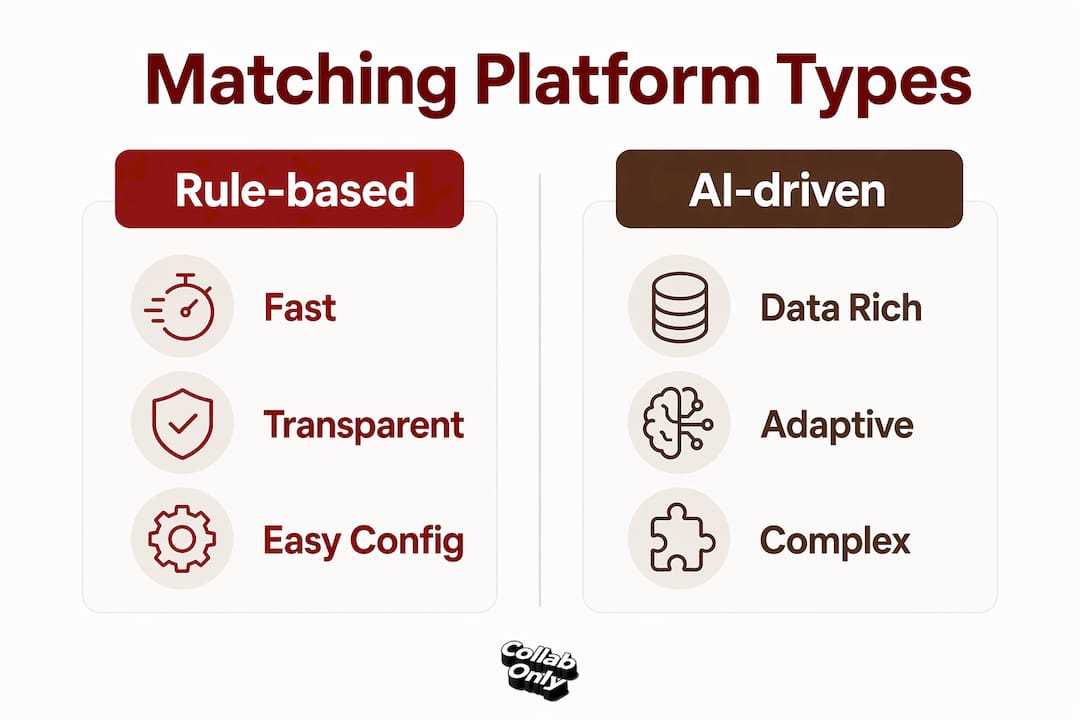
Rule-based matching applies fixed filters to narrow a pool of candidates. A brand might filter for creators with more than 10,000 followers on Instagram, located in the United States, and active in the fitness category. The system returns everyone who meets those criteria. This approach is fast and transparent but cannot account for nuanced compatibility factors like audience engagement quality or brand tone alignment.

Scoring-based systems
Scoring models assign weighted values to multiple attributes and rank candidates by total score. A platform might weight audience engagement rate more heavily than follower count, producing a ranked list rather than a binary pass/fail result. This approach handles complexity better than rule-based filters and allows platforms to prioritize what matters most to each user group.
AI and machine learning systems
AI-driven matching processes unstructured data, such as content tone, visual style, and audience sentiment, into numerical vectors for high-speed similarity searches. This is the most accurate approach for complex compatibility requirements. The role of AI in marketing has expanded precisely because it can surface non-obvious matches that rule-based systems would miss entirely.
The table below summarizes the three approaches:
| Approach | Strength | Limitation |
|---|---|---|
| Rule-based | Fast, transparent, easy to configure | Cannot capture nuanced compatibility |
| Scoring-based | Handles multiple weighted criteria | Requires careful weight calibration |
| AI/ML | Processes complex, unstructured data | Depends heavily on data quality |
Pro Tip: AI matching accuracy depends not on the algorithm alone but on the quality of the initial feature extraction. Flawed data preparation produces poor embeddings, which means even a sophisticated model will surface irrelevant matches.
What are the benefits and challenges of matching platforms?
Matching platforms deliver measurable advantages, but they also carry structural challenges that every operator and user should understand before committing to one.
Core benefits
- Reduced search costs. Platforms replace hours of manual research with an automated process that surfaces qualified candidates in minutes. For a brand running an influencer campaign, this translates directly into time and budget savings.
- Network effects. Two-sided platforms create value for both user groups through positive cross-side network effects. As more creators join, brands find better matches. As more brands join, creators access more opportunities. Each new participant increases the platform's value for everyone else.
- Authentication and trust. Platforms that verify user identities and track performance history reduce the risk of fraudulent profiles and misrepresented metrics. This is a core differentiator between a professional matchmaking service and an open directory.
- Compatibility counseling. The best platforms do not just surface matches. They guide users through the selection process, helping them articulate what they need and evaluate options against those criteria.
Structural challenges
- The cold start problem. Platforms struggle initially until they reach a critical user base. A platform with few creators offers little value to brands, and vice versa. Most successful platforms solve this by focusing on one side first and building supply before opening demand.
- Balance between sides. Maintaining the right ratio of supply to demand requires active governance. An oversupply of creators with too few active brands produces frustrated users on both sides.
- Authenticity verification. Confirming that follower counts, engagement rates, and audience demographics are genuine requires ongoing monitoring. Platforms that skip this step expose brands to wasted spend.
- Privacy and data trust. Users share sensitive business and personal data during the intake process. Platforms must demonstrate clear data governance policies to earn and retain that trust.
How are matching platforms used in digital marketing?
Matching platforms have become the operational backbone of creator-brand collaboration in digital marketing. The traditional process of finding an influencer involved manual searches across TikTok, Instagram, and YouTube, followed by cold outreach with low response rates. A purpose-built matching platform replaces that entire workflow.
- AI-powered fit identification. Platforms in marketing use scoring and AI algorithms to identify creators whose audience demographics, content style, and engagement patterns align with a brand's campaign objectives. This goes beyond follower count to assess genuine audience fit.
- Reduced time to partnership. Manual outreach cycles can take weeks. A matching platform compresses that timeline by surfacing pre-vetted, compatible candidates and enabling instant communication upon a mutual match.
- Campaign-specific filtering. Brands can filter by platform (TikTok, Instagram, YouTube), content category, audience location, engagement rate, and collaboration type. This specificity reduces irrelevant outreach and improves campaign ROI.
- Scalable collaboration management. Platforms that support multiple simultaneous campaigns allow marketing teams to manage creator relationships at scale without proportional increases in headcount.
- Fan and community engagement. Beyond brand-creator pairs, platforms like Collabonly extend matching to fans, giving audiences early access and exclusive offers while giving brands a direct channel to their most engaged community members.
Collabonly applies this model across TikTok, Instagram, and YouTube, connecting brands with nano and micro influencers through a swipe-based interface that triggers instant chat upon a match. The result is a collaboration process that removes the friction of cold outreach entirely. For brands evaluating marketing platform options, the ability to move from search to conversation in minutes is a concrete operational advantage.
Key Takeaways
A matching platform is only as effective as the combination of its search quality, authentication rigor, and compatibility counseling, and all three must operate together to produce reliable results.
| Point | Details |
|---|---|
| Core definition | A matching platform connects distinct user groups using criteria or algorithms to reduce search costs. |
| Three service pillars | Search, authentication, and compatibility counseling must all function together for effective matching. |
| Algorithm choice matters | Rule-based, scoring-based, and AI systems each suit different complexity levels and data types. |
| Network effects drive value | Growth on one side of a platform increases value for the other, making early user acquisition critical. |
| Marketing applications | Creator-brand platforms use AI matching to replace manual outreach with fast, vetted introductions. |
The misconception that costs brands real money
The most persistent mistake I see brands make is treating a matching platform as a glorified search engine. They filter by follower count, pick the top result, and wonder why the campaign underperforms. That is not matchmaking. That is browsing.
True matchmaking emphasizes long-term compatibility and feedback-driven refinement. A platform that does not collect post-match outcome data cannot improve its recommendations over time. Brands that choose platforms based on catalog size alone are optimizing for the wrong variable.
The second misconception is that AI matching is a black box you simply trust. In practice, AI matching success depends critically on the quality of the initial feature extraction from user data. A platform with a sophisticated algorithm but poorly structured intake data will consistently produce mediocre matches. Before committing to any platform, ask how it structures user profiles and what data points feed its matching model.
The platforms that will define creator-brand collaboration in 2026 and beyond are those that balance all three pillars: search, authentication, and counseling. Platforms that excel at one while neglecting the others produce a poor user experience regardless of how advanced their technology appears on the surface. The brands that understand this distinction will make better platform choices and run better campaigns.
— Samuel
Collabonly connects brands and creators without the outreach friction
Collabonly is a matching platform built specifically for the brand-creator ecosystem, covering TikTok, Instagram, and YouTube. It uses a swipe-based interface and AI-powered matching to connect brands with nano and micro influencers whose audience profiles align with specific campaign goals.
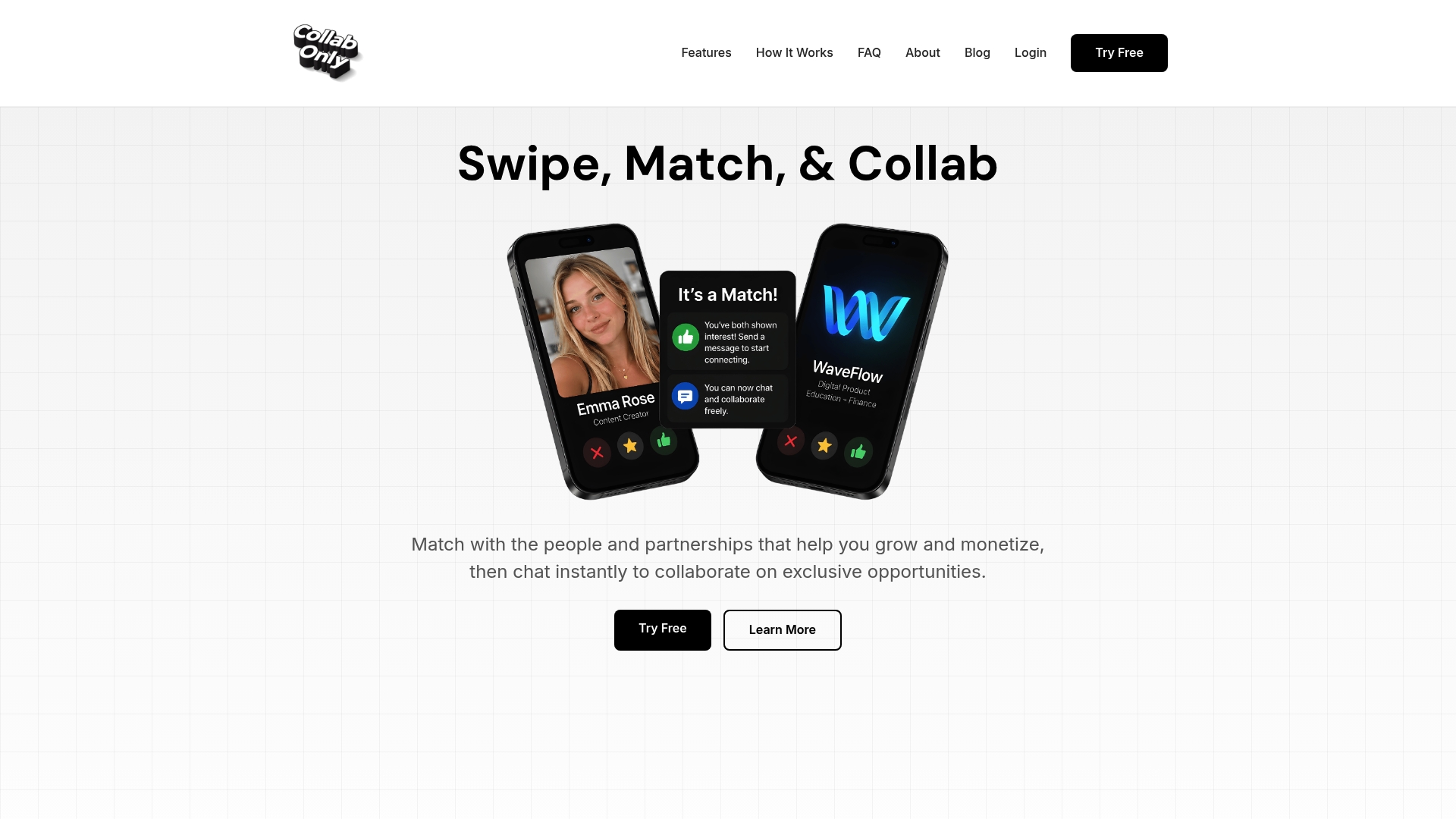
Brands that hire nano influencers through Collabonly skip the cold outreach cycle entirely. A mutual match triggers instant chat, moving from discovery to conversation in minutes rather than weeks. For teams that need to hire micro influencers at scale, the platform's filtering and matching logic handles compatibility assessment automatically. The result is a faster path from campaign brief to active creator partnership, with authentication built into the process from the start.
FAQ
What is a matching platform in simple terms?
A matching platform is an intermediary system that connects two distinct groups of users, such as brands and creators, by analyzing their needs and applying criteria or algorithms to identify compatible pairs.
How does a matching platform differ from a simple directory?
A directory lists profiles without evaluating compatibility. A matching platform actively applies search, authentication, and compatibility counseling to surface relevant, vetted matches and facilitate introductions.
What types of matching platforms exist?
Matching platforms use rule-based filters, scoring-based ranking systems, or AI and machine learning models. Each approach suits different levels of matching complexity and data availability.
What is the cold start problem in matching platforms?
The cold start problem occurs when a new platform has too few users on one or both sides to generate valuable matches. Most platforms solve this by building supply on one side before opening the platform to the other.
How do matching platforms benefit digital marketing campaigns?
Matching platforms in marketing connect brands with compatible creators using AI-driven fit analysis, reducing manual search time and improving campaign alignment by pairing brand objectives with relevant audience profiles.