

TL;DR:
- Brand promotion involves coordinated activities across multiple channels to build long-term brand equity and influence consumer perception. It is distinct from product promotion and advertising, requiring sustained investment and a unified narrative to enhance brand recognition and preference over time. Implementing a structured plan with clear objectives, consistent messaging, and balanced measurement ensures effective brand promotion that sustains brand health beyond short-term sales.
Brand promotion is defined as the coordinated set of marketing activities designed to build brand awareness, shape consumer perception, and influence long-term preference for a brand over its competitors. Unlike advertising, which is a single paid channel, brand promotion spans public relations, sponsorships, in-store activation, digital content, and influencer partnerships working in concert. Brands like Nike and Apple have built market dominance not through any single ad campaign but through sustained, multi-channel promotion that compounds over years. Understanding the full scope of brand promotion, and how it differs from product promotion and advertising, is the prerequisite for any marketer building a brand with lasting equity.
What is brand promotion and why does it matter?
Brand promotion encompasses coordinated activities to build awareness, shape perception, and influence brand preference well beyond what advertising alone can achieve. This distinction matters because many marketing budgets are allocated almost entirely to advertising, leaving the broader promotional ecosystem underfunded and misaligned.

The importance of brand promotion lies in its compounding effect on brand equity. Metrics like Net Promoter Score (NPS), unaided brand recall, and brand preference share are the direct outputs of sustained promotional investment. Amazon Ads, for example, offers brand-building ad formats specifically designed to separate awareness objectives from conversion objectives, recognizing that the two require different strategies and timelines.
Brand promotion also targets consumer attitudes, not just purchase behavior. Brand promotion targets changing consumer attitudes and long-term preference more than short-term sales. A brand that consistently communicates its values across every touchpoint builds the kind of trust that converts first-time buyers into repeat customers and advocates.
What are the main strategies and channels used in brand promotion?
Brand promotion strategy operates across a promotional mix that includes advertising, public relations, sponsorships, in-store activation, digital content, and influencer marketing. Each channel serves a distinct function within the overall effort to build recognition and preference.
The core channels and their roles include:
- Advertising: Paid placements across television, digital, out-of-home, and audio that create broad awareness and reinforce brand identity at scale.
- Public relations: Earned media coverage, press releases, and media partnerships that build credibility through third-party validation rather than paid placement.
- Sponsorships: Brand associations with events, sports teams, or cultural moments (such as Red Bull's sponsorship of extreme sports) that transfer the emotional equity of the event to the brand.
- In-store activation: Point-of-sale displays, sampling programs, and experiential retail that influence preference at the moment of purchase.
- Digital and social media: Content marketing, paid social, and community management on platforms like Instagram, TikTok, and YouTube that sustain ongoing brand conversations. Collabonly's analysis of social media growth strategies confirms that consistent platform-specific content is now a non-negotiable component of brand promotion.
- Influencer marketing: Creator partnerships that generate peer-credibility and authentic brand advocacy within specific sub-niches and audience segments.
The framework that ties these channels together is Integrated Marketing Communications (IMC), which coordinates all promotional tools to deliver a consistent brand narrative across every touchpoint. IMC prevents the common failure mode where each channel runs with separate creative ideas, diluting brand narrative impact and reducing customer recognition.
Pro Tip: Balance central strategy with local execution. The central brand team must control the core messaging architecture while local teams adapt execution to their market context. Misalignment in local activation undermines brand integrity even when media presence is strong.
How does brand promotion differ from product promotion and advertising?
The three terms are frequently conflated, but they operate at different levels of the marketing system and serve different objectives. Treating them as interchangeable leads to misallocated budgets and mismatched success metrics.
| Dimension | Brand promotion | Product promotion | Advertising |
|---|---|---|---|
| Primary objective | Build long-term brand equity, trust, and recognition | Drive short-term sales and conversion for specific SKUs | Deliver paid brand or product messages through specific media channels |
| Time horizon | Long-term, continuous | Short-term, campaign-specific | Varies by campaign objective |
| Key metrics | Brand awareness, NPS, brand preference share | Volume sold, conversion rate, ROAS | Impressions, click-through rate, cost per acquisition |
| Scope | Full promotional mix across all channels | Discounts, coupons, limited-time offers, trade promotions | Paid placements only |
| Example | Apple's "Think Different" brand narrative | A 20% off promotion on the iPhone 15 | A Google Display Network banner ad |
Brand promotion builds brand equity over the long term, while product promotion focuses on short-term sales. This means a brand running only product promotions is effectively borrowing against its equity without reinvesting in it. Over time, consumers begin to associate the brand with discounts rather than value, which erodes price authority and margin.
Advertising is one channel within brand promotion, not a synonym for it. A brand that equates its advertising spend with its brand promotion investment is systematically underinvesting in PR, sponsorships, influencer partnerships, and community-building activities that collectively drive preference.
What practical steps can businesses take to plan brand promotion?
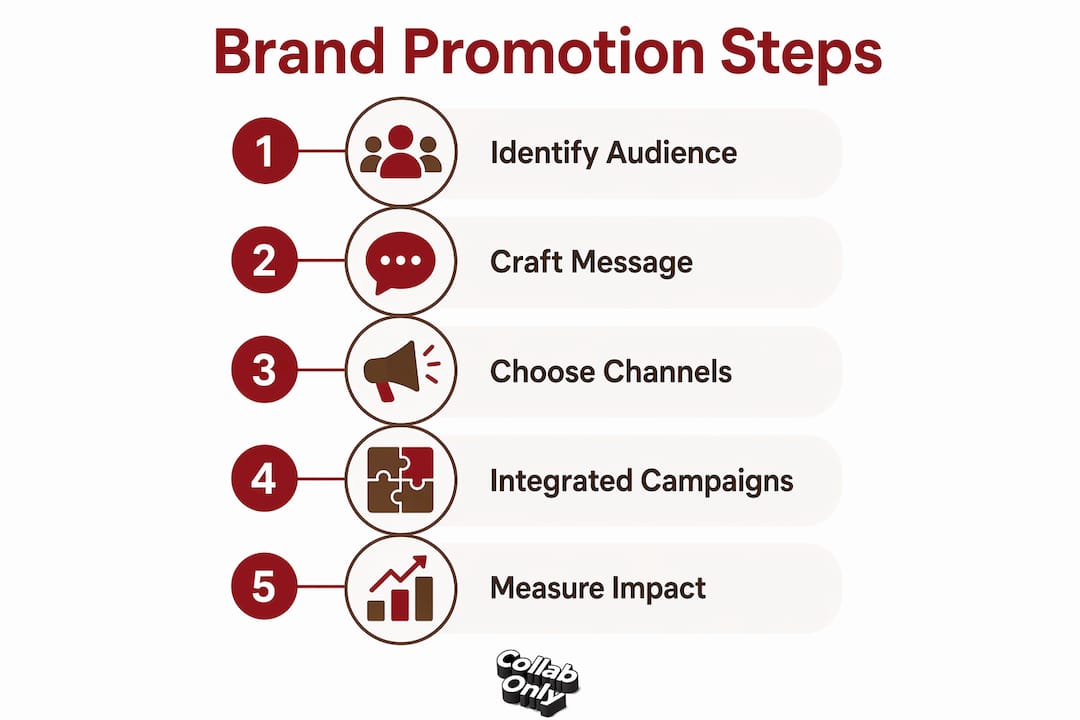
Effective brand promotion requires a structured planning process that connects communication objectives to measurable outcomes. The following sequence provides a repeatable framework for marketers building or auditing their brand promotion programs.
-
Define specific communication objectives. Promotion goals include awareness, trial, retention, and improved brand image tailored to audience segments. Vague objectives like "increase awareness" are insufficient. Objectives should specify the target segment, the desired attitude or behavior shift, and the measurement method.
-
Audit the current promotional mix. Map every active channel against the brand's communication objectives. Identify gaps where channels are absent and redundancies where multiple channels are delivering the same message without additive reach.
-
Develop a unified brand narrative. All channel executions must derive from a single brand story. Running each channel with separate creative ideas dilutes brand narrative impact and customer recognition. The narrative should articulate the brand's core value proposition, personality, and differentiation in terms that translate across paid, earned, and owned media.
-
Allocate budget across short-term and long-term objectives. A common planning error is concentrating spend on product promotion and performance advertising while neglecting brand-building investment. Sustained brand promotion requires a dedicated budget line that is protected from short-term performance pressure.
-
Establish a brand health measurement cadence. Pairing brand awareness metrics with preference and brand health proxies provides a fuller picture to optimize brand promotion investments. Quarterly brand tracking studies using NPS, aided and unaided recall, and brand preference surveys give marketers the data needed to defend brand-building budgets in performance-driven organizations.
-
Coordinate central and local execution. For multi-market brands, the central team sets the messaging architecture and creative standards. Local teams execute within those parameters, adapting for language, cultural context, and channel mix without deviating from the core brand narrative.
Pro Tip: Treat brand promotion as a continuous operating capability, not a campaign. Brands that activate only around product launches or seasonal moments lose the compounding recognition benefit that sustained promotion delivers.
What role do influencers and brand partnerships play in modern brand promotion?
Influencer marketing and brand partnerships have become structural components of brand promotion strategy, not optional add-ons. Their primary contribution is peer-credibility: the transfer of trust from a creator's established audience to the brand they endorse.
Nano and micro-influencers offer cost-effective engagement and credible brand advocacy, particularly within geo-concentrated or sub-niche audiences where macro-influencer reach is inefficient. This makes them especially valuable for brands targeting specific demographics, communities, or regional markets.
Key considerations for integrating influencers into brand promotion include:
- Influencer tier selection: Nano influencers (1,000 to 10,000 followers) deliver high engagement rates and strong peer-credibility within tight communities. Micro-influencers (10,000 to 100,000 followers) balance reach with authenticity. Macro-influencers and celebrities maximize reach but typically generate lower engagement rates and higher cost per impression.
- Brand-creator alignment: The creator's content category, audience demographics, and brand values must align with the promoting brand. Misaligned partnerships generate impressions without building genuine preference.
- Long-term creator relationships: One-off sponsored posts generate limited brand equity. Sustained creator partnerships, where the influencer becomes a recognizable brand advocate over multiple campaigns, build the kind of repeated exposure that shifts consumer preference. Collabonly's research on modern brand partnerships confirms that long-term collaborations consistently outperform transactional one-off activations on brand equity metrics.
- Measurable outcomes: Influencer campaigns should be measured against brand promotion metrics (reach, brand recall lift, sentiment) alongside conversion metrics to capture their full contribution to the promotional mix.
Understanding partnership marketing strategies provides additional context for how brand collaborations extend reach and credibility beyond what any single brand can achieve independently.
Key takeaways
Brand promotion is the continuous, multi-channel effort to build brand equity through awareness, perception management, and preference influence, and it requires distinct objectives, metrics, and investment from product promotion or advertising alone.
| Point | Details |
|---|---|
| Brand promotion defined | Coordinated activities across PR, advertising, sponsorships, and digital channels that build long-term brand equity. |
| Distinct from advertising | Advertising is one channel within brand promotion; conflating the two leads to systematic underinvestment in PR, influencers, and sponsorships. |
| IMC as the organizing framework | Integrated Marketing Communications ensures all channels deliver a consistent brand narrative, preventing dilution of brand recognition. |
| Measurement requires brand health metrics | NPS, unaided recall, and brand preference share must accompany sales data to accurately evaluate brand promotion performance. |
| Influencers as structural components | Nano and micro-influencers deliver peer-credibility and cost-effective advocacy within sub-niche and geo-concentrated audiences. |
Why most brands underinvest in promotion without realizing it
Most marketing organizations I have observed operate with a structural bias toward performance marketing. The metrics are immediate, the attribution is clear, and the ROI narrative is easy to present in a quarterly review. Brand promotion, by contrast, produces results on a timeline that rarely aligns with fiscal quarters, which makes it politically difficult to defend even when the evidence for its long-term value is strong.
The most common failure pattern is not ignorance of brand promotion's importance. It is the gradual reallocation of brand-building budgets toward performance channels during periods of revenue pressure, followed by confusion when brand preference metrics decline 12 to 18 months later. The causal link is real but delayed, which makes it invisible to organizations that measure marketing effectiveness on a 90-day cycle.
The second failure pattern is treating influencer marketing as a conversion tactic rather than a brand-building tool. Brands that evaluate influencer campaigns solely on ROAS are measuring the wrong output. The primary value of a well-matched creator partnership is the trust transfer and repeated brand exposure it delivers to an engaged, sub-niche audience. That value accumulates over time and shows up in brand preference data, not in last-click attribution reports.
The practical recommendation is to establish two separate measurement systems: one for performance marketing and one for brand health. Protecting brand promotion investment requires data that speaks the language of brand equity, not just conversion. Quarterly brand tracking, NPS monitoring, and share-of-voice analysis give marketing leaders the evidence they need to maintain brand-building budgets through short-term pressure cycles.
— Samuel
How Collabonly helps brands execute influencer-driven promotion
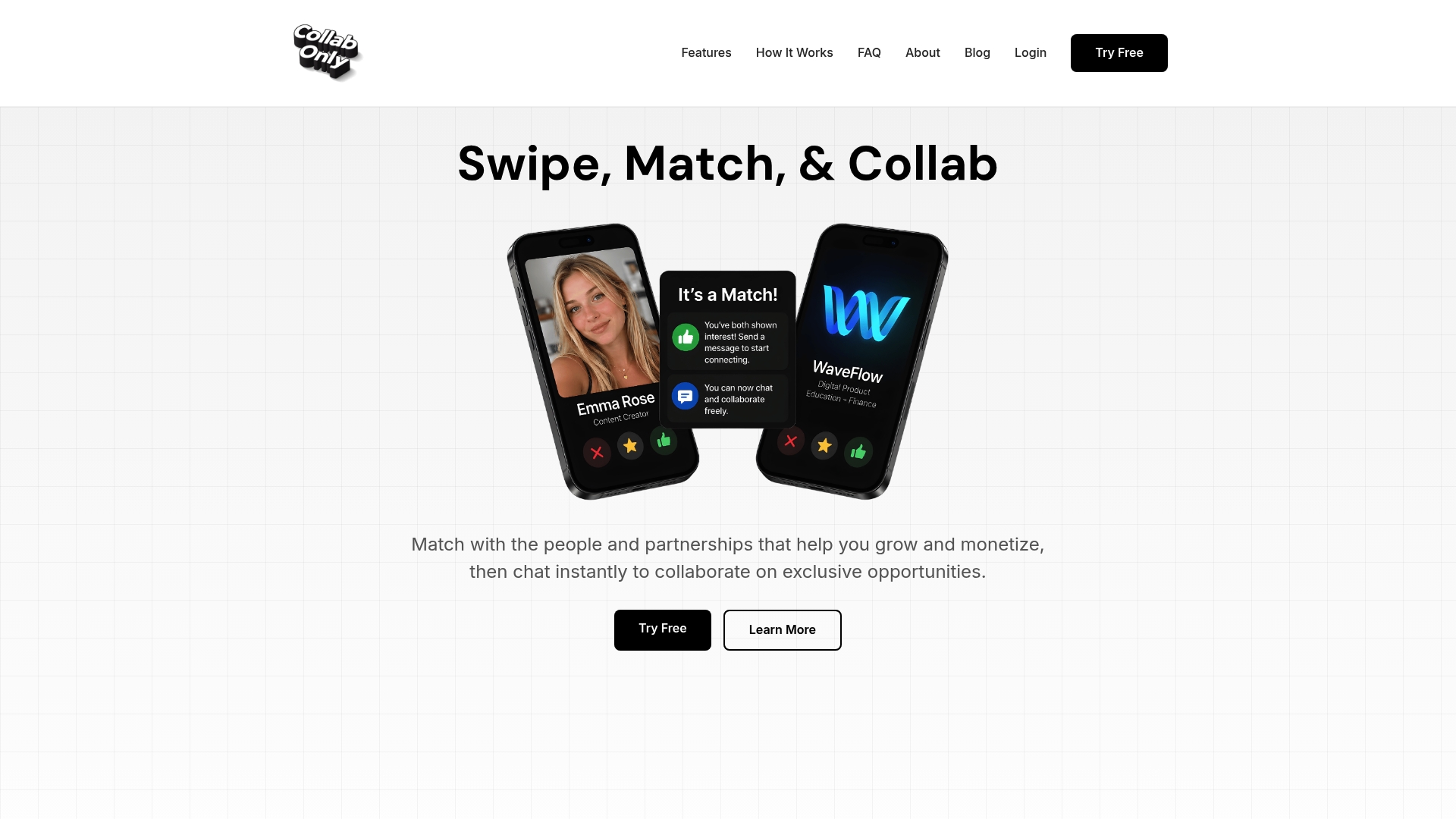
Collabonly is built for brands that recognize influencer marketing as a core brand promotion channel, not a tactical afterthought. The platform's swipe-to-match interface connects brands with nano and micro-influencers across TikTok, Instagram, and YouTube, eliminating the slow outreach cycles and lost DMs that make influencer sourcing inefficient at scale. Brands can filter by audience demographics, content category, and platform to identify creators whose sub-niche audiences align with specific brand promotion objectives. Instant chat upon matching accelerates campaign coordination, and the platform supports both one-off activations and the sustained creator relationships that drive measurable brand equity gains. For brands ready to scale influencer-driven promotion, start matching on Collabonly or explore dedicated options to hire micro-influencers for targeted campaigns.
FAQ
What is brand promotion in marketing?
Brand promotion is the coordinated use of advertising, PR, sponsorships, digital content, and influencer partnerships to build brand awareness, shape consumer perception, and influence long-term brand preference. It is distinct from product promotion, which focuses on driving short-term sales for specific products.
How does brand promotion differ from advertising?
Advertising is one paid channel within the broader brand promotion mix. Brand promotion also spans PR, in-store activation, sponsorships, and influencer marketing, making advertising a subset rather than a synonym for brand promotion.
What metrics measure brand promotion effectiveness?
Brand promotion is measured using brand health metrics including unaided brand recall, NPS, and brand preference share, alongside sales data. Relying solely on conversion metrics like ROAS undervalues the long-term equity that brand promotion builds.
Why is Integrated Marketing Communications important for brand promotion?
IMC ensures all promotional channels deliver a consistent brand narrative, preventing the dilution of brand recognition that occurs when channels operate with separate creative strategies. Consistency across touchpoints is what converts repeated exposure into genuine brand preference.
What types of influencers work best for brand promotion?
Nano and micro-influencers are most effective for building peer-credibility and authentic brand advocacy within specific audience segments. Macro-influencers maximize reach but at higher cost and lower engagement rates, making them better suited for broad awareness objectives than for preference-building within sub-niche communities.