

TL;DR:
- Social commerce involves buying and selling products entirely within social media platforms without leaving the app. It relies on impulse discovery through creator content and signals a shift from traditional search-based ecommerce. Brands must adopt native, authentic content and enable SKU-level attribution to succeed in this channel.
Social commerce is defined as the buying and selling of products directly within social media platforms, completing the entire purchase journey without the customer leaving the app. This model has moved well beyond niche status: sales through social networks are projected to exceed 17% of total online sales by 2025, a figure that signals a structural shift in how consumers discover and buy products. Platforms like TikTok Shop and Instagram Shops have made in-app checkout the norm for millions of shoppers, particularly younger demographics. For brands and marketers, understanding the social commerce definition is no longer optional. It is a prerequisite for building a competitive digital sales strategy in 2026.
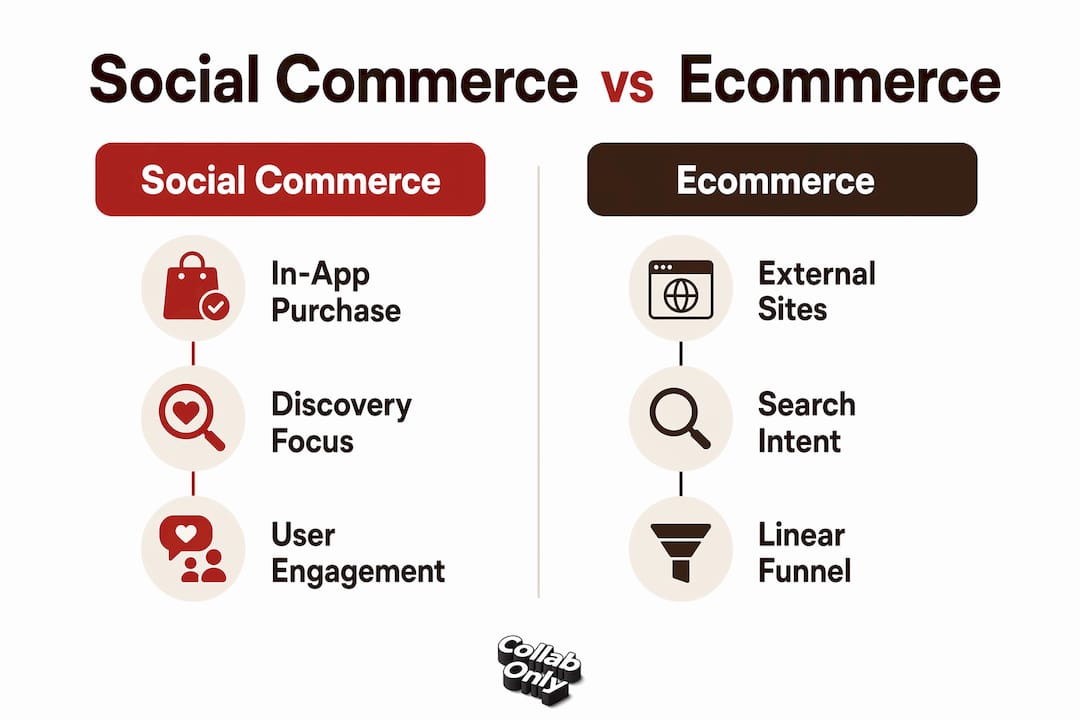
What is social commerce and how does it differ from traditional ecommerce?
Social commerce and traditional ecommerce share the same end goal, a completed sale, but they operate on fundamentally different mechanics. Traditional ecommerce depends on intent: a consumer searches for a product, visits a website, and moves through a linear funnel from product page to cart to checkout. Social commerce inverts that sequence entirely.

In social media shopping, discovery comes first. A user scrolls through a feed, encounters a creator demonstrating a product, and purchases it within seconds, all without leaving the app. That impulse-driven path is the defining characteristic of social commerce. The algorithm, not the consumer's search query, initiates the buying moment.
Social commerce completes an entire purchase journey inside the app, creating a continuous loop rather than a linear funnel. This distinction matters because it changes how marketers should allocate budget, create content, and measure success. A brand optimized for search-intent ecommerce needs a fundamentally different playbook for social commerce.
| Dimension | Traditional ecommerce | Social commerce |
|---|---|---|
| Consumer intent | Active search, high purchase intent | Passive discovery, impulse-driven |
| Purchase location | External website or app | Natively within the social platform |
| Buying journey | Linear funnel (search, browse, checkout) | Continuous loop (discover, engage, buy, share) |
| Content driver | Product listings, SEO | Creator content, algorithms, social proof |
| Attribution model | Last-click, session-based | SKU-level, creator-linked |
Pro Tip: Map your existing ecommerce funnel against the social commerce loop before launching. The two require separate content strategies, separate KPIs, and often separate creative teams.
What platforms and tools power social commerce in 2026?
Leading platforms including Facebook, Instagram, Pinterest, and TikTok now offer dedicated social commerce capabilities. Each platform approaches the channel differently, and marketers need to tailor tactics accordingly rather than applying a single template across all four.
Core platform capabilities
- TikTok Shop is the most aggressive social commerce platform in the US market as of early 2026. Its native checkout, creator affiliate program, and live shopping features make it particularly effective for impulse purchases among younger demographics. Brands selling trend-driven products, apparel, beauty, and accessories see the highest conversion rates here.
- Instagram Shops integrates product catalogs directly into brand profiles and creator posts. Product tagging is used by 41% of brands on Instagram to reduce friction in the shopping journey. Tapping a tagged product surfaces pricing, details, and a direct checkout path without any redirect.
- Facebook Shops serves an older demographic and works well for community-driven categories like home goods, local products, and services. Its integration with Facebook Groups creates a peer-recommendation layer that amplifies social proof.
- Pinterest functions as a visual catalog with strong purchase intent signals. Users on Pinterest actively save and revisit products, making it closer to search-intent behavior than the other three platforms.
Key features to activate
- Native checkout: eliminates redirect friction and keeps the buyer inside the platform
- Live shopping: real-time product demonstrations with instant purchase links, particularly effective on TikTok
- Creator affiliate links: ties specific creators to specific SKUs for direct attribution
- User-generated content (UGC) reposts: brands resharing authentic customer content to build peer credibility
- Shoppable stories and reels: short-form video formats with embedded product links
Pro Tip: Do not activate every platform simultaneously. Start with the one platform where your target audience is most active, build a repeatable content and creator workflow, then expand. Spreading resources across four platforms at launch dilutes performance on all of them.
What are the benefits and challenges of social commerce for brands?
Social commerce delivers measurable advantages, but it also introduces operational demands that traditional ecommerce does not. Brands that enter the channel without accounting for both sides tend to underperform.
Benefits
- Shortened path to purchase: the discovery-to-checkout sequence can happen in under 60 seconds, reducing the drop-off that plagues multi-step ecommerce funnels
- Social proof at the point of sale: peer reviews, comments, and authentic endorsements appear directly alongside the product, increasing consumer trust and conversion rates in ways that static product pages cannot replicate
- Higher organic reach: creator-led content benefits from algorithmic distribution, giving brands access to audiences they have not paid to reach directly
- Transparent attribution: creator affiliate programs and SKU-level tracking connect specific content to specific revenue, making ROI visible at a granular level
- Community-driven feedback loops: comments and DMs generate real-time product feedback that brands can use to adjust inventory, messaging, and positioning
For more on how partnership campaigns drive results, the mechanics of creator-led social commerce align closely with the most effective co-marketing structures.
Challenges
- Content authenticity requirements: creator content performs best when unpolished and native-feeling rather than highly produced. Brands accustomed to broadcast-quality assets often resist this, which directly hurts conversion.
- In-app customer service demands: brands need clear processes to handle DMs and comments in real time because social commerce buyers expect immediate responses. A 24-hour reply window that works for email support fails in a TikTok Shop context.
- Platform dependency risk: algorithm changes or policy updates on any single platform can disrupt revenue overnight
- Misaligned expectations: brands that treat social commerce as simply another storefront, rather than a content-led discovery channel, consistently miss performance targets
Social proof strategies are particularly relevant here. Brands that actively cultivate reviews, comments, and creator endorsements at the point of purchase see materially higher engagement than those relying on product listings alone.
Pro Tip: Audit your brand's content approval process before launching on TikTok Shop. If every creator post requires three rounds of legal review, you will consistently miss the trend windows that drive impulse purchases.
How can marketers integrate social commerce into their digital strategy?
Social commerce does not replace a brand's existing digital marketing infrastructure. It extends it. The most effective approach treats social commerce as a distinct channel with its own content logic, creator relationships, and attribution model, while connecting it to broader brand promotion and ecommerce operations.
A structured integration follows this sequence:
- Define platform-specific objectives. Decide whether a given platform will serve awareness, conversion, or both. TikTok Shop skews toward conversion; Pinterest skews toward consideration. Mixing objectives on a single platform without separate content tracks creates measurement confusion.
- Build a creator partnership framework. Identify creators whose audience demographics match your buyer profile. For brands targeting Gen Z on TikTok, finding the right TikTok creators is the single highest-leverage activity in the entire social commerce setup process.
- Map creators to SKUs. Assign specific products to specific creators based on audience fit and content style. This enables SKU-level attribution, which is the foundation of effective ROI tracking in social commerce. Generic affiliate codes assigned to all creators simultaneously obscure which content actually drives revenue.
- Establish a real-time engagement protocol. Designate a team member or agency to monitor comments, DMs, and live shopping sessions. Community responsiveness directly affects conversion rates in social commerce in ways that do not apply to static ecommerce pages.
- Integrate UGC into your broader content calendar. Authentic customer content generated through social commerce channels can be repurposed across email, paid social, and your website product pages. This extends the value of each piece of creator or customer content beyond its original platform.
- Review attribution monthly. Social commerce attribution models are still maturing. Monthly reviews of creator-to-SKU performance allow brands to reallocate creator budgets toward the content types and creators that generate actual revenue rather than impressions.
Understanding digital brand promotion as a broader discipline helps contextualize where social commerce fits. It is one layer of a multi-channel strategy, not a standalone replacement for paid search or owned media.
Key Takeaways
Social commerce is the most direct path from consumer discovery to purchase available to brands in 2026, and it requires a content-led, creator-driven approach that is fundamentally different from traditional ecommerce.
| Point | Details |
|---|---|
| Social commerce definition | Buying and selling completed entirely within a social media app, not redirected to an external site. |
| Platform selection matters | TikTok Shop leads for impulse purchases; Instagram Shops suits product tagging; Pinterest aligns with higher-intent browsing. |
| Content authenticity drives conversion | Unpolished, native-style creator content outperforms highly produced brand assets on algorithm-driven platforms. |
| SKU-level attribution is non-negotiable | Mapping specific creators to specific products is the only way to measure social commerce ROI accurately. |
| Real-time engagement affects revenue | Brands must handle DMs and comments immediately; delayed responses directly reduce conversion rates in social commerce. |
The part most brands get wrong about social commerce
Most brands enter social commerce with the wrong mental model. They treat it as a new storefront, upload their existing product catalog, run a few creator posts, and then wonder why conversion rates are low. The problem is not the platform. The problem is the assumption that social commerce is a distribution channel when it is actually a content channel that happens to have a checkout button.
The brands I have seen succeed consistently share one trait: they give creators genuine creative latitude. They resist the urge to script every line and approve every frame. A creator who can speak naturally about a product, in their own voice, to their own audience, will outperform a polished brand video every time on TikTok. The algorithm rewards content that feels native to the platform, and native content rarely looks like a television commercial.
The other underrated factor is community management. Brands that staff their social commerce channels with people who can respond to comments within minutes, answer product questions in live sessions, and handle complaints publicly without escalating them, those brands build the kind of trust that converts browsers into repeat buyers. Social commerce is not a set-and-forget channel. It demands presence, and that presence is a competitive advantage most brands are not willing to invest in.
The forward trajectory is clear. Social commerce will continue to absorb a larger share of total online sales, creator-led selling will become more sophisticated, and platforms will deepen their native checkout capabilities. Brands that build the internal processes and creator relationships now will have a structural advantage over those who wait.
— Samuel
How Collabonly connects brands to social commerce creators
Collabonly is built for exactly the kind of creator-brand matching that social commerce demands. Brands can find and connect with creators across TikTok, Instagram, and YouTube through a swipe-based matching interface that eliminates the slow back-and-forth of cold outreach.

For brands building a social commerce presence, the platform removes the most time-consuming part of the process: finding creators whose audience, content style, and niche align with specific products. Once matched, instant chat replaces the DM and email delays that typically slow campaign launches. Whether you are a Gen Z fashion brand looking for TikTok creators or a product brand building an affiliate network, Collabonly connects you to the right partners without the friction.
FAQ
What is the social commerce definition?
Social commerce is the practice of buying and selling products directly within a social media platform, completing the full purchase journey, from discovery to checkout, without leaving the app.
How does social commerce differ from ecommerce?
Traditional ecommerce relies on consumers actively searching for products on external websites, while social commerce is driven by algorithmic discovery and creator content that triggers impulse purchases inside the platform.
Which platforms support social commerce in 2026?
TikTok Shop, Instagram Shops, Facebook Shops, and Pinterest all offer dedicated social commerce features including native checkout, product tagging, and live shopping capabilities.
Why does creator content need to be unpolished for social commerce?
Algorithm-driven platforms like TikTok favor content that feels native and authentic. Highly produced brand assets perform poorly compared to raw, creator-led videos because they do not match the organic content style users expect in their feeds.
How do brands measure ROI in social commerce?
The most accurate method is SKU-level attribution, which links specific creators to specific products through affiliate codes or platform-native tracking, allowing brands to identify which content directly generates revenue.