

TL;DR:
- Effective partnership campaigns involve deep co-creation and a clear guiding principle to drive authentic audience engagement and measurable results. Brands that give partners creative authority and respond quickly to cultural moments outperform those relying on superficial brand placements. Building rapid, real-time content processes and choosing the right format aligned with objectives are essential to success.
Partnership campaigns are defined as collaborative marketing efforts where two or more brands co-create content, products, or experiences to reach shared audiences and generate measurable business outcomes. The most effective examples of partnership campaigns go far beyond logo placement or simple endorsements. Campaigns like Starbucks × Spotify and Dunkin' with Megan Thee Stallion demonstrate that deep creative integration, not surface-level association, drives audience engagement and sales growth. Understanding what partnership marketing delivers gives brand managers a clear framework for evaluating which collaborative formats will generate the strongest return.
What makes partnership campaigns successful?
The most effective joint marketing strategies share four defining characteristics that separate them from standard sponsorships or licensing deals.
- Co-creation over placement. Partners influence the concept, product, and content from the start. Co-creation drives stronger audience connection and cultural integration than top-down placements ever can.
- Narrative authorship. Tiffany & Co. and Netflix moved beyond product adjacency to creative authorship, embedding archival jewelry directly into the storytelling of Frankenstein rather than placing it on a shelf in the background.
- A clear guiding principle. Campaign effectiveness increases when partnerships address a specific market gap with a single unifying idea that drives both strategy and execution.
- Cultural speed. KFC Arabia's CMO stated that the most disruptive campaigns are made with audiences, not for them. Real-time co-creative content platforms now allow brands to respond to cultural moments within hours, not weeks.
Campaigns that check all four boxes consistently outperform those built on simple brand adjacency. The difference shows up in engagement rates, earned media, and, ultimately, revenue.
Pro Tip: Before signing any partnership agreement, define a single guiding principle in one sentence. If both partners cannot agree on that sentence, the campaign will lack direction regardless of budget.
7 standout examples of partnership campaigns
The following case studies represent diverse formats, industries, and audience strategies. Each one illustrates a specific tactic that marketers can extract and apply.
1. Müller and Myprotein: solving consumer confusion with "The Power of Two"
Müller and Myprotein identified a genuine market problem: consumers found the protein product category confusing and difficult to navigate. Rather than competing for the same shelf space, the two brands built a campaign around a single guiding principle called "The Power of Two," which positioned their complementary products as a unified solution. The Müller and Myprotein campaign generated £26 million in sales in the first year, with measurable increases in value share and volume share across a 12-month period. The lesson is direct: partnerships that solve a real consumer problem outperform those built purely on brand visibility.

2. KFC Arabia: turning a supply crisis into a viral AI drama
KFC Arabia faced a cheddar sauce shortage and chose to address it through a serialized AI-driven social drama rather than a standard apology post. The campaign invited fans to contribute story arcs in real time, turning a potential PR problem into a co-creative entertainment event. The result was 4 million views, 85,000 likes, 130,000 shares, and 2,800 fan-contributed story comments, all with zero paid seeding. AI and real-time content platforms enabled KFC Arabia to move at cultural speed, producing content fast enough to stay relevant throughout the crisis cycle.
3. Tiffany & Co. and Netflix: jewelry as narrative, not decoration
The Tiffany & Co. and Netflix collaboration on Frankenstein is one of the clearest recent examples of creative authorship in brand partnerships. Tiffany did not simply place products in scenes. The brand displayed archival jewels in flagship store windows, hosted exhibitions, and integrated its heritage directly into premiere events. This approach shifted Tiffany from sponsor to co-author of the cultural moment. The campaign demonstrates that luxury brands gain more from narrative depth than from logo exposure, a principle that applies equally to mid-market brands with strong heritage assets.
4. Nike, McDonald's, and Devin Booker: authentic story as campaign infrastructure
Wieden+Kennedy built this three-way partnership around a real story: Devin Booker's genuine personal connection to McDonald's. The campaign took the form of a desert scavenger hunt, where fans followed clues to access early sneaker drop activations and exclusive cultural experiences. Embedding genuine stories into campaign architecture creates participation, not just viewership. The Nike and McDonald's case proves that experiential marketing works best when the story is real, not constructed for the campaign.
Pro Tip: When evaluating a potential brand partner, ask whether there is a genuine shared story between the partner, the product, and the audience. Manufactured narratives rarely sustain engagement past the launch week.
5. Dunkin' and Megan Thee Stallion: co-creation across culture, music, and product
Dunkin' gave Megan Thee Stallion genuine creative input across the entire campaign, not just a spokesperson role. The partnership blended humor, music, product development, and cultural positioning to reframe Dunkin's protein offerings as relevant to a younger, entertainment-driven audience. The campaign won gold at The Drum Awards and demonstrated that multi-layered co-creation, where the partner shapes the product and the narrative, produces stronger cultural integration than a standard endorsement deal. Dunkin' did not hire a celebrity. It built a creative collaborator.
6. CC Clarke, Just Eat, and Superdrug: social-first beauty with live activation
This three-brand campaign fused Instagram Reels content with in-home experiential activations booked through Eventbrite. CC Clarke provided cultural credibility in the beauty space, Just Eat provided the logistics and delivery mechanic, and Superdrug provided the product range. The CC Clarke, Just Eat, and Superdrug campaign shows that three-way partnerships work when each partner contributes a distinct and non-overlapping capability. Social-first content drove awareness, while the live activation converted that awareness into direct consumer experience.
7. Starbucks and Spotify: sharing platforms instead of building them
Starbucks and Spotify integrated their loyalty and marketing systems rather than each building separate technology. Starbucks used Spotify's existing platform infrastructure to offer in-store music curation tied to the Starbucks Rewards program. This resource-sharing model reduced development costs for both parties while creating a differentiated customer experience that neither brand could have delivered alone. Tech integration partnerships are particularly effective when both brands serve overlapping audiences but operate in non-competing categories.
Comparing partnership campaign formats
Different campaign formats suit different brand objectives, resource levels, and audience expectations. The table below maps the most common formats against key decision criteria.
| Format | Audience engagement | Resource intensity | Best suited for |
|---|---|---|---|
| Co-creative content | Very high | Medium | Brands with strong creator relationships |
| Product collaboration | High | High | Brands with complementary product lines |
| Experiential activation | High | Very high | Brands targeting Gen Z and millennial audiences |
| Tech and loyalty integration | Medium | High | Brands with existing digital ecosystems |
| Social-first influencer content | High | Low to medium | Brands seeking rapid cultural reach |
Choosing the right format depends on three factors:
- Partner capability alignment. The Starbucks and Spotify model works because each brand contributed a distinct technical asset. Forcing a tech integration without the right infrastructure produces friction, not value.
- Audience behavior. Experiential activations like the Nike and McDonald's scavenger hunt require audiences who are willing to participate actively. Social-first formats work better for audiences who consume passively.
- Campaign timeline. Co-creative content can move quickly. Product collaborations require lead time for development, testing, and distribution.
Reviewing proven brand collaboration formats before committing to a structure prevents misalignment between campaign ambition and operational reality.
How to apply these lessons to your marketing strategy
The case studies above share a set of repeatable principles that marketers can apply regardless of budget or industry.
- Define the guiding principle first. Müller and Myprotein built their entire campaign around "The Power of Two." Every execution decision flowed from that single idea. Without a unifying principle, partnership campaigns fragment into disconnected tactics.
- Give partners genuine creative authority. Dunkin' succeeded because Megan Thee Stallion shaped the product and the narrative. Campaigns where the partner is treated as an afterthought produce afterthought results.
- Use AI and real-time production to move at cultural speed. KFC Arabia's drama worked because the brand responded to a live situation with live content. Brands that plan for cultural agility, rather than waiting for quarterly campaign cycles, capture moments that slower competitors miss.
- Measure beyond impressions. The Müller and Myprotein campaign tracked value sales, value share, and volume share over 12 months. Impressions and reach are inputs. Revenue and market share are outcomes.
- Match the format to the objective. A tech integration will not generate the same cultural heat as a co-creative influencer campaign. Define the primary objective first, then select the format that delivers it most directly.
For brands building their first structured partnership program, reviewing how to collaborate with brands effectively provides a practical starting framework.
Key takeaways
The most effective partnership campaigns are built on co-creation, a clear guiding principle, and genuine narrative integration rather than surface-level brand association.
| Point | Details |
|---|---|
| Co-creation outperforms placement | Partners who shape the concept and product produce stronger engagement than those who simply appear in campaigns. |
| Guiding principles drive consistency | A single unifying idea, like "The Power of Two," aligns every execution decision across a campaign. |
| Cultural speed is now a competitive advantage | AI-enabled real-time content production allows brands to respond to moments as they happen, not weeks later. |
| Format must match objective | Tech integrations, experiential activations, and social-first content each serve different audience behaviors and business goals. |
| Measure outcomes, not just reach | Sales growth, market share, and volume share reveal campaign impact more accurately than impressions alone. |
The shift I see defining partnership marketing in 2026
The campaigns that have stood out most in recent years share one quality that older partnership models consistently lacked: the partner is a genuine co-author, not a paid guest. When I look at what Dunkin' built with Megan Thee Stallion or what KFC Arabia pulled off with its AI drama, the common thread is that both brands gave up some control to gain something more valuable: cultural authenticity.
The brands still operating on a sponsorship-first model, where a logo appears next to a celebrity and the campaign calls it a partnership, are losing ground to brands that treat collaboration as a creative discipline. The Tiffany and Netflix case is particularly instructive here. Tiffany did not need Netflix's audience to know the brand existed. It needed a context that made the brand feel alive and current. That is a fundamentally different objective, and it required a fundamentally different type of deal.
For 2026, I expect AI-enabled co-creation to accelerate this shift further. The brands that build internal processes for rapid content production and real-time audience collaboration will run circles around those still waiting for quarterly campaign approvals. The infrastructure for culture-speed marketing now exists. The question is whether brand managers have the organizational flexibility to use it. Top brand partnership examples from the past two years consistently show that speed and authenticity together are the new competitive standard.
— Samuel
Collabonly connects brands with the right creative partners
Finding the right partner for a co-creative campaign has historically been the hardest part of the process. Cold outreach, unanswered DMs, and slow agency introductions cost brands weeks of lead time before a single creative conversation begins.
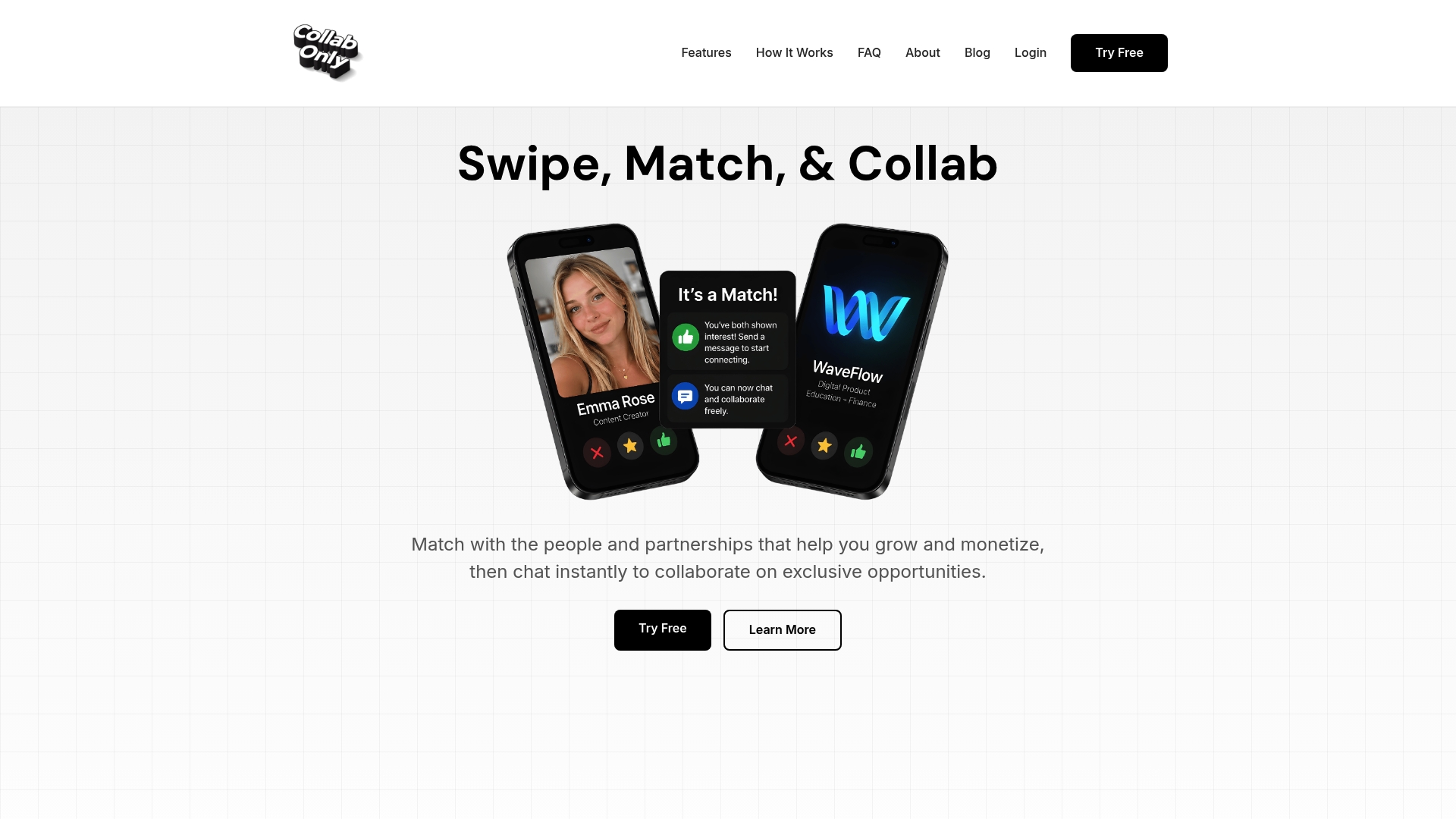
Collabonly removes that friction through a matching system that connects brands directly with nano and micro influencers aligned to their campaign objectives. Brands seeking nano influencer partnerships or looking to hire micro influencers can match, chat, and brief partners in a single platform, without the back-and-forth that slows traditional outreach. The swipe-to-match interface means brand managers spend time on creative decisions, not logistics. For teams ready to build campaigns with genuine creative partners, Collabonly is the starting point.
FAQ
What are partnership campaigns in marketing?
Partnership campaigns are collaborative marketing efforts where two or more brands co-create content, products, or experiences to reach shared audiences. They differ from sponsorships because both partners contribute creative input and share campaign ownership.
What makes a partnership campaign successful?
Successful partnership campaigns are built on co-creation, a clear guiding principle, and cultural relevance. Campaigns like Müller and Myprotein's "The Power of Two" show that addressing a real consumer need with a unified strategy drives measurable sales outcomes.
How do I choose the right partnership campaign format?
Match the format to your primary objective and your partner's core capability. Tech integrations suit brands with existing digital ecosystems, while social-first co-creative content works best for brands targeting rapid cultural reach with lower resource investment.
Can small brands run effective partnership campaigns?
Yes. Social-first formats and influencer co-creation require significantly lower resource investment than product collaborations or experiential activations. Nano and micro influencer partnerships deliver high engagement within defined audience communities without enterprise-level budgets.
How should brands measure partnership campaign results?
Track outcome metrics including sales growth, market share, and volume share rather than relying solely on impressions or reach. The Müller and Myprotein campaign measured value sales and volume share over 12 months, providing a clear picture of long-term business impact.