

Gift products to discover creators, test fit, and generate authentic content at low cost. Pay when you need guaranteed deliverables, usage rights, or a specific launch date. The strongest brand programs run both: gifting as the discovery funnel, paid deals as the scaled-up commitment, with FTC disclosure requirements shaping every outreach message along the way.
TL;DR:
- Gifting programs involve sending free products without contractual obligations, but creators should disclose the relationship if they post.
- Paid collaborations require clear contracts outlining deliverables, usage rights, timelines, and potential exclusivity, boosting the value of content.
- Switching from gifting to paid deals depends on engagement signals, content quality, and whether the creator has already proven their fit.
- Tracking gifted products against content creation time is essential to determine if accepting the gift remains a cost-effective choice.
- Automated platforms like Collabonly streamline discovery and conversion processes, preventing missed opportunities and speeding up creator onboarding.
Table of Contents
- Gifting vs Paid Collaborations: How Product Seeding Actually Works
- The Pros and Cons of Gifting for Brands and Creators
- What a Paid Collaboration Actually Buys You
- Building the Gifting to Paid Collaboration Pipeline
- How to Run a Gifting Program That Converts to Paid Deals
- How Collabonly Fits Into the Gifting and Paid Workflow
- An Editorial Take on the Gifting vs Paid Debate
- If Tracking Gifts and Conversions Feels Like a Full-Time Job
- Sources
- FAQ
Gifting vs Paid Collaborations: How Product Seeding Actually Works
Gifting, also called product seeding, means sending free product to a creator with no contractual obligation attached. The creator can post, ignore it, or mention it in passing. That distinction is the entire legal and strategic backbone of the practice: the moment a brand requires a post as a condition of the gift, the arrangement stops being a gift and becomes a sponsored relationship subject to different disclosure rules.
At scale, gifting programs follow a repeatable shape. Brands build a target list, ship product with light packaging or a personal note, and follow up once, gently, without pressure. There's no brief, no contract, no deadline. What there is, instead, is volume: a brand might gift to many creators in a niche to find those who create something worth building on.
The FTC's material-connection guidance still applies here. Even unpaid product carries value, so creators who choose to post about a gift should disclose the relationship voluntarily, and smart brands build that expectation into their outreach language rather than leaving it to chance:
- Use phrasing like "no obligation to post, but if you do, please disclose you received this as a gift."
- Never phrase outreach as "post by [date]" or "share to your story" when nothing is being paid for.
- Build a disclosure reminder into any automated follow-up sequence.
- Keep records of who received product and what, if anything, they posted.
Post rates vary sharply by category and creator tier. Visually strong categories (beauty, food, home goods) and nano and micro creators tend to post gifted product far more often than macro creators, who typically expect payment regardless of product value.
The Pros and Cons of Gifting for Brands and Creators
Gifting earns its place in a marketing budget because the math is simple: product cost replaces media spend, and the output, when it lands, tends to read as more authentic than a scripted paid post. For creators, gifting offers something different from cash. It's product access, portfolio-ready content, and a low-pressure way to build a relationship with a brand before either side commits to more.
The tradeoffs are real, though. Gifting gives brands no guarantee of output, no default usage rights to repost or boost the content, and a weak fit for anything tied to a launch date. A brand racing to hit a product-drop deadline cannot count on a gifted creator to post on time, or at all.
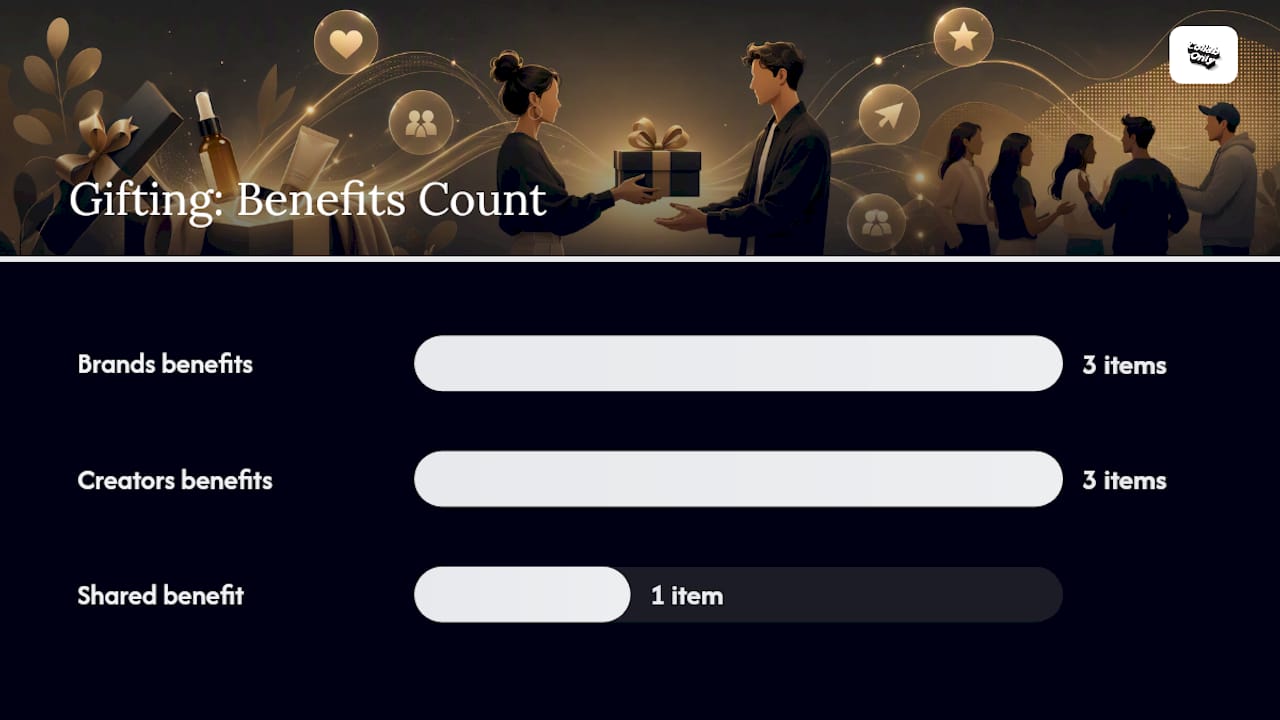
Benefits by side:
- Brands get discovery at scale, authentic UGC, and a growing contact list of proven creators without upfront cash commitment.
- Creators get free product, content for their portfolio, and an early relationship that can convert into paid work later.
- Both sides get a low-risk way to test fit before either commits budget or deliverables.
Deciding whether to accept a gifted offer comes down to one question: does the product cost less than the time it takes to shoot and edit content around it? If yes, and the brand fits your niche, accept. If a brand pushes deadlines or deliverable expectations onto an unpaid gift, that's a signal to decline or ask for payment instead.
Pro Tip: Track every gifted product you accept against the hours you spend creating content for it. If that math stops working in your favor, it's time to ask for paid terms.
What a Paid Collaboration Actually Buys You
A paid collaboration isn't compensation for goodwill. It's a purchase of specific deliverables, timelines, approval rounds, and usage rights spelled out in a contract, which is exactly what separates it from the open-ended nature of gifting. That contract typically covers:
- Deliverables: exact number and type of posts, stories, or videos, with content specs.
- Usage rights: whether the brand can repost the content on its own channels.
- Whitelisting: whether the brand can run paid ads through the creator's account handle.
- Exclusivity: whether the creator agrees not to work with competing brands for a set period.
- Timeline: posting dates tied to a launch window, sale, or campaign flight.
This is why paid deals are the only realistic option for time-sensitive launches, whitelisting campaigns, or macro-tier creators, whose audiences are too large to court with free product alone. Usage rights and whitelisting in particular change what the content is worth. A paid partnership with whitelisting rights turns one creator's video into a paid-media asset a brand can boost to a much larger audience, which raises the effective value of that single post well beyond its organic reach.
Rates shift based on creator tier, how many rights are included, exclusivity length, and current demand in that creator's niche. A nano creator granting full usage rights and boosting permissions will often charge more than a mid-tier creator who grants none.
Building the Gifting to Paid Collaboration Pipeline
Deciding between gifting and paid partnership gets easier once you frame it as five triggers: how predictable the output needs to be, whether you need usage rights, how much scale you're chasing, whether you already have proof this creator performs, and what tier they sit in. Any launch-critical need or rights requirement points to paid. Everything exploratory points to gifting.
The pipeline that connects the two looks like this:
- Discover: gift product broadly across a niche to surface creators worth watching.
- Evaluate: track post rate, content quality, and engagement against your account baseline.
- Convert: send a paid brief to top performers with clear deliverables and rights.
- Scale: build a recurring paid roster from creators who've already proven fit.
Industry guidance on influencer gifting programs consistently recommends this staged model. Measurable signals that justify conversion include engagement lift over your account's normal rate, any referral traffic or conversions tied to the post, and whether the creator's content is polished enough to reuse as paid media.
How to Run a Gifting Program That Converts to Paid Deals
- Target creators whose audience and content style match your product category.
- Send product with no strings attached and clear, optional disclosure language.
- Record who received product, when, and whether they posted.
- Follow up once, roughly a few weeks after delivery, with a helpful, non-transactional message.
- Evaluate post rate and engagement against your baseline metrics.
- Convert top performers with a paid brief: deliverables, rights, timeline, rate.
A follow-up might read: "No pressure at all, just checking if the product arrived okay!" A conversion email should look different: "We loved what you created and want to talk about a paid partnership with usage rights."
Pro Tip: Keep every follow-up soft and helpful, never transactional. The data you capture, not the pressure you apply, is what tells you who's worth paying.
How Collabonly Fits Into the Gifting and Paid Workflow
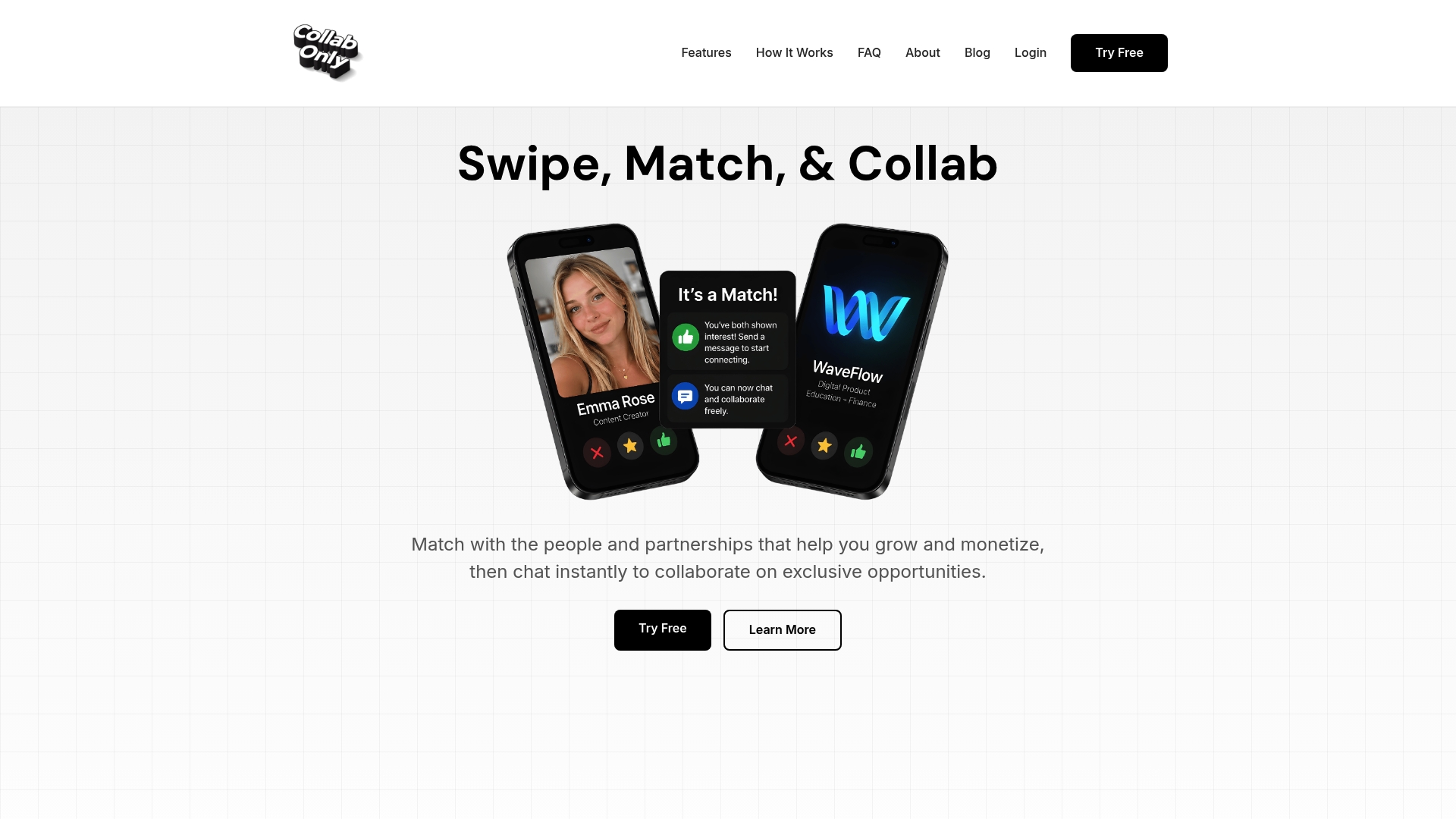
Running this pipeline manually across dozens or hundreds of creators is where most brands lose track of who received what. A swipe-based matching system with instant chat can support high-volume discovery and conversion tracking across TikTok, Instagram, and YouTube, without outreach getting buried in DMs or slow email replies.
An Editorial Take on the Gifting vs Paid Debate
Too many brands treat gifting and paid deals as competing philosophies instead of connected stages of the same pipeline. The mistake isn't picking the wrong one, it's failing to track the signals that tell you when to move a creator from one to the other. Watch engagement lift and content quality, not gut feeling, and let that data decide who gets a paid brief next.
— Samuel
If Tracking Gifts and Conversions Feels Like a Full-Time Job
Manually chasing down who received product, who posted, and who's ready for a paid brief eats up hours that should go toward actual campaign strategy. Such platforms can replace spreadsheet chaos with a swipe-based matching system and instant chat, so a match doesn't sit unanswered in a DM for days while a competitor locks in the same creator.
That speed matters most in the exact moment this article describes: catching a gifted creator's strong engagement lift and moving fast to convert them into a paid roster spot before another brand does. For teams building or scaling a nano-influencer program specifically, Collabonly's nano-influencer marketing tools are built to handle both the discovery-phase gifting outreach and the paid-conversion step in one place. Explore the nano-influencer page and see how many creators in your niche are already active on the platform.
Sources
- What You Need to Know About Gifted vs. Paid Collaborations for Content Creators
- Paid vs Gifted Collaborations
- Influencer gifting program guide
FAQ
How do gifted collaborations work?
A brand sends free product to a creator with no contractual requirement to post. Any post that follows is voluntary, and the creator should disclose the gift as a material connection if they choose to share it.
What does a paid collaboration actually mean?
A paid collaboration is a contracted deal where a brand pays for specific deliverables, a timeline, and usage rights, unlike gifting, which offers attention without guaranteed assets or rights.
Do influencers have to pay taxes on gifted products?
Gifted products generally count as taxable income at fair market value once a creator's gifting activity resembles business income rather than a one-off personal gift, so most professional creators should track and report gifted product value with an accountant's guidance.
How much do influencers charge for paid partnerships?
Rates vary widely by creator tier, usage rights, exclusivity, and niche demand, with nano and micro creators charging less than macro creators, especially once whitelisting or boosting rights are added to the contract.
When should a brand use Collabonly instead of manual outreach?
Once a gifting program outgrows spreadsheets and scattered DMs, a matching platform like Collabonly helps track discovery, conversations, and conversion signals in one place across multiple social platforms.