

Influencer marketing produces measurable, positive returns when three elements are in place: proper attribution infrastructure, incrementality testing against a holdout group, and KPIs that map to actual business outcomes rather than vanity metrics. Without those three, ROI numbers are guesses dressed up as data. The first move, before a single creator gets paid, is building an attribution plan.
TL;DR:
- Accurate influencer ROI measurement requires comprehensive cost calculation, including production, gifts, amplification, and licensing, not just creator fees.
- Proper attribution setup with standardized UTMs, unique promo codes, and defined conversion events is essential before launching campaigns.
- Incrementality testing using holdout groups helps identify true campaign lift by excluding sales that would have occurred anyway, providing more reliable ROI estimates.
- KPIs must be aligned with campaign goals, with awareness campaigns focusing on reach and sentiment, while direct-response efforts prioritize revenue and cost per acquisition.
- Using a centralized tracking and matching platform reduces measurement friction, enabling faster testing, more reliable data, and clearer reporting to leadership.
Table of Contents
- What Is Influencer ROI, and How Do You Calculate It?
- Why Measuring Influencer ROI Matters for Budget Decisions
- Which KPIs Matter Depend on the Campaign's Goal
- How to Measure Influencer ROI: Attribution and Tracking Setup
- Incrementality Testing: Proving the Lift Is Real
- What ROI Benchmarks Actually Tell You
- How to Improve Influencer ROI Across Selection, Creative, and Ops
- How to Report Influencer ROI to Leadership
- A Marketplace's View on Reducing Measurement Friction
- Run Your Next Campaign With Measurement Built In
- Sources
- FAQ
What Is Influencer ROI, and How Do You Calculate It?
Influencer ROI measures the financial return generated by a campaign relative to what it cost to run. The core formula, endorsed across measurement frameworks, is straightforward: (Total Revenue − Total Costs) ÷ Total Costs × 100. A campaign that generates $15,000 in attributed revenue against $5,000 in costs returns 200% ROI.
The tricky part is what belongs in "Total Costs." Most brands undercount by including only the creator's flat fee. A complete figure adds production support, gifted product, paid amplification spend, usage rights licensing, and any platform or agency fees tied to the campaign. Skip any of these and the ROI figure looks inflated.
Two related concepts matter here. Earned media value (EMV) estimates what the exposure would have cost as paid media, useful for awareness campaigns but a poor stand in for revenue. Customer lifetime value (CLV) captures what a converted customer is worth beyond the first purchase, which matters because a single campaign can look weak on immediate ROI while quietly building a base of high value repeat buyers. Blending CLV into your ROI model, rather than judging only first-touch revenue, changes the verdict on plenty of campaigns that look mediocre in month one.
Why Measuring Influencer ROI Matters for Budget Decisions
ROI is not a report card, it is the input that decides next quarter's budget. Brands that skip measurement tend to keep funding the creators who feel successful rather than the ones whose numbers prove it, and those are not always the same people.
Roughly 70% of marketers now measure influencer marketing ROI in some form, up sharply from where the category stood a few years ago. That shift reflects finance teams asking harder questions about marketing spend generally, and influencer budgets no longer get a pass just because the content looks good.
The catch is that ROI means different things depending on where a campaign sits in the funnel. An awareness push with a mega influencer should be judged on reach efficiency and brand lift, not last-click conversions. A bottom-funnel push with a niche creator using a promo code should be judged almost entirely on revenue and cost per acquisition. Sprout Social's framework recommends contextualizing ROI across the full customer journey rather than treating every post as a standalone transaction. Get that context wrong and you'll cut a creator relationship that was actually building your best future customers, or keep funding one that only ever drove cheap impressions.
Which KPIs Matter Depend on the Campaign's Goal
A single dashboard cannot serve an awareness campaign and a direct-response one. The metrics that prove success at the top of the funnel are close to irrelevant at the bottom, and treating them as interchangeable is where a lot of reporting goes wrong.
Immediate signals show whether content landed with an audience before any purchase behavior kicks in:
- Impressions and reach, to gauge raw exposure
- Engagement rate, weighted toward saves and shares over likes, since likes are the cheapest signal to inflate
- Comment sentiment, which flags a creator mismatch even when the engagement count looks healthy
Performance signals bridge attention to intent:
- Click-through rate on the link in bio, story swipe up, or shoppable tag
- Landing page conversion rate once traffic arrives
- Cost per click, benchmarked against your paid social costs for a sanity check
Revenue signals are what finance actually cares about:
- Attributed sales via promo code or UTM-tagged link
- Revenue per post, useful for comparing creators of different sizes on equal footing
- Cost per acquisition (CPA) and return on ad spend (ROAS) when amplification dollars are layered on
Long-term signals capture value that a 30-day attribution window misses entirely:
- Customer lifetime value of buyers acquired through influencer channels versus other channels
- Repeat purchase rate
- Branded search lift in the weeks following a campaign, which often shows up before sales do
For a pure awareness play, prioritize reach and sentiment. For consideration, prioritize click-through and landing page behavior. For anything meant to move product, CPA and revenue per post should be the numbers that decide whether the creator gets rebooked.
How to Measure Influencer ROI: Attribution and Tracking Setup
Attribution is where most influencer measurement plans fall apart, not because the concept is hard but because the setup gets rushed after the content is already live. Fix the tracking stack before the first brief goes out.
1. Build a UTM taxonomy before launch. Every link a creator posts needs consistent source, medium, campaign, and creator-name parameters, so a report six weeks later can filter by individual creator without manual cleanup.
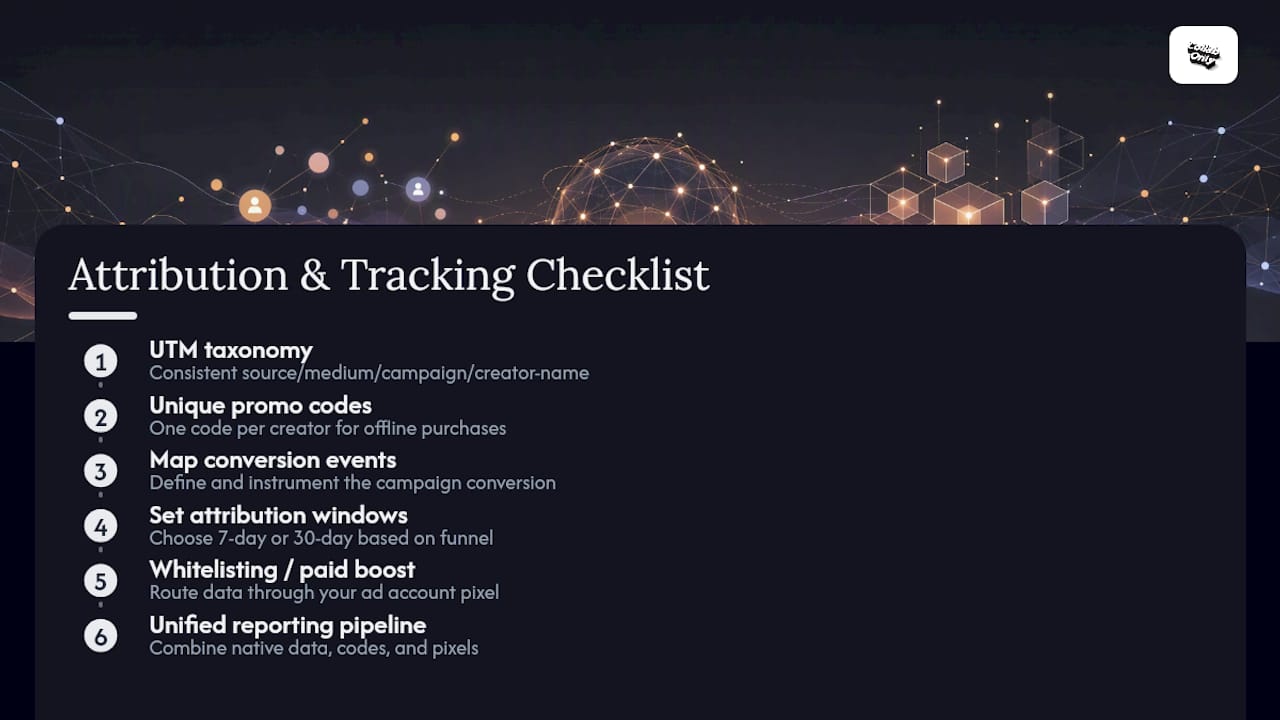
2. Assign a unique promo or affiliate code per creator. Codes solve the problem UTMs cannot: purchases that happen outside the click, like someone who saw a story, closed the app, and bought later on desktop.
3. Map conversion events before campaign launch. Decide whether "conversion" means a purchase, an app install, an email signup, or a cart add, and instrument that event in your analytics platform so every creator's report uses the same definition.
4. Set attribution windows deliberately. A seven-day click window suits impulse purchases; a 30-day window suits considered purchases like software subscriptions or furniture. Mismatched windows are a common source of ROI numbers that don't hold up to scrutiny.
5. Use whitelisting or paid amplification codes when you're boosting creator content as ads. This routes performance data through your own ad account's pixel instead of relying solely on the creator's self-reported screenshots.
6. Build a single reporting pipeline that pulls platform-native data, promo code redemptions, and pixel-based conversions into one sheet or dashboard, rather than reconciling three spreadsheets by hand every month.
Which attribution model to apply depends on funnel position. Last-click attribution works fine for direct-response codes where the path to purchase is short. Multi-touch attribution earns its complexity for longer sales cycles where a creator's content is one touchpoint among several. Modeled attribution, which statistically estimates influence when direct tracking is incomplete, becomes necessary once a campaign spans TikTok, Instagram, and YouTube simultaneously and no single platform sees the whole picture.
Cross-platform tracking inconsistency and dependence on creator-reported screenshots are the two most common points of failure in influencer reporting. Creators have no incentive to report a weak result accurately, and platform-native analytics rarely export cleanly into a brand's own attribution system.
Pro Tip: Require creators to grant collaborator access to their post analytics rather than accepting screenshots. Platform-native access lets you pull impressions and reach directly, which removes an entire category of reporting disputes before they start.
Getting this checklist right early makes the difference between a campaign report you can defend to finance and one that gets quietly ignored next quarter.
Incrementality Testing: Proving the Lift Is Real
Naive attribution has a structural flaw: it credits a creator for every sale that happens to follow their post, including sales that would have happened anyway. Someone who was already going to buy your product this month, and happened to see a creator's story first, gets counted as an influencer-driven conversion under most standard attribution setups. Incrementality testing exists to strip that noise out.

The simplest design is a two-cell holdout: split a comparable audience into an exposed group and a suppressed group that sees no creator content, then compare conversion rates between them. A three-cell design adds a group exposed to paid amplification on top of organic creator content, isolating how much lift the paid spend adds beyond the organic post alone. For always-on influencer programs, a rolling holdout rotates which regional or demographic segment gets suppressed each month, so measurement doesn't require pausing the entire program.
Contamination is the biggest threat to clean results. Content spreads organically past your intended targeting, and platform algorithms sometimes leak exposure into a "suppressed" segment anyway. Whitelisting the creator's handle for paid ads and using audience suppression lists are the standard mitigations, alongside keeping test cells geographically or demographically distinct enough that spillover is unlikely.
Once you have a clean lift percentage, converting it into a monetized ROI figure finance will accept means multiplying that incremental conversion rate by average order value and total addressable reach, then comparing the result against total campaign cost. That's the number that survives a budget review.
What ROI Benchmarks Actually Tell You
Benchmark figures circulate widely and get cited with more confidence than the underlying data supports. A frequently repeated figure from Tomoson's brand survey put average returns near $6.50 for every $1 spent, and other industry studies report ranges from roughly $5.20 to $6.50 per dollar. Treat these as directional, not predictive. Self-reported brand surveys skew toward respondents who had a good experience, and few of these studies isolate incremental lift.
The bigger driver of your actual number is campaign mix. A beauty brand running affiliate-code campaigns with micro creators will see a very different ROI profile than a SaaS company running a single awareness push with one large creator, even with identical budgets. Funnel position matters just as much as industry: a bottom-funnel push with strong offer mechanics routinely beats a top-funnel awareness campaign on pure ROI math, even when the awareness campaign delivers more strategic value.
A quick example: if a holdout test shows a 4% incremental lift in conversion rate across a 50,000-person exposed audience with a $60 average order value, that's roughly $120,000 in incremental revenue. Against a $20,000 campaign cost, that's a 500% ROI, comfortably inside the reported ranges but backed by an actual experiment rather than a borrowed industry average.
How to Improve Influencer ROI Across Selection, Creative, and Ops
Raising ROI is rarely about spending more. It's usually about fixing four specific leaks: who you hire, what you brief them to make, how you amplify it, and how efficiently your team runs the whole process.
- Selection: Prioritize audience fit and engagement quality over raw follower count; a creator with 40,000 highly engaged, niche-relevant followers regularly outperforms one with 400,000 broad, disengaged ones on cost per acquisition.
- Creative: Write briefs with a clear, single call to action rather than a list of talking points; ambiguous briefs produce content that looks great and converts nothing.
- Amplification: Boost your top three organically performing posts with paid spend within the first 48 hours, rather than spreading budget evenly across every piece of content regardless of early performance.
- Ops: Standardize rate cards by follower tier and engagement rate so negotiations don't start from scratch every time, and build a rights management process so strong content gets reused across owned channels instead of expiring after 24 hours.
Pro Tip: Ask every shortlisted creator for a screenshot of their past brand-partnership performance before you sign anything. A creator with weak historical engagement quality will not suddenly perform better because your product is better.
Automation helps at the ops layer specifically: templated briefs, standardized usage-rights contracts, and a repeatable creator matching process cut the administrative time that otherwise eats into the hours you'd spend analyzing results instead.
How to Report Influencer ROI to Leadership
An ROI report earns trust when it leads with the business outcome, not the content. Open with a one-line executive summary: total incremental revenue, overall ROI percentage, and the single best-performing creator or content format. Follow that immediately with your top three KPIs tied to the campaign's original goal, whether that's CPA, branded search lift, or CLV.
Meltwater's reporting guidance recommends pairing direct performance metrics with supporting brand signals like EMV and sentiment score, since a campaign can hit its revenue number while quietly damaging brand perception, and leadership needs to see both halves of that picture. A short slide deck works better than a dense spreadsheet: one slide for the summary, one for the KPI table, one for a sentiment or search-lift chart, and one for next-quarter recommendations.
Credibility comes from showing your work. Name the attribution window you used, describe the holdout methodology if you ran one, and state your sample size. A report that hides its methodology invites the exact skepticism it's trying to avoid.
A Marketplace's View on Reducing Measurement Friction
Most influencer ROI failures start before the campaign does, when deliverables are vague and creator data lives in scattered DMs. A matching platform that standardizes deliverables and centralizes chat, the way Collabonly does across TikTok, Instagram, and YouTube, gives brands a consistent format to pull usage rights, posting timelines, and analytics access from every creator, rather than renegotiating basics with each new partnership. That consistency is what makes a fast holdout test practical: matched creators, comparable terms, and a data structure built for comparison from the start.
— Samuel
Run Your Next Campaign With Measurement Built In
Collabonly is built for brands who want to test influencer ROI without the overhead of a full agency retainer, matching you directly with creators whose audience and engagement data are visible before you ever message them. The swipe-based discovery and instant chat cut the weeks normally lost to outreach and back-and-forth negotiation, which means your holdout test or pilot campaign can launch in days instead of a full quarter.
If you're specifically testing incremental lift on a smaller budget before committing to a larger program, start with the nano influencer marketplace, where smaller, highly engaged creators make a clean two-cell holdout design affordable to run. For a broader pilot across platforms and creator sizes, the influencer marketplace gives you the discovery and matching tools to build a comparable test group fast. Either path starts the same way: define your KPI, pick your attribution window, and match with creators whose audience data you can actually verify before you pay for a single post.
Sources
- Influencer Marketing ROI (Measurement Guide) | Sprout Social
- How to measure influencer marketing campaigns | Improvado
- Holdout tests for influencer incremental lift | Influencers-Time
FAQ
What does a 20% ROI mean for an influencer campaign?
A 20% ROI means the campaign generated a modest but positive return once all revenue and costs are accounted for using the formula (Total Revenue − Total Costs) ÷ Total Costs × 100. It's worth comparing against your other marketing channels before judging it as strong or weak.
How profitable is being an influencer?
Profitability varies enormously by follower count, niche, and how many brand deals a creator lands per month, with most income concentrated among a small share of top-tier creators. There's no single reliable figure for "average" creator profitability because compensation structures differ so widely across platforms and deal types.
How much does an influencer with 1,000,000 followers make per sponsored post?
Rates for creators at that scale vary widely based on platform, engagement rate, and content format, with no single standardized figure across the industry. Brands typically negotiate rates using engagement rate and historical campaign performance rather than follower count alone.
How do you calculate influencer marketing ROI?
Use the formula (Total Revenue − Total Costs) ÷ Total Costs × 100, making sure total costs include creator fees, production, gifted product, and any paid amplification spend. Pairing that number with an incrementality test gives you a more defensible figure than raw attribution alone.
What's the biggest mistake brands make when measuring influencer ROI?
Relying entirely on creator self-reported screenshots instead of platform-native analytics access or independent tracking through UTMs and promo codes. That single gap is behind most of the inconsistent, hard-to-defend ROI reports marketing teams bring to budget reviews.