

The most effective tips for building online communities share one structural principle: define purpose before platform, activate members before scaling, and enforce guidelines before growth creates enforcement problems. Six actions determine whether a new community reaches self-sustaining engagement or stalls at a ghost-town feed.
- Define a one-sentence community promise. Vague missions attract vague members. Write: "This community is for [specific person] who wants [specific outcome]." First task: draft that sentence today and test it on five potential members.
- Choose the minimal viable platform. Pick the simplest tool that supports your required behaviors (threaded discussion, direct messaging, basic moderation). First task: list three must-have behaviors, then select the platform that covers all three.
- Publish community guidelines on day one. Short, concrete rules prevent toxic norms from forming before you have the moderation capacity to correct them. First task: write five rules with one do/don't example each.
- Pre-seed 20–50 founding members before any public announcement. Practitioner guidance consistently shows that a community with visible activity converts new visitors; an empty one does not. First task: identify your first 20 invitees from existing contacts, subscribers, or followers.
- Design a 7-day activation path. Members who do not take a meaningful action in their first week carry a significantly elevated churn risk, according to Bonfire's 20 hard-won rules. First task: map one action per day for days 1 through 7.
- Avoid monetization until trust is established. Introducing paid tiers before members feel genuine value erodes the trust that makes a community worth paying for. First task: set a milestone (roughly 50 genuinely engaged members) as your monetization trigger.
Collabonly's swipe-based matching interface accelerates the pre-seeding step by connecting brands, creators, and fans who are already aligned on goals, reducing the cold-start problem that kills most early communities.
Pro Tip: Write your community's one-sentence promise on a sticky note and place it where you will see it every day. Every platform decision, content choice, and moderation call should pass a single test: does this serve that promise?
Key Takeaways
Building a self-sustaining online community requires a structured 90-day sequence: define purpose first, activate founding members before public launch, enforce guidelines from day one, and delay monetization until roughly 50 genuinely engaged members are present.
| Point | Details |
|---|---|
| Purpose before platform | Write your one-sentence community promise before selecting any platform or creating any channels. |
| First-week activation is critical | Members who do not take a meaningful initial action promptly have a significantly higher churn risk. |
| Guidelines on day one | Short, example-based rules published at launch prevent toxic norms from forming before moderation scales. |
| MAU over headcount | Track monthly active user percentage and first-week activation rate, not total member count. |
| Collabonly for founding cohort | Collabonly's matching system reduces cold-start friction by connecting community builders with goal-aligned creators and brands. |
Table of Contents
- What does your first 90 days of community building look like?
- How do you move from idea to an active, self-sustaining community?
- What do the research and practitioner rules actually say?
- How do you write guidelines and build a moderation system that scales?
- How do you convert new joiners into active members in the first 7 days?
- What content cadence keeps a community active without burning out the host?
- Which metrics actually predict community health?
- When should you introduce paid tiers, and how should you structure them?
- How do culture, roles, and structure need to change as you scale?
- What features should you evaluate when choosing a community platform?
- What the conventional wisdom on community building gets wrong
- Collabonly accelerates the hardest part of community building
- Sources
- FAQ
What does your first 90 days of community building look like?
A structured timeline prevents the two most common failure modes: launching too fast with no activity, and stalling after the initial burst. The sequence below maps the critical deliverables across week 1, month 1, and months 2–3.
Week 1: foundation
- Write and publish your one-sentence community promise and a short "who this is for" description.
- Create three core spaces: a welcome channel, a main discussion channel, and a resources channel.
- Publish your community guidelines (five rules minimum, with examples).
- Personally invite 20–50 founding members from your existing network.
- Post a welcome thread and ask each founding member one direct question to seed the first conversations.
- Set up your welcome message automation so every new joiner receives a response within 24 hours.
First 48–72 hours priority: Get at least 10 founding members to post a self-introduction. That visible activity is the social proof that converts the next wave of joiners.
Month 1: activation and cadence
- Establish a three-post-per-week host cadence (Monday prompt, mid-week resource, Friday wins thread).
- Select one or two moderators from your most engaged founding members.
- Run your first community event (an office hours session or a live Q&A works well at this stage).
- Track your first-week activation rate: what percentage of new joiners complete at least one meaningful action in their first seven days?
- Review your welcome flow and adjust based on where new members drop off.
Months 2–3: growth and measurement
- Run two to three growth experiments (referral invitations, a member spotlight series, a micro-challenge).
- Segment your most active members and give them a formal role (contributor, ambassador, or moderator).
- Execute a soft public launch: announce the community on one or two external channels and measure conversion.
- Conduct your first exit survey with any members who have gone inactive.
- Set a 90-day retention target and review your monthly active user (MAU) percentage against it.
| Milestone | Deliverable | Timing |
|---|---|---|
| Community promise published | One-sentence purpose statement live | Day 1 |
| Core spaces created | Welcome, discussion, resources channels | Day 1–2 |
| Guidelines published | Five rules with do/don't examples | Day 1 |
| Founding members onboarded | 20–50 members active | Week 1 |
| First activation metric | First-week action rate tracked | End of week 1 |
| Moderator selected | At least one moderator appointed | End of month 1 |
| First event completed | Office hours or AMA held | Month 1 |
| Soft public launch | External announcement on 1–2 channels | Month 2 |
| Exit survey deployed | Inactive member feedback collected | Month 2–3 |
| 90-day retention review | MAU% and activation rate benchmarked | Day 90 |
How do you move from idea to an active, self-sustaining community?
The sequence below follows a plan-build-launch-iterate cycle. Each step includes specific micro-tasks and a rough timing guide so you can move at a deliberate pace without losing momentum.
Step 1: plan (days 1–3)
Define your community promise in one sentence. Identify your target member profile: who they are, what problem they share, and what outcome they want from the community. Set two to three success metrics before you touch any platform. HubSpot's launch guidance is explicit on this point: choose your platform only after you have defined the behaviors you want members to exhibit, not before.
Metrics to define at this stage: first-week activation rate, 30-day MAU percentage, and a qualitative "would you miss this community?" score from your founding cohort.
Step 2: build (days 3–7)
Choose the platform that supports your required behaviors with the least complexity. Create three to five focused spaces. Seed three to five evergreen resource posts (a FAQ, a glossary, a curated reading list) so new joiners have something to consume immediately. Prepare your welcome flow: an automated welcome message, a day-3 follow-up, and a day-7 check-in.
Pro Tip: Resist the urge to create more than five spaces at launch. A community with ten empty channels signals low activity. Three active channels signal a healthy, focused group.
Step 3: soft launch (days 7–21)
Recruit your founding members through direct, personal outreach. Pre-seed five to ten discussion threads so the community does not look empty when they arrive. Personally welcome each of the first 50 members by name. Ask each one a specific question based on their profile or stated interest. That personal touch converts passive joiners into active contributors faster than any automated sequence.

Step 4: public launch (weeks 3–6)
Announce the community on your existing channels: email list, social profiles, and any partner networks. Run one early conversion experiment, such as a referral contest or a limited-time founding member badge. Micro-influencer outreach works particularly well at this stage: one creator with a highly engaged niche audience can deliver more qualified members than a broad paid campaign.
Pro Tip: Do not announce the community until you have at least 20 active members and five visible discussion threads. An empty community at public launch is harder to recover from than a delayed launch.
Step 5: iterate (ongoing, monthly)
Run a scheduled refresh cycle: review engagement data, refine your content cadence, update your welcome flow based on activation data, and reset your 30-day goals. The cycle is review, refine, welcome, engage, reset. Communities that skip the review step tend to plateau at whatever activity level they reached in month two.
What do the research and practitioner rules actually say?
The most credible guidance on community building converges on a short list of rules that practitioners have validated across hundreds of communities. These are not theoretical; they reflect patterns that consistently separate communities that grow from those that stall.
- Write guidelines on day one. Short, example-based rules are easier to enforce and prevent toxic norms from forming before you have the moderation capacity to address them. Bonfire's practitioner rules treat this as non-negotiable.
- Enforce consistently or not at all. Selective enforcement is more damaging than no enforcement because it signals that rules are negotiable. Every moderation decision sets a precedent.
- Act fast on toxicity. A single unaddressed toxic post shifts the perceived norms of the entire community. Speed matters more than perfection in the first response.
- The first seven days drive activation. Members who do not engage in their first week carry a substantially elevated churn risk. A structured welcome flow that pushes a first meaningful action within 48 hours is the single highest-leverage onboarding investment.
- Avoid monetizing too early. Introducing paid tiers before members feel genuine value erodes the trust that makes a community worth paying for.
- Design for peer-to-peer interaction. Communities where the host answers every question burn out their founders and produce shallow member relationships. The goal is member-to-member exchange, with the host guiding rather than dominating.
Statistic callout: Pew Research Center data found that 64% of Americans believe social media has a mostly negative effect on the country. That figure is a direct argument for safety-first moderation and explicit community guidelines: members join your community specifically to escape the toxicity of public platforms.
Academic research on online peer interactions and moderated groups supports the same conclusion: structured, moderated environments produce meaningfully better social connection outcomes than unmoderated ones.
Priority order for the first three months: guidelines and enforcement first, onboarding second, content cadence third, monetization last.
How do you write guidelines and build a moderation system that scales?
Guidelines fail in two predictable ways: they are too long to read, or too vague to enforce. The solution is short, concrete rules with one do/don't example each, published on day one and pinned where every new member will see them.
Sample guideline snippets for day one
- Be specific and constructive. Share your actual experience, not a generalized opinion. Do: "I tried X and found Y." Don't: "X is terrible."
- No self-promotion without context. Share your work only when it directly answers a question or adds to an active discussion. Do: "I wrote about this exact problem here." Don't: "Check out my new course."
- Respect disagreement. Challenge ideas, not people. Do: "I see it differently because..." Don't: Personal attacks or dismissive language.
- Stay on topic. Every post should connect to the community's stated purpose. Off-topic content will be moved or removed without warning.
- Report, don't retaliate. If you see a rule violation, use the report function. Do not engage with the offending post.
Moderator checklist
- Warning template: "Your recent post [specific post] did not meet our guideline on [specific rule]. Please review the guidelines. A repeat violation may result in removal from the community."
- Removal rule: remove content that violates guidelines within 24 hours of identification; log every removal with a timestamp and rule citation.
- Appeal process: any member who believes a removal was in error may submit a written appeal within 72 hours; a second moderator reviews all appeals.
- Burnout protection: no moderator should handle more than two hours of active moderation per day; rotate responsibilities on a weekly schedule.
Escalation flow
- Warn: Send a private warning with a specific rule citation and a link to the guidelines.
- Remove content: Remove the offending post and log the action.
- Temporary suspension: A 48-hour suspension for a second violation within 30 days.
- Permanent ban: Applied after a third violation or for a single severe offense (harassment, hate speech, spam). Log the ban with full context and retain the record.
Appoint at least one moderator by the time the community reaches 200 members. At that scale, a single founder cannot maintain response times without support.
Pro Tip: Select moderators from your most engaged founding members, not your most vocal ones. The best moderators are consistent, calm, and respected by the group, not necessarily the most active posters.
How do you convert new joiners into active members in the first 7 days?
Activation is the single metric most predictive of long-term retention. A member who completes one meaningful action in their first week is substantially more likely to still be active at 90 days. The goal of onboarding is to make that first action as easy and obvious as possible.
Statistic callout: Practitioners consistently cite a 70% churn likelihood for members who do not engage within their first seven days. A structured welcome sequence that drives a first action within 48 hours is the highest-leverage retention investment available to a community builder.
Recommended automated welcome sequence
- Immediately on join (day 0): Send a welcome message that includes the community's one-sentence promise, a link to the guidelines, and one specific action: "Introduce yourself in the welcome channel by answering these two questions: [question 1], [question 2]."
- Day 3 follow-up: "Have you had a chance to introduce yourself? Here are three recent discussions you might find relevant: [link 1], [link 2], [link 3]."
- Day 7 check-in: "You have been a member for a week. What is one question you have not found the answer to yet? Post it in the main discussion channel and the community will respond."
What counts as activation?
- Posting a self-introduction in the welcome channel
- Completing a profile (name, role, one-line bio)
- Posting a first comment or reply in any discussion thread
- Reacting to at least three posts
Track your first-week activation rate: the percentage of new joiners who complete at least one of the above actions within seven days. That number, reviewed monthly, tells you more about community health than total member count.
Building trust online follows the same principle: the first interaction sets the tone for the entire relationship. A welcome sequence that feels personal and specific converts at a higher rate than a generic "thanks for joining" message.
What content cadence keeps a community active without burning out the host?
A sustainable content rhythm starts host-heavy and transitions to member-led as the community matures. Most communities get stuck at 80/20 in the wrong direction because the host never explicitly designs for member contribution.
Starter cadence (weeks 1–8)
- Monday: A discussion prompt tied to the community's core topic. Format: one question, no more than three sentences of context.
- Wednesday: A curated resource (article, tool, framework) with a two-sentence explanation of why it is relevant.
- Friday: A wins thread. "What is one thing that worked for you this week?" This format generates member-sourced content with minimal host effort.
Event ideas that generate sustained engagement
- Monthly office hours: A 60-minute live session where the host answers member questions. Record and post the replay.
- AMA (Ask Me Anything): Invite a relevant guest or a highly engaged member to field questions for 48 hours in a dedicated thread.
- Monthly challenge: A structured 30-day challenge tied to the community's purpose. Participants post daily or weekly updates.
- Member spotlight: Feature one member per week with a short Q&A. Rotate through your most active contributors first.
- Micro-mastermind: Small-group sessions (four to six members) organized around a shared problem. These generate the highest-quality peer-to-peer connections.
Pro Tip: When a member posts something particularly useful, ask their permission to repurpose it as a pinned resource or a featured post. This signals that member contributions are valued and encourages others to post with similar quality.
Practical user engagement tactics confirm that predictable rhythms outperform sporadic high-effort posts. Members return when they know what to expect and when to expect it.
Which metrics actually predict community health?
Total member count is a vanity metric. The metrics below are the ones that predict whether a community will grow or stall.
Core metrics to track
- Monthly active users (MAU): The percentage of total members who take at least one action in a given month. Track this as a percentage, not a raw number.
- First-week activation rate: The percentage of new joiners who complete a meaningful action within seven days of joining.
- Reply-to-post ratio: The average number of replies per original post. A ratio below 1.0 indicates that members are posting but not engaging with each other.
- 30/60/90-day retention cohorts: Track what percentage of members who joined in a given month are still active at 30, 60, and 90 days.
- Exit survey responses: When a member goes inactive, send a short three-question survey. Ten exit responses are more actionable than any dashboard metric.
| Metric | What it measures | Growth lever |
|---|---|---|
| First-week activation rate | Onboarding effectiveness | Improve welcome sequence and day-3 follow-up |
| MAU percentage | Ongoing engagement | Strengthen content cadence and event frequency |
| Reply-to-post ratio | Peer-to-peer interaction quality | Add discussion prompts; reduce host-only posts |
| 30-day retention cohort | Early churn risk | Refine onboarding; add day-7 check-in |
| Exit survey response themes | Churn drivers | Address top-cited reasons in next refresh cycle |
For deeper context on growing a brand audience through community, MAU percentage and activation rate are the two numbers that most directly predict whether a community will generate sustainable ROI.
When should you introduce paid tiers, and how should you structure them?
The timing rule is straightforward: do not monetize before trust. A practical benchmark is roughly 50 genuinely engaged members who would feel a real loss if the community disappeared. Before that threshold, paid tiers signal that the community exists to extract value rather than create it.
Tier structure template
- Free tier: Access to the welcome channel, main discussion, and public resources. No time limit. This is the permanent entry point and the source of your future paid members.
- Mid tier ($X/month): Access to exclusive content, member spotlights, and monthly events. The price should be low enough to test willingness to pay without creating a significant barrier.
- Premium tier ($X/month): Access to all mid-tier benefits plus direct access to the host (office hours, private channel, or 1:1 sessions). Price-anchor this tier against the cost of a single consulting hour.
Monetization checklist
- Survey your most active free members before launching paid tiers: "Would you pay for [specific benefit]? What would be a fair price?"
- Announce paid tiers as an addition, not a replacement. Free members must still receive meaningful value.
- Grandfather your founding members into the free tier permanently. Their loyalty and activity are worth more than their subscription revenue.
- Test one paid benefit at a time. Do not launch a full three-tier structure until you have validated that at least one tier has genuine demand.
Pro Tip: The strongest signal that a community is ready to monetize is unsolicited requests: members asking where they can pay for more access. If you are not hearing that, the community is not ready.
How do culture, roles, and structure need to change as you scale?
Scaling triggers are predictable. The governance decisions that work at 50 members break at 200, and the structure that works at 200 breaks at 1,000. The rules below give you specific thresholds and the corresponding actions.
Scaling triggers and responses
- 200 members: Appoint at least one dedicated moderator. Document your moderation SLAs (response time targets, escalation steps). The founder can no longer handle moderation alone without compromising response quality.
- 500 members: Document your community's culture explicitly. Write a one-page culture document that captures your values, tone, and behavioral norms. New moderators and members should read it before participating.
- 1,000+ members: Introduce formal roles (contributor, ambassador, moderator, admin). Segment communications by member interest or activity level. A single announcement channel for 1,000+ members produces noise, not signal.
Channel policy
Add a new channel only when an existing channel can sustain at least three posts per week on its own. A channel that requires the host to post to stay active is a channel the community does not need yet.
Governance checklist
- Documented values and behavioral norms (written, pinned, and referenced in the welcome flow)
- Onboarding refresh cycle (review and update the welcome sequence every 90 days)
- Moderation SLAs (maximum response time for reported content: 24 hours)
- Exit-survey process (automated trigger when a member goes 30 days without activity)
- Moderator rotation schedule (to prevent burnout and maintain fresh perspectives)
Pro Tip: Document your culture before you think you need to. The communities that lose their identity at scale are the ones that assumed culture would maintain itself. It does not.
What features should you evaluate when choosing a community platform?
Platform selection is a consequential decision because migrating an active community is disruptive and costly. Evaluate platforms against the behaviors you defined in your planning phase, not against a generic feature checklist.
Feature checklist
- Search and indexed resources: Can members find past discussions and pinned resources without scrolling? Searchability determines whether your community accumulates knowledge or just generates noise.
- Moderation tools: Does the platform support warning systems, content removal, member suspension, and ban logs? Manual moderation at scale is unsustainable without platform-level tooling.
- Segmentation and roles: Can you assign different permissions to different member tiers (free, paid, moderator, admin)?
- Analytics: Does the platform report MAU, activation rates, and post-level engagement? If it only reports total members, you are flying blind.
- Payment gating: Can you restrict access to specific channels or content based on subscription status?
- Integrations: Does the platform connect to your email provider, Zapier, and SSO systems? Integration gaps create manual work that compounds at scale.
- Content permanence: Are discussions archived and searchable, or do they disappear after a set period?
Control vs. discoverability trade-offs
Owned or dedicated community platforms give you control over data, monetization, and feature sets. Research from the University of Michigan found that firms running their own social networks can capture better business outcomes than those relying solely on large public platforms. The trade-off is discoverability: public platforms have built-in audiences; owned platforms require you to drive traffic.
A practical approach: start on a platform where your target members already spend time, then migrate to an owned platform once you have validated demand and built a core member base. The real role of social media platforms in community building is acquisition, not retention. Owned infrastructure handles retention better.
Minimum viable setup
Three channels, a welcome flow, and basic moderation tools are sufficient for the first 90 days. Signs that migration to owned infrastructure is warranted: you are hitting platform limits on segmentation, your analytics needs exceed what the platform reports, or you are ready to introduce payment gating.
What the conventional wisdom on community building gets wrong
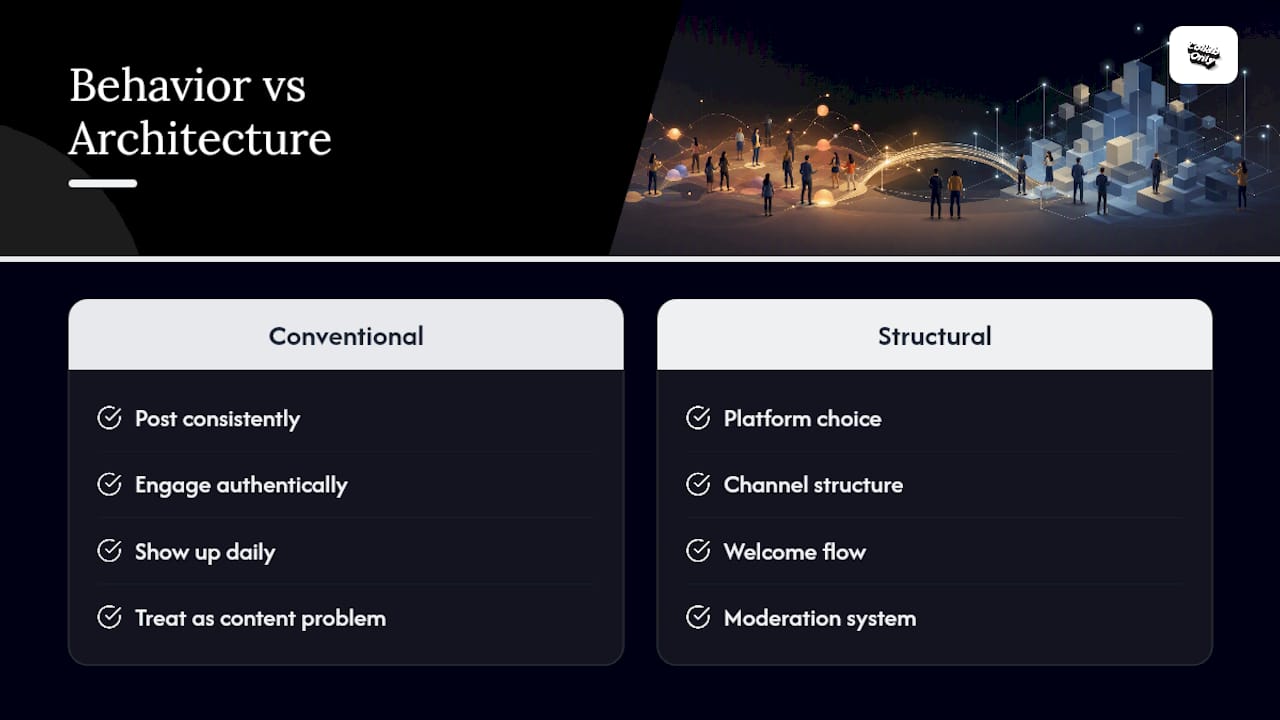
Most guides treat community building as a content problem. Post consistently, engage authentically, show up every day. That advice is not wrong, but it misses the structural decisions that actually determine whether a community reaches self-sustaining activity.
The real leverage points are architectural, not behavioral. The platform choice, the channel structure, the welcome flow, and the moderation system are set once and shape every interaction that follows. A community with a weak welcome flow will churn members regardless of how good the content is. A community with too many channels will dilute activity regardless of how engaged the host is.
The second thing most guides underweight is the cost of early monetization. Introducing paid tiers before members have internalized the community's value does not just slow growth; it reframes the entire relationship. Members who joined for peer connection start evaluating whether the community is "worth it" as a product. That shift is difficult to reverse.
The third, and most counterintuitive, point: the best community builders are not the most active ones. They are the ones who design systems that make member-to-member interaction the default. A host who answers every question is building dependency, not community. The goal is to make the host's absence feel manageable, not catastrophic.
Creator communities that drive sustainable ROI share one structural feature: they are designed for peer-to-peer exchange from day one, with the host in a curatorial rather than a central role.
Collabonly accelerates the hardest part of community building
The hardest part of building an online community is not the content or the platform. It is the cold start: finding the right founding members before you have social proof to attract them organically.
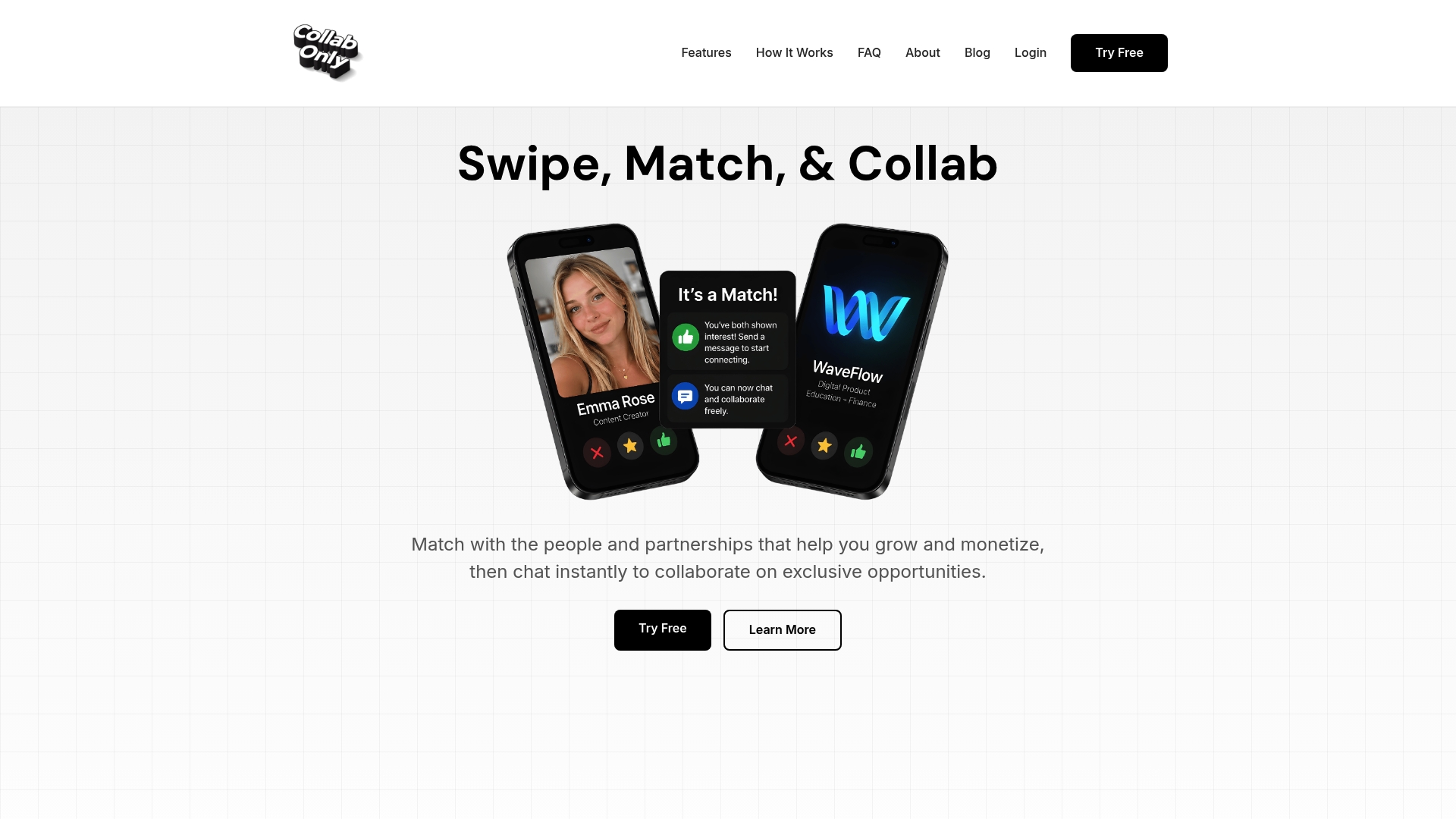
Collabonly's swipe-based matching system connects brands, creators, and fans who are already aligned on goals, making it the most direct path to a qualified founding cohort. Instead of cold outreach through DMs that go unanswered or email campaigns with low conversion, Collabonly delivers instant chat upon a match, so the conversation starts with mutual intent already established. For community builders who need to recruit 20–50 founding members quickly, the platform's discovery layer across TikTok, Instagram, and YouTube surfaces the exact profiles most likely to activate and contribute. Find and connect with creators whose audiences align with your community's purpose, then use those early partnerships to seed the discussions, events, and content that make a community worth joining. Start building your founding cohort on Collabonly today.
Sources
- Online Community Best Practices — 20 Hard-Won Rules | Bonfire
- 64% of Americans say social media have a mostly negative effect on the way things are going in the U.S. today | Pew Research Center
- Firms' own social networks better for business than Facebook | University of Michigan News
- How to Launch an Online Community | HubSpot Blog
- Systeme
FAQ
What is the most effective way to create an online community?
Define a specific one-sentence community promise, pre-seed 20–50 founding members before any public announcement, and publish clear guidelines on day one. According to HubSpot's launch guidance, defining desired member behaviors before selecting a platform is the step most builders skip and most regret.
What makes a good online community?
A good online community has a clear, specific purpose, consistent moderation, and a structure that encourages peer-to-peer interaction rather than host-dependent content. Members should be able to find value from other members, not only from the founder or host.
Which strategies work best for building a strong online community?
The highest-impact strategies are a structured first-week activation sequence (to reduce early churn), a predictable content cadence that transitions from host-led to member-sourced, and consistent guideline enforcement. Bonfire's practitioner research identifies the first seven days as the single most critical window for long-term retention.
What are the 5 C's of community engagement?
Definitions vary across practitioners, but a widely used framework covers: Content (relevant, consistent posts), Conversation (two-way dialogue between members), Curation (surfacing the best member contributions), Consistency (predictable cadence and enforcement), and Culture (documented norms that shape behavior). The relative weight of each shifts as a community scales.
When should a community start charging for membership?
Delay paid tiers until roughly 50 genuinely engaged members are present and members would feel a real loss if the community disappeared. Introducing monetization before that threshold reframes the relationship from peer community to product subscription, which is difficult to reverse.