

TL;DR:
- Effective content collaboration relies on clear goals, defined roles, and aligned workflows. Combining S.M.A.R.T. goals, goal-focused feedback, and human-AI workflows enhances productivity without sacrificing quality. Building a disciplined tech stack and promoting leadership-driven culture are key to long-term success.
Content collaboration is the strategic coordination of people and processes to create and promote content efficiently and effectively. The best content collaboration tips share a common foundation: clear goals, defined roles, and structured workflows that keep teams aligned without constant meetings. Applying the S.M.A.R.T. framework, tracking KPIs, and integrating human-AI workflows are the three practices that separate high-output teams from those stuck in revision loops. Collabonly connects brands, creators, and audiences within a single matching platform, making goal-aligned partnerships faster to form and easier to manage.
1. Set clear, measurable goals before work begins

The S.M.A.R.T. framework is the most reliable method for defining collaboration goals. Each goal must be Specific, Measurable, Achievable, Relevant, and Time-bound. A vague goal like "improve content quality" gives no team member a clear target. A S.M.A.R.T. version reads: "Reduce cross-team review response time to under 24 hours within one quarter."
Linking goals to KPIs with measurable performance expectations within 90 days is the standard that high-performing teams use. KPIs create accountability because every contributor can see whether the team is on track. Useful KPIs for content teams include content output volume per sprint, average review cycle length, and audience engagement rates per published piece.
- Define one primary KPI per collaboration goal.
- Set a 30-day checkpoint to assess early progress.
- Tie individual task deadlines to the overarching goal timeline.
- Document goals in a shared space every contributor can access.
Pro Tip: Write your collaboration goal as a single sentence that includes a number, a deadline, and a named outcome. If you cannot do that, the goal is not specific enough to track.
2. Define roles, responsibilities, and ownership upfront
Without clear role and permission structures, teams face chaos and rework, risking publishing unfinished drafts or overwriting each other's content. Role clarity is not a formality. It is the structural layer that prevents duplicated effort and costly errors.
Every collaborative project needs four defined roles at minimum:
- Content lead. Owns the brief, the narrative direction, and the final approval before publishing.
- Contributors. Writers, designers, or video producers who create within assigned lanes and do not edit outside their scope.
- Reviewer. A designated editor or strategist who checks for brand voice, accuracy, and goal alignment.
- Publisher. The only person with permission to move content from draft to live. This single-owner rule eliminates accidental publishing.
Approval workflows should move in one direction: draft to review to approval to publish. Circular workflows, where content bounces back and forth without a clear decision-maker, are the primary cause of missed deadlines in content teams. Assign a named decision-maker at each stage and document that structure before the first piece of content is created.
Pro Tip: Use a simple RACI matrix (Responsible, Accountable, Consulted, Informed) to map every role to every task. It takes 20 minutes to build and saves hours of confusion per project.
3. Choose tools that match your team's actual workflow
Too many apps in a tech stack cause fragmentation. The fix is not finding better tools. The fix is aligning the tools you already have with your mission and communicating expectations about how each tool gets used.
A functional content collaboration tech stack covers four categories:
| Category | Purpose | Example types |
|---|---|---|
| Project management | Task assignment, deadlines, progress tracking | Kanban boards, sprint planners |
| Shared documents | Real-time co-editing and version history | Cloud-based word processors |
| Communication | Synchronous and asynchronous team messaging | Chat platforms, video call tools |
| Version control | Tracking changes and preventing overwrites | Document history, approval logs |
The goal is one tool per category, not one tool per person. When team members use different apps for the same function, information fragments and decisions get made in silos. Standardize the stack, document which tool handles which function, and enforce that structure consistently.
Pro Tip: Audit your current tools quarterly. If a tool has not been used by the full team in 30 days, remove it from the stack. Dead tools create confusion about where the "real" work lives.
4. Build communication rhythms that protect focus time
Effective collaboration requires objective feedback tied strictly to goals, which shortens review cycles and preserves contributor morale. The most common communication failure in content teams is feedback that reflects personal taste rather than goal alignment. "I don't like this tone" is not useful feedback. "This section does not match the brand voice guidelines in our brief" is.
Structured communication practices that work:
- Schedule two fixed review windows per week instead of allowing ad hoc feedback at any time.
- Require all feedback to reference a specific goal or KPI from the project brief.
- Use asynchronous written comments for non-urgent input to protect deep work time.
- Send a weekly summary note to all contributors covering decisions made, blockers resolved, and next steps.
- Keep all project communication in one documented channel, not split across email, chat, and verbal conversations.
Asynchronous review windows and lane-based workflows focus contributor time and prevent the disruptive cycle of constant meetings and mid-draft editing. Teams that protect focus time produce higher-quality first drafts, which reduces total review cycles.
5. Establish a feedback culture grounded in goals
Feedback is the mechanism that turns a draft into a finished product. When feedback is goal-focused, it accelerates the review cycle. When it is opinion-based, it creates conflict and delays. The distinction matters because content teams often include contributors with strong creative instincts who interpret subjective feedback as personal criticism.
The rule is simple: every piece of feedback must answer the question, "Does this content achieve the stated goal?" If the answer is yes, the feedback is valid. If the answer is no, the feedback is a preference, not a requirement. Feedback focused on achieving clearly defined goals keeps morale and progress high. This principle applies equally to internal team reviews and to brand-creator partnerships where the brand and creator may have different aesthetic instincts.
Pair this with a content development workflow that documents each feedback round, so no comment gets lost and no revision gets repeated.
6. Integrate human-AI collaboration for scalable output
A human-AI collaboration model built around four phases, Plan, Create, Atomize, and Audit, is the current best practice for content teams that need to scale output without diluting quality. Each phase has a defined human and AI role.
- Plan. Humans define the strategy, audience, and goals. AI analyzes search data, identifies content gaps, and suggests topic clusters.
- Create. Humans write, record, or design the core content. AI assists with outlines, SEO formatting, and structural suggestions.
- Atomize. AI repurposes long-form content into social posts, email snippets, and short-form video scripts. Humans review each output for brand voice accuracy.
- Audit. Humans conduct the final quality review. AI flags technical issues such as broken links, keyword gaps, and readability scores.
This model keeps brand voice and narrative in human hands while AI handles the technical and repetitive scaling tasks. The role of AI in content strategy is to reduce production costs and increase output volume, not to replace the creative judgment that makes content worth reading. Teams that adopt this model report faster production cycles without the quality drop that comes from simply hiring more contributors.
7. Track performance and iterate on your collaboration process
Effective content teamwork does not end at publishing. The final phase of any collaborative content strategy is performance review, and it feeds directly back into the goal-setting phase. Teams that skip this step repeat the same inefficiencies in every new project.
Establish a post-project review cadence. After each major content piece or campaign, the team should assess three metrics: Did the content meet its KPI targets? Which collaboration stage caused the most delays? What single process change would have the greatest impact on the next project? Document the answers and update the workflow before the next project begins. This iterative loop is how teams improve collaboration over time, not by adding new tools, but by refining the human processes around the tools they already use. For practical formats that work across team sizes, the types of content collaborations guide covers structures from co-authored articles to full brand-creator campaigns.
Key Takeaways
The most effective content collaboration combines S.M.A.R.T. goals, defined ownership, a focused tech stack, and a human-led AI workflow to produce consistent, high-quality output.
| Point | Details |
|---|---|
| S.M.A.R.T. goals drive accountability | Link every collaboration goal to a KPI with a 90-day measurement window. |
| Role clarity prevents costly errors | Assign a named owner for each stage, including a single publisher with final approval rights. |
| Tech stack discipline reduces fragmentation | Limit tools to one per function category and audit the stack every 30 days. |
| Goal-focused feedback shortens review cycles | Require all feedback to reference a specific project goal, not personal preference. |
| Human-AI workflows scale output without quality loss | Use AI for technical tasks and scaling; keep humans in control of brand voice and final review. |
Why most collaboration advice misses the real problem
The standard advice on effective content teamwork focuses almost entirely on tools. Pick the right project management platform, use a shared document system, set up a communication channel. That advice is not wrong. It is just incomplete, and in practice, it leads teams to invest in software instead of behavior.
Most collaboration improvement fails because teams prioritize tools over behavioral structure. Leadership modeling collaborative behaviors drives real change. I have seen this pattern repeat across content teams of every size. The team adopts a new platform, spends two weeks configuring it, and then continues the same dysfunctional review process inside the new interface. The tool changes. The behavior does not.
The teams that actually improve do one thing differently: their leaders participate in the collaboration process visibly and consistently. They write feedback using the same goal-referenced format they ask contributors to use. They respect the asynchronous review windows they set for others. They document decisions in the shared channel instead of making calls in private messages. Culture in a content team is not what the handbook says. It is what the people with authority actually do.
The second thing those teams get right is protecting focus time as a structural priority, not a personal preference. A lane-based workflow with scheduled review windows is not about being precious with your calendar. It is about recognizing that deep creative work requires uninterrupted time, and that constant interruptions produce shallow drafts that require more revision cycles, not fewer.
— Samuel
How Collabonly connects you with the right collaboration partners
Finding the right partner is the step that most content collaboration guides skip entirely. You can have perfect goals, clear roles, and a clean tech stack, and still produce mediocre content if the brand-creator match is wrong.
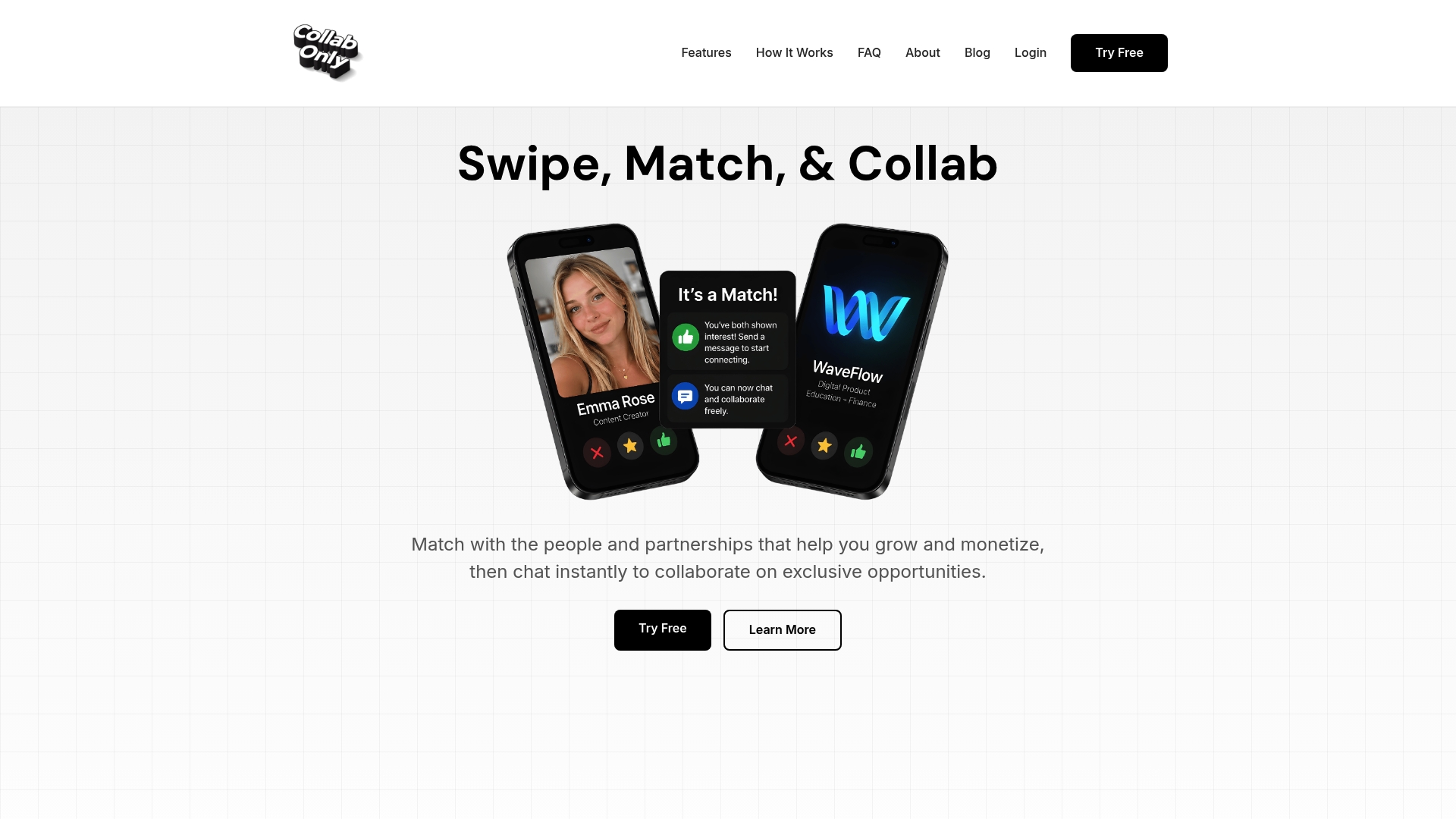
Collabonly solves the match problem directly. The platform connects brands with creators across TikTok, Instagram, and YouTube through a swipe-based matching system that eliminates slow email outreach and lost DMs. Brands seeking luxury lifestyle influencers on Instagram can find and connect with vetted creators whose audience demographics align with campaign goals. The same matching logic applies to pet influencers for dog brands and niche verticals where audience trust drives conversion. Instant chat upon matching means collaboration starts in minutes, not weeks.
FAQ
What is content collaboration in marketing?
Content collaboration is the coordinated process by which multiple contributors, including writers, designers, strategists, and brand partners, work together to create and promote content toward a shared goal. It includes internal team workflows and external brand-creator partnerships.
How do S.M.A.R.T. goals improve content collaboration?
S.M.A.R.T. goals give every contributor a specific, measurable target, which reduces ambiguity and makes performance tracking possible. Teams that link goals to KPIs within 90-day windows consistently improve accountability and output quality.
What causes the most delays in collaborative content projects?
Unclear roles and unstructured feedback loops cause the most delays. When no single person owns the final approval decision, content cycles through revisions indefinitely without reaching a publishable state.
How does AI fit into a content collaboration workflow?
AI handles technical and repetitive tasks such as SEO formatting, content repurposing, and readability analysis. Human-led, AI-accelerated models keep brand voice and creative direction in human hands while AI scales production volume.
How many tools does a content team actually need?
A functional content collaboration stack requires four tool categories: project management, shared documents, communication, and version control. One tool per category is the standard. Adding more tools without removing others creates fragmentation and reduces team efficiency.