

TL;DR:
- Choosing the right collaboration ideas enhances a creator’s strategic growth and audience engagement.
- Evaluating potential partners based on audience overlap, content compatibility, and relationship energy improves success.
Choosing the right collaboration ideas for creators is one of the most strategically consequential decisions you make as a content creator. Most creators approach partnerships by chasing follower counts or accepting whoever reaches out first, which explains why so many collabs underperform. The real differentiator is matching your creative goals, audience profile, and available resources to a format that produces measurable, repeatable outcomes. This article outlines a practical evaluation framework and ten concrete collaboration concepts, ranked and compared so you can move from idea to execution with confidence.
Table of Contents
- Key Takeaways
- Criteria to evaluate collaboration ideas for creators
- 10 collaboration ideas every creator should know
- Collaboration format comparison
- Situational recommendations for choosing the right format
- What I have actually learned about creator collaborations
- Find your next collaboration partner on Collabonly
- FAQ
Key Takeaways
| Point | Details |
|---|---|
| Engagement over follower count | Creators with smaller but highly engaged audiences consistently outperform larger passive followings in partnership outcomes. |
| Use a scoring framework | Evaluate potential partners on audience overlap, content compatibility, and practical feasibility before any outreach. |
| Format determines results | Different collaboration formats carry distinct trade-offs in effort, audience reach, and relationship durability. |
| Relationship energy matters | Partnerships built on genuine appreciation and trust produce more creative effort and better long-term results. |
| Repeatability signals success | One-off collabs rarely compound; recurring formats build anticipation and sustained audience growth. |
Criteria to evaluate collaboration ideas for creators
Before committing to any creative partnership concept, you need a scoring framework that goes beyond intuition. Audience overlap and engagement parity matter more than total follower count, because a partner with 15,000 highly active subscribers in your niche will deliver more meaningful cross-exposure than a partner with 150,000 passive followers who rarely interact.
The evaluation criteria that experienced creators use most consistently include:
- Audience overlap and engagement parity: How much does your partner's audience resemble yours in interest and participation level?
- Content format compatibility: Do your respective production styles, posting cadences, and platform preferences align well enough to co-create without friction?
- Motivation alignment: Are both parties driven by the same core objective (audience growth, skill development, revenue, community), or are the incentives misaligned from the start?
- Value exchange fairness: Does each side contribute equitably in terms of effort, assets, or distribution reach?
- Practical feasibility: Time zones, editing software, equipment access, and scheduling bandwidth are not minor details. They determine whether a collab ships or stalls.
- Relationship energy: Friendly, appreciative partners inspire extra effort and deeper commitment, which consistently produces better creative work.
Scoring candidates on these dimensions enables data-driven decisions rather than popularity-based guesses. A simple 1 to 5 rating across each criterion gives you a composite score that makes comparison objective and defensible.
Pro Tip: Run a 14-day post-collab scorecard tracking both leading indicators (new subscribers, content shares) and lagging indicators (retention rate, recurring engagement). This approach, rather than focusing on raw impressions, more accurately reflects true collaboration success.
10 collaboration ideas every creator should know
## 1. Multi-perspective content series
Two creators examine the same topic from opposing or complementary angles, releasing episodes in parallel or as a combined series. A fitness creator and a nutritionist co-producing a "training meets recovery" series is a straightforward example. Each side brings a distinct expertise layer, and the combined narrative is richer than either creator could produce alone.
The format works particularly well on YouTube and podcasts, where long-form depth is rewarded by the algorithm and by subscriber loyalty. It is also one of the more repeatable collaboration projects for artists and niche specialists because the structure scales across multiple episodes.
## 2. Skill swap partnerships
One creator provides video editing in exchange for graphic design, or copywriting in exchange for social media strategy. Skill swaps are among the most underutilized teamwork ideas for creators, particularly for independent creators operating without budgets.

The practical value is immediate: you receive professional-quality work you cannot produce yourself, and your partner gets the same. The social capital built through direct contribution often strengthens the relationship more than any revenue split would.
## 3. Joint content bundles or mini-courses
Two creators with complementary expertise co-produce an educational product, such as a photo editing course paired with a lighting tutorial from a second creator. Each side markets to their audience, and both benefit from the combined credibility.
Long-term co-created strategic alliances like these outperform one-off sponsorships because they position both creators as trusted advisors rather than promotional channels. The revenue split structure also creates a built-in incentive for both parties to promote actively.
## 4. Challenge streams and competitive co-creation
This format pairs two creators in a structured challenge — a cooking battle, a 24-hour creative sprint, a coding showdown — broadcast live or released as a series. The competitive framing generates natural tension and high viewer engagement. It is particularly effective for gaming, craft, and fitness creators where performance is visible and measurable.
The key success factor is production clarity. Setting clear objectives and timelines early prevents feedback bottlenecks and keeps the energy focused during recording. Without that upfront alignment, challenge formats often collapse under logistical confusion.
## 5. Resource sharing arrangements
Creators in the same city or creative ecosystem pool equipment, studio space, or software licenses. A photographer shares a lighting kit with a videographer in exchange for co-branded credits in published content. This format lowers production costs for both parties and often leads to organic creative collaboration as the relationship deepens.
The arrangement requires explicit agreements on usage schedules and replacement responsibilities. Without those boundaries, resource sharing can damage relationships faster than any bad collab video.
## 6. Creative fusion projects
A genre-crossing project where two creators blend their formats — a musician scores original tracks for a travel vlogger's series, or a digital illustrator designs custom animations for a tech reviewer's channel. Creative fusion is one of the more distinctive joint project ideas for influencers because the output is genuinely novel and difficult to replicate.
The audience discovery potential is high. Each creator's subscribers encounter a format they did not expect, which generates curiosity, shares, and cross-follows at above-average rates.
## 7. Community events and virtual meetups
Joint-hosted live sessions, AMAs (ask me anything), or community challenges where both creator audiences participate together. The format is particularly effective for building community depth rather than raw audience size, which aligns with the broader shift toward modern brand partnerships that prioritize genuine engagement.
Virtual meetups require minimal production overhead and can be executed on Instagram Live, Discord stages, or X Spaces with no budget at all.
## 8. Co-written articles, newsletters, or scripted videos
Two creators with distinct analytical or narrative voices co-author a piece that neither would have produced alone. A UX designer and a content strategist co-writing a piece on "designing for attention" is a practical example. The format is underused in the video-first creator space, which makes it a differentiator.
Co-written content also supports SEO and long-form discovery in ways that short video formats cannot, giving both creators a durable content asset with compounding search value.
## 9. AI-assisted co-creation workflows
Two creators use AI tools collaboratively to accelerate research, scripting, or content repurposing. One creator handles prompt architecture and output curation, while the other manages publishing and community response. This is one of the more forward-looking collaborative content strategies gaining traction in 2026.
Importantly, AI amplifies creativity rather than replacing it. The best partnerships in this format use AI for workflow efficiency while preserving each creator's distinct voice and perspective. Reviewing AI's role in marketing workflows gives useful context for structuring these arrangements practically.
Pro Tip: Assign clear ownership of AI outputs before production begins. Define who controls final editorial decisions to prevent creative friction and protect each creator's brand voice.
## 10. Recurring event series with fixed cadences
A monthly co-hosted episode, quarterly creator summit, or weekly collaborative post series that audiences can anticipate. Recurring formats are the most undervalued of all inspiring collaboration examples because they compound over time, building a dedicated cross-audience that neither creator holds independently.
Successful outreach for recurring series should be specific and value-focused, with a clear proposal for cadence, ownership, and mutual benefit. Vague or generic pitches rarely convert into durable collaborative commitments.
Collaboration format comparison
The table below maps the ten formats across five dimensions to help you identify the best fit for your current goals and constraints.
| Format | Audience growth potential | Effort required | Repeatability | Budget needs | Best for |
|---|---|---|---|---|---|
| Multi-perspective series | High | Medium | High | Low | Education and analysis creators |
| Skill swap | Low to medium | Low | Medium | None | Independent creators without budgets |
| Joint course or bundle | High | High | Medium | Low to medium | Educators and specialists |
| Challenge streams | Medium to high | Medium | High | Low | Live and performance-based creators |
| Resource sharing | Low | Low | High | None | Local creator communities |
| Creative fusion | High | High | Low | Medium | Audience discovery and brand building |
| Community events | Medium | Low | High | None | Community-focused and niche creators |
| Co-written content | Medium | Medium | Medium | None | Writers, analysts, and SEO-focused creators |
| AI-assisted co-creation | Medium to high | Low to medium | High | Low | Tech-forward and high-output creators |
| Recurring event series | High | Medium | Very high | Low | Creators prioritizing long-term growth |
Situational recommendations for choosing the right format
The right collaboration format depends directly on where you are in your creator trajectory. Generic advice to "just collaborate more" ignores the real strategic variables. Consider the following guidance when making your decision.
For creators in early-stage growth (under 10,000 subscribers or followers):
- Prioritize skill swaps and resource sharing to build relationships and production quality without financial exposure.
- Recurring event series with a peer-level creator can accelerate audience growth more efficiently than any single viral piece.
- Use a social media collaboration framework to evaluate metrics beyond impressions before committing to a format.
For mid-tier creators (10,000 to 100,000 followers) focused on deepening engagement:
- Joint courses and multi-perspective series are the highest-leverage formats because they convert casual viewers into committed community members.
- Creative fusion projects generate above-average share rates in this tier, particularly when the genre blend is unexpected and well-executed.
For established creators seeking strategic scale:
- AI-assisted co-creation and recurring series provide the repeatability and efficiency that high-output creators need.
- Outreach pitches should be specific, value-forward, and clearly structured around mutual benefit rather than generic requests.
Regardless of tier, first-time collaborators benefit most from low-effort, high-clarity formats such as community events or co-written content. These minimize execution risk while establishing the relationship foundation that more complex projects will require later.
What I have actually learned about creator collaborations
I have watched creators approach partnerships as purely transactional events, and it rarely produces work anyone is proud of. The most durable collaborations I have seen are built on what I would call relationship energy: a genuine appreciation for what the other person brings to the table, not just what their audience size adds to a distribution spreadsheet.
Here is my honest take. Most creators overestimate the value of a one-time collab and underestimate the compounding value of a recurring one. A single crossover episode might generate a subscriber spike. A monthly co-hosted series builds an audience that considers itself part of both communities. Those are fundamentally different outcomes, and only one of them compounds.
I also think the planning phase gets chronically undervalued. The creators who enter a collaboration with clearly documented objectives, defined roles, and an agreed feedback process consistently produce better work than those who "just see how it goes." Spontaneity is not a strategy. Clear planning is.
Finally, patience. The best partnerships I have observed took time to find the right rhythm. The early episodes or pieces were often rough. The relationship matured through iteration, honest feedback, and mutual investment. That process cannot be shortcut by platform features or algorithmic timing. It requires two people who respect each other's craft enough to stay in the process.
— Samuel
Find your next collaboration partner on Collabonly
Knowing the right collaboration ideas for creators is only half the equation. Finding the right partner to execute them is where most creators lose momentum.
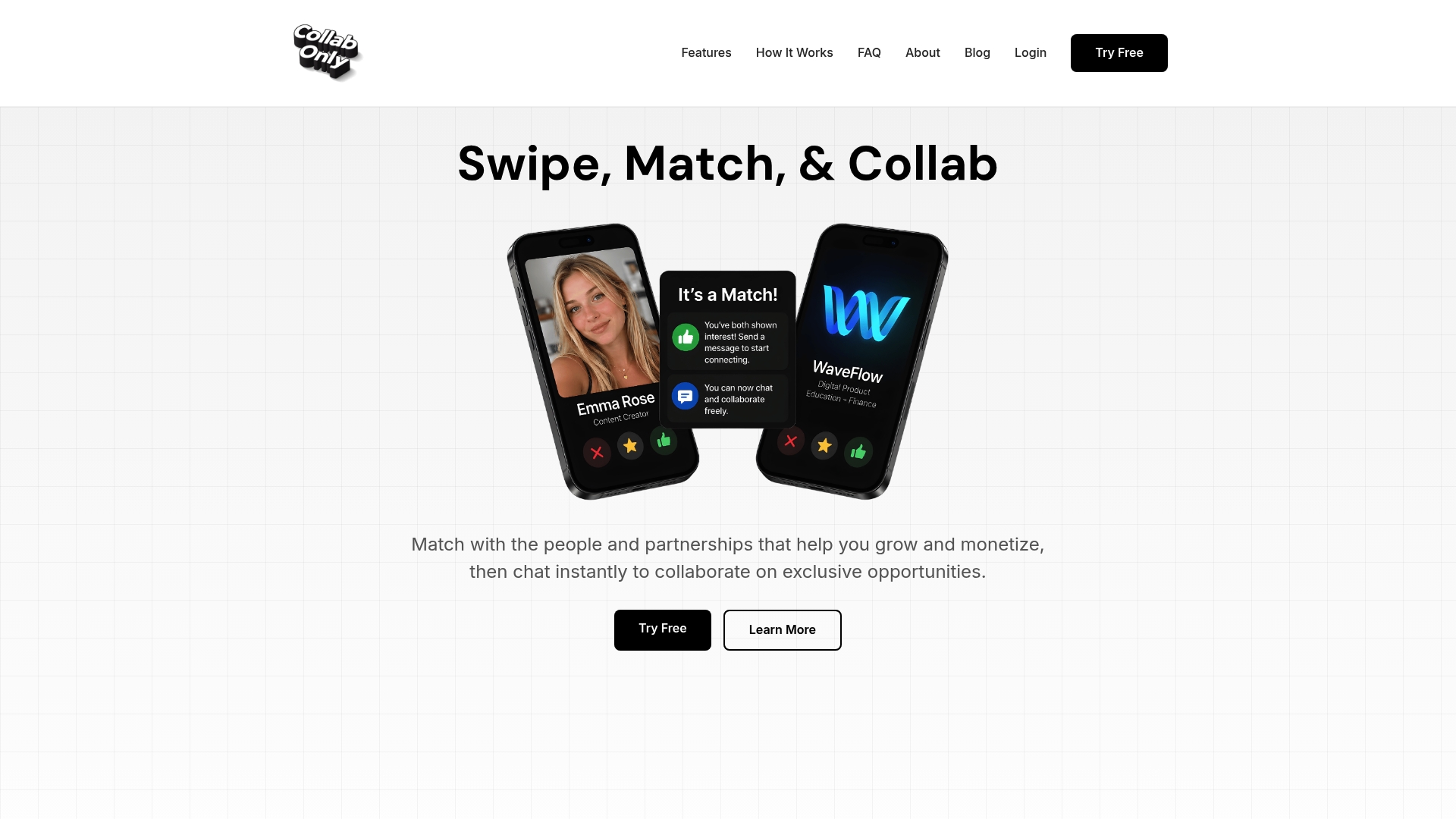
Collabonly was built to solve that specific problem. The platform's swipe-based matching system connects creators, brands, and collaborators based on audience alignment, content category, and partnership goals rather than raw follower counts. Once matched, instant chat removes the slow outreach cycle that kills collaboration momentum before it starts. Whether you are a nano creator looking for niche partnership opportunities or an established creator ready to build a recurring content series with a strategic partner, Collabonly surfaces the right matches without the friction. Start matching with creators whose goals, audiences, and content styles align with yours.
FAQ
What are the best collaboration ideas for creators just starting out?
Skill swaps and community co-hosted events are the most practical starting points because they require no budget and build real relationships. These formats also establish the trust needed for more complex joint projects later.
How do I evaluate a potential collaboration partner?
Score candidates on audience overlap, engagement parity, content compatibility, timezone alignment, and value exchange fairness. Data-driven partner scoring consistently produces better outcomes than selecting based on popularity alone.
Are recurring collaboration series worth the extra commitment?
Yes. Recurring formats compound over time by building a cross-audience that anticipates each release, which single collabs cannot replicate. The additional commitment pays dividends in long-term retention.
How does AI fit into creator collaboration workflows?
AI tools accelerate research, scripting, and content repurposing without replacing each creator's voice. The most effective setups assign clear editorial ownership so AI output enhances rather than dilutes the creative partnership.
How do how to collaborate with creators differ on large vs. small platforms?
On smaller platforms, community events and co-written content generate proportionally higher engagement because audiences are more concentrated. On larger platforms, multi-perspective series and joint courses benefit from algorithmic amplification and search discovery, making them higher-leverage formats at scale.