

TL;DR:
- Affiliate collaboration is a performance-based marketing model where brands pay commissions only after a measurable customer action occurs. It is distinct from partner marketing, which involves broader strategic relationships and retainer fees, with affiliates bearing promotional costs. Successful programs require clear attribution rules, audience alignment, compliance, and consistent communication to build long-term, mutually beneficial partnerships.
Affiliate collaboration is defined as a performance-based marketing partnership where a brand pays a promoter (an affiliate) a commission only after a measurable customer action occurs, such as a completed sale, a qualified lead, or a confirmed subscription. The industry term for this model is affiliate marketing, and the phrase "affiliate collaboration" reflects how brands and creators increasingly frame it as a mutual, relationship-driven arrangement rather than a transactional vendor exchange. Understanding this distinction matters because it shapes how programs are structured, how affiliates are recruited, and how long-term revenue is built. Platforms like Collabonly, programs like the Automattic Creator Program, and compliance frameworks from Shopify all operate within this same foundational model.
What is affiliate collaboration and how does it work?
Affiliate collaboration is performance-based: payment is contingent on an agreed outcome, attributed through a tracking layer that connects customer events back to the specific affiliate who drove them. The brand functions as the advertiser, supplying the product, the offer, and the commission structure. The affiliate functions as the promoter, supplying the audience, the content, and the distribution channel.

This model separates affiliate marketing from nearly every other form of paid media. A brand running display ads or sponsoring a podcast pays upfront regardless of results. In affiliate collaboration, brands pay no upfront media cost. The affiliate absorbs their own promotional costs, whether that means producing YouTube content, writing SEO articles, or running paid social ads, and recoups those costs through earned commissions.
The tracking layer is the operational backbone of the entire arrangement. Every affiliate receives a unique tracked link or discount code. When a customer clicks that link and completes the target action within the attribution window (commonly 30 days), the platform records the event and credits the affiliate. Attribution models vary: last-click attribution credits the final affiliate touchpoint with the full commission, while multi-touch models distribute credit proportionally across every affiliate that influenced the customer journey. The choice of attribution model directly affects which affiliates get paid and how much, making it one of the most consequential decisions a brand makes when designing a program.
Pro Tip: Set your attribution model before recruiting affiliates. Changing from last-click to multi-touch after launch creates retroactive commission disputes that erode trust and stall program growth.
Key structural components of any affiliate collaboration program include:
- Tracked links or unique promo codes assigned per affiliate
- A defined commission rate (percentage of sale or fixed dollar amount)
- A tracking window specifying how long after a click a conversion qualifies
- Eligible event types (sale, lead, app install, subscription renewal)
- Payment schedule and minimum payout thresholds
How does affiliate collaboration differ from partner marketing?
The terms "affiliate collaboration" and partnership marketing are often used interchangeably, but they describe structurally different arrangements with different risk profiles, contract lengths, and relationship depths. Conflating them leads to misaligned expectations on both sides of the deal.
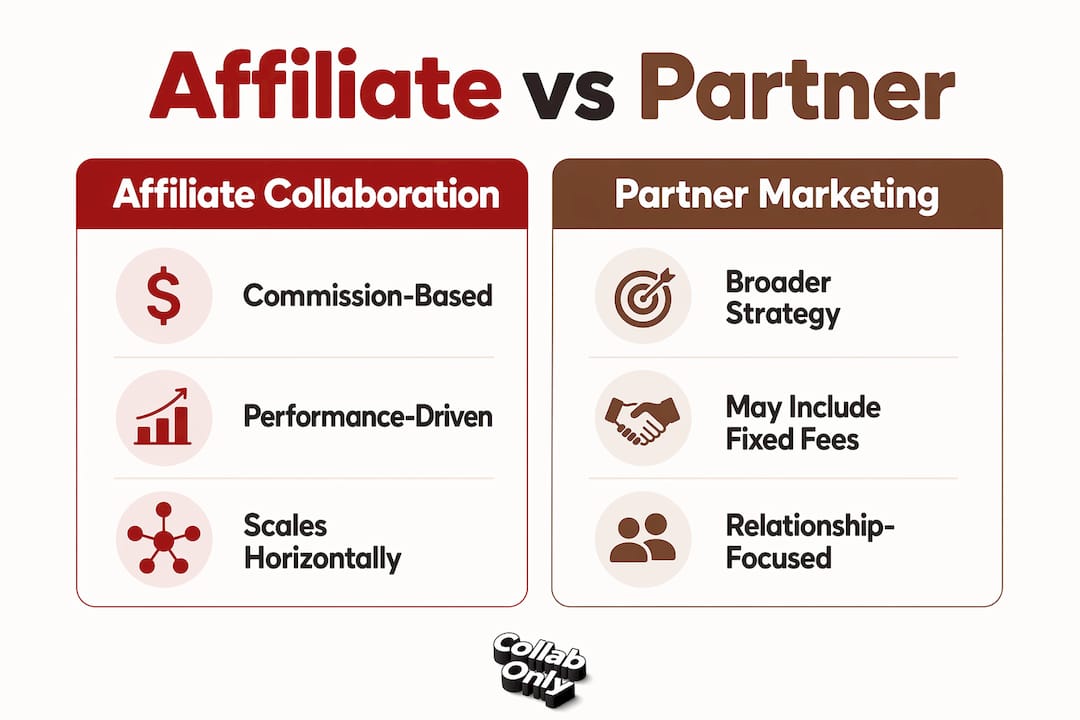
Affiliate marketing is commission-based and performance-driven, while partner marketing is broader and more strategic, often involving retainer fees, co-branded campaigns, joint product development, or shared go-to-market resources. An affiliate earns only when results are delivered. A strategic partner may receive a monthly retainer regardless of immediate conversion outcomes, in exchange for deeper integration into the brand's marketing ecosystem.
| Dimension | Affiliate collaboration | Partner marketing |
|---|---|---|
| Compensation | Commission on results only | Retainer, flat fee, or hybrid |
| Relationship depth | Transactional, scalable | Strategic, relationship-driven |
| Risk distribution | Affiliate bears promotional cost | Shared between both parties |
| Contract length | Often open-ended or rolling | Fixed term with renewal clauses |
| Scale potential | High (hundreds of affiliates) | Lower (select strategic partners) |
The practical implication is that affiliate collaboration scales horizontally. A brand can onboard hundreds of affiliates simultaneously because each one operates independently and is compensated only on results. Strategic partner marketing scales vertically, deepening a smaller number of high-value relationships. Neither model is superior. The right choice depends on whether the brand needs broad reach at low fixed cost or concentrated strategic alignment with a few key players.
Pro Tip: If a creator asks for a guaranteed monthly fee with no performance component, that is a partner marketing conversation, not an affiliate one. Treat it accordingly: negotiate deliverables, exclusivity, and reporting requirements before signing.
How to implement and maximize affiliate collaboration success
Execution quality separates programs that scale from programs that stall. The following steps reflect the operational sequence that consistently produces measurable results for both brands and creators.
-
Choose your program structure. Brands can manage affiliate programs directly through in-house software or via affiliate networks such as ShareASale, Impact, or CJ Affiliate, which handle tracking, payments, and affiliate recruitment. Direct programs offer more control over commission rules and affiliate relationships. Networks offer faster access to an existing pool of vetted affiliates.
-
Define commission economics before recruiting. Set a commission rate that is competitive within your product category while preserving margin. Establish the tracking window, eligible conversion events, and any tiered bonuses for high-volume affiliates. Clear attribution rules upfront prevent disputes that block scaling.
-
Recruit affiliates aligned with your audience. A fitness supplement brand placing affiliate links with a personal finance creator will generate low conversion rates regardless of commission generosity. Audience alignment between the affiliate's content niche and the brand's product category is the primary driver of conversion quality. Tools like the Collabonly influencer marketplace allow brands to filter creators by platform, niche, and audience demographics before initiating contact.
-
Build compliance into onboarding. FTC disclosure requirements mandate that affiliates disclose material connections clearly and visibly, placed with the endorsement itself. Non-compliant disclosures expose both the brand and the affiliate to regulatory risk. Include disclosure language templates in your affiliate onboarding kit and audit published content periodically.
-
Consider hybrid incentive structures. Hybrid models combining a monthly retainer with performance commissions stabilize creator earnings while maintaining outcome alignment. This structure is particularly effective for mid-tier creators (100,000 to 500,000 followers) who produce consistent content but face revenue volatility from commission-only arrangements.
-
Monitor attribution and optimize commissions continuously. Review which affiliates drive the highest conversion rates, average order values, and customer lifetime values. Increase commissions for top performers, pause or restructure agreements with low performers, and test new creative formats with emerging affiliates.
What do effective affiliate collaboration examples look like?
Concrete examples clarify what commission economics and program design look like in practice.
The Automattic Creator Program offers commissions of up to $300 per sale with a 30-day tracking window, illustrating how software and SaaS brands structure high-ticket affiliate programs. The 30-day window is standard across most categories, giving affiliates sufficient time to capture delayed purchase decisions without creating indefinite commission liability for the brand.
Commission rate benchmarks vary significantly by product category:
| Product category | Typical commission range | Notes |
|---|---|---|
| SaaS and software | 20% to 40% of first payment | High margin supports higher rates |
| Physical consumer goods | 5% to 15% of sale value | Lower margin compresses rates |
| Financial products | Fixed $50 to $200 per lead | Lead-based, not sale-based |
| Digital courses and info products | 30% to 50% of sale value | High margin, low fulfillment cost |
Influencer tier also affects compensation structure. Nano-influencers (under 10,000 followers) typically operate on commission-only terms because their audience size limits guaranteed value. Macro-influencers (500,000 to 1 million followers) frequently negotiate hybrid arrangements, combining a flat content fee with a lower commission rate. This reflects the strategic value of blending performance accountability with relationship-building across different creator tiers.
Common pitfalls in commission design include:
- Setting tracking windows shorter than the average purchase decision cycle, which undercounts legitimate conversions
- Failing to specify whether commissions apply to first-time purchases only or include renewals and upsells
- Using last-click attribution in multi-channel campaigns, which systematically underpays affiliates who drive early-stage awareness
- Neglecting to audit AI-driven affiliate tools for attribution accuracy when automated agents are involved in the conversion path
Key takeaways
Affiliate collaboration succeeds when brands define precise attribution rules, align creator incentives with program economics, and treat affiliates as accountable partners rather than passive distribution channels.
| Point | Details |
|---|---|
| Performance-based structure | Brands pay commissions only after a measurable customer action is confirmed. |
| Attribution model selection | Choosing last-click versus multi-touch attribution determines which affiliates get paid and how much. |
| Affiliate vs. partner marketing | Affiliate collaboration is transactional and scalable; partner marketing is strategic and relationship-driven. |
| Hybrid compensation | Combining a retainer with commissions stabilizes creator earnings and aligns outcomes for both parties. |
| Compliance is non-negotiable | FTC disclosure requirements apply to every affiliate post, and brands are responsible for enforcing them. |
Why affiliate collaboration requires a partnership mindset, not just a payment system
From my perspective, the single most common failure mode in affiliate programs is treating them as a payment mechanism rather than a relationship system. I have reviewed programs where brands set up tracking links, published a commission rate, and then waited for results. They got low-quality traffic, minimal conversions, and affiliates who quietly deprioritized their content in favor of brands that communicated, provided creative assets, and increased commissions for performance.
The brands that build durable affiliate revenue treat their top affiliates the way a sales organization treats its best account executives: with regular communication, performance feedback, early access to new products, and tiered incentives that reward loyalty. This is not sentiment. It is operational logic. An affiliate who generates $50,000 in monthly revenue for a brand has leverage. If that affiliate feels undervalued, they redirect their audience to a competitor's program.
The distinction between affiliate collaboration and platform-based collaboration is also worth internalizing. Affiliate programs embedded in broader collaboration platforms give brands access to creator data, audience analytics, and direct communication channels that standalone affiliate networks do not provide. That infrastructure difference compounds over time. Brands using richer platforms make faster decisions about which affiliates to invest in and which to restructure.
My practical advice: define your attribution model, your commission economics, and your compliance requirements before you recruit a single affiliate. Then recruit for audience alignment, not follower count. And communicate with your affiliates monthly, at minimum. The programs that scale are the ones where affiliates feel like partners with skin in the game, not contractors waiting for a payment.
— Samuel
Find and manage affiliate collaborations through Collabonly
Collabonly connects brands and creators through a swipe-based matching system designed to eliminate the friction of cold outreach, unanswered DMs, and slow email threads. Brands can filter creators by niche, platform, and audience size, including specialized segments like luxury lifestyle influencers on Instagram, to identify affiliates whose audiences match their product category precisely.
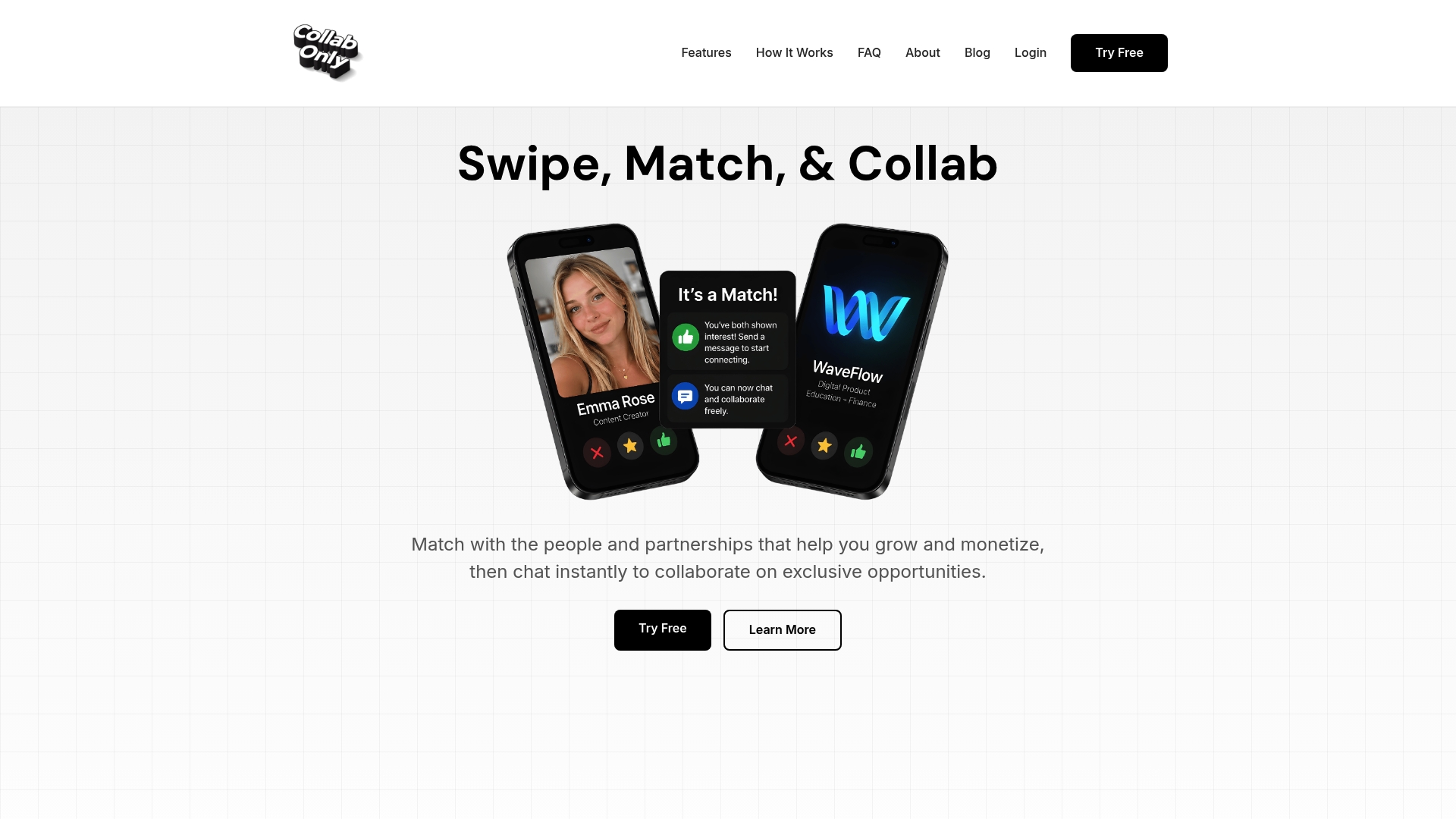
Once matched, brands and creators communicate through instant chat, agree on commission structures, and track collaboration performance without switching between multiple tools. For brands building affiliate programs and creators looking for brand deals that align with their content, Collabonly provides the matching infrastructure and communication layer that makes affiliate collaboration operationally practical from day one.
FAQ
What is affiliate collaboration in simple terms?
Affiliate collaboration is a marketing arrangement where a brand pays a creator or publisher a commission only after that affiliate drives a measurable result, such as a sale or a qualified lead. No result means no payment, which distinguishes it from sponsorship or retainer-based deals.
How does affiliate collaboration differ from influencer marketing?
Influencer marketing typically involves a flat fee paid upfront for content creation and audience exposure, regardless of conversion outcomes. Affiliate collaboration pays commissions on results only, making it performance-based rather than reach-based.
What attribution model should brands use for affiliate programs?
Last-click attribution is the most common default, crediting the final affiliate touchpoint with the full commission. Multi-touch attribution is more accurate in multi-channel campaigns but requires more sophisticated tracking infrastructure to implement correctly.
Are affiliates required to disclose their partnerships?
Yes. FTC guidelines require that affiliates disclose material connections clearly and visibly, placed directly with the endorsement. This applies to social media posts, blog content, video descriptions, and any other format where an affiliate promotes a brand in exchange for compensation.
What commission rates are typical in affiliate collaboration programs?
Commission rates range from 5% to 15% for physical goods, 20% to 40% for SaaS products, and 30% to 50% for digital courses. Fixed-dollar commissions are common in financial services, where a confirmed lead may pay $50 to $200 regardless of the eventual sale value.