

A repeatable influencer campaign workflow runs through eight stages: goal-setting, audience mapping, discovery, vetting, outreach and contracting, briefing, approvals and launch, then tracking and reporting. Pairing this sequence with a single source of truth and automation at defined handoffs is what separates brands running five campaigns a year from those running fifty, especially as the global influencer market keeps expanding and competition for creator attention tightens. This guide includes templates, scorecards, and specific automation points for every stage.
TL;DR:
- Automation at key handoff points helps brands scale from five to fifty campaigns annually in a competitive influencer market.
- Defining goals, KPIs, and attribution methods before outreach ensures accurate measurement and effective targeting, especially regarding tracking for sales and conversions.
- Building a unified system of record with standardized templates for briefs, contracts, and scorecards reduces operational chaos as creator programs grow.
- Relying on a single platform for discovery, vetting, and communication, such as a matching system with instant chat, minimizes delays and errors in scaling influencer collaborations.
- Prioritizing foundational workflows before automating, and maintaining clear approval and disclosure procedures, prevents costly missteps during campaign launch and reporting.
Table of Contents
- What Does a Complete Influencer Campaign Workflow Look Like?
- How Do You Set Goals, KPIs, and Attribution Before Choosing Creators?
- Who Are You Actually Trying to Reach?
- How Should You Vet Creators Before Reaching Out?
- How Do You Handle Outreach, Contracts, and Disclosure?
- What Belongs in an Influencer Brief That Actually Works?
- What Should Happen Before You Hit Publish?
- How Do You Measure Whether the Campaign Actually Worked?
- Where Should You Automate the Influencer Campaign Workflow?
- What Templates Should You Set Up This Week?
- How Does a Single Collaboration System Reduce Operational Risk?
- What Do Teams Get Wrong When Scaling Creator Programs?
- How Collabonly Fits Into Your Influencer Campaign Workflow
- Sources
- FAQ
What Does a Complete Influencer Campaign Workflow Look Like?
The end-to-end creator operations model groups a campaign into eight functional stages: sourcing, outreach, contracting, production, approvals, tracking, payouts, and reactivation. Mapping those against time and decision points looks like this:
- Goals and KPIs (1 to 3 days): Lock objectives, budget, and attribution method before anyone touches a creator list.
- Audience mapping and platform mix (1 to 2 days): Define who you need to reach and where they actually spend time.
- Discovery and vetting (3 to 7 days): Build a shortlist and score candidates against a rubric, not gut feel.
- Outreach and contracting (5 to 10 days): This is the first gate. Deals stall here more than anywhere else in the pipeline.
- Briefing and co-creation (3 to 7 days): Deliver the brief, review drafts, manage revisions.
- Approvals (1 to 3 days): The second gate. Legal, brand, and disclosure sign-off before anything publishes.
- Launch and monitoring (1 day, plus a monitoring window): Coordinate posting times, tracking links, and paid amplification.
- Tracking and reporting (7 to 30 days): Early signal checks feed into a 30-day closed-loop review that ties to revenue or awareness KPIs.
Awareness campaigns compress the front end and extend the tracking window; performance campaigns do the opposite, front-loading vetting and attribution setup because every dollar needs to trace back to a sale.
How Do You Set Goals, KPIs, and Attribution Before Choosing Creators?
Every downstream decision in the influencer marketing process depends on what you define here. An awareness objective maps to reach, video completion rate, and share of voice. A conversion objective maps to cost per acquisition, click-through rate, and revenue per creator. Confusing the two is the single most common reason campaigns get judged unfairly after the fact.
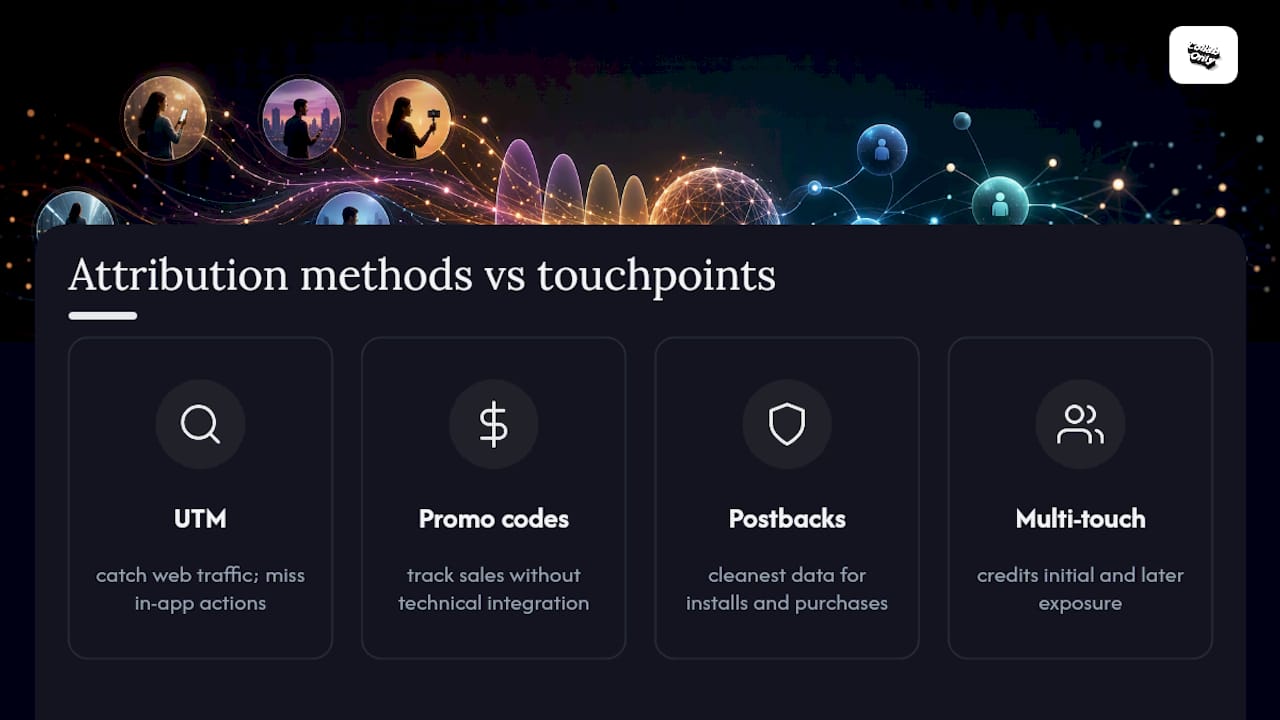
Attribution needs a plan before launch, not after. UTM parameters catch web traffic reliably but miss in-app actions on TikTok or Instagram. Unique promo codes solve that gap and double as a retail-friendly way to track sales without technical integration. Server-to-server postbacks give the cleanest data for app installs and purchases, feeding results directly into your ad platform or analytics stack instead of relying on self-reported screenshots from creators. For campaigns spanning multiple touchpoints, a multi-touch attribution framing that credits both the initial influencer exposure and a later retargeting ad tends to produce a more honest ROI picture than last-click alone.
Budget breaks into four buckets: creator fees, production support (if you're shipping product or covering shoot costs), paid amplification of top-performing posts, and tool subscriptions for discovery and reporting platforms. Most teams underbudget the fourth category and pay for it later in manual labor.
Pro Tip: Set your attribution method before you approach a single creator. Retrofitting tracking links after content goes live almost always means losing the first 48 hours of data, which is usually when engagement peaks.
Who Are You Actually Trying to Reach?
Discovery without a defined audience wastes time on creators who look impressive but reach the wrong people. Build a micro-persona first: age range, platform habits, content formats they engage with, and the type of creator voice that resonates with them. This step should live in your creative brief, not just your media plan.
- A B2C consumer brand chasing awareness usually leans TikTok and Instagram Reels, favoring short-form video with high completion rates.
- A B2B or considered-purchase brand often gets more mileage from YouTube long-form or LinkedIn creator content, where audiences expect depth over speed.
- Conversion-focused campaigns typically perform better with a higher volume of micro-influencers than a handful of macro names, since engagement efficiency tends to favor smaller, tighter audiences over broad reach.
- Audience overlap between a creator's followers and your customer base matters more than raw follower count.
- Comment quality (specific, on-topic replies versus generic emoji spam) is a faster fit signal than engagement rate alone.
Platform mix should follow the objective, not the trend. Chasing a channel because a competitor is active there, without checking whether your audience actually lives there, is one of the more expensive mistakes in influencer campaign planning.
How Should You Vet Creators Before Reaching Out?
Discovery happens through three channels: platform-native marketplaces and creator databases, inbound applications from creators who already want to work with you, and organic search for hashtags and niche communities your audience follows. Each surfaces different types of candidates, and running all three in parallel produces a stronger shortlist than relying on one.
Vetting is where most influencer outreach strategy efforts fall apart from rushing. Build a checklist and apply it consistently:
- Engagement quality — check whether likes and comments come from real accounts with post history, not follow-for-follow bots.
- Audience makeup — request or pull demographic breakdowns to confirm the follower base matches your target persona, not just the creator's stated niche.
- Growth pattern review — a sudden follower spike with flat engagement is a red flag for purchased followers or a bot wave.
- Requestable analytics — ask for screenshots of platform-native insights (reach, saves, audience location) rather than accepting a media kit at face value.
- Content history audit — scroll back three to six months to confirm brand safety and consistency of voice.
A simple scoring rubric turns this into something repeatable across a team: rate each candidate 1 to 5 on audience fit, engagement authenticity, content quality, and professionalism, then rank by total score. Anyone scoring below a set threshold, say 12 out of 20, gets cut before outreach begins, saving your team from negotiating with creators who were never going to work out.
How Do You Handle Outreach, Contracts, and Disclosure?
Outreach works best on a defined cadence rather than a single message and a hope. A first touch, a follow-up at day 3, another at day 7, and a final check-in at day 14 covers most response windows without feeling like harassment. Automating the follow-up reminders while keeping the first message personal is where teams find the biggest time savings without damaging the relationship.
Negotiation should lock five things before anyone signs: exact deliverables (post count, format, platform), usage rights (organic only, or paid amplification and how long), exclusivity terms (category lockout period), revision rounds included in the fee, and payment terms (net 15, net 30, or milestone-based). Leaving any of these vague is how disputes happen three weeks into a campaign.
Every contract needs a home in a central vault, not a scattered folder of PDFs. Track creator legal name, payment details, contract start and end dates, usage rights window, exclusivity terms, and renewal or reactivation eligibility in one record per creator. A contract terms toolkit with standardized clauses speeds this up considerably.
Disclosure isn't optional. FTC guidance requires material connections to be disclosed clearly at the start of sponsored content, and for video, that disclosure needs to be both spoken and shown on screen, not buried in a caption's fourth line.
What Belongs in an Influencer Brief That Actually Works?
A brief that's too rigid kills the authentic voice that made the creator worth hiring in the first place. A brief that's too loose produces content that misses the point entirely. The fix is a one-page structure that sets guardrails without scripting every word.
- Objective — one sentence stating what the content needs to accomplish.
- Audience — the micro-persona defined earlier in the process, restated for the creator.
- Key messages — two or three points that must appear, not ten that guarantee a robotic read.
- Deliverables — exact post count, format, and platform, with dimensions or duration specs.
- Legal and disclosure requirements — the exact disclosure language and placement expected.
- Timing — draft due date, feedback window, and final publish date.
Brief components that balance structure with creative freedom consistently produce fewer revision rounds, which matters because every extra round adds days to your timeline and friction to the relationship. Set a firm revision limit, typically two rounds, with a 48 hour turnaround SLA on each side. Usage rights and licensing terms should be tracked against the same contract vault fields established during negotiation, not re-litigated during production. If a brand wants to repurpose organic content into paid ads later, that right needs to exist in writing before the shoot, not after the content performs well. A reusable brief template removes most of the guesswork here.
What Should Happen Before You Hit Publish?
Approvals need named owners and time limits, or they become the bottleneck that kills a launch date. A typical flow: brand marketing reviews for message accuracy within 24 hours, legal reviews for disclosure compliance within 24 hours, and the creator gets final sign-off notification within 24 hours of both approvals clearing.
- Confirm every tracking link, UTM parameter, and promo code is live and tested before the creator has access to publish.
- Verify disclosure language is present and correctly placed in both the caption and, for video, on screen and spoken aloud.
- Lock the scheduled publish time with the creator and confirm time zone alignment.
- Assign one team member to monitor the first two hours post-launch for broken links, comment issues, or platform glitches.
- Set an escalation contact for both the brand side and the creator side in case something breaks mid-launch.
Launch day is where planning either pays off or falls apart in front of an audience. A checklist executed the same way every time removes the guesswork.
How Do You Measure Whether the Campaign Actually Worked?
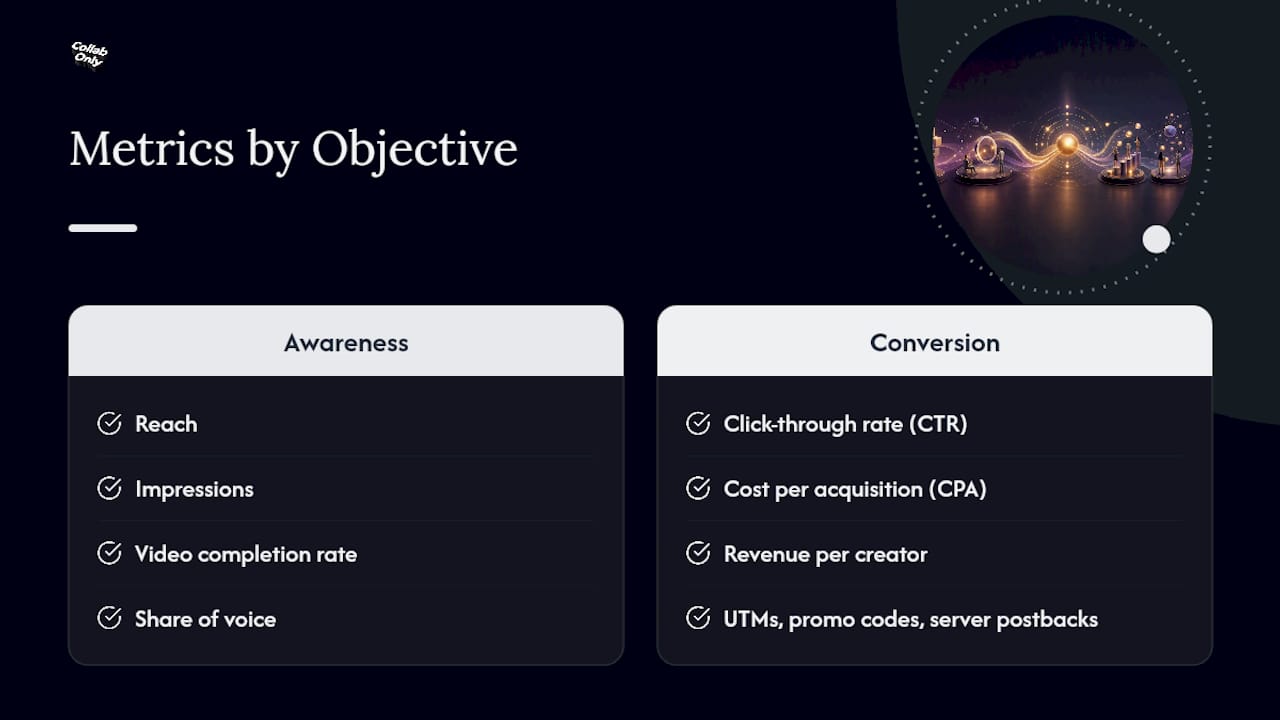
Measuring influencer campaign success starts with matching metrics to the objective set back in stage one. Awareness campaigns track reach, impressions, video completion rate, and share of voice. Conversion campaigns track click-through rate, cost per acquisition, and revenue per creator, instrumented through UTMs, unique promo codes, and server-side postbacks where app or in-store data is involved.
The measurement cadence matters as much as the metrics themselves. A 7-day signal check separates early engagement momentum from noise, catching underperformers early enough to shift budget toward amplification on the posts that are working. The 30-day closed-loop review is where attribution actually settles once delayed conversions, returns, and multi-touch paths have had time to resolve.
The influencer marketing market has grown large enough that treating measurement as an afterthought is no longer a minor oversight. It's a budget risk.
Build a creator scorecard that persists beyond a single campaign: engagement rate, CPA or CPE, content quality rating, responsiveness during production, and a simple extend/pause/drop decision field. Everyone else gets a clear, data-backed reason for the decision instead of a vague "it didn't feel right."
Where Should You Automate the Influencer Campaign Workflow?
Automation only helps when it's applied to the right stage. Discovery benefits from marketplace platforms that filter by audience demographics and engagement authenticity in bulk. Contracting benefits from templated agreements and e-signature tools that cut turnaround from days to hours. Publishing and scheduling benefit from calendar tools like the Xyla content calendar, which coordinates multi-platform posting times without manual reminders. Tracking and reporting benefit most from centralized dashboards that pull UTM and promo code data into one view instead of five spreadsheets.
- Discovery and vetting: marketplace filters, audience overlap tools, engagement authenticity checks.
- System of record and CRM: centralized creator database with contract status and payment history.
- Contracting: templated agreements, e-signature, automated reminder sequences.
- Review and approvals: shared review links with commenting and version tracking.
- Publishing: scheduling tools with time zone and platform-specific formatting.
- Tracking and reporting: dashboards pulling live UTM, promo code, and postback data.
Pilot new automation on one narrow slice of the pipeline first, like automated outreach follow-ups, and measure whether response rates hold steady. AI-driven campaign tools claim time savings of 10 to 20 hours per campaign by automating outreach, scheduling, and reporting, though results vary by team size and campaign complexity, so treat vendor figures as a directional target rather than a guarantee. Buy over build for most mid-size teams. Custom-built tracking only makes sense once campaign volume justifies the engineering time.
What Templates Should You Set Up This Week?
A small set of standardized artifacts does more for consistency than any single tool purchase. Store each in your system of record with a unique creator ID attached so records never get orphaned across spreadsheets.
- Brief template — one page, stored per campaign, linked to the creator record.
- Contract checklist — standardized clauses for deliverables, usage rights, and payment terms.
- Vetting scorecard — the 1 to 5 rubric from the discovery stage, reused for every candidate.
- Launch checklist — the pre-publish verification list, copied fresh for each campaign.
- Post-campaign scorecard — CPA, engagement rate, and the extend/pause/drop field.
Assign each creator a unique ID at first contact and carry it through every stage. This single habit is what makes reactivation for future campaigns fast instead of a rebuild from scratch.
How Does a Single Collaboration System Reduce Operational Risk?
Manual influencer campaign management breaks down the moment a team scales past a handful of active creators, mostly because outreach lives in email, contracts live in a shared drive, and performance data lives in three different spreadsheets that never quite agree with each other.
A single source of truth with unique creator IDs and linked assets cuts reconciliation work dramatically and enables automated attribution through server-side postbacks instead of manual data entry.
A matching platform addresses this by combining discovery, communication, and relationship data in one interface. The swipe-based matching system surfaces creators across TikTok, Instagram, and YouTube based on stated fit criteria. Instant chat upon a match replaces the outreach cadence problem entirely; there's no cold email sitting unread for a week. Because match, chat, and (eventually) contract status live in the same system, the creator record itself becomes the single source of truth referenced throughout this guide, rather than a separate spreadsheet someone forgets to update.
What Do Teams Get Wrong When Scaling Creator Programs?
The most common failure isn't picking bad creators. It's skipping the system of record until the team is managing forty relationships in someone's inbox, at which point untangling it costs more than building it right the first time would have.
The second failure is treating a scorecard as optional paperwork instead of the mechanism that turns "this creator felt great to work with" into a defensible extend or drop decision. The third is over-automating too early, particularly first-touch outreach, which still needs a human voice to land.
Teams moving from 10 creators to 100 should prioritize in this order: build the system of record first, standardize the brief and contract before adding volume, then automate follow-ups and reporting last. Skipping ahead to automation before the foundation exists just scales the chaos faster.
— Samuel
How Collabonly Fits Into Your Influencer Campaign Workflow
Every stage covered here, from discovery through outreach to contracting, tends to live in separate tools that don't talk to each other. That gap is exactly where most campaign management for influencers grinds to a halt, waiting on an email reply or a lost DM.
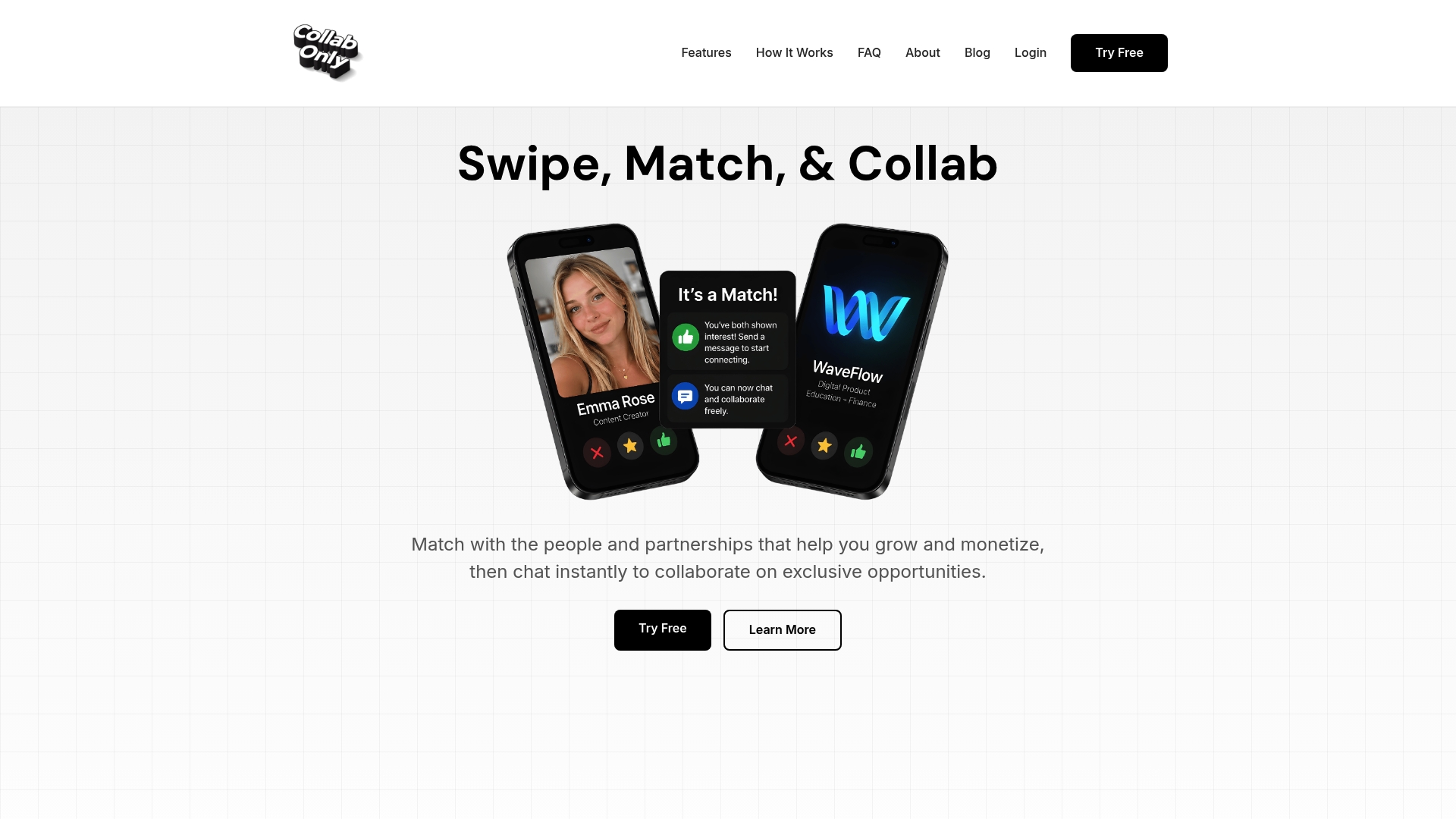
A swipe-based matching system puts discovery, vetting signals, and outreach in one place, then replaces the slow back-and-forth with instant chat the moment a brand and creator match. It works across TikTok, Instagram, and YouTube, so the platform-mix decisions covered earlier don't require juggling separate discovery tools per channel. Instead of chasing creators through email threads that go cold after three days, you're chatting with matches who already fit your stated criteria the moment they swipe right. For brands running influencer partnership workflow at any scale, from a first pilot campaign to a full creator program, that single point of connection removes the slowest, most error-prone part of the process. Visit the influencer marketplace to see available creators and start your first match today.
Sources
- End-to-End Creator Operations: A Single Workflow From Outreach to Reporting
- Influencer market size (statistic)
- Influencer Marketing Strategy: A 5-Step Guide for 2026
FAQ
What Is an Influencer Campaign Workflow?
It's the repeatable eight-stage process, from goal-setting through discovery, outreach, briefing, approvals, launch, and reporting, that brands use to run and scale influencer marketing campaigns consistently.
How Long Does a Typical Influencer Campaign Take?
Most campaigns run three to six weeks from initial goal-setting to launch, with discovery and outreach typically consuming the largest share of that timeline.
What KPIs Should I Track for Influencer Campaigns?
Match KPIs to your objective: reach, impressions, and video completion rate for awareness; click-through rate, cost per acquisition, and revenue per creator for conversion, instrumented through UTMs, promo codes, or server-side postbacks.
How Do I Vet an Influencer Before Signing a Contract?
Check engagement authenticity, audience demographic overlap with your target persona, follower growth patterns for red flags, and request platform-native analytics screenshots rather than relying on a media kit alone.
Can a Marketplace Platform Replace Manual Influencer Outreach?
A matching platform like Collabonly replaces cold email and lost DMs with instant chat upon a match, centralizing discovery and communication in one system rather than eliminating the need for vetting and contracting steps.
What Should Go in an FTC-Compliant Disclosure?
Disclosures must appear clearly at the start of sponsored content, and for video, they need to be both spoken aloud and shown on screen, not buried in caption text.