

Every influencer contract needs eight core provisions: campaign scope and deliverables, compensation and payment terms, content usage and licensing, FTC disclosure requirements, exclusivity restrictions, approval and revision procedures, confidentiality and non-disparagement language, and termination with indemnification and dispute resolution. Skip any one of these influencer agreement clauses and you invite the exact ambiguity that turns a paid partnership into a legal headache. The sections below break down how to draft and negotiate each one.
TL;DR:
- Clear definitions of parties, scope, and deliverables are essential to prevent disputes over contractual obligations.
- Specificity in content deliverables, posting windows, and technical specifications helps avoid misunderstandings and delays.
- Explicit payment schedules, including deadlines, split payments, and late fee terms, reduce late-payment issues.
- Limiting license scope and duration, especially for usage rights and exclusivity, protects creators from over-commitment and loss of income.
- Well-structured approval, revision, and termination clauses minimize campaign delays and ensure proper handling of breaches.
Table of Contents
- What Influencer Contract Terms Must Cover
- Campaign Scope and Deliverables
- Compensation and Payment Terms
- Content Usage, Licensing, and Ownership
- FTC Disclosure and Regulatory Compliance
- Exclusivity, Competitive Restrictions, and Post-Campaign Terms
- Content Approval, Revisions, Posting Schedule, and Technical Specs
- Confidentiality, Non-Disparagement, and Publicity
- Termination, Indemnification, Liability, and Dispute Resolution
- Practical Checklist and Negotiation Scripts
- Common Contract Failures and Practical Fixes
- Collab Only Helps You Coordinate Without the Chaos
- Sources
- FAQ
What Influencer Contract Terms Must Cover
The full range of influencer contract terms falls into eleven functional areas: parties and definitions, scope of work, deliverables, posting schedule, compensation, content approval, usage and licensing, exclusivity, FTC compliance, confidentiality, and termination, according to Conversion Studio's clause mapping. That structure exists because vague scope-of-work language is one of the most common sources of disputes between brands and creators, per Morgan Lewis's analysis of influencer agreement drafting.
Before either party signs anything, the contract needs clear definitions: who counts as the "brand," who counts as the "creator" (an individual, an LLC, or an agency acting on their behalf), and what "the campaign" actually means in scope and timeframe. Skipping this section sounds harmless until a dispute arises and nobody agrees on who was contractually obligated to do what.
Campaign Scope and Deliverables
Deliverables need to be countable, not descriptive. "Promote the product on Instagram" is not a deliverable. "Two Instagram Reels (60 to 90 seconds each), one static feed post, and three Stories within a 24-hour window" is.
A workable scope section specifies:
- The exact platforms and account handles involved
- Content type and count (Reel, static post, Story, YouTube integration)
- Required captions, hashtags (#ad or #sponsored), and account tags
- The exact posting window or date, not a vague "sometime in March"
Attach a one-page technical exhibit covering aspect ratio, file format, minimum video length, and resolution, with sign-off criteria for what counts as an accepted deliverable. A sample line might read: "Creator will publish one Instagram Reel (9:16, minimum 30 seconds, MP4) tagging @brand and using #ad, posted between June 3 and June 5, 2026." Specificity here does more to prevent disputes than any other single clause, a point Morgan Lewis makes repeatedly in its guidance for brands drafting these agreements.
Compensation and Payment Terms
Influencer compensation typically follows one of four structures: flat fees per campaign, per-post fees, monthly retainers for ongoing content, or performance-based and affiliate models tied to sales or clicks. Whichever structure you choose, the contract should state it plainly and attach a payment schedule.
Cover these payment mechanics explicitly:
- Invoicing requirements (net 15, net 30, required documentation)
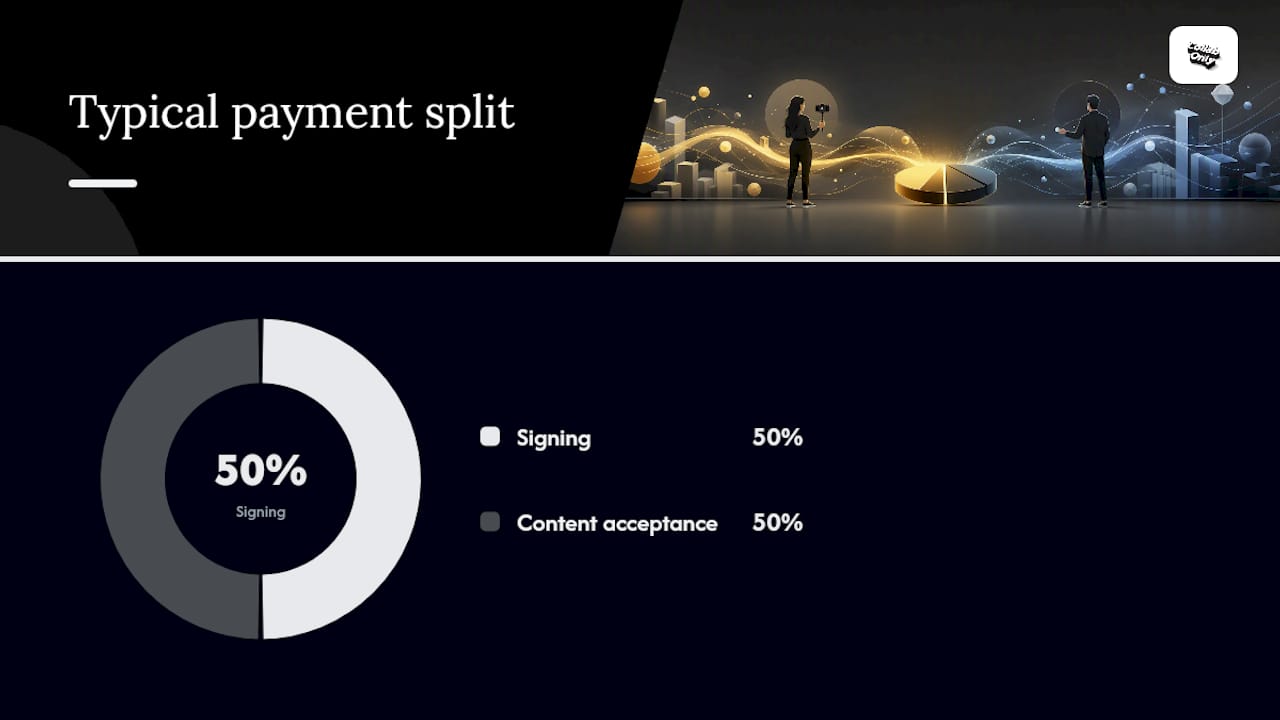
- A split schedule, commonly 50% on signing and 50% on content acceptance
- A kill fee (often 25 to 50% of the total fee) if the brand cancels after work has started
- Expense reimbursement rules and required receipts
- Tax reporting responsibilities (1099 issuance for US creators earning above IRS thresholds)
Statistic Callout: Unclear payment terms are a frequent driver of late-payment disputes between brands and creators, according to Conversion Studio's industry data. A 50/50 split tied to concrete milestones, rather than vague "upon completion" language, closes most of that gap.
Late-payment remedies matter too. Add a clause specifying interest on overdue invoices (commonly 1.5% monthly) and the creator's right to pause future deliverables until payment clears.
Content Usage, Licensing, and Ownership
Copyright ownership and usage rights are not the same thing, and conflating them costs creators money. Under US copyright law, the creator owns the content they produce unless the contract explicitly assigns ownership to the brand. Most brands do not need full ownership. They need a license broad enough to run the content where they want it.
A usage clause should specify:
- Duration: 30 days, six months, or perpetual (perpetual costs more)
- Channels: organic social only, versus paid ads, website, and email
- Territory: domestic use versus worldwide
- Exclusivity: whether the brand can license the same content to other advertisers
- Sublicensing and modification rights: whether the brand can edit or resell the content
Brands frequently request perpetual, worldwide, royalty-free rights by default. Creators should push back and negotiate a time-limited license, such as "90 days across organic and paid social," with a separate paid add-on for extended paid-media use, an approach Gross Law Group recommends when creators feel pressured to sign away broader rights than the campaign actually requires.
FTC Disclosure and Regulatory Compliance
The Federal Trade Commission holds both the brand and the creator liable when a sponsored post lacks a clear, conspicuous disclosure of the material connection between them, per the FTC's endorsement guidance. That joint liability is exactly why disclosure language belongs in the contract itself, not left to the creator's discretion.
The disclosure needs to be hard to miss, not buried in a caption or hashtag pile. Platform-native labels like Instagram's "Paid Partnership" tag or a standalone #ad at the start of a caption both satisfy the standard when used correctly.
Effective contract language should require:
- A specific disclosure format per platform (#ad, #sponsored, or the platform's built-in paid-partnership tag)
- Placement at the start of the caption or clearly visible on-screen in video
- A screenshot submitted to the brand within 24 hours of posting as proof of compliance
If the brand scripts specific product claims, the contract should state who is legally responsible for verifying those claims are truthful, since platform disclosure labels differ (TikTok's label reads differently than YouTube's), and inconsistent labeling across platforms is a common compliance gap.
Exclusivity, Competitive Restrictions, and Post-Campaign Terms
Exclusivity clauses go wrong in two ways: the competitor category is too broad, or the window runs too long without extra pay. "No skincare brands" is reasonable. "No beauty, wellness, or lifestyle brands" is not, unless the fee reflects that scope.
Negotiate exclusivity using these guardrails:
- Define the competitor category narrowly, by product type, not industry
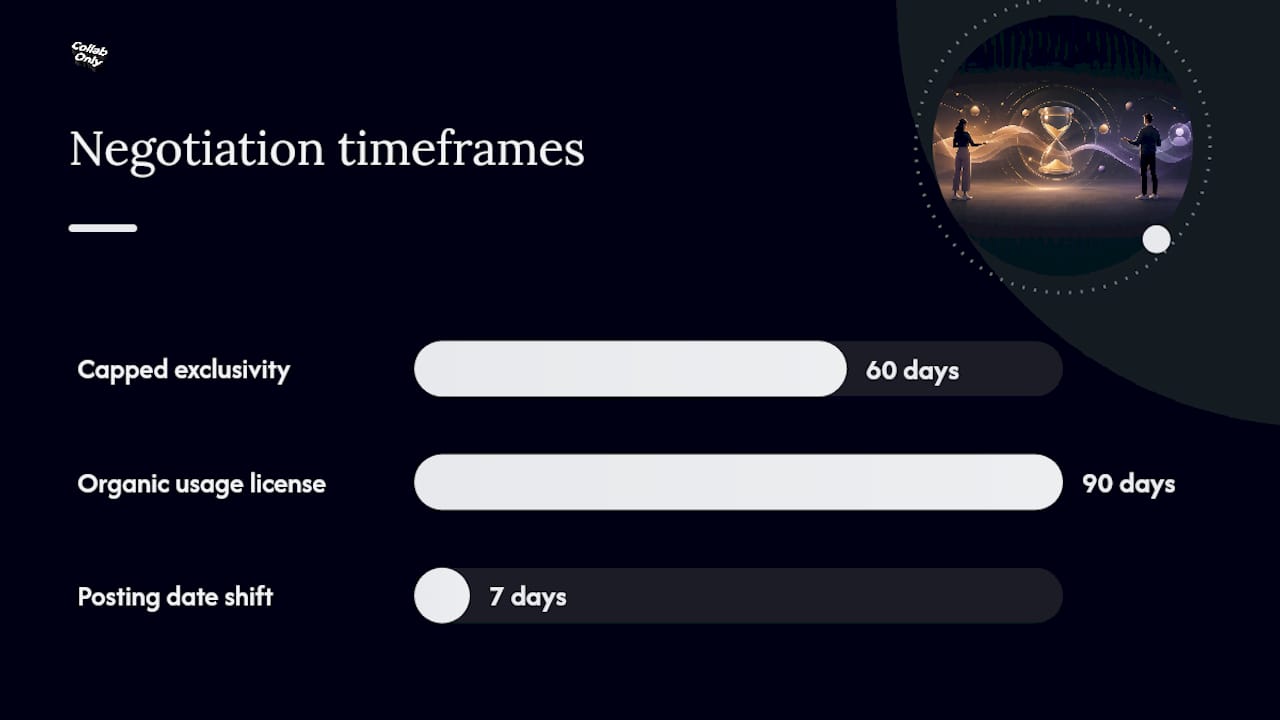
- Set a fixed window (30, 60, or 90 days) rather than open-ended language
- Price longer exclusivity at a premium, since it limits the creator's other income
- Consider a first right of refusal or non-solicit clause as a lighter alternative to full exclusivity
Pro Tip: If a brand insists on broad exclusivity, counter with a carve-out list of specific brands you already work with, attached as an exhibit. It is far easier to negotiate three named exceptions than to redefine an entire product category.
Content Approval, Revisions, Posting Schedule, and Technical Specs
Approval delays kill campaign timing more than any other single issue. The fix is a workflow with hard deadlines on both sides, not open-ended "brand will review" language.
A workable approval process includes:
- One draft submission, with the brand given 48 to 72 business hours to respond
- A maximum of two revision rounds included in the fee, with additional rounds billed separately
- A "deemed approved" clause: if the brand misses the review deadline, the content is automatically approved for posting
- A locked posting date once final approval is granted, with a grace period of no more than 24 hours
- A technical spec checklist (attached as an exhibit) covering resolution, aspect ratio, and file format, so approval is not a subjective judgment call
Pairing a short contract with a spec exhibit and a shared posting calendar keeps both sides working from the same facts instead of arguing about what "good enough" content looks like, a practice Conversion Studio highlights as one of the more effective ways to cut disputes before they start.
Confidentiality, Non-Disparagement, and Publicity
Brands routinely share pre-launch details, like pricing, product specs, and launch dates, before a campaign goes live. A confidentiality clause should name exactly what counts as protected: embargoed product information, pricing strategy, and unreleased creative assets.
Non-disparagement language needs narrower scope than brands typically propose. Reasonable terms include:
- A mutual (not one-sided) non-disparagement obligation
- A carve-out allowing truthful statements made in legal proceedings or regulatory disclosures
- No restriction on honest product reviews given outside the paid partnership
Tailored carve-outs for lawful reporting are standard practice, since an overly broad non-disparagement clause can conflict with a creator's basic right to speak honestly, a distinction KJK's contract guidance for influencers draws out clearly. The contract should also state who can announce the partnership publicly, and when, plus how the creator gets credited.
Termination, Indemnification, Liability, and Dispute Resolution
Termination clauses need trigger events, cure periods, and clear rules for partial payment. Without them, either party can walk away mid-campaign with no consequence, or worse, hold the other hostage over a minor breach.
Standard termination structure includes:
- Named triggers: breach of contract, missed deadlines, brand safety violations, non-payment
- A cure period of 5 to 14 business days to fix a curable breach before termination takes effect
- Payment for work completed and accepted before termination, prorated fairly
Indemnification should run in both directions, narrowly. The brand indemnifies the creator against false advertising claims tied to brand-provided scripts or claims; the creator indemnifies the brand against copyright infringement in original content. Creators should push back on open-ended indemnity language and negotiate a liability cap tied to the total contract value, a limit Gross Law Group recommends as standard protection against disproportionate exposure.
For disputes, name a governing state law and forum, and consider mediation or arbitration through an accredited provider like the American Arbitration Association before either side files a lawsuit. It is faster and considerably less expensive than court.
Practical Checklist and Negotiation Scripts
Before signing anything, run the draft against this list:
- Parties and definitions clearly named
- Deliverables counted, not described
- Payment schedule and kill fee specified
- Usage license scoped by duration, channel, and territory
- FTC disclosure format named per platform
- Exclusivity category and window defined narrowly
- Approval rounds and deadlines set
- Confidentiality and non-disparagement carve-outs included
- Termination triggers and cure periods stated
- Governing law and dispute resolution method named
Three scripts worth keeping on hand: For capped exclusivity, try "I can agree to exclusivity within skincare specifically, for 60 days, at a 20% premium on the base fee." For extended usage rights, try "The base fee covers organic use for 90 days. Paid media placement requires an additional licensing fee." For faster payment, try "I can move the posting date up by one week if we shift to 50% on signing and 50% on delivery, rather than 50% on final acceptance."
Collab Only's guide on collaborating with brands walks through more of this negotiation process. When a deal involves six figures or unusual licensing terms, bring in a lawyer.
Common Contract Failures and Practical Fixes
The disputes that end up in an inbox rarely stem from bad faith. They stem from a deliverable line that said "post about the product" with no count, no date, and no format attached. Brand assumed three posts; creator delivered one. Nobody was wrong, technically, because nothing was specified.
Three fixes solve most of this before it starts: attach a one-page spec exhibit to every contract instead of burying technical details in the main text, put every posting date on a shared calendar both parties can see, and pair the legal contract with a plain-language creative brief so intent and legal language never contradict each other.
Formal agreements with these elements built in tend to generate fewer disputes than loose verbal understandings or single-paragraph emails, which is the whole argument for spending the extra hour on the details.
— Samuel
Collab Only Helps You Coordinate Without the Chaos
A solid contract only works if the brief behind it stays clear from the first message to the final invoice. Collab Only centralizes brief documents, deliverable specs, and messaging in one thread, so the details you negotiate into your contract, posting windows, revision limits, usage terms, don't get lost in a scattered email chain or a DM that falls through the cracks.
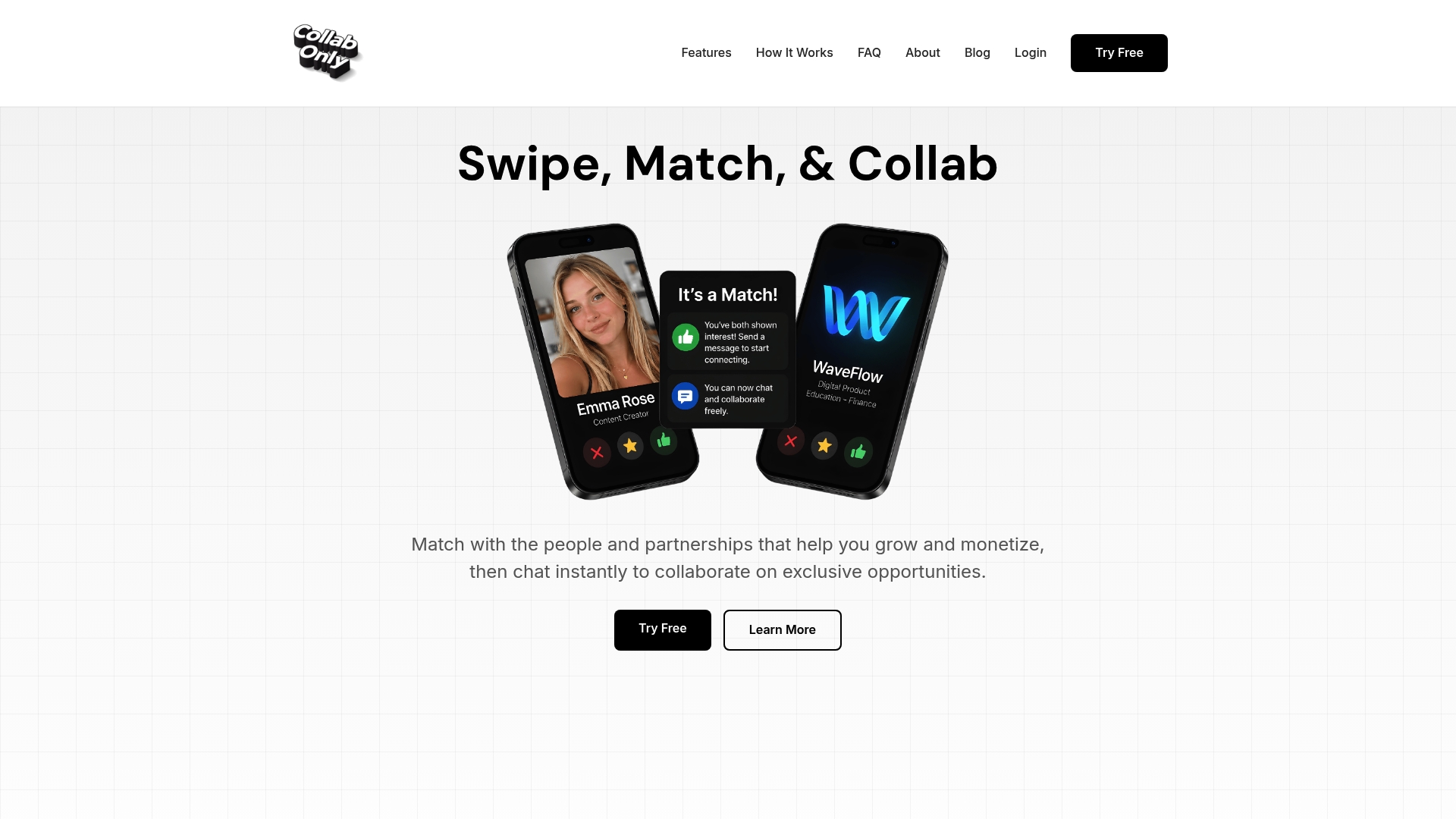
If you're a brand sourcing nano or micro creators for a campaign, or a creator trying to keep five simultaneous brand deals straight, matching through a swipe interface with instant chat cuts the back-and-forth that usually delays a signed agreement. Browse or hire nano influencers on Collab Only to see how faster matching translates into faster, cleaner deal terms.
Sources
- Endorsements: guide for influencers and brands — FTC
- An influencer’s guide to contracts — Kohrman Jackson Krantz
- Social media influencer agreements: Part 1 — Morgan Lewis
- Influencer contract agreements & brand deals — Gross Law Group
- Influencer agreement template and checklist — Conversion Studio
FAQ
What Should an Influencer Contract Include?
At minimum: campaign scope and deliverables, payment terms, content usage and licensing, FTC disclosure requirements, exclusivity restrictions, approval procedures, confidentiality and non-disparagement language, and termination and dispute resolution terms.
How Much Does an Influencer With 100,000 Followers Make?
Earnings vary widely by platform, engagement rate, and niche, and depend heavily on whether the deal is a flat fee, per-post rate, or performance-based structure rather than follower count alone.
What Are the Four Types of Influencers?
Influencers are commonly grouped by audience size into nano, micro, macro, and mega or celebrity categories. Brands sourcing nano and micro creators often use platforms like Collab Only for faster matching at that scale.
Who Pays the Influencer in a Brand Deal?
The brand or its agency pays the creator directly, according to the payment schedule in the signed contract, typically split between a signing deposit and a payment due on content acceptance or delivery.
Can a Brand Use My Content Forever After One Campaign?
Only if the contract grants a perpetual license or transfers ownership outright. Absent that language, usage rights default to a limited scope, and creators should negotiate a defined duration and channel restrictions before signing.