

Product seeding is the practice of sending free product to creators or customers with no obligation to post, in exchange for the possibility of an organic mention. There's no contract, no required deliverable, and no fee. When it's run as a system rather than a one-off gift box, it produces:
- User-generated content at a fraction of paid-shoot costs
- Durable creator relationships that later convert to affiliates or paid partners
- Scalable brand awareness inside niche communities where paid ads feel intrusive
Choose seeding when you need volume and authenticity; choose paid sponsorship when you need a guaranteed deliverable on a fixed timeline. The two are not interchangeable, and treating them as the same thing is where most programs go wrong.
Key Takeaways
Product seeding works when it's run as a repeatable system with clear KPIs, camera-ready packaging, and automated fulfillment, not as a one-time gift box.
| Point | Details |
|---|---|
| Define the model correctly | Seeding carries no posting obligation; paid sponsorship requires a contracted deliverable, and mixing the two invites legal risk. |
| Target by engagement, not size | Nano and micro creators with high engagement rates post more often than larger accounts with weak engagement. |
| Expect a 20 to 50% post rate | Budget CPP accordingly, since a wave's real cost per post depends heavily on creator tier and targeting quality. |
| Automate fulfillment, humanize outreach | Claim links and delivery-triggered reminders handle logistics so your team's time goes into personal notes and relationships. |
| Use a platform to cut outreach time | Collabonly's matching and instant chat replace slow DMs and email threads with same-day creator connections. |
Table of Contents
- What Product Seeding Means and How It Differs From Gifting or Sponsorship
- Who Should You Seed for the Best Post Rates?
- How Do You Run a Product Seeding Program Step by Step?
- What Packaging Choices Make Creators Want to Post?
- How Do You Scale Product Seeding Without Losing Control?
- How Do You Measure Whether Product Seeding Is Working?
- What Does Product Seeding Cost, and How Do You Budget It?
- What Mistakes Sink Most Product Seeding Programs?
- Where Does a Collaboration Platform Fit Into a Seeding Engine?
- How Should Brands Handle Returns or Negative Feedback From Seeded Recipients?
- What Legal Risks Exist Beyond FTC Disclosure Rules?
- Three Lessons From Watching Seeding Programs Succeed and Fail
- How Collabonly Helps You Run Seeding at Scale
- Sources
- FAQ
What Product Seeding Means and How It Differs From Gifting or Sponsorship
Marketers use "seeding" and "gifting" almost interchangeably, but the distinction matters for how you brief creators and what you can legally expect back. Gifting is the transaction itself: you send a product for free. Seeding is the strategic system built around that transaction, choosing recipients, timing waves, tracking results. Paid sponsorship is a different category entirely: money changes hands for a contracted deliverable, usually with usage rights and a required posting date.
Seeding programs typically run through one of a few formats:
- Open drops — a public application or sign-up form anyone can claim
- Claim links — a personalized link sent to a shortlist that lets the creator select size, color, or shipping address
- VIP lists — an ongoing roster of top performers who get early access to every launch
- Customer-to-creator — flagging existing buyers with a following and inviting them into the program directly
Because no payment or contract obligates a post, the legal bar is lower than sponsorship, but it isn't zero. The FTC's influencer disclosure guidance makes clear that a free product still counts as compensation if the creator posts about it, and disclosure tags like #gifted apply regardless of whether money was involved.
Who Should You Seed for the Best Post Rates?
Not every recipient is worth a box. Prioritize in this order:
- Existing customers with a following. They already believe in the product, which removes the single biggest variable in whether a post reads as genuine.
- Nano and micro creators (roughly 1,000 to 50,000 followers). Their audiences skew toward high trust and tight niches, and they tend to post at higher rates than larger accounts because a gifted product still feels like a notable event to them.
- Niche-specialist creators whose content already centers on your category, even at modest follower counts.
- Community leaders on Discord, subreddits, or Facebook groups who influence purchase decisions without traditional follower metrics at all.
Pro Tip: Engagement rate predicts post likelihood better than follower count almost every time. A creator with 8,000 followers and a 6% engagement rate is a better seeding bet than one with 80,000 followers and a 0.8% rate.
Industry benchmarks compiled from multiple seeding guides put expected post rates in the 20 to 50% range. Nano and micro tiers cluster toward the higher end because the gesture still feels personal to them, while mid-tier and larger creators, who get pitched constantly, land closer to the lower end unless the product is unusually relevant to their content.
When inventory is limited, apply three filters before you ship anything: does this person's audience overlap with your buyer profile, have they posted about comparable products before, and do they respond to messages in a reasonable window? A creator who never replies to DMs rarely replies to a shipping confirmation either.
How Do You Run a Product Seeding Program Step by Step?
A seeding wave has six stages, and skipping any one of them is usually why a campaign quietly underperforms.
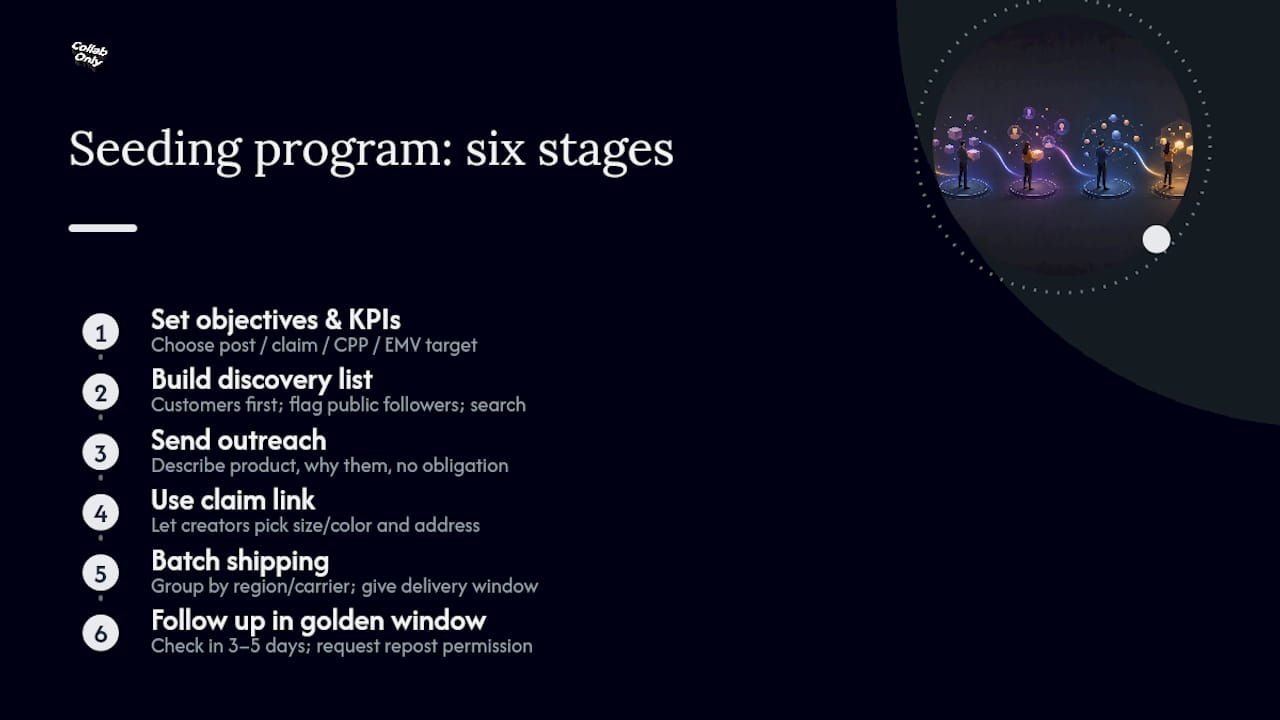
1. Set the objective and KPIs before you pick a single recipient. Decide whether this wave optimizes for post rate, claim rate, cost per post (CPP), or earned media value (EMV). A launch wave and an evergreen UGC wave should have different targets.
2. Build the discovery list. Pull from your existing customer list first, flag anyone with a public following in your CRM, and supplement with platform search for creators already talking about your category. This is also where a matching platform for product launches speeds up sourcing compared to manual hashtag scrolling.
3. Send outreach that avoids implying obligation. Say what the product is, why you thought of them specifically, and that there's no requirement to post. Avoid phrases like "in exchange for a post" or "as part of this partnership," which shift the relationship into sponsorship territory and can create expectations of payment neither side intends. A structured campaign brief keeps this language consistent across a team.
4. Use a claim link, not a spreadsheet. Let the creator select size, color, and confirm their own shipping address. Self-selection cuts return rates because the creator gets what they actually want, not what someone guessed for them.
5. Ship in batches, not one at a time. Group by region or carrier zone to reduce cost and set a realistic delivery window, then communicate that window so creators aren't guessing.
6. Follow up inside the golden window. The three to five days after delivery produce the highest conversion from delivery to post. A short, polite check-in, "Hope it arrived okay, no pressure either way!", performs better than silence or a hard ask.
Pro Tip: Capture content permissions at the same time you send the follow-up, not after you spot a post you want to reuse. A simple line asking permission to repost on your brand channels, with a yes/no reply, avoids a second awkward outreach later.
Archive whatever comes back in a shared folder tagged by creator name, date, and platform, and keep a one-line record of any usage permission granted. That record is what protects you if you later want to run the content as paid ad creative.
What Packaging Choices Make Creators Want to Post?
The unboxing moment is the actual content, not a delivery afterthought. Design for the camera:
- Use a color palette and layout that photograph well in low light, since most creators film in a bedroom or kitchen, not a studio.
- Add one small, unexpected extra, a sticker, a pin, a tiny card, that gives them something to hold up on camera.
- Write a short, specific handwritten note referencing something from their actual content, not a generic "thanks for being you."
- Include a quick-start card with a 10-second filming prompt, a sharing incentive like a personal discount code for their audience, and one usage idea they might not think of themselves.
Forbes Councils' guidance on seeding programs backs this up directly: a camera-friendly unboxing and a personalized touch materially increase the odds a gifted product turns into organic content rather than sitting unused in a closet.
Pro Tip: Print the filming prompt directly on the insert card instead of emailing it separately. Creators film immediately after opening the box, and a prompt they have to go dig up in their inbox rarely gets used in time.

Sustainability signals matter more than most brands assume. Recyclable mailers and minimal plastic read as intentional to creators who care about their own audience's perception, and that perception can end up in the caption itself.
How Do You Scale Product Seeding Without Losing Control?
The three problems that break a seeding program at scale are fulfillment logistics, data capture, and compliance tracking, in that order. A brand that can hand ship 20 boxes a month falls apart at 200 unless it automates the repetitive parts and keeps the relational parts human.
- Fulfillment logistics. Batch by carrier zone, set standing SKU allocations for seeding stock separate from sellable inventory, and build a reorder trigger before you run out mid wave.
- Data capture. Claim links that pull address, size, and platform handle into one record eliminate the spreadsheet chaos that causes wrong sizes and lost shipments.
- Content tracking. Delivery-triggered reminders and simple auto-capture of tagged posts replace the manual habit of scrolling hashtags hoping to spot a mention.
- Compliance. Keep a record of what was sent, when, and any disclosure language shared with the creator; store permission replies alongside the content itself.
SeedingOps and comparable operational guides point to the same conclusion: at scale, fulfillment and tracking are the failure modes that kill programs, and automation primitives like claim links and delivery-triggered reminders fix the biggest share of them.
The strongest seeding operations separate the mechanical work from the relational work entirely. Automate the claim link, the shipping trigger, and the reminder. Keep the personal note, the VIP invite, and the reply to a creator's DM entirely human.
This is precisely where a platform like Collabonly earns its place in the stack. Its swipe-based matching surfaces creators who already fit a brand's niche, and instant chat on a match removes the slow email thread that usually stalls outreach before a box ever ships.
How Do You Measure Whether Product Seeding Is Working?
A seeding wave without metrics is just a shipping expense. Track these five numbers:
- Claim rate = creators who accept ÷ creators invited
- Post rate = creators who post ÷ products delivered
- Cost per post (CPP) = total wave cost ÷ number of posts generated
- Earned media value (EMV) = estimated ad-equivalent value of the organic reach and engagement generated
- Creator lifetime value = cumulative value of a creator across every future wave, affiliate link, or paid deal they eventually convert into
Worked example: a wave of 100 units at $30 landed cost, plus $8 average shipping, totals $3,800. If ten of those posts get reused as paid ad creative, the effective cost per usable asset drops sharply below that raw CPP.
Industry benchmarks put post rates in the 20 to 50% range depending on creator tier, so a CPP anywhere from roughly $60 to $170 per post is within normal range, not a sign something went wrong. Set your KPI target based on the wave's goal: optimize for post rate when you need volume of UGC, for EMV when the goal is broad awareness, and for creator lifetime value when the real objective is building an affiliate bench over time. Analytics-focused measurement approaches can help translate these raw numbers into a comparison against paid campaign ROI.
What Does Product Seeding Cost, and How Do You Budget It?
Budget by line item, not by gut feel:
- COGS — the landed cost of the product itself
- Domestic shipping — typically $5 to $15 per unit depending on size and speed
- Packaging — inserts, mailers, and any branded extras
- Fulfillment labor — packing time, even if it's a founder doing it after hours
- Platform or tooling fees — claim-link software, CRM, or a matching platform subscription
Sample per-influencer costs run from roughly $25 to $170 depending on product price and shipping method. A pilot wave of 25 to 50 units tests targeting cheaply. A steady monthly cadence of 100 to 200 units builds a consistent content pipeline. A scale program of 500-plus units per month needs the automation covered above or the labor cost quietly eats the budget.
To model effective cost per usable asset, divide total wave cost by the number of posts you'd actually reuse or count toward KPIs, not just total units shipped.
What Mistakes Sink Most Product Seeding Programs?
- Poor targeting. Sending to anyone with a pulse and a follower count wastes inventory that could have gone to a creator who actually converts.
- No follow-up system. Ship-and-forget programs lose the golden window entirely and rely on luck for every post that happens.
- Ignoring the creator's experience. A confusing claim link, a late shipment, or a tone-deaf outreach message damages the relationship before the box even arrives.
- Language that implies obligation. Phrases like "we'd love to see a post from you in return" cross the line from gift to unpaid work, and creators notice.
Before each wave ships, run this checklist: targeting criteria confirmed, claim links tested, outreach copy reviewed for obligation language, shipping batch scheduled, and follow-up reminders queued for the three to five day window.
Where Does a Collaboration Platform Fit Into a Seeding Engine?
Every seeding bottleneck maps to a specific feature gap: slow discovery needs better matching, slow replies need instant chat, and messy preference collection needs a structured claim flow instead of email threads.
- Matching replaces manual hashtag searches with a filtered pool of creators already aligned to your niche.
- Instant chat on match eliminates the days-long lag of cold DMs and unanswered emails.
- Preference and claim capture built into the platform reduces the size and address errors that cause returns.
A platform is worth adding to your stack the moment your in-house spreadsheet process starts producing more shipping mistakes than posts.
Collabonly was built around exactly that gap: brands and creators match through a swipe interface, then move straight into chat without the outreach lag that stalls most in-house programs. For a small team running its first few waves, a manual process still works. Once volume climbs past what one person can track in a spreadsheet, a platform earns its subscription cost back in fulfillment accuracy alone.
How Should Brands Handle Returns or Negative Feedback From Seeded Recipients?
Occasionally a seeded product disappoints, wrong fit, defect, or the creator just doesn't like it, and how you handle that moment shapes whether they ever engage with your brand again.

Never pressure a creator into posting anyway after a bad experience with the product. That single move can turn a quiet non-post into a public complaint about being pushed. Instead, treat the feedback as free product research: ask what specifically didn't work, thank them for the honesty, and offer a replacement or a different item if one seems like a better fit.
For actual defects or damage in shipping, process it like a standard customer return, refund the shipping cost if you charged one, and don't ask for the product back unless it has real resale value. The cost of a replacement item is almost always lower than the cost of a public negative post from someone who felt dismissed.
Keep a simple log of negative feedback by product line. If three or more creators flag the same issue, size runs small, a scent is too strong, a fabric pills quickly, that's a product signal worth escalating internally, not just a seeding side note. Some of the most useful product feedback a brand receives never shows up in a formal survey; it shows up in a creator's honest reply to a follow-up message.
Treat every seeded recipient, even the ones who never post, as a potential future customer or referral source. A gracious response to a disappointing experience costs little and often outlasts the missed post in terms of long-term goodwill.
What Legal Risks Exist Beyond FTC Disclosure Rules?
FTC disclosure is the most cited compliance issue in seeding, but it isn't the only one. A few areas deserve attention before a program scales past a handful of creators.
Contest and sweepstakes law applies if your seeding program involves any kind of drawing, giveaway, or "tag a friend to be entered" mechanic. Many states regulate promotional giveaways, and requiring an entry fee or purchase to qualify can trigger lottery statutes in some jurisdictions. Keep entry free and simple if you want to avoid that layer entirely.
Intellectual property and content rights matter once you plan to reuse a creator's post as ad creative. A creator owns the copyright to their own content by default, even when the product itself was free. Get explicit written permission, even a simple message thread confirming "yes, you can repost this," before running someone else's video as paid media.
International shipments raise a separate set of issues: customs declarations, import duties the recipient may not expect to pay, and, in some countries, stricter advertising disclosure rules than the FTC's. The European Union's influencer marketing guidelines under its Unfair Commercial Practices Directive are generally stricter about labeling gifted content than U.S. rules, so a program that ships internationally should research the destination country's own disclosure standard rather than assuming FTC guidance covers it.
Data privacy applies the moment you collect a creator's home address and contact details through a claim link. Store that information securely and only for as long as the program requires it, particularly if any recipients are in a jurisdiction covered by GDPR or a U.S. state privacy law.
Three Lessons From Watching Seeding Programs Succeed and Fail
The programs that work treat seeding as the top of a funnel, not a one-off gesture. The SeedingOps model of a gift-to-affiliate-to-paid ladder consistently outperforms treating every creator as a single transaction. The most surprising lesson: the personal note matters more than the product's retail price. Read more on the Collabonly blog.
How Collabonly Helps You Run Seeding at Scale
Running seeding well means solving the same three problems every wave: finding the right creators fast, getting a reply before the moment passes, and keeping fulfillment accurate enough that a claim link doesn't turn into a returns headache. Collabonly is built specifically around that sequence, not around cold outreach and hope.
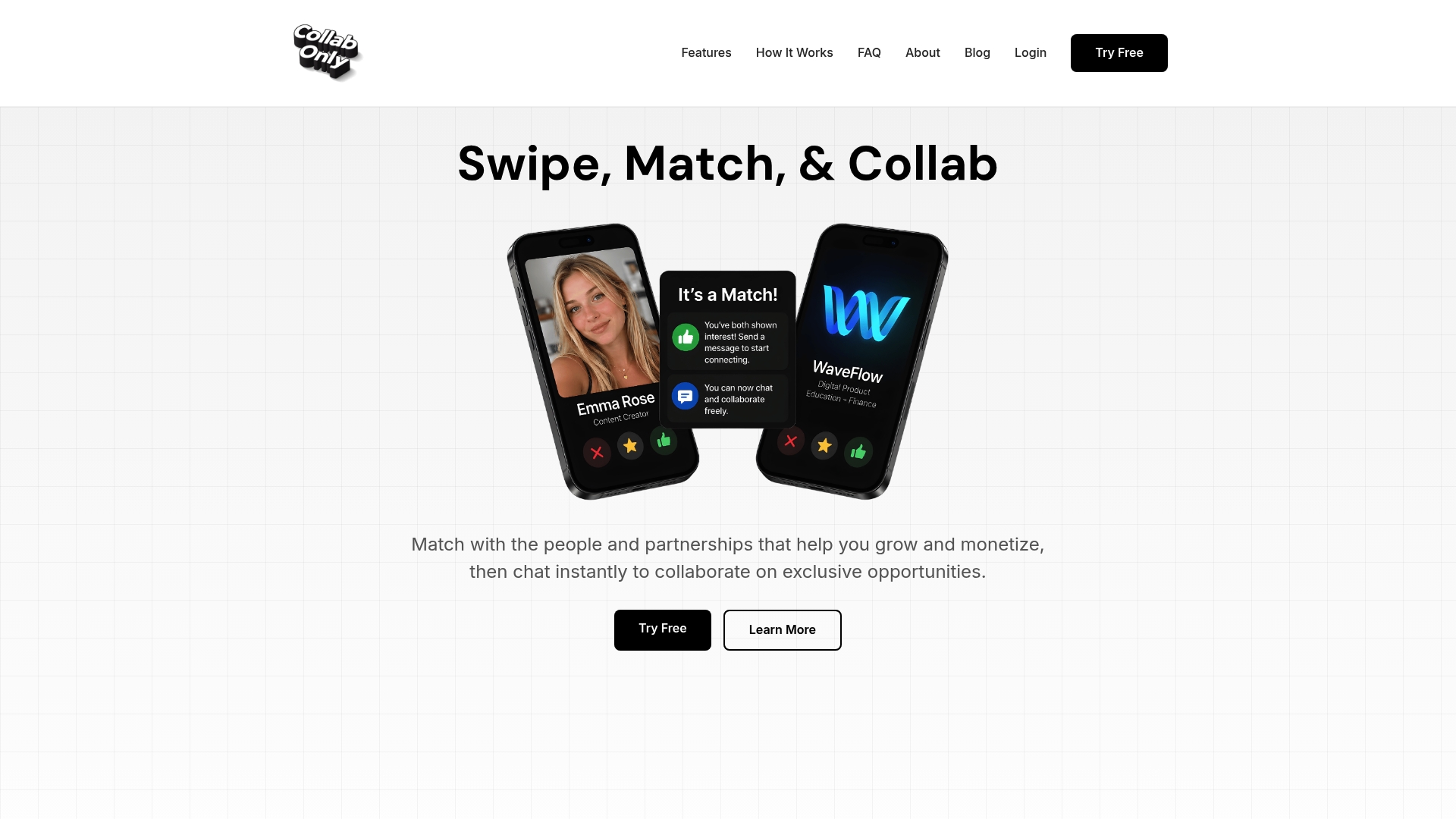
Instead of scrolling hashtags and sending DMs that sit unread for a week, brands on Collabonly swipe through creators already filtered by niche and audience fit, then move straight into instant chat the moment there's a match. That single change, cutting outreach time from days to minutes, is the difference between running one seeding wave a quarter and running one every month without adding headcount. For a marketing team specifically looking to build a nano-influencer pipeline, the nano-influencer marketing page walks through exactly how the matching and chat flow works for high-volume, lower-cost creator waves. Set up a profile and see which creators are already a match for your next launch.
Sources
- FTC: Disclosures for endorsements and testimonials (influencer guidance)
- How Businesses Can Best Utilize Product Seeding Campaigns (Forbes)
FAQ
What does product seeding mean?
Product seeding is sending free product to creators or customers with no obligation to post, aimed at generating organic content and relationships rather than a guaranteed deliverable.
Is product seeding the same as gifting?
Gifting is the transaction of sending a free product; seeding is the broader strategic system around it, including targeting, tracking, and follow-up designed to turn gifts into content.
How much does product seeding cost?
Per-influencer costs typically range from about $25 to $170 depending on product price and shipping, with a pilot wave of 25 to 50 units being the cheapest way to test targeting.
What is the 5-3-2 rule on Instagram?
The 5-3-2 rule is a content-mix guideline, roughly five curated or educational posts, three engagement-focused posts, and two promotional posts, and it isn't a seeding-specific framework, though creators receiving seeded product often slot that content into the "curated" category.
Do creators have to disclose gifted products?
Yes. Under FTC guidance, a free product still counts as compensation once a creator posts about it, so disclosure tags like #gifted are required regardless of whether money changed hands.
How can a platform like Collabonly speed up seeding programs?
Collabonly's swipe-based matching surfaces creators already aligned to a brand's niche, and instant chat on a match removes the outreach delay that typically stalls in-house seeding programs.