

TL;DR:
- Partnership-driven collaboration consistently outperforms direct sales by increasing deal size, win rates, and reducing cycle time.
- Embedding real-time partner data into CRM and leveraging ecosystem-led growth strategies significantly boost revenue and customer retention.
Collaboration revenue is generated when businesses combine intellectual property, expertise, and existing customer relationships to create offerings that neither party could produce or sell as effectively alone. This model explains why organizations from Salesforce to IBM have shifted toward partnership-led growth as a primary distribution strategy, not a supplementary one. The core mechanism is straightforward: partners bring pre-built trust with their customers, and that trust transfers directly into faster deal cycles, higher conversion rates, and larger contract values. Understanding why collaborations drive revenue requires examining the data behind partner-attached deals, the mechanics of ecosystem-led growth (ELG), and the compounding retention effects that make collaborative models structurally superior to direct-only sales.
Why collaborations drive revenue: the sales performance case
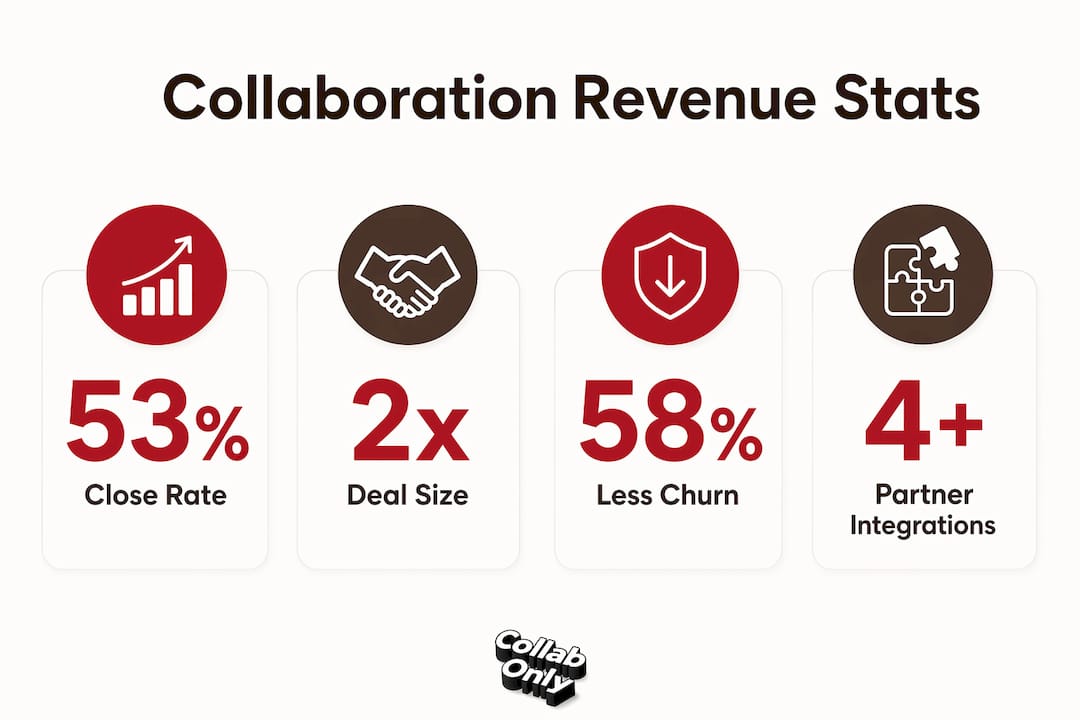
The financial case for partnership-led growth is grounded in measurable deal performance, not theory. Partner-attached deals close 53% more often, move 30 to 46% faster through the sales cycle, and average twice the deal size of direct sales. That combination of higher win rates, shorter cycles, and larger contracts means the unit economics of partner-sourced pipeline are structurally superior to cold outreach or inbound-only models.
The reason for this performance gap is peer-credibility transfer. When a trusted partner introduces your product to their existing customer, the credibility gap that typically slows a sales cycle is already closed. The buyer does not need to independently verify your company's reliability because a vendor they already trust has done that work. This is why partner-sourced pipelines convert at 8 to 10 times the rate of direct-sourced leads, making every marketing dollar allocated to partner channels dramatically more productive.
Co-selling workflows amplify this effect further. When two sales teams share account intelligence, they identify whitespace opportunities that neither team would find independently. A SaaS company selling project management software, for example, gains immediate access to a partner's installed base of operations teams when the two organizations align on a shared account map. The result is a warmer pipeline with higher intent signals from day one.
- Partner-attached deals deliver better unit economics across win rates, cycle times, customer acquisition cost, and retention.
- Shared account intelligence surfaces whitespace that direct sales teams cannot see on their own.
- Co-selling motions reduce the credibility gap by transferring existing trust from partner to prospect.
- Direct-only sales models are aging out as partnership ecosystems become the primary distribution model for growth-stage companies.
Pro Tip: Before launching a co-sell motion, align on a shared definition of a qualified opportunity with your partner. Misaligned qualification criteria are the single most common reason co-selling programs stall in the first 90 days.
How ecosystem-led growth turns partner data into measurable revenue
Ecosystem-led growth (ELG) is the practice of using real-time partner overlap data, account mapping, and integration signals to inform go-to-market decisions at every stage of the funnel. It differs from traditional channel sales in one critical way: ELG treats partner data as a first-class input into CRM workflows, not as a periodic report reviewed in quarterly business reviews.
The revenue impact of this distinction is significant. Consider the following sequence that defines a mature ELG motion:
- Map your customer and prospect accounts against your partner's customer base to identify shared and adjacent accounts.
- Embed partner overlap data directly into your CRM so sales representatives see partner signals alongside standard account data.
- Use integration signals to identify which of your customers are already using a partner's product, then trigger warm introduction workflows automatically.
- Track partner-influenced pipeline as a distinct KPI, separate from partner-sourced pipeline, to measure the full revenue contribution of your ecosystem.
- Reallocate marketing budget toward partner channels based on conversion rate data, not historical spend patterns.
The retention data behind ELG is equally compelling. Customers using a product plus four partner integrations are 58% less likely to churn. This is not a coincidence. Each integration deepens the customer's operational dependency on your product, raising the switching cost and increasing the probability of renewal. Companies fully committed to ELG report 40 to 60% of total pipeline as partner-influenced, which fundamentally changes how growth teams should allocate resources.
Pro Tip: Many firms fail by treating partnerships as peripheral marketing activities rather than integrating partner data deeply into sales workflows and CRM. The firms that win treat partner overlap data with the same urgency as inbound lead notifications.

For a broader understanding of how platform-based models support these workflows, platform-based collaboration in 2026 provides useful context on the infrastructure layer that makes ELG scalable.
How collaboration mitigates risk and builds trust for sustainable profits
Beyond lead generation, the benefits of partnerships include structural risk reduction that improves long-term profitability. Strategic alliances share the R&D burden, reducing upfront costs and accelerating innovation cycles. Two companies co-developing an integration or a joint solution split the engineering investment while both gaining access to the resulting product. This model shortens time to market and reduces the capital exposure of either party.
Trust transfer is the second risk-reduction mechanism. Partner referrals provide a warm entry into customer relationships, leveraging established credibility and reducing the credibility gap that typically inflates sales costs. A cold prospect requires multiple touchpoints, case studies, and reference calls before committing. A partner-referred prospect often arrives with those objections already resolved.
The third and most durable risk-reduction mechanism is integration-driven switching costs. When a customer embeds your product into their workflow alongside two, three, or four partner integrations, the cost of switching vendors becomes prohibitive. Integrations create compounding switching costs that reduce churn and deepen customer entrenchment over time. This transforms collaboration from a marketing tactic into a structural revenue moat.
"Building compounding switching costs via integrations transforms collaboration from a marketing tactic into a durable revenue moat." — Ecosystem-Led Growth: The SaaS GTM Strategy for 2026
- Shared R&D investment reduces per-company innovation costs while accelerating product development timelines.
- Trust transfer from partner referrals reduces sales cycle length and lowers customer acquisition cost.
- Integration density raises switching costs, improving net revenue retention and customer lifetime value.
- Ecosystem loyalty compounds over time: the more integrations a customer uses, the less likely they are to evaluate competitors.
For concrete illustrations of how these dynamics play out in practice, brand partnership examples from leading companies demonstrate the revenue mechanics described above.
Applying effective collaboration strategies to maximize revenue growth
Translating the theory of collaboration revenue growth into execution requires a structured approach. The following framework addresses the four operational areas where most partnership programs either succeed or break down.
Identifying and qualifying the right partners
Partner quality determines pipeline quality. The most productive partners share a significant portion of your ideal customer profile (ICP) without competing directly for the same contracts. Use account mapping tools such as Crossbeam or Reveal to quantify the overlap between your customer base and a prospective partner's. Prioritize partners where the overlap is high and the product relationship is complementary, not substitutive.
Orchestrating co-selling and joint marketing
Effective co-selling requires orchestration tools that align account mapping and whitespace data across multiple partners in real time. Joint marketing campaigns should be built around shared customer pain points, not individual product features. A co-branded content asset, a joint webinar, or a shared case study creates more credibility than either party's solo content because it signals that two trusted vendors endorse the same solution.
Tracking ecosystem-sourced pipeline KPIs
| KPI | What it measures |
|---|---|
| Partner-sourced pipeline | Deals where a partner made the initial introduction |
| Partner-influenced pipeline | Deals where a partner accelerated or supported an existing opportunity |
| Integration adoption rate | Percentage of customers using one or more partner integrations |
| Partner-attached win rate | Win rate on deals with active partner involvement vs. direct-only deals |
| Churn rate by integration count | Retention variance between customers with zero vs. four-plus integrations |
Common pitfalls to avoid
- Treating partner relationships as one-time campaigns rather than ongoing co-sell motions with shared accountability.
- Failing to embed partner data into CRM, which forces sales representatives to manage partner intelligence manually and inconsistently.
- Allocating partner marketing budgets based on historical spend rather than conversion rate data from partner-sourced pipeline.
- Scaling to multi-partner selling without aligned real-time data and coordinated sales motions, which creates execution gaps that erode the revenue advantage.
Pro Tip: Start with two to three high-overlap partners before scaling to a multi-partner ecosystem. Depth of execution with a small number of partners consistently outperforms shallow engagement across a large partner network.
For a structured introduction to the mechanics of partnership marketing, partnership marketing strategies covers the foundational frameworks that support the execution steps above.
Key takeaways
Collaborations drive revenue because partner-attached deals consistently outperform direct sales across every measurable dimension: win rate, cycle time, deal size, and customer retention.
| Point | Details |
|---|---|
| Partner deals outperform direct sales | Partner-attached deals close 53% more often and average twice the deal size of direct deals. |
| ELG converts data into pipeline | Embedding partner overlap data in CRM enables warm introductions and accelerates deal velocity. |
| Integration density reduces churn | Customers using four or more partner integrations are 58% less likely to churn. |
| Trust transfer lowers acquisition cost | Partner referrals arrive with credibility already established, reducing sales cycle length and cost. |
| Execution discipline determines outcomes | Multi-partner selling requires real-time data alignment and coordinated sales motions to scale effectively. |
Why the collaboration revenue shift is permanent, not cyclical
The transition from direct-only sales to ecosystem-led growth is not a trend that will reverse when market conditions change. It is a structural shift driven by the economics of trust, data, and switching costs. From my perspective, the most significant change in B2B sales and marketing over the past several years is not the rise of AI or the proliferation of new channels. It is the recognition that the most efficient path to a qualified buyer runs through a partner who already has that buyer's trust.
The firms that treat partnership data as a secondary input, something to review quarterly rather than act on daily, are systematically underperforming their potential. The firms that embed partner signals into their CRM, track partner-influenced pipeline with the same rigor as direct pipeline, and build integration density as a deliberate retention strategy are compounding their revenue advantages year over year.
The uncomfortable truth is that most organizations still treat collaboration as a support function rather than a primary growth channel. That gap represents a significant opportunity for the businesses and marketers willing to reorient their go-to-market around ecosystem-led principles. The data is not ambiguous. Partner-sourced pipeline converts at 8 to 10 times the rate of direct-sourced leads. The question is not whether collaboration drives revenue. The question is how quickly your organization is willing to act on that fact.
— Samuel
Start building revenue-driving collaborations with Collabonly
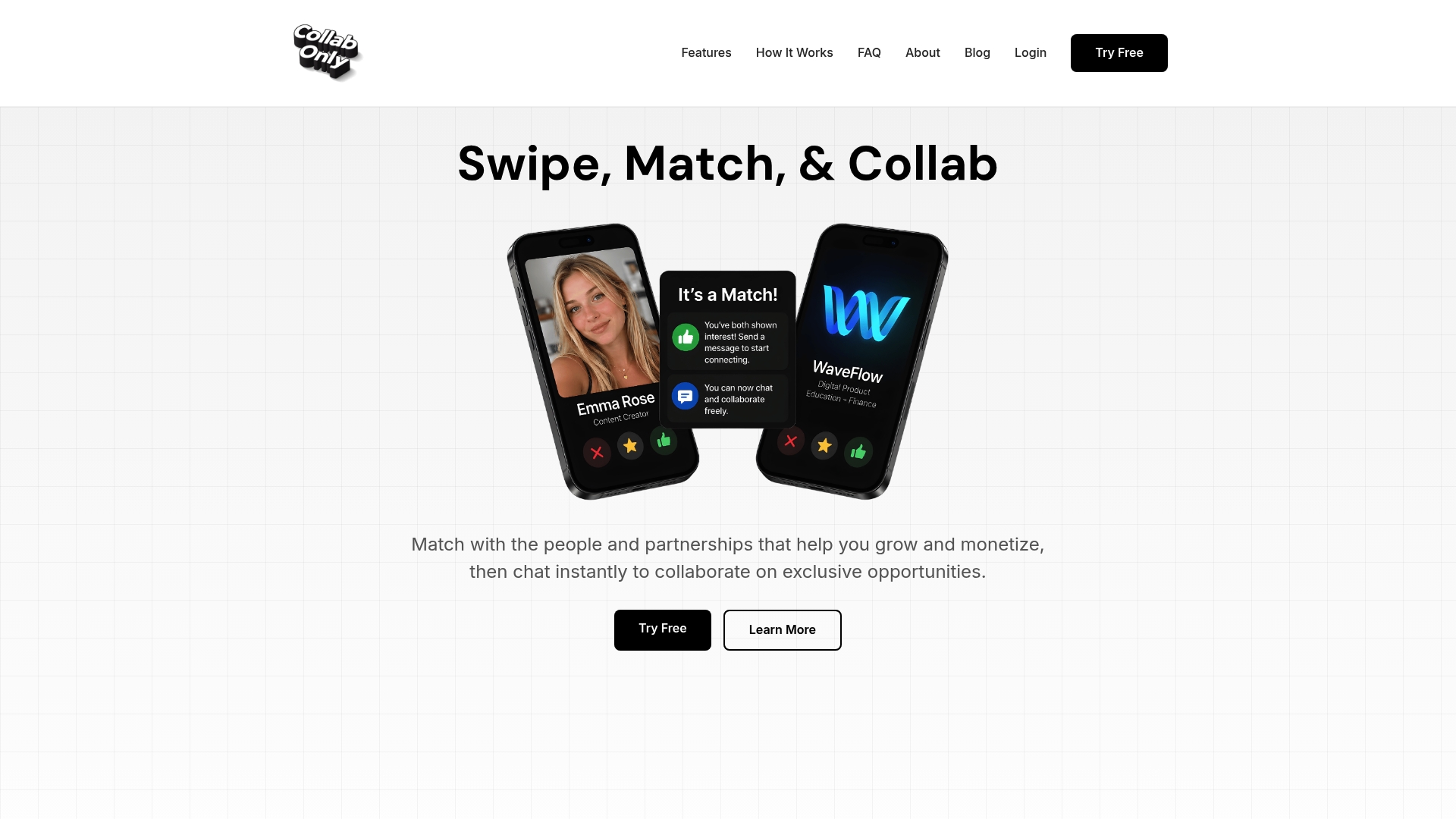
Collabonly is a matching platform built for brands, creators, and marketers who want to activate partnership-led growth without the friction of cold outreach and unanswered DMs. The platform connects businesses with nano and micro-influencers across TikTok, Instagram, and YouTube through a swipe-based matching system that surfaces goal-aligned partners instantly. Once matched, teams move directly into chat, eliminating the delays that typically slow collaboration pipelines. For businesses ready to treat collaboration as a primary revenue channel, Collabonly's matching platform provides the infrastructure to identify, engage, and activate partners at scale. Brands focused on cost-efficient reach can also explore nano influencer marketing as a high-conversion entry point into collaborative growth.
FAQ
Why do collaborations drive revenue more effectively than direct sales?
Partner-attached deals close 53% more often and average twice the deal size of direct deals because partners transfer existing trust to new prospects, eliminating the credibility gap that slows direct sales cycles.
What is ecosystem-led growth and how does it increase profits?
Ecosystem-led growth (ELG) is a go-to-market strategy that uses real-time partner overlap data and integration signals to identify and accelerate deals. Companies fully committed to ELG report 40 to 60% of total pipeline as partner-influenced.
How do integrations reduce customer churn in collaborative models?
Customers using a product alongside four or more partner integrations are 58% less likely to churn, because each integration raises the operational switching cost and deepens dependency on the core product.
What KPIs should businesses track for collaboration revenue growth?
The four most important metrics are partner-sourced pipeline, partner-influenced pipeline, partner-attached win rate, and churn rate segmented by integration count. These KPIs distinguish between deals that partners originated and deals that partners accelerated.
How do businesses identify the right partners for co-selling?
Use account mapping tools such as Crossbeam or Reveal to quantify ICP overlap between your customer base and a prospective partner's. Prioritize partners with high overlap and complementary, non-competing products to maximize pipeline quality and conversion rates.