

The fastest way to grow an online audience in 2026 is to own your distribution, publish at a consistent cadence, and design growth as a deliberate movement from discovery to trust to retention. Algorithm-chasing and follower-buying are not strategies; they are noise. The content creator growth tips that produce durable results share three properties: they compound over time, they generate first-party data, and they reduce dependence on any single platform.
Start here, in order:
- Own at least one first-party channel (email newsletter, SMS, or private community) before scaling any platform.
- Publish 3–5 times per week on your primary platform; Buffer's cadence research shows this is where real growth typically begins.
- Engage actively in comments and DMs within the first 60 minutes of every post.
- Identify two to three potential collaboration partners this week and draft a one-paragraph outreach message.
- Repurpose every long-form asset into at least three shorter formats before moving to new content.
- Track three to five KPIs weekly; drop any metric that does not predict retention or conversion.
Beehiiv's 2026 analysis frames this well: sustainable growth requires designing content and touchpoints to move people through discovery, trust, and repeated interaction, reducing dependence on viral hits. Hootsuite's engagement research adds that interactive features, authentic storytelling, and responsive community management materially improve retention at every stage of that movement.
Key Takeaways
Sustainable audience growth in 2026 requires owning your distribution, publishing at a growth-triggering cadence of 3–5 posts per week, and designing every tactic to move people from discovery through trust to retention.
| Point | Details |
|---|---|
| Own distribution first | Launch a newsletter or private community before scaling any social platform to reduce algorithm dependence. |
| Post at growth cadence | Three to five posts per week is where growth inflection typically begins, per Buffer's creator research. |
| Partnerships expand trust fast | Collaborations borrow peer-credibility and can produce measurable referral sign-ups within 14–30 days. |
| Repurpose every long-form asset | One podcast episode or article can generate six or more platform-ready formats without additional production hours. |
| Collabonly for partner discovery | Collabonly's matching marketplace accelerates the partnership stage of the 90-day plan by replacing cold outreach with instant-match collaboration. |
Table of Contents
- What are the six highest-impact audience growth strategies for 2026?
- How does the discover-trust-retain framework work in practice?
- How do you build a content strategy that sustains growth?
- What posting cadence actually drives growth, and how do you avoid burnout?
- How do you find the right collaboration partners and structure a successful swap?
- Why does owning your distribution matter more than platform reach?
- How do you turn one long-form asset into six or more pieces of content?
- What should you do on each platform right now?
- Which metrics actually predict growth, and how do you track them?
- What does a practical 90-day growth experiment look like?
- Which tools support planning, scheduling, editing, and analytics?
- How were these recommendations formed?
- How do you identify and reach the right audience segments?
- How are AI tools and emerging formats changing audience growth in 2026?
- What paid growth strategies produce the best ROI?
- What psychological principles drive audience growth?
- How does a personal or brand story build connection and loyalty?
- What legal and ethical obligations apply to audience growth tactics?
- What would actually be done first if starting from zero today?
- Collabonly accelerates the partnership stage of your 90-day plan
- Sources
- FAQ
What are the six highest-impact audience growth strategies for 2026?
Ranked by the ratio of measurable impact to execution effort, these six tactics represent the clearest return on time invested for creators, marketers, and small business owners.
- Own your distribution first. Building an email list or private community gives you a channel no algorithm can revoke. High impact, moderate setup effort, results visible within 30–60 days.
- Publish at a growth-triggering cadence. Several posts per week on a primary platform is where growth inflection typically begins. Moderate effort once batching is in place; results in 30–90 days.
- Strategic partnerships and co-creation. Collaborating with aligned creators expands the surface area of trust because an introduction via a trusted voice reduces friction for new subscribers. High impact, low ongoing cost, results in 14–30 days per campaign.
- Repurpose systematically. Converting one long-form asset into six or more shorter formats multiplies reach without multiplying production hours. Moderate effort, compounding results over 60–90 days.
- Engage with precision. Responding to comments, running polls, and featuring user-generated content (UGC) signals algorithmic relevance and builds community loyalty simultaneously. Low effort, continuous impact.
- Measure and iterate in 30-day cycles. Short experiments with clear benchmarks turn strategy into repeatable learning. Low effort, high strategic value.
Tactics to deprioritize: buying followers (produces zero engagement signal and can suppress organic reach), chasing trending audio or formats without strategic fit (burns production time for one-off spikes), and posting on every platform simultaneously without a repurposing system (dilutes quality and creator bandwidth).
When choosing where to start, select the one or two tactics that address your current weakest link. If you have no owned channel, start there. If you have a list but no posting discipline, prioritize cadence. Trying to execute all six at once is a reliable path to burnout and mediocre execution across the board.
How does the discover-trust-retain framework work in practice?
Beehiiv's audience growth framework organizes sustainable growth into three sequential stages, each with a distinct goal and a distinct set of tactics.
Discover is the stage where new people encounter your content for the first time. The primary goal is reach and relevance. Tactics that serve this stage include short-form video (TikTok, Reels, YouTube Shorts), SEO-optimized long-form content, platform collaborations, and paid discovery ads. The metric that matters here is new unique visitors or new followers per week.
Trust is the stage where a new audience member decides whether to stay. The goal is credibility and connection. Tactics include consistent posting cadence, transparent storytelling, recurring content series, and responsive engagement in comments and DMs. The metric is engagement rate and return visit frequency.
Retain is the stage where a casual follower becomes a loyal community member or paying customer. The goal is habit formation and first-party data capture. Tactics include email newsletters, private communities (Discord, Slack, Circle), SMS updates, and exclusive content. The metric is email open rate, community activity, and conversion rate.
A practical micro-scenario: a fitness creator posts a 30-second Reel demonstrating a technique (Discover). The caption invites viewers to comment their biggest training question, and the creator responds to every reply within an hour (Trust). At the end of the week, the creator sends a newsletter to subscribers with a deeper breakdown of the same technique, exclusive to the list (Retain). Each stage feeds the next, and the loop compounds.

How do you build a content strategy that sustains growth?
Content strategy is not a content calendar. It is a set of deliberate decisions about topic, medium, angle, and recurring format that make production repeatable and audience expectations clear.
Choosing topic, medium, and angle. The most durable content occupies a specific intersection: a topic you can speak to with authority, a medium your target audience already consumes, and an angle that differentiates you from the ten other creators covering the same topic. A business coach who writes about pricing strategy (topic) through short LinkedIn posts (medium) from the perspective of a former freelancer who made every pricing mistake (angle) is far more memorable than one who covers "business tips" broadly.
Setting content pillars. Three to five content pillars give your audience a reliable map of what to expect and give you a production framework that prevents blank-page paralysis. Each pillar should pass three validation checks:
- Search or discovery signal: people are actively searching for or engaging with this topic on at least one platform.
- Engagement signal: content in this category generates comments, saves, or shares rather than passive views.
- Monetization signal: the pillar connects logically to a product, service, partnership, or affiliate offer.
Building a signature series. One recurring series, published on a fixed schedule, does more for audience habit formation than any single viral post. The format can be simple: a weekly Q&A, a monthly case study breakdown, or a recurring "behind the numbers" post. The key is that the audience knows it is coming and looks for it.
Pro Tip: Before committing to a new pillar, publish three pieces of content in that category and measure engagement. If none of the three outperforms your baseline, the pillar lacks audience fit regardless of how strategically sound it seems on paper.
What posting cadence actually drives growth, and how do you avoid burnout?
Buffer's data-backed research is direct on this point: real growth commonly begins at a cadence of 3–5 posts per week. Publishing once or twice per week maintains visibility but typically does not produce the same growth inflection. That said, publishing five low-quality posts per week is worse than publishing two strong ones; cadence and quality are not in opposition, but they require a production system to coexist.
Batching and scheduling. The most sustainable workflow concentrates production into one or two dedicated sessions per week rather than creating content daily. A practical structure: one session for ideation and scripting, one for recording or writing, and a third (optional) for editing and scheduling. Tools like Buffer and Hootsuite allow scheduling across multiple platforms from a single queue, which eliminates the daily friction of manual posting.
A minimal content bank. Maintaining a buffer of five to ten ready-to-publish pieces prevents the cadence from collapsing during high-workload weeks. The content bank is not a backlog; it is insurance.
Protecting creative energy. The single most effective burnout-prevention tactic is a non-negotiable production day: one fixed day per week where content creation is the only priority. Micro-deadlines within that day (outline by 10 AM, draft by noon, final by 3 PM) prevent the open-ended creative session from expanding into anxiety.
Cadence benchmark: 3–5 posts per week is where growth inflection typically begins, per Buffer's 2026 creator research. One to two posts per week maintains presence but rarely triggers the same compounding effect.
How do you find the right collaboration partners and structure a successful swap?
Partnerships are among the fastest ways to expand reach because they borrow trust rather than build it from scratch. Shopify's audience growth analysis identifies collaboration as one of seven core strategies for building genuinely engaged audiences. The operative word is "aligned": a partner whose audience overlaps with yours but does not duplicate it exactly.
Identifying partner fit. Two criteria matter most. First, audience complementarity: the partner's followers share your audience's interests but may not yet know your content exists. Second, content quality parity: a collaboration with a creator whose production quality is significantly lower than yours can dilute brand perception. An outreach checklist:
- Audience size within 20–50% of your own (avoids the asymmetric-value problem).
- Engagement rate above your platform's average (a large but disengaged audience transfers little trust).
- No direct competitive overlap in product or service offering.
- At least three to five pieces of content that demonstrate consistent voice and quality.
Co-creation formats to test. Guest content swaps (you write for their newsletter, they write for yours) are low-friction and high-trust. Joint live sessions on Instagram or LinkedIn generate real-time engagement from both audiences simultaneously. Co-hosted events or webinars produce email sign-ups from both lists. For more on structuring these arrangements, partnership campaign examples offer concrete templates.
Measuring partnership ROI. Track three metrics per collaboration: referral sign-ups (new email or community subscribers attributed to the partner), engagement lift (did your average engagement rate increase in the week following the collab?), and 30-day retention (did the new subscribers stay active?).
For a deeper look at structuring these arrangements, partnership marketing strategy guides cover the negotiation and measurement mechanics in detail.
Why does owning your distribution matter more than platform reach?
Platform reach is rented. Email lists, private communities, and SMS subscribers are owned. When an algorithm shifts, a platform deprioritizes certain content types, or an account gets suspended, creators and brands with owned distribution channels continue reaching their audience without interruption. Mailchimp's research confirms that email and other first-party channels remain among the most reliable ways to own distribution and deepen audience relationships that survive algorithm changes.
Setting up owned channels. A practical setup checklist:
- Newsletter: launch on Beehiiv (built-in growth tools, referral programs, and monetization features make it the strongest option for creator-focused newsletters in 2026).
- Community: create a Discord server or Circle community with three to five channels organized by topic; seed it with five to ten high-value posts before inviting the first members.
- Scheduling: use Buffer or Hootsuite to maintain platform presence while the owned channels build; both integrate with major platforms and support cross-posting.
- SMS: use a compliant SMS platform (Klaviyo or Postscript for e-commerce; SimpleTexting for general use) and collect opt-ins at every owned touchpoint.
Building retention loops. The newsletter is not a broadcast tool; it is a retention mechanism. Each issue should contain at least one piece of content exclusive to subscribers, one direct engagement prompt (a question, a poll, or a reply invitation), and one link back to a platform asset that new followers can discover. This loop moves people from platform follower to email subscriber to active community member, capturing first-party data at each step. For a detailed list-building approach, proven email list growth strategies cover opt-in mechanics and segmentation in depth.
How do you turn one long-form asset into six or more pieces of content?
Repurposing is not recycling. It is a deliberate pipeline that extracts maximum reach from a single high-effort asset by adapting it to the format, length, and audience behavior of each platform. Mailchimp's omnichannel research shows that multi-channel approaches increase retention and reduce reliance on any single platform.
A concrete example: one 45-minute podcast episode becomes:
- Full episode published on Spotify, Apple Podcasts, and YouTube (with SEO-optimized title and description).
- Three to five short clips (60–90 seconds each) extracted for TikTok, Reels, and YouTube Shorts, each with a standalone hook and caption.
- A written summary article (800–1,200 words) published on the brand blog, optimized for the episode's primary search term.
- A LinkedIn carousel (eight to ten slides) pulling the episode's three strongest frameworks or data points.
- A newsletter section (200–300 words) summarizing the episode's key insight with a link to the full audio.
- Three to five social posts (Twitter/X, Threads, LinkedIn text posts) each pulling one quotable line or stat from the episode.
Platform optimization notes: TikTok and Reels clips perform best at 30–60 seconds with on-screen captions and a hook in the first two seconds. YouTube Shorts benefit from a vertical frame and a direct question in the title. LinkedIn carousels should open with a counterintuitive claim or a specific number. Newsletter snippets should end with a clear reason to click through to the full asset. For additional distribution tactics, content promotion strategies cover platform-specific amplification in detail.
What should you do on each platform right now?
YouTube functions as the world's second-largest search engine, which means every video asset should be optimized for search terms, not just for social discovery. Hootsuite's engagement data confirms that interactive formats, recurring series, and UGC consistently outperform one-off posts across platforms.
TikTok. Goal: discovery through search and For You Page placement. Do this now: (1) include your primary keyword in the first spoken sentence and in the caption; (2) post at least one "search-intent" video per week targeting a specific question your audience types; (3) end every video with a direct question to drive comments.
YouTube (Shorts and long-form). Goal: search-driven discovery and long-session retention. Do this now: (1) optimize every title and description for a specific search query; (2) publish one Short per week repurposed from long-form content; (3) add chapters to every video over eight minutes to improve watch time and search indexing.
Instagram (Reels and carousels). Goal: reach expansion via Reels and save-rate optimization via carousels. Do this now: (1) open every Reel with a hook that names the viewer's problem in two seconds; (2) design carousel slide one as a standalone claim that earns the swipe; (3) use the caption to invite saves ("save this for when you need it").
LinkedIn. Goal: authority-building and B2B audience growth. Do this now: (1) post a text-only opinion or case study three times per week; (2) comment substantively on five posts per day from accounts your audience follows; (3) use the newsletter feature to capture first-party subscribers directly on-platform.
Threads and X. Goal: conversation-driven discovery and community signaling. Do this now: (1) post one strong opinion or data point per day; (2) reply to at least ten relevant conversations daily; (3) use threads or long-form posts to expand on ideas that perform well as short posts.
Timing windows vary by account and audience. Use each platform's native analytics to identify your specific peak engagement hours rather than relying on generic benchmarks, then test posting 30 minutes before that window.
Which metrics actually predict growth, and how do you track them?
Vanity metrics (total follower count, raw impressions) describe the past. The metrics that predict future growth describe behavior: are people returning, engaging meaningfully, and converting to owned channels?
PostSyncer's 2026 engagement analysis makes a useful distinction: likes signal passive approval, comments signal active interest, and shares signal advocacy. Each maps to a different stage of the discover-trust-retain framework, and each predicts a different downstream outcome.
Primary KPIs to track weekly:
- Email subscriber growth rate (net new subscribers per week, not total list size).
- Meaningful engagement rate (comments plus shares divided by reach, not likes divided by followers).
- Community activity rate (posts, replies, or reactions per active member per week in your owned community).
- Conversion rate from platform to owned channel (what percentage of new followers subscribe to your email list within 30 days?).
- Content retention rate (for video: average percentage viewed; for newsletters: click-to-open rate).
A simple weekly dashboard. One spreadsheet with five columns (metric, last week, this week, 4-week average, trend direction) reviewed every Monday morning is sufficient. The goal is not to analyze exhaustively but to spot directional changes early. If email subscriber growth drops two weeks in a row, the newsletter's lead magnet or call-to-action needs attention before the trend compounds.
Timeline expectations. Meaningful movement in engagement metrics typically appears within 30 days of a consistent cadence. Email list growth compounds noticeably at 60–90 days. Community activity takes 60–120 days to reach self-sustaining levels. Conversion rate optimization is a 90-day-plus project.
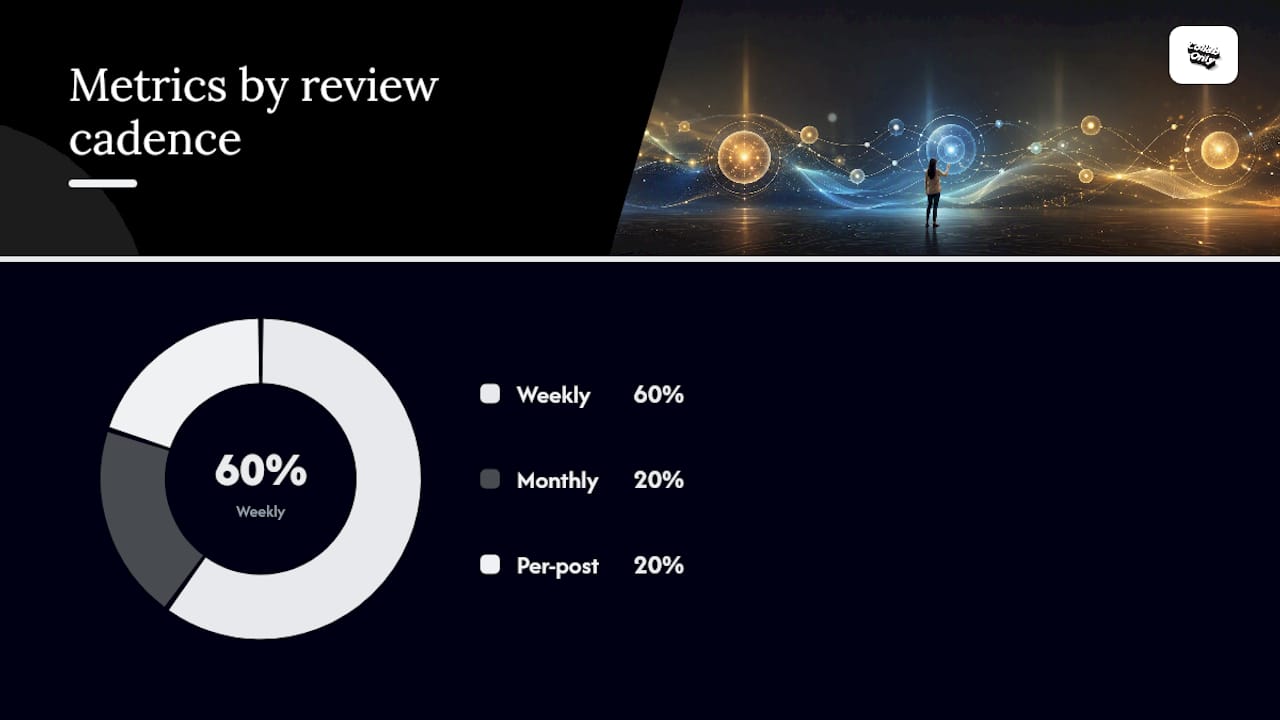
| Metric | What it predicts | Review cadence |
|---|---|---|
| Email subscriber growth rate | Long-term audience ownership | Weekly |
| Meaningful engagement rate | Algorithm reach and trust stage | Weekly |
| Community activity rate | Retention and loyalty | Weekly |
| Platform-to-email conversion rate | Distribution resilience | Monthly |
| Content retention rate | Content quality and format fit | Per-post |
What does a practical 90-day growth experiment look like?
Digitalways' rapid growth research identifies short experiments with clear inputs and measurable benchmarks as the mechanism that turns strategy into repeatable learning. The following plan is designed for a solo creator or small team running their first structured growth experiment.
Days 1–30: Foundation.
- Audit current content performance: identify the top three posts by engagement rate and the bottom three; document what differentiates them.
- Define three content pillars and validate each against the search, engagement, and monetization checklist.
- Launch or optimize one owned channel (newsletter or community); set a weekly publishing schedule.
- Identify three potential collaboration partners; send outreach to all three.
- Benchmark: record current email subscriber count, weekly engagement rate, and follower count on primary platform.
Success at Day 30: at least one owned channel active, three pillars defined, outreach sent, baseline metrics documented.
Days 31–60: Execution.
- Maintain 3–5 posts per week on primary platform; batch-produce content every Monday.
- Publish newsletter weekly; include one exclusive piece of content per issue.
- Complete at least one collaboration (guest post, newsletter swap, or joint live).
- Begin repurposing: every long-form asset produces at least three shorter formats.
- Review weekly dashboard every Monday; adjust underperforming content types.
Success at Day 60: engagement rate trending upward, email list growing week over week, one collaboration completed.
Days 61–90: Optimization.
- Double down on the one content pillar with the highest engagement and conversion signals.
- Launch a second collaboration; negotiate a recurring swap if the first performed well.
- Test one paid amplification tactic (boosted post or newsletter sponsorship swap) with a defined budget and a specific conversion goal.
- Conduct a 90-day audit: compare all metrics against Day 1 baseline; identify the single highest-leverage change for the next cycle.
Success at Day 90: measurable growth in at least three of five KPIs, one repeatable content format identified, one partnership relationship established for ongoing collaboration.
| Phase | Key activities | Success benchmark |
|---|---|---|
| Days 1–30 | Audit, pillar definition, owned channel launch, partner outreach | Baseline documented, one channel live |
| Days 31–60 | Consistent cadence, newsletter, first collaboration, repurposing | Engagement trending up, list growing |
| Days 61–90 | Pillar doubling, second collab, paid test, full audit | Three of five KPIs improved vs. baseline |
Which tools support planning, scheduling, editing, and analytics?
The right tool stack for a solo creator or small team is minimal: one scheduling tool, one analytics layer, one editing tool, and one community or newsletter platform. Adding tools beyond these four categories typically adds overhead without adding capability.
- Buffer: scheduling and analytics for social platforms; best for solo creators and small teams who need a clean queue and basic performance data without enterprise complexity. Use it to maintain posting cadence across TikTok, Instagram, LinkedIn, and X from a single dashboard.
- Hootsuite: scheduling, social listening, and team collaboration; best for agencies and marketing teams managing multiple accounts or clients. Its engagement inbox consolidates comments and DMs across platforms, which supports the first-60-minutes engagement discipline.
- Beehiiv: newsletter creation, subscriber growth tools, and monetization; best for creators building an owned email audience. Its referral program and recommendation network accelerate list growth without paid acquisition.
- CapCut or Descript: video editing for short-form content; CapCut for mobile-first creators, Descript for teams that need transcript-based editing and podcast production.
- Notion or Airtable: content planning and content bank management; both support a simple editorial calendar with pillar tagging and status tracking.
- Native platform analytics: use each platform's own analytics (TikTok Analytics, Instagram Insights, YouTube Studio) for content-level performance data before investing in a third-party analytics tool.
A minimal workflow: ideate and script in Notion (Monday), record and edit in Descript or CapCut (Tuesday), schedule in Buffer or Hootsuite (Wednesday), publish newsletter in Beehiiv (Thursday), review dashboard metrics (Monday of the following week).
How were these recommendations formed?
The recommendations in this article draw from four evidence types: platform-published research and creator guides (Buffer, Hootsuite, Beehiiv), e-commerce and marketing industry analyses (Shopify, Mailchimp), third-party growth strategy research (Digitalways, PostSyncer), and established content marketing frameworks validated across multiple verticals.
Evaluation criteria applied to every tactic: effort-to-impact ratio (tactics requiring disproportionate effort for marginal gain were deprioritized), ownership (tactics that build first-party assets were weighted more heavily than platform-dependent ones), sustainability (tactics that can be maintained at a consistent cadence without burnout), and measurability (tactics with clear, trackable output metrics were preferred over those with diffuse or lagging signals).
One important caveat: growth timelines and engagement benchmarks vary significantly by vertical, audience size, and platform. A B2B LinkedIn creator and a consumer-facing TikTok creator operate in different algorithmic environments with different audience behaviors. The frameworks here are designed to be adapted, not applied uniformly. Run the 90-day experiment with your specific baseline metrics, and let your own data override any generic benchmark.
How do you identify and reach the right audience segments?
Audience segmentation is the practice of dividing a broad audience into subgroups based on shared characteristics, behaviors, or needs, then tailoring content to each subgroup's specific signals. For most creators and small businesses, three to four segments are sufficient: by content interest (which pillar they engage with most), by stage in the discover-trust-retain framework (new follower vs. active community member vs. paying customer), and by platform behavior (where they consume content and how they prefer to engage).
Practical segmentation starts with existing data. Sort your email list by open rate and click behavior: subscribers who open every issue and click through to platform content are your highest-engagement segment; subscribers who open but never click are consuming but not converting; subscribers who have not opened in 60 days need a re-engagement sequence or removal. On social platforms, use native analytics to identify which content types attract your highest-engagement followers versus your passive audience.
Tailoring content to segments does not require producing entirely different content for each group. It requires adjusting the angle, depth, and call-to-action. A post about content strategy aimed at a new creator emphasizes fundamentals and quick wins; the same topic aimed at an experienced marketer emphasizes measurement, iteration, and systems. The pillar is identical; the execution is calibrated. For a more detailed approach to audience engagement strategies, segmentation mechanics and behavioral targeting are covered in depth.
How are AI tools and emerging formats changing audience growth in 2026?
AI tools have shifted from novelty to production infrastructure for most serious creators and marketing teams. The most practical applications in 2026 are not content generation (AI-written content without human editorial judgment tends to produce generic output that underperforms on engagement) but production efficiency: AI-assisted transcription and repurposing (Descript, Otter.ai), caption generation from video transcripts, thumbnail A/B testing, and content performance prediction.
Short-form video remains the dominant discovery format across TikTok, Reels, and YouTube Shorts, and the algorithmic preference for it is not expected to diminish. The differentiation in 2026 is not in the format itself but in the specificity of the content: creators who use short-form video to answer a precise question or demonstrate a specific technique outperform those who produce broadly entertaining content without a clear search or interest signal.
Augmented reality (AR) filters and interactive content formats (polls, quizzes, collaborative posts) are increasingly available on Instagram, TikTok, and Snapchat. Their primary value is engagement depth rather than reach: a viewer who interacts with an AR filter or completes a poll spends more time with the content and generates a stronger algorithmic signal than a passive viewer. For teams with design resources, custom AR filters tied to a campaign or content series can meaningfully lift engagement rate.
The practical guidance: adopt AI for production efficiency, not content substitution. Use short-form video as a discovery mechanism, not a content strategy in itself. Test interactive formats in one campaign before scaling them.
What paid growth strategies produce the best ROI?
Paid audience growth works best as an amplification layer on top of organic content that already demonstrates engagement, not as a substitute for it. Boosting a post that is already performing well organically costs less per engagement than promoting cold content, because the platform's algorithm has already validated the content's relevance signal.
Three paid formats worth testing for audience growth specifically (as distinct from direct sales):
- Social media follower campaigns: Meta's "Page Likes" or "Profile Visits" objectives, TikTok's "Followers" objective. Best for accelerating discovery-stage growth when organic reach is limited by account size. Budget allocation: start with $5–$10 per day for 14 days, measure cost per new follower, and compare against organic growth rate.
- Newsletter sponsorship swaps: paying to be featured in a complementary newsletter's issue. This is paid partnership rather than paid advertising, and it tends to produce higher-quality subscribers because the introduction comes via a trusted voice. Cost varies by list size and engagement rate.
- Retargeting campaigns: serving ads to people who have already visited your website or engaged with your content. These campaigns target the trust stage of the framework, not the discovery stage, and typically produce higher conversion rates at lower cost per acquisition than cold-audience campaigns.
Budget allocation principle: allocate the majority of paid spend to the stage of the framework where your organic funnel is weakest. If discovery is strong but retention is low, paid retargeting to drive email sign-ups will outperform follower campaigns.
What psychological principles drive audience growth?
Audience growth is, at its core, a behavioral problem. People follow, subscribe, and return because content satisfies a specific psychological need: the need for information that reduces uncertainty, the need for identity affirmation (content that reflects who they are or who they want to be), or the need for community (belonging to a group with shared interests or values).
The most durable content strategies address at least two of these three needs simultaneously. A creator who produces precise, data-backed marketing analysis (information) while building a community of practitioners who share results and ask questions (belonging) creates a retention loop that is difficult to replicate with content alone.
Consistency matters psychologically as well as algorithmically. Audiences form expectations based on posting patterns, and when those expectations are met reliably, the creator or brand builds what behavioral economists call "predictive trust": the audience trusts that the next piece of content will be worth their time before they have seen it. This is the mechanism behind the signature series concept described earlier. Breaking a consistent pattern, even once, can disrupt that trust more than the missed post suggests.
Reciprocity is another underused lever. Creators who respond to comments, feature audience questions in their content, and publicly acknowledge community members activate a reciprocal obligation in the audience: people who feel seen are more likely to share, recommend, and stay.
How does a personal or brand story build connection and loyalty?
A brand story is not a biography. It is a specific, repeatable narrative that explains why the brand or creator exists, what problem it was built to solve, and what it believes about the world that most competitors do not. The most effective brand stories share three structural elements: a clear origin (what happened that made this necessary?), a stated belief (what does the brand hold to be true that others overlook?), and a consistent enemy (what is the brand working against, whether a bad practice, a false assumption, or an industry norm?).
For creators, the personal story functions as a trust accelerant. Audiences who understand a creator's origin and motivation are more likely to extend the benefit of the doubt when content misses, more likely to share the creator's work with their own networks, and more likely to convert to paid products or communities. The story does not need to be dramatic; it needs to be specific and honest. A marketing consultant who built their practice after watching a small business fail because of poor digital strategy has a more compelling origin than one who "has always been passionate about marketing."
Consistency in story-telling across platforms is as important as consistency in posting cadence. The same origin, belief, and enemy should surface in newsletter introductions, social media bios, podcast guest appearances, and collaboration pitches. Audiences encounter a brand across multiple touchpoints; a fragmented story produces a fragmented impression.
What legal and ethical obligations apply to audience growth tactics?
Several audience growth tactics carry legal or regulatory obligations that creators and marketers in the United States must address explicitly.
Sponsored content and paid partnerships. The Federal Trade Commission (FTC) requires clear and conspicuous disclosure of any material connection between a creator and a brand, including gifted products, affiliate commissions, and paid collaborations. "Ad," "Paid partnership," or "#sponsored" placed prominently at the beginning of a post or video satisfies this requirement. Burying a disclosure in a caption below a "more" fold or in a list of hashtags does not.
Email list compliance. The CAN-SPAM Act governs commercial email in the United States and requires that every commercial email include a physical mailing address, a clear unsubscribe mechanism, and an honest subject line. Purchased email lists are not only ineffective for engagement; sending to them without explicit opt-in consent creates legal exposure.
Data privacy. If your audience includes visitors from the European Union, the General Data Protection Regulation (GDPR) applies to how you collect, store, and use their data, regardless of where your business is based. California residents are covered by the California Consumer Privacy Act (CCPA). Both require clear privacy policies, opt-in consent for data collection, and the ability for users to request deletion of their data.
UGC and content rights. Featuring user-generated content in your marketing requires explicit permission from the creator, even when the content was posted publicly. A comment or tag is not a license to reuse.
This section provides general information, not legal advice. Consult a qualified attorney for guidance specific to your situation and jurisdiction.
What would actually be done first if starting from zero today?
The conventional advice is to "find your niche" and "be consistent." Both are correct and both are insufficient without a more specific sequence.
The single first action, if starting from zero today, would be to launch a newsletter before building a social following. Here is the reasoning: social platforms are discovery engines, but they are poor retention tools. A newsletter subscriber has made an active choice to receive content in their inbox; a social follower has made a passive choice to see content if the algorithm surfaces it. The gap in intent between those two actions is enormous, and it compounds over time.
The immediate three tasks following that decision: (1) choose a specific, narrow topic for the newsletter that can be covered with genuine authority, not broad interest; (2) publish the first three issues before promoting the newsletter anywhere, so that the first visitor who lands on the sign-up page can read real content before deciding to subscribe; (3) identify one collaboration partner whose audience overlaps with the newsletter's topic and propose a cross-promotion within the first 30 days.
The trade-off is real: this approach builds slowly at first. A newsletter with 50 subscribers is less impressive than a social account with 5,000 followers. The metric that matters is not size; it is the ratio of active engagement to total audience.
Chasing platform growth without an owned channel is building on rented land. The algorithm changes; the list does not.
Collabonly accelerates the partnership stage of your 90-day plan
The partnership stage of the 90-day experiment is where most creators and small businesses stall, not because the strategy is wrong but because finding the right collaborator through cold outreach is slow, inconsistent, and difficult to scale. Collabonly solves that specific bottleneck.
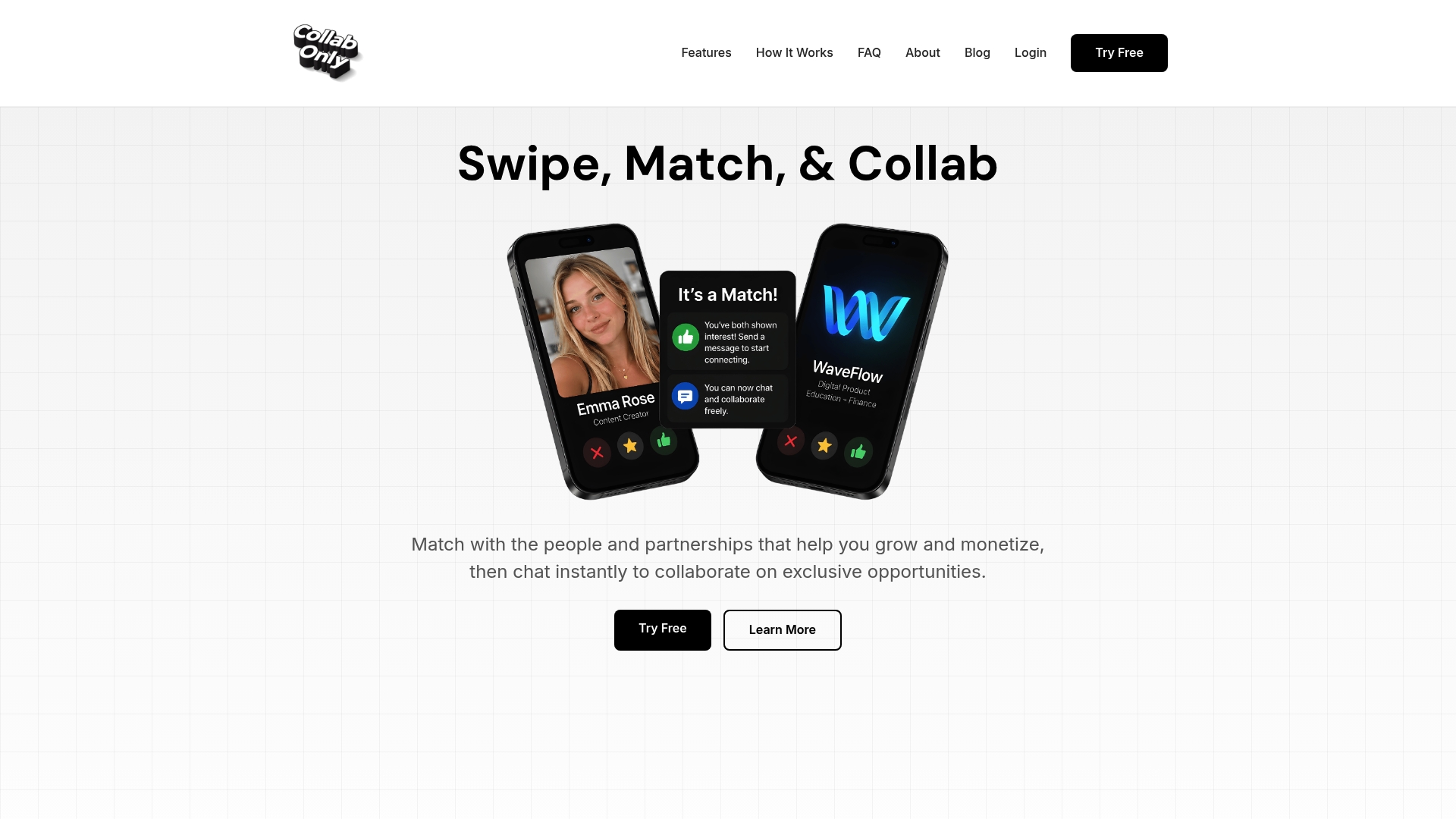
Collabonly is a matching marketplace for brands, creators, and marketers that replaces the cold-DM and slow-email cycle with a swipe-based interface and instant chat upon match. For a creator running the 30/60/90 plan, Collabonly maps directly onto Days 1–30 (partner identification) and Days 31–60 (first collaboration execution): instead of spending two weeks researching and cold-outreaching three potential partners, you match with pre-vetted, goal-aligned collaborators in a fraction of the time. Brands can connect with nano influencers for high-trust, geo-concentrated campaigns, or hire micro influencers for broader reach with strong engagement rates. The platform supports TikTok, Instagram, and YouTube collaborations, which means it fits directly into the platform-by-platform tactics covered in this article. Start your first match on Collabonly and have a collaboration partner identified before Day 30 of your experiment.
Sources
- How to Grow on Social Media in 2026: A Data-Backed Guide | Buffer
- Audience Growth Strategies: Best & Worst Approaches (2026) | beehiiv Blog
- Social media engagement strategies | Hootsuite blog
- Audience Growth Strategy: How To Grow Your Audience Quickly (2025) - Shopify
FAQ
How do you build an audience in 2026?
Start by owning at least one first-party channel (email newsletter or private community), then publish at a cadence of 3–5 posts per week on your primary platform, and use strategic collaborations to accelerate discovery. The discover-trust-retain framework, supported by Beehiiv's 2026 analysis, provides the repeatable structure for moving new followers toward loyal subscribers.
What is the 5-3-2 rule on Instagram?
The 5-3-2 rule is a content mix guideline suggesting that for every ten posts, five should be curated content from others, three should be original content, and two should be personal or behind-the-scenes posts. It is a general framework for balancing value delivery with brand personality; definitions vary by practitioner, and the optimal ratio for your account depends on your audience's engagement patterns.
What is the 3-3-3 rule in marketing?
The 3-3-3 rule is an informal content planning heuristic that recommends organizing content around three core pillars, publishing three times per week, and engaging with three audience members or community conversations per day. It is not a standardized industry framework; treat it as a starting structure and adjust based on your own performance data.
What is the 5-3-1 rule on social media?
The 5-3-1 rule is a posting ratio guideline: for every nine posts, five provide value or education, three share curated or community content, and one is a direct promotional or conversion-focused post. Like the 5-3-2 rule, it is a practitioner heuristic rather than a platform-endorsed standard, and its effectiveness depends on audience type and platform context.
How long does it take to see real audience growth?
Meaningful movement in engagement metrics typically appears within 30 days of a consistent cadence; email list growth compounds noticeably at 60–90 days; and community activity reaches self-sustaining levels at 60–120 days. The 90-day experiment plan in this article provides specific benchmarks for each phase.