

TL;DR:
- Content partnerships involve formal collaborations between brands or creators to co-create, co-distribute, or co-promote content for mutual audience benefit. They significantly enhance brand lift, SEO authority, and audience growth when both parties align their goals, resources, and content formats effectively. Patience and ongoing collaboration across multiple formats produce the strongest long-term results.
A content partnership is a formal collaboration between two or more brands or creators to co-create, co-distribute, or co-promote content that delivers mutual value to each party's audience. The practice sits at the intersection of partnership marketing and content strategy, making it one of the most cost-efficient growth channels available to modern marketers. Partnering with publishers to distribute content can result in a 50% higher brand lift compared to solo efforts. That figure alone explains why brands from software companies to consumer goods labels are formalizing content collaboration strategies at scale. Formats range from joint webinars and co-branded research reports to guest blog exchanges and co-produced video series.
What is a content partnership and how does it work?
A content partnership is defined as a formal agreement between brands to co-create, co-distribute, or co-promote content with clear goals and mutual accountability. Each party contributes resources, whether that means budget, audience access, subject matter expertise, or distribution channels, and each party benefits from the combined output. The arrangement differs from a simple sponsorship because both sides shape the content itself, not just the placement.

The mechanics are straightforward. Two brands identify overlapping audience segments and a shared content objective. They agree on format, ownership, and promotion responsibilities. They produce the content together and distribute it across both parties' channels simultaneously. The result is content that reaches a larger, more qualified audience than either brand could access alone.
The primary goal of content partnerships is to provide genuine value to the audience while both parties gain visibility and engagement. That audience-first orientation separates effective partnerships from transactional content swaps that readers quickly recognize and dismiss.
What are the different types of content partnership formats?
Content partnership models vary widely in format, resource commitment, and audience focus. Understanding the distinctions helps marketers match the right structure to their goals and capacity.
| Format | Resource Commitment | Primary Benefit | Best Use Case |
|---|---|---|---|
| Joint webinar | Medium (shared production cost) | Live audience engagement and lead capture | B2B brands with complementary expertise |
| Co-branded research report | High (data, design, distribution) | Backlinks, press coverage, authority building | Thought leadership campaigns |
| Guest blog exchange | Low (writing time only) | SEO backlinks and new audience exposure | Content-heavy brands at similar scale |
| Co-produced video series | High (budget, talent, editing) | Brand awareness and social reach | Consumer brands with visual storytelling goals |
| Co-hosted podcast series | Medium (recording, editing) | Niche audience loyalty and long-form authority | Industry-specific B2B or B2C brands |
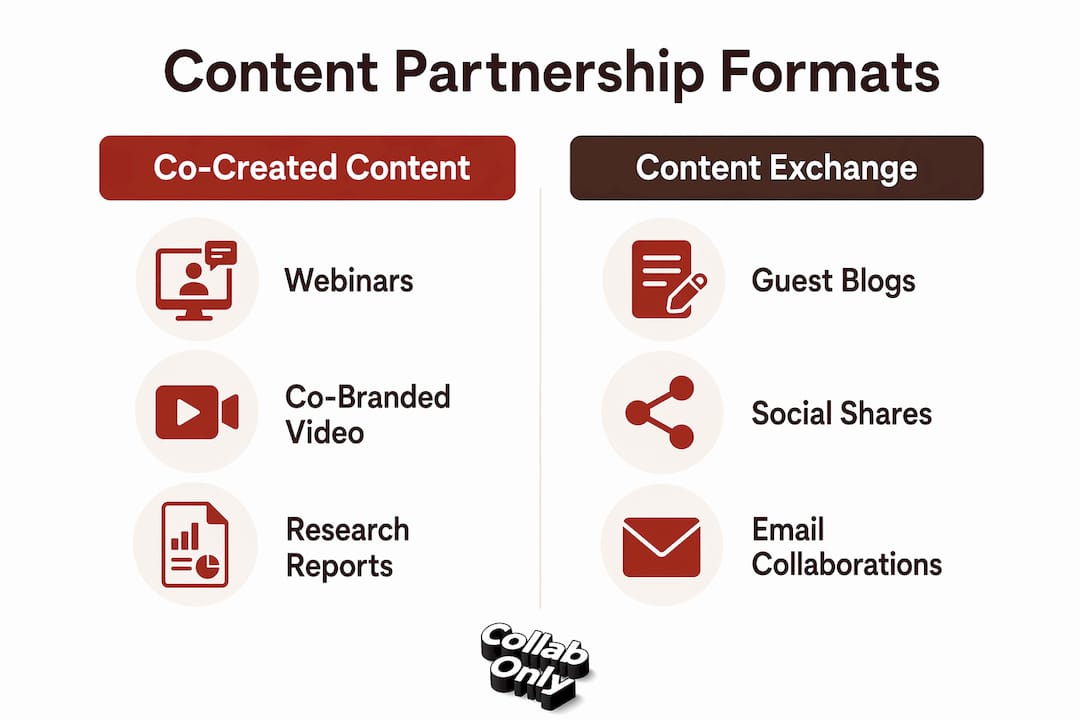
The most resource-intensive formats, such as co-branded video, require creative alignment and combined budgets for quality that is unattainable in-house alone. A solo brand producing a high-production video series may spend significantly more per episode than two brands splitting the same cost while doubling the distribution footprint.
Co-created content and content exchange programs represent the two broadest categories. Co-created content means both parties contribute to a single asset, such as a joint research report published under both logos. A content exchange program means each party produces separate content that the other distributes, such as a guest blog series. The types of content collaborations available in 2026 span both categories, and the right choice depends on audience alignment and creative capacity.
Pro Tip: Match the format to your partner's content production strengths, not just their audience size. A partner with a highly engaged email list of 20,000 subscribers often delivers better results than one with a million passive social followers.
Why are content partnerships beneficial for brands and marketers?
Strategic content partnerships outperform solo strategies by combining complementary audiences and shared distribution channels. The benefits are measurable and span audience growth, cost efficiency, SEO authority, and brand credibility.
The core advantages include:
- Audience expansion. Each partner exposes the other's content to a pre-qualified segment that shares interests but may not yet follow the other brand. This is faster and cheaper than paid acquisition for reaching warm audiences.
- Shared cost efficiency. Webinar production costs split between two partners reduce the expense per brand while doubling the potential audience reach. The same logic applies to research reports, video production, and event sponsorships.
- SEO and backlink gains. Joint research reports receive more backlinks, press coverage, and downloads than individual efforts. Two authoritative domains linking to shared content compound the SEO signal.
- Accelerated learning and risk sharing. Sharing risk and learning accelerates testing of new content formats, leading to better SEO and authority results without one brand absorbing the full cost of experimentation.
- Brand credibility transfer. Association with a respected partner brand signals quality to new audiences. This peer-credibility effect is particularly valuable for younger or less-established brands entering a new market segment.
"Brands should see content partnerships as strategic advantages, leveraging joint creative vision and investment for elevated content quality." — NonStop Marketing
The SEO dimension deserves specific attention. Branded content strategies that incorporate co-created assets consistently show stronger organic performance than single-brand content. Two authoritative voices on a single topic signal depth and credibility to search engines and readers alike. For brands investing in organic growth through high-quality content, a well-structured content partnership is one of the most efficient paths to building that authority.
What are the key success factors for content partnerships?
Successful partnerships combine complementary audiences, balanced resource contributions, and a shared focus on audience-serving educational content. The most common failure point is misaligned expectations, not misaligned audiences.
The critical success factors are:
- Audience alignment without competition. Partner with complementary companies serving the same user base rather than direct competitors. A project management software brand and a time-tracking tool brand share an audience of operations professionals without competing for the same purchase decision.
- Clear goals and shared metrics. Define what success looks like before production begins. Agree on specific metrics such as downloads, registrations, backlinks, or social reach so both parties evaluate the partnership on the same terms.
- Defined roles and ownership. Specify who owns the final asset, who controls distribution, and who handles promotion. Ambiguity on ownership creates friction after the content is published.
- Open communication and editorial integrity. Both parties must feel comfortable raising concerns about content quality or brand alignment. Partnerships that suppress editorial feedback produce content that neither audience trusts.
- Genuine value exchange. Avoid partnerships where one brand contributes significantly more than the other. Imbalanced contributions create resentment and reduce the quality of future collaboration.
The brand partnership best practices that consistently produce results share one trait: both parties treat the audience as the primary stakeholder, not their own brand visibility.
Pro Tip: Before signing any partnership agreement, audit your partner's recent content for tone, accuracy, and audience engagement. A partner whose content quality does not match yours will dilute your brand's credibility regardless of their audience size.
How can brands initiate and manage effective content partnerships?
Building an effective content partnership follows a repeatable process. The steps below apply whether you are producing a single co-authored article or a multi-month webinar series.
- Identify potential partners. Search for brands with overlapping audience demographics but non-competing products or services. Evaluate their content quality, publishing frequency, and audience engagement rate before making contact.
- Establish a formal or informal agreement. Document the scope, timeline, content ownership, distribution rights, and each party's promotional commitments. A simple one-page brief works for smaller collaborations; larger campaigns warrant a formal contract.
- Align on content planning. Co-develop a content brief that reflects both brands' messaging priorities and the audience's informational needs. Assign a primary editor from each side to maintain quality control throughout production.
- Execute joint promotion. Coordinate launch timing so both parties publish and promote simultaneously. Synchronized promotion maximizes the initial distribution window and signals to algorithms that the content is generating cross-platform engagement.
- Measure and refine. Track agreed metrics at 30, 60, and 90 days post-publication. Use the data to assess whether the partnership format delivered on its goals and to inform the structure of future collaborations.
The table below summarizes the key decisions at each stage:
| Stage | Key Decision | Common Mistake |
|---|---|---|
| Partner identification | Audience fit over brand prestige | Choosing partners based on follower count alone |
| Agreement | Define ownership and distribution rights | Leaving content rights ambiguous |
| Content planning | Shared editorial brief with both voices | One brand dominating the creative direction |
| Promotion | Synchronized multi-channel launch | Staggered promotion that dilutes momentum |
| Measurement | Pre-agreed metrics tracked consistently | Evaluating success with different KPIs post-launch |
Platforms that facilitate AI-driven content strategy and SEO are increasingly used to identify partnership opportunities based on topical authority gaps and audience overlap data. These tools reduce the manual research burden at the partner identification stage.
Key Takeaways
A content partnership delivers measurable brand lift, SEO authority, and audience growth when both parties contribute equally, align on audience-first goals, and commit to consistent measurement.
| Point | Details |
|---|---|
| Core definition | A content partnership is a formal agreement to co-create, co-distribute, or co-promote content for mutual benefit. |
| Brand lift advantage | Partnering with publishers for content distribution can produce 50% higher brand lift than solo content efforts. |
| Format selection | Match the content format to both partners' production capacity and audience alignment, not just audience size. |
| Avoid direct competitors | Partner with complementary brands serving the same audience to maximize reach with minimal friction. |
| Measure consistently | Agree on shared metrics before launch and track them at 30, 60, and 90 days to assess true partnership value. |
The long game: why patience separates good partnerships from great ones
The most common mistake I see brands make with content partnerships is treating them as one-off transactions. A single co-authored blog post or a single joint webinar rarely moves the needle on its own. The brands that extract the most value from collaborative content are the ones that commit to a series, build a shared audience over multiple touchpoints, and refine their approach based on actual performance data.
Authentic collaboration changes the quality of the content itself. When two brands genuinely respect each other's expertise, that dynamic shows in the final product. Readers and viewers recognize the difference between a forced co-branding exercise and a conversation between two credible voices. The former gets skimmed; the latter gets shared.
The trend I find most significant right now is the shift toward multimedia content partnerships. Brands that once limited collaboration to guest posts are now co-producing short-form video for TikTok and Instagram, co-hosting podcast series, and building joint content hubs that live on both partners' websites simultaneously. This multi-format approach compounds the SEO and audience benefits far faster than any single-format strategy.
Patience and consistency are the actual differentiators. A content partnership that runs for six months with a committed partner will outperform a dozen one-off collaborations with high-profile brands every time.
— Samuel
How Collabonly connects brands with the right content partners
Finding the right content partner has historically been the hardest part of the process. Cold outreach gets ignored, and DMs disappear into crowded inboxes.

Collabonly solves the discovery problem directly. The platform's influencer marketplace connects brands with creators and partners across TikTok, Instagram, and YouTube through a match-based system that surfaces goal-aligned collaborators rather than just high-follower accounts. Brands can filter by niche, audience demographics, and platform to find partners whose audiences genuinely overlap with their own. For brands building ambassador-led content programs, Collabonly's brand ambassador jobs listing connects you with creators ready to co-produce and co-promote at scale. The result is faster partner identification, instant communication upon matching, and fewer wasted outreach cycles.
FAQ
What is the content partnership definition in marketing?
A content partnership is a formal collaboration between two or more brands or creators to co-create, co-distribute, or co-promote content for mutual audience and business benefit. The arrangement includes shared resources, joint promotion, and agreed metrics for measuring outcomes.
What are the main benefits of content partnerships?
Content partnerships deliver audience expansion, shared production costs, SEO backlink gains, and accelerated brand credibility. Partnering with publishers for content distribution can produce 50% higher brand lift compared to solo content efforts.
How do you find the right content partnership partner?
Identify brands with overlapping audience demographics but non-competing products or services. Evaluate content quality, publishing consistency, and audience engagement before initiating contact, and prioritize audience alignment over raw follower count.
What formats do content partnerships typically use?
Common formats include joint webinars, co-branded research reports, guest blog exchanges, co-produced video series, and co-hosted podcasts. The best format depends on each partner's production capacity and the shared audience's content preferences.
How do you measure the success of a content partnership?
Agree on specific metrics before launch, such as downloads, backlinks, registrations, or social reach, and track them at 30, 60, and 90 days post-publication. Using pre-agreed KPIs prevents both parties from evaluating the partnership on different terms after the fact.