

TL;DR:
- Cross-platform promotion involves coordinated marketing across multiple digital channels with shared audience data and synchronized triggers. It improves brand visibility and engagement by delivering relevant, platform-native content that reinforces messages throughout the customer journey. Effective execution requires unified audience definitions, native creative formats, and a hybrid measurement approach to ensure accurate performance tracking.
Cross-platform promotion is defined as the coordinated distribution of marketing content across multiple digital channels, unified by a single campaign goal and adapted natively in format and tone for each platform. This is the recognized industry term for what practitioners also call cross-channel advertising or multi-platform marketing. The distinction matters: coordination is the operative word. Brands that limit promotion to a single platform risk leaving 60–80% of potential audience reach untapped. With 75% of consumers thinking about shopping multiple times per week, a coordinated presence across TikTok, Instagram, YouTube, search, and retail media is not optional. It is the baseline for effective brand engagement.
What is cross-platform promotion, and how does it differ from multichannel marketing?
The two terms are not interchangeable, and conflating them is the most common strategic error brand managers make. Multichannel marketing means a brand maintains a presence on several platforms. Cross-platform promotion means those platforms actively share data, audiences, and campaign triggers with each other.
Multichannel marketing provides coverage; cross-platform promotion provides coordination. Without shared audience signals and synchronized data, a multichannel approach fragments the budget and delivers inconsistent brand experiences. A consumer who sees a retargeting ad on Instagram for a product they already purchased on your website is a symptom of multichannel without coordination.
True cross-platform promotion operates across three shared layers:
- Shared audience definition: One unified audience segment is pushed simultaneously to all active platforms, preventing overlap and redundant impressions.
- Native creative system: The core message is rendered in formats native to each channel. A 15-second vertical video on TikTok, a carousel on Instagram, and a sponsored product listing on Amazon all carry the same campaign intent but different executions.
- Centralized measurement framework: Performance data from all channels feeds into a single reporting structure, enabling true ROI comparison rather than siloed platform metrics.
Tom Demers notes that shared data and audience triggers are what prevent repetitiveness and enable genuine coordination across channels. Without all three layers in place, what brands call "cross-platform" is still just multichannel.
Pro Tip: Before launching any coordinated campaign, audit whether your audience segments are defined once and pushed to all platforms simultaneously, or defined separately per platform. The latter is multichannel, not cross-platform.
How does cross-platform promotion enhance brand visibility and engagement?
Coordinated cross-platform campaigns produce measurably better outcomes than isolated channel efforts. The core mechanism is frequency with relevance: a consumer encounters the brand on YouTube, then sees a consistent message on Instagram, then finds a search ad that reinforces the same offer. Each touchpoint builds on the last rather than starting from zero.

Consistent messaging adapted for platform-native experiences keeps the brand top-of-mind across the full customer journey. Nathaniel Miller emphasizes that cross-platform promotion only succeeds when messaging coherence spans the entire user journey, ensuring relevance as audiences move between platforms. This is the mechanism behind improved brand recall: repetition with contextual adaptation, not repetition with identical creative.
The practical benefits for brand managers include:
- Reduced cost per acquisition, because coordinated frequency shortens the decision cycle.
- Higher engagement rates, because platform-native creative performs better than repurposed assets.
- Fewer wasted impressions, because a unified audience definition prevents the same person from being targeted as a new prospect after they have already converted.
- Stronger brand recall, because the consumer encounters a coherent narrative rather than disconnected messages.
Consumer attention is fragmented across programmatic display, search, social, connected TV (CTV), and retail media. A cross-platform marketing strategy captures that attention at multiple points in a non-linear customer journey, rather than betting everything on a single channel's algorithm. You can read more about growing brand audience reach through coordinated channel strategies to understand how audience expansion compounds over time.
What are the core components of executing cross-platform promotion?
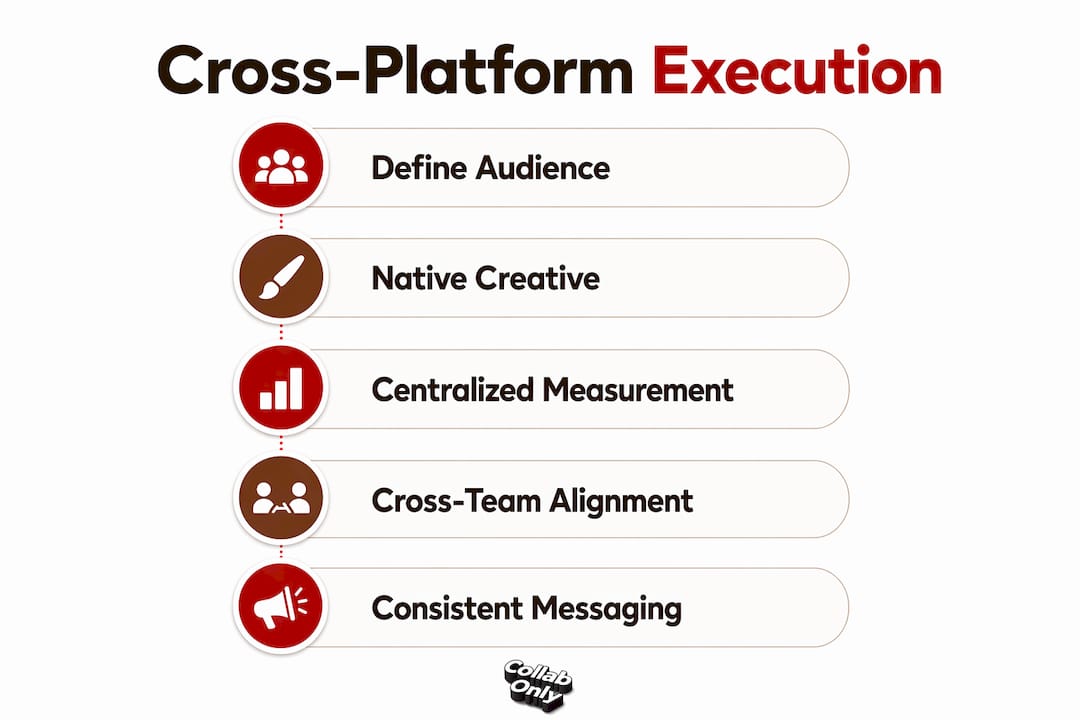
Execution is where most cross-platform strategies fail. The theory is straightforward; the operational discipline is not. Successful campaigns require four sequential steps:
-
Define one audience segment. Use your CRM or customer data platform (CDP) to build a single audience definition. Export that segment to every active platform simultaneously. This prevents the common error of building separate audiences per platform that overlap and compete against each other in ad auctions.
-
Build a native creative system. Start with the core message and produce platform-specific executions from it. A product launch campaign might use a long-form YouTube video as the anchor, a 15-second TikTok cut for awareness, an Instagram carousel for feature detail, and a search ad for intent capture. Blind reposting harms effectiveness; each execution must match the platform's format, caption style, and call-to-action norms.
-
Synchronize campaign triggers. Marketing automation tools and CDPs play a critical role in building shared audience definitions and synchronizing campaign triggers across channels. When a user completes a purchase, that signal should suppress retargeting ads across all platforms within hours, not days.
-
Establish a centralized measurement framework. Define your primary KPI before launch. All platform-level metrics feed into that single question. Removing any shared layer of audience, creative, or measurement breaks cross-platform coordination and reverts the campaign to fragmented multichannel.
Common pitfalls to avoid include publishing identical captions across platforms, setting different campaign objectives per platform without a unifying goal, and treating each platform's reporting dashboard as the source of truth. Platform dashboards optimize for their own metrics. Your centralized framework is the only reliable measure of cross-campaign performance.
Pro Tip: Small and mid-sized brands without a full data team can achieve cross-platform coordination through simplified event sharing via a single pixel or server-side tag connected to all platforms. Full CDP infrastructure is not required to start.
Effective execution also requires cross-team alignment. Your paid media team, organic content team, and analytics team must operate from the same campaign brief, the same audience definition, and the same measurement framework. Siloed teams produce siloed campaigns, regardless of the technology in place. For practical guidance on coordinated content campaigns, the principles of sequencing and native adaptation apply directly.
How do you measure cross-platform promotion effectiveness?
Measurement is the hardest operational challenge in cross-platform promotion. Each platform uses a distinct attribution model. Google attributes conversions to the last click. Meta uses a 7-day click and 1-day view window by default. Amazon attributes to the last touch within its own ecosystem. When all three run simultaneously, conversion credit overlaps and total reported conversions exceed actual sales.
Platforms use distinct attribution models and reporting frameworks, causing inconsistent metrics and overlapping conversion credit. This is not a bug. It is a structural feature of how each platform is incentivized to report performance. Brand managers who sum platform-reported conversions will consistently overcount results.
The solution is a hybrid measurement approach:
| Measurement layer | Method | Purpose |
|---|---|---|
| Platform-level | Native dashboards | Optimize individual channel tactics |
| Cross-platform | Unified dashboard or BI tool | Compare channel contribution to shared KPI |
| Incrementality | Holdout testing or geo-lift studies | Measure true causal impact of each channel |
| Attribution | Server-side tagging or MTA model | Reduce double-counting across platforms |
Industry analysts caution that over-centralization can harm platform-specific agility. The recommended model combines shared strategy with independent platform-specific optimizations. Each channel team retains the authority to adjust bids, creative, and targeting within its platform. The centralized framework governs the shared goal, the audience definition, and the primary KPI. This hybrid structure prevents both the fragmentation of pure multichannel and the rigidity of over-centralized control.
Server-side tagging reduces data loss from browser-based tracking restrictions and provides a more accurate signal for cross-platform attribution. Marketing services partners who specialize in unified measurement can accelerate this infrastructure for brands that lack in-house technical resources. For a broader view of how digital campaigns drive organic growth alongside paid cross-platform efforts, the principles of incrementality testing apply across both paid and organic channels.
Key Takeaways
Cross-platform promotion succeeds only when a single audience definition, native creative execution, and centralized measurement operate together across every active channel.
| Point | Details |
|---|---|
| Coordination defines cross-platform | Shared audience signals and data triggers separate cross-platform promotion from basic multichannel presence. |
| Native creative is non-negotiable | Each platform requires format-specific executions; repurposed assets underperform platform-native content. |
| Measurement requires a hybrid model | Combine platform-level optimization with a centralized KPI framework to avoid double-counting conversions. |
| CDPs and automation enable scale | Marketing automation tools and CDPs synchronize audience definitions and campaign triggers across channels. |
| Audience fragmentation demands presence | With 75% of consumers thinking about shopping multiple times per week, single-channel strategies miss the majority of touchpoints. |
Where most cross-platform strategies actually break down
The theory of cross-platform promotion is well-documented. The practice is where I consistently see brand managers lose ground, and the failure point is almost never the technology.
The most frequent breakdown is organizational. Paid media, organic content, and analytics teams each receive separate briefs, build separate audience segments, and report to separate managers. The result is three teams running three campaigns on the same platforms, each optimizing for different metrics, each claiming credit for the same conversions. No amount of CDP infrastructure fixes a governance problem.
The second most common failure is creative discipline. Brands invest in a unified message and then allow each platform team to adapt it independently, without a shared creative system. Within two weeks, the Instagram team has pivoted to a different visual style, the TikTok team is chasing a trend, and the YouTube pre-roll still reflects the original brief. The consumer sees three different brands.
What actually works is a campaign brief that functions as a contract. It specifies the single audience definition, the primary KPI, the core message, and the creative constraints for each platform. Every team signs off before launch. Deviations require approval. This sounds bureaucratic, but it is the only structure that produces genuine coordination at scale.
The brands that execute cross-platform promotion well treat it as a product, not a campaign. They build repeatable systems: audience templates, creative frameworks, measurement dashboards. Each campaign improves the system rather than rebuilding it from scratch. That compounding operational advantage is what separates brands with consistent cross-platform results from those chasing one-off wins.
— Samuel
How Collabonly fits into your cross-platform promotion strategy
Cross-platform promotion requires consistent brand presence across channels, and influencer partnerships are one of the most efficient ways to extend that presence with platform-native credibility.
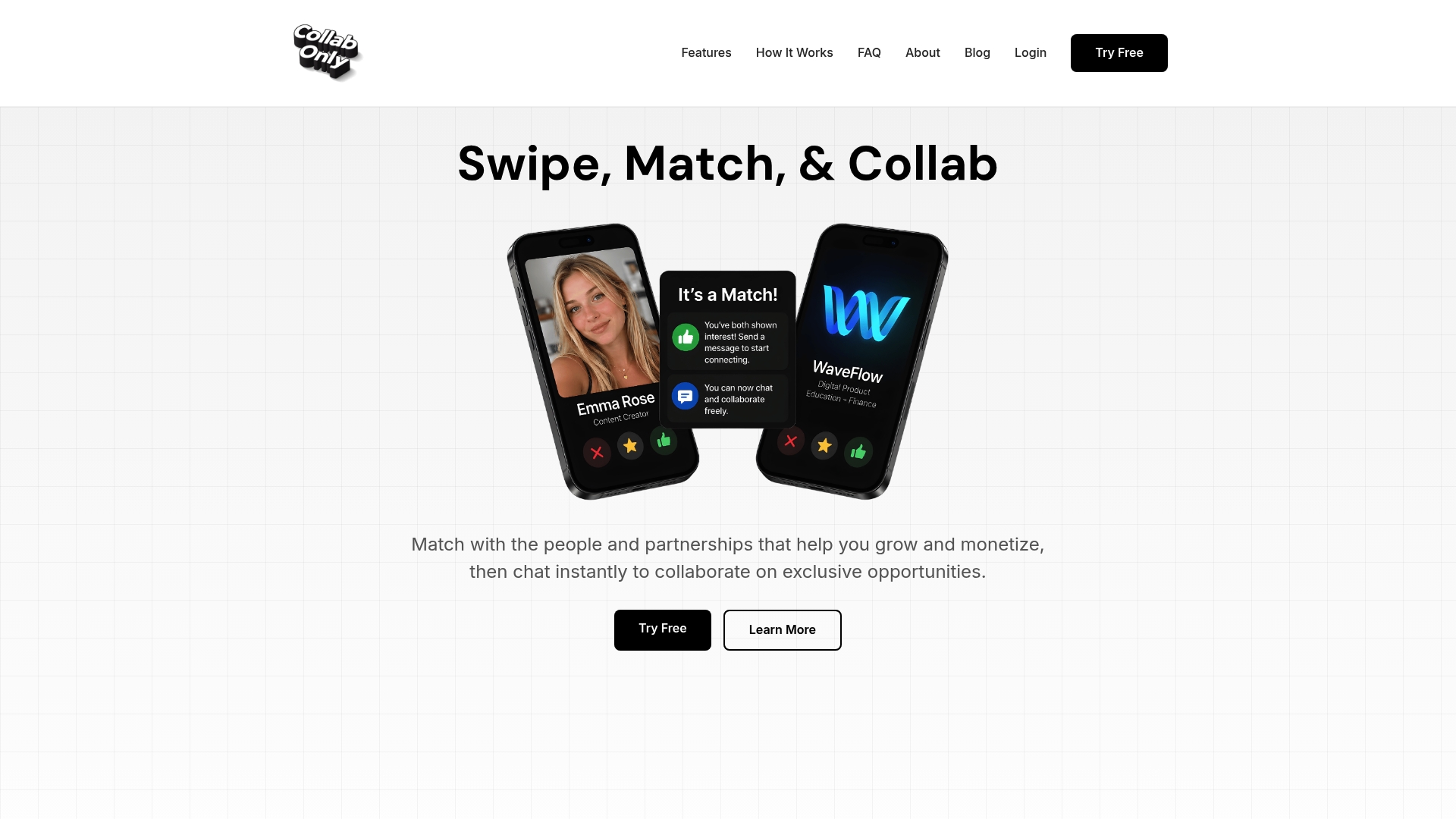
Collabonly connects brands with nano and micro influencers across TikTok, Instagram, and YouTube through a matching system that removes the friction of traditional outreach. Instead of lost DMs and slow email threads, brands match with creators whose audience and content style align with the campaign brief, then move directly to coordinated execution. For brands running nano influencer campaigns as part of a broader cross-platform strategy, Collabonly provides the infrastructure to source, match, and activate creators at scale. Brands seeking broader reach can also hire micro influencers through the same platform to extend campaign coverage across multiple channels simultaneously.
FAQ
What is cross-platform promotion in simple terms?
Cross-platform promotion is the coordinated distribution of marketing content across multiple digital channels, unified by one goal and adapted in format for each platform. It differs from multichannel marketing because it requires shared audience data and synchronized campaign triggers, not just presence on multiple platforms.
What are the main benefits of cross-platform promotion?
The primary benefits include expanded audience reach, stronger brand recall through consistent multi-touchpoint messaging, reduced cost per acquisition, and fewer wasted impressions from unified audience definitions. Brands that limit promotion to a single platform risk leaving the majority of their potential audience unreached.
How do you measure cross-platform promotion performance?
Use a hybrid measurement model: native platform dashboards for channel-level optimization, a centralized BI tool or unified dashboard for cross-channel KPI tracking, and holdout or geo-lift testing for incrementality. Summing platform-reported conversions without deduplication consistently overstates results due to overlapping attribution windows.
What tools support cross-platform marketing strategy execution?
Customer data platforms (CDPs), marketing automation tools, and server-side tagging infrastructure are the core technical components. CDPs build and synchronize shared audience definitions across platforms. Server-side tagging reduces data loss from browser-based tracking restrictions and improves attribution accuracy.
How does influencer marketing fit into cross-platform promotion?
Influencer partnerships extend coordinated brand messaging with platform-native content that performs better than brand-produced assets on social channels. Nano and micro influencers, in particular, deliver high engagement rates within specific audience segments, making them effective components of a multi-channel coordinated campaign.