

A strategic partnership is a formal collaborative agreement between two or more independent organizations that share resources, expertise, or market access to achieve goals neither could reach as efficiently alone. Each party retains full legal and operational autonomy. No new legal entity is created, no assets are merged, and no ownership changes hands. What changes is the capacity of each organization to compete, grow, and deliver value, because they now draw on capabilities that would otherwise take years and significant capital to build internally.
The core features that define a strategic alliance include:
- Independent organizations collaborating under a contractual agreement
- Shared resources such as technology, distribution networks, or specialized knowledge
- Mutual value creation as the primary objective, not financial consolidation
- Preserved autonomy for each partner across operations, branding, and legal structure
- Defined scope and duration, distinguishing the arrangement from a merger or acquisition
This structure is what separates a strategic alliance from a joint venture, where partners typically create a new shared entity, or from a merger, where two companies combine into one. The distinction carries real consequences for governance, risk exposure, and exit flexibility.
What are the main types of strategic partnerships?
Strategic alliances fall into three primary categories based on where each partner sits in the industry value chain. Understanding the category helps clarify what a partnership is designed to accomplish and what risks it carries.

Vertical partnerships
Vertical partnerships connect businesses at different stages of the same production or distribution process. A manufacturer that formalizes an agreement with a regional distributor is the clearest example. Each party operates at a distinct stage, and the collaboration accelerates product flow without either company absorbing the other's function.
- Link businesses at different production or delivery stages
- Common in manufacturing, logistics, retail, and technology supply chains
- Reduce friction between handoff points in the value chain
Horizontal partnerships
Horizontal partnerships bring together companies operating at the same stage of production, often within the same industry. These arrangements can involve direct competitors. The logic is that two companies with overlapping markets can co-invest in shared infrastructure, research, or distribution while still competing on product differentiation.
- Connect companies at the same production stage or within the same sector
- Often involve co-marketing, joint research, or shared distribution
- Require careful governance to protect proprietary information
Diagonal partnerships
Diagonal partnerships cross industry lines entirely. Two companies with unrelated core businesses find that their audiences, technologies, or operational capabilities complement each other. A fitness app partnering with a health insurance provider is a practical example: neither competes with the other, but both benefit from access to the other's user base and credibility.
- Cross-industry collaborations sharing complementary audiences or capabilities
- Lower competitive risk than horizontal arrangements
- Often produce the most visible co-marketing outcomes
The three-category framework of vertical, horizontal, and diagonal partnerships applies across industries and scales, from early-stage startups to Fortune 500 companies.
What are the key benefits of strategic partnerships?
The advantages of forming a strategic alliance extend well beyond simple cost savings. When structured correctly, partnerships accelerate growth across multiple dimensions simultaneously.
- Market access: Partnering with an established player in a target geography or demographic gives immediate reach that organic expansion would take years to build.
- Resource sharing: Technology platforms, research infrastructure, and distribution networks become accessible without the capital expenditure of building them independently. Collaborations deliver measurable impact such as increased leads and deal closures compared to companies operating without alliances.
- Risk distribution: When two organizations co-invest in a new product line or market entry, the financial and operational risk is divided. Neither party carries the full exposure of going alone.
- Accelerated innovation: Shared expertise compresses development timelines. A company with strong engineering capacity partnering with one that has deep regulatory knowledge can bring a compliant product to market faster than either could independently.
- Transfer of credibility: Smaller firms that partner with recognized market leaders gain immediate customer trust. Partnering with established brands reduces marketing overhead and builds customer confidence that would otherwise require years of brand-building to earn.
- Flexibility: Unlike mergers and acquisitions, strategic alliances allow collaboration without asset merging or loss of operational control, making them easier to enter, adjust, and exit.
For brands operating in digital marketing and content ecosystems, these benefits translate directly into faster audience growth, stronger campaign performance, and more efficient use of creative resources. Collabonly's matching platform is built around exactly this dynamic, connecting brands and creators whose goals align so that both parties extract measurable value from each collaboration. Understanding partnership marketing strategies is a practical starting point for any brand evaluating this path.
What are the risks and disadvantages of strategic partnerships?
A partnership that looks balanced on paper can deteriorate quickly when expectations diverge in practice. The risks are real and worth examining before any agreement is signed.
- Imbalanced benefits: When one partner extracts significantly more value than the other, trust erodes. Clearly defined, mutually beneficial objectives are the primary defense against this outcome.
- Management conflicts: Differences in organizational culture, decision-making speed, and risk tolerance create friction. Two companies that operate well independently may struggle to coordinate on shared initiatives.
- Dependency risk: Over-reliance on a partner's resources or distribution channel creates vulnerability. If the partner exits, pivots, or underperforms, the dependent party faces a gap it may not be able to fill quickly.
- Information exposure: Sharing proprietary technology, customer data, or operational processes requires trust and contractual protection. Without both, sensitive information can migrate in unintended directions.
- Reputational risk: A partner's public misstep, quality failure, or ethical controversy can reflect on the other party, particularly when the collaboration is visible to customers.
- Coordination overhead: Managing a partnership requires dedicated time and resources. Companies that treat alliances as passive arrangements typically see them underperform or collapse.
The coordination and power-dynamic challenges documented across alliance research consistently point to one root cause: insufficient upfront agreement on roles, governance, and success metrics. Addressing these before the partnership launches is far less costly than resolving them after.
How do you establish a successful strategic partnership?
Forming a productive alliance requires deliberate sequencing. Moving too quickly to agreement without completing the foundational steps produces partnerships that look functional on paper but fail in execution.
-
Define objectives first. Both parties must articulate what they need from the partnership and what they are prepared to contribute. Vague goals produce vague outcomes. Specific, measurable objectives create accountability from day one.
-
Select partners for strategic fit, not convenience. The right partner fills a genuine resource or market gap. Selecting a partner based on existing relationships or brand familiarity, without assessing complementary strengths, is one of the most common formation errors.
-
Negotiate a clear agreement. The partnership agreement should define each party's contributions, decision-making authority, revenue or cost-sharing arrangements, intellectual property rights, and exit conditions. Ambiguity in any of these areas becomes a conflict point later.
-
Build a communication and governance structure. Assign relationship owners on both sides. Establish meeting cadences, escalation paths, and reporting formats before the partnership goes live.
-
Evaluate regularly and adapt. A partnership that delivered value in its first year may need restructuring in its third as both organizations evolve. Scheduled reviews with agreed performance metrics keep the relationship calibrated to current realities.
Pro Tip: Treat the partnership as an active management responsibility, not a signed agreement that runs itself. The alliances that deliver sustained value are the ones where both parties invest ongoing attention, not just initial negotiation effort.
Collabonly's platform addresses the formation challenge directly by matching brands and creators based on goal alignment rather than surface-level metrics, reducing the friction that typically slows the partner identification and outreach phases. Effective partnership outreach strategies can further accelerate this process.

Expert insights and real-world examples of strategic partnerships
The most instructive lesson from alliance research is that partnerships fail at the governance stage far more often than at the strategy stage. Two organizations can identify a genuinely complementary opportunity and still produce a failed alliance if the operating model is not designed carefully.
Successful partnerships 'borrow' capabilities from established players, enabling faster and more cost-efficient growth than building those capabilities internally over years. The transfer of credibility from a recognized brand to a smaller partner compresses market entry timelines and reduces the marketing investment required to earn customer trust.
The legal and operational independence each partner retains is a structural advantage that joint ventures do not offer. In a joint venture, both parties are exposed to the new entity's liabilities. In a strategic alliance, each organization's core assets remain protected, and the collaboration is governed by contract rather than shared ownership.
Real-world partnership structures illustrate how the three types play out in practice:
| Partnership type | Example structure | Primary benefit |
|---|---|---|
| Vertical | Manufacturer and regional distributor | Faster market reach, reduced logistics cost |
| Horizontal | Two technology firms co-developing a shared API standard | Shared R&D cost, broader ecosystem adoption |
| Diagonal | Fitness platform and health insurer | Cross-audience access, mutual credibility transfer |
Pro Tip: When evaluating a potential partner, map their capabilities against your current resource gaps before assessing brand alignment. A partner who fills a genuine operational gap delivers more durable value than one who simply shares your audience.
The transfer of credibility dynamic is particularly relevant for brands entering new verticals or demographics. A smaller brand that co-markets with a recognized leader in a category signals quality to that leader's audience without having to earn that trust independently. Collabonly's matching system applies this principle at scale, connecting emerging brands with creators whose established audiences provide exactly this credibility transfer. Reviewing partnership campaign examples shows how this plays out across different content formats and platforms. For brands exploring influencer-led growth, understanding how to leverage influencers for organic growth provides a practical framework for applying alliance principles in digital marketing contexts.
What factors determine whether a strategic partnership succeeds?
Most alliance failures trace back to the same set of avoidable conditions. The success factors are not complicated, but they require consistent discipline to maintain.
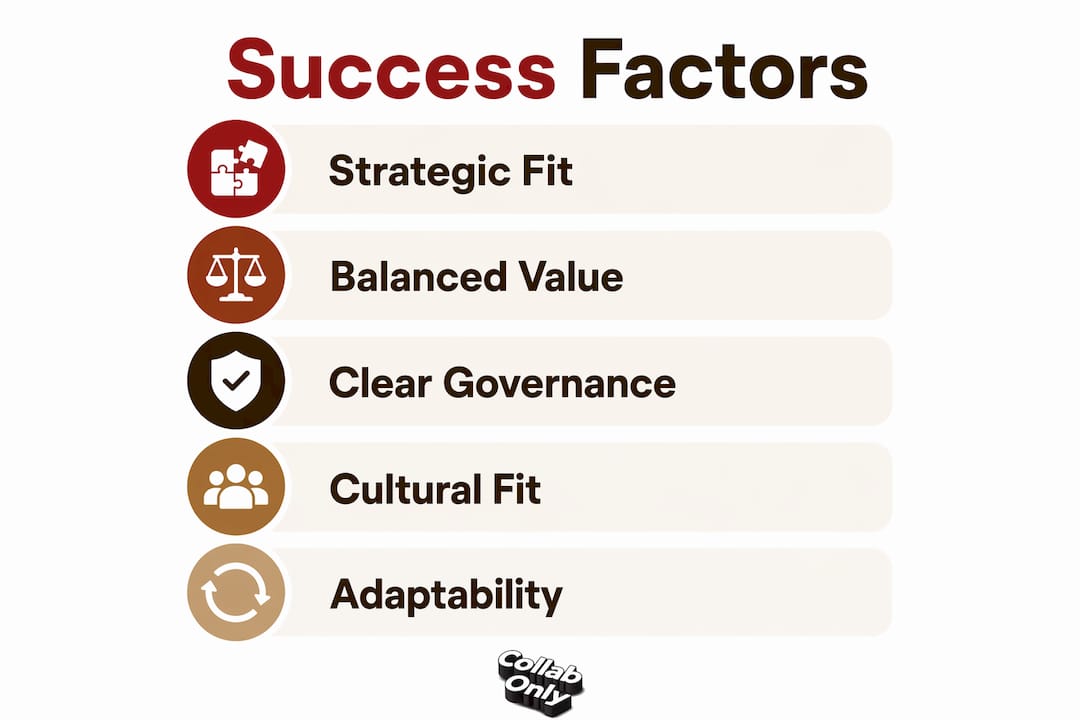
Genuine strategic fit is the foundation. A partnership built on complementary strengths, where each party provides something the other cannot efficiently build alone, has a structural reason to persist. One built on convenience or brand affinity does not.
Balanced value distribution keeps both parties invested. When one organization consistently extracts more than it contributes, the other's motivation to maintain the relationship declines. Periodic reviews of contribution and benefit ratios prevent this drift.
Clear governance removes ambiguity from decision-making. Defined roles, escalation paths, and accountability structures mean that disagreements get resolved through process rather than politics.
Cultural compatibility between organizations affects execution speed and relationship quality. Companies with significantly different risk tolerances, communication styles, or operational tempos will spend disproportionate energy managing internal friction rather than delivering on the partnership's objectives.
Adaptability extends partnership longevity. Market conditions change, organizational priorities shift, and the original terms of an alliance may no longer reflect current realities. Partnerships with built-in review mechanisms and renegotiation provisions outlast those locked into static agreements.
What are the most common challenges in strategic partnerships?
The challenges that most frequently derail alliances are predictable, which means they are also preventable with the right preparation.
Misaligned expectations at the outset produce the most common failure pattern. When each party enters the partnership with a different understanding of what success looks like, conflict is inevitable. The solution is explicit, written alignment on objectives before any resources are committed.
Power imbalances create resentment over time. When one partner is significantly larger, better-resourced, or more brand-recognized, the smaller partner may feel that the terms of the relationship consistently favor the other side. Structuring agreements with explicit protections for the smaller party, including defined contribution requirements from the larger partner, addresses this directly.
Information-sharing hesitation slows execution. Partners who withhold data, delay reporting, or restrict access to relevant systems undermine the collaboration's effectiveness. Establishing data-sharing protocols and confidentiality agreements at the outset removes the ambiguity that causes this hesitation.
Relationship drift occurs when both organizations deprioritize the partnership as internal demands increase. Assigning dedicated relationship managers on both sides, with clear accountability for partnership health, prevents the gradual disengagement that leads to dissolution.
What legal agreements govern strategic partnerships?
The contractual foundation of a strategic alliance determines how well it functions when conditions change or disputes arise. Several agreement types are standard across well-structured partnerships.
A partnership agreement or memorandum of understanding establishes the scope, objectives, duration, and governance structure of the collaboration. This document should be specific enough to resolve ambiguity but flexible enough to accommodate reasonable evolution in the relationship.
Intellectual property provisions define who owns what is created during the partnership and what each party can do with shared information after the alliance ends. This is particularly critical in technology and content partnerships where new assets are produced collaboratively.
Confidentiality agreements protect proprietary information exchanged during the partnership. These should specify what constitutes confidential information, how it may be used, and what obligations persist after the partnership concludes.
Exit clauses define the conditions under which either party can terminate the agreement, the notice period required, and how shared assets or liabilities are handled at dissolution. Partnerships without clear exit provisions create legal exposure when the relationship ends, as most eventually do.
Each partner maintaining full legal and operational independence means that the contractual structure carries more weight in a strategic alliance than it does in a joint venture or merger. The agreement is the governance mechanism.
How do you measure whether a strategic partnership is working?
Measuring partnership effectiveness requires metrics that reflect both parties' objectives, not just one side's performance indicators.
Shared KPIs established at the outset give both parties a common language for evaluating progress. These might include new customer acquisition attributable to the partnership, revenue generated through co-marketing activities, cost reductions from shared operations, or product development milestones reached through combined expertise.
Contribution audits assess whether each party is delivering on its agreed commitments. These reviews should occur at defined intervals, typically quarterly or semi-annually, and should produce documented findings rather than informal assessments.
Relationship health indicators capture qualitative dimensions that quantitative metrics miss. Communication frequency, response times, escalation rates, and stakeholder satisfaction on both sides signal whether the working relationship is functioning well or deteriorating.
Market outcome tracking connects partnership activity to business results. If the alliance was formed to enter a new market segment, tracking penetration rates and customer acquisition costs in that segment directly measures whether the partnership is delivering its core purpose.
Partnerships that lack measurement frameworks tend to persist past their useful life or dissolve before they have delivered their full potential. Both outcomes are costly. Regular, structured evaluation keeps the alliance calibrated and gives both parties the information they need to decide whether to continue, restructure, or exit.
Key Takeaways
Strategic partnerships deliver measurable competitive advantage when built on genuine complementarity, balanced governance, and active relationship management rather than convenience or informal agreement.
| Point | Details |
|---|---|
| Definition and structure | A strategic partnership is a contractual collaboration between independent organizations sharing resources without merging assets or legal entities. |
| Three partnership types | Vertical, horizontal, and diagonal partnerships each serve distinct strategic purposes depending on value chain position and industry relationship. |
| Primary benefits | Market access, risk sharing, accelerated innovation, and credibility transfer are the core advantages, particularly for smaller firms partnering with established brands. |
| Key risks | Imbalanced benefits, dependency, information exposure, and coordination failures are the most common causes of alliance breakdown. |
| Success requirements | Genuine strategic fit, clear governance, balanced value distribution, and regular performance reviews determine whether a partnership delivers sustained value. |
FAQ
What is a strategic partnership in simple terms?
A strategic partnership is a formal agreement where two independent organizations share resources, expertise, or market access to achieve goals that benefit both parties, without merging their operations or creating a new legal entity.
How does a strategic alliance differ from a joint venture?
A strategic alliance preserves each partner's full legal and operational independence, while a joint venture creates a new shared legal entity that both parties co-own and co-manage.
What are the most common types of strategic partnerships?
The three primary types are vertical partnerships (linking different value chain stages), horizontal partnerships (connecting companies at the same production stage, often in the same industry), and diagonal partnerships (cross-industry collaborations sharing complementary audiences or capabilities).
What makes a strategic partnership fail?
Most alliance failures stem from misaligned expectations, imbalanced benefit distribution, insufficient governance structures, or treating the partnership as a passive arrangement rather than an actively managed relationship.
How do you find the right strategic partner?
Select partners based on genuine strategic fit, specifically whether they fill a resource or market gap your organization cannot address efficiently alone, rather than on brand familiarity or existing relationships.