

TL;DR:
- Digital partnerships involve long-term, shared-risk collaborations that develop digital solutions and drive mutual growth. They outperform traditional vendor relationships by increasing success rates, revenue, and operational efficiency through formal governance and strategic alignment. Successful implementation depends on clear goals, strong relationships, and platforms like Collabonly that facilitate genuine creator collaborations.
A digital partnership is defined as a long-term, co-invested collaboration between two or more organizations that jointly develop digital solutions, share accountability for outcomes, and align on mutual growth goals. Unlike a vendor contract, this relationship extends into shared risk, co-innovation, and joint planning. Business professionals and marketers who understand what is digital partnership gain a structural advantage: they build growth engines rather than transactional pipelines. The concept sits at the intersection of technology strategy and modern brand partnerships, and its relevance has grown sharply as digital transformation accelerates across every industry.

What is a digital partnership and why does it matter?
A digital partnership is a formal, goal-aligned relationship where two organizations co-own digital initiatives rather than one party simply purchasing services from another. The industry term for its most structured form is a "strategic technology partnership," though the broader definition of digital partnership covers marketing collaborations, content co-creation, and platform integrations as well.
Digital Public-Private Partnerships represent one institutional variant, where public agencies and private firms jointly manage shared digital resources such as data, algorithms, and infrastructure. That model illustrates a core principle: true digital partnerships create new legitimacy and social value that neither party could generate alone.
The importance of digital collaboration becomes clear when you examine project outcomes. Partnership-based projects achieve a 70–80% success rate, compared to 20–30% for transactional vendor-led projects. That gap is not incidental. It reflects the difference between a team that shares your goals and a supplier that fulfills a purchase order.
For marketers specifically, digital partnerships open access to new audiences, shared content infrastructure, and co-branded campaigns that neither party could fund or distribute alone. The definition of digital partnership, at its most practical, is two organizations deciding to win together rather than independently.
What are the key benefits of forming digital partnerships?
The benefits of digital partnership are measurable, not theoretical. Organizations that form strategic technology partnerships report over 20% average revenue growth from joint innovations. That figure reflects compounding returns: shared investment in product development, co-marketed solutions, and integrated customer experiences all contribute to revenue that neither party would have generated independently.
Operational gains are equally significant:
- Reduced time-to-market. Digital business ecosystems built on inter-firm partnerships reduce network latency and accelerate product delivery cycles. Shared infrastructure eliminates redundant build phases.
- Faster innovation cycles. Partners bring complementary expertise. One organization's data capability combined with another's distribution network produces solutions faster than either could build internally.
- Shared risk and resources. Co-investment models distribute financial exposure. Both parties have skin in the game, which aligns incentives and raises the quality of decision-making.
- Expanded market reach. Digital partnerships give each party access to the other's customer base, platform, and credibility. A brand with strong product but limited reach pairs well with a creator or platform that has the opposite profile.
- Mutual accountability. When both parties own outcomes, performance reviews become collaborative rather than adversarial. Problems surface earlier and get resolved faster.
The revenue growth benefits compound over time because integration ecosystems grow more valuable as they mature. A partnership that starts with a single co-branded campaign can evolve into a shared data infrastructure, a joint product line, or a co-developed platform. That trajectory is not available in a standard vendor relationship.
Pro Tip: Map your organization's capability gaps before approaching a potential partner. The strongest digital partnerships pair complementary strengths, not identical ones.
How do digital partnerships differ from traditional vendor relationships?
The distinction between a digital partner and a vendor is structural, not cosmetic. A vendor executes a defined scope of work for a fee. A digital partner acts as an extension of your leadership team, proactively managing risks and aligning digital initiatives with your long-term revenue goals.
| Dimension | Digital partnership | Vendor relationship |
|---|---|---|
| Accountability | Shared; both parties own outcomes | Vendor delivers; client accepts or rejects |
| Risk model | Co-invested; both absorb downside | Client bears risk; vendor charges for changes |
| Planning horizon | Long-term roadmap, joint milestones | Project-scoped, contract-bound |
| Innovation role | Partner challenges assumptions, co-creates | Vendor executes specifications |
| Intellectual property | Formally negotiated, jointly governed | Typically owned by client or vendor alone |
| Adaptability | Initiatives evolve without restarting | Scope changes require new contracts |
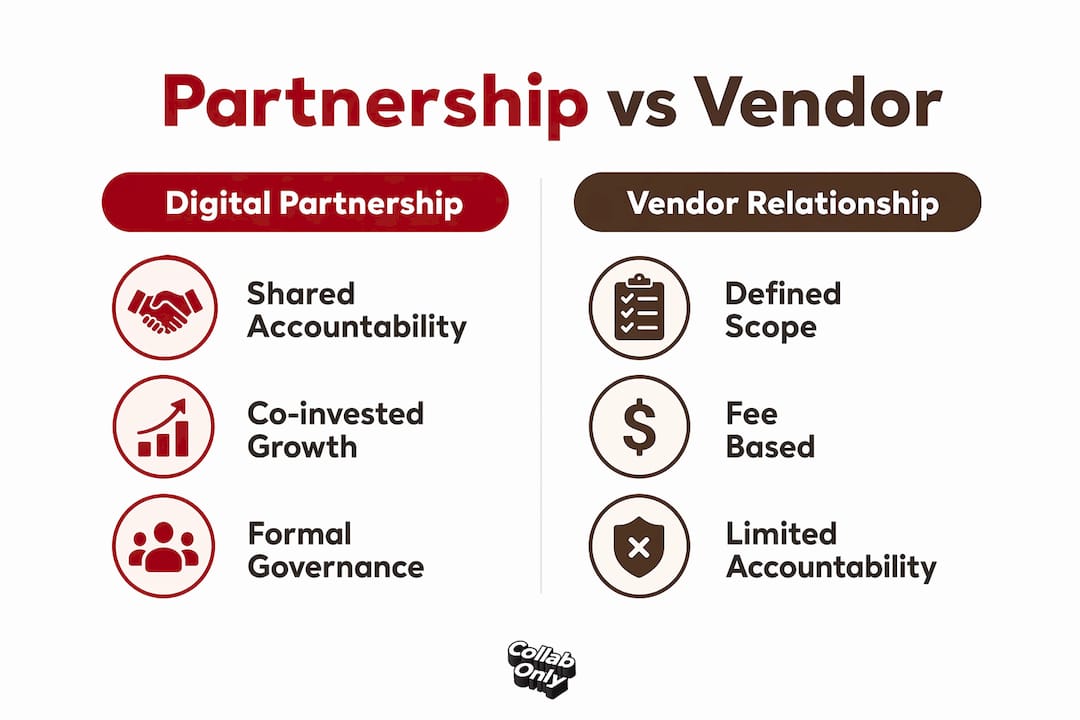
Digital partners proactively align initiatives with strategic growth and share risks transparently. Vendors, by contrast, optimize for contract compliance. That difference shapes every interaction, from how problems get escalated to how new opportunities get evaluated.
Formal governance is what makes the partnership model durable. Digital partnerships require formal agreements covering intellectual property, certification, and joint go-to-market rights. Without those agreements, collaboration erodes into ambiguity, and ambiguity creates conflict.
Pro Tip: Before signing any partnership agreement, define who owns jointly developed intellectual property. Leaving that question open is the single most common source of partnership breakdown.
How do you create successful digital partnerships?
Building a successful digital partnership follows a sequence. Skipping steps early produces misalignment that compounds over time.
-
Define shared goals with measurable outcomes. Vague alignment on "growth" is not sufficient. Specify the revenue target, the market segment, the product milestone, or the audience metric that both parties will be held to.
-
Qualify partners on strategic fit, not just capability. A technically capable partner who does not share your planning horizon or risk tolerance will behave like a vendor under pressure. Assess culture and decision-making style alongside technical credentials.
-
Involve executive leadership from both sides early. Partnerships that live only at the operational level stall when resources need to be reallocated. Executive sponsorship keeps priorities aligned when conditions change.
-
Establish a joint roadmap with defined review cycles. Success in digital partnerships depends on a long-term roadmap and partners willing to challenge assumptions early. Build in quarterly reviews where both parties can surface concerns and adjust direction.
-
Formalize governance before work begins. Cover intellectual property ownership, data sharing protocols, co-marketing rights, and exit terms in writing. Governance is not bureaucracy. It is the structure that keeps trust intact when the relationship is tested.
-
Adopt a procurement culture that rewards value creation. Effective digital partnerships require shifting procurement cultures from transactional to value-creation and strategic alignment. If your internal processes treat all external relationships as vendor contracts, partnerships will underperform.
Overcoming the digital marketing challenges that arise during partnership formation requires both parties to invest in communication infrastructure, not just project management tools. Shared dashboards, joint Slack channels, and co-located sprint reviews are practical mechanisms that keep alignment from drifting.
What are real-world examples of digital partnerships in marketing?
Digital partnership examples from marketing and technology illustrate how the model works across different scales and industries.
-
Integrated platform partnerships. A retail brand and a logistics technology firm co-develop a real-time inventory and delivery tracking experience. The retailer gains operational data it could not build internally. The logistics firm gains a high-volume client whose data improves its routing algorithms. Both parties benefit from the integration.
-
Content co-creation partnerships. A software company and a media publisher jointly produce a research report series. The software company provides data and analysis. The publisher provides distribution and editorial credibility. The resulting content reaches audiences neither party could access alone.
-
Brand and creator partnerships. A consumer brand partners with a network of micro-influencers on TikTok and Instagram to co-develop product content. The brand gains authentic peer-credibility within specific sub-niches. The creators gain early access to products, revenue, and audience growth. Platforms like Collabonly formalize this matching process, connecting brands with creators whose audience profiles align with campaign goals.
-
Technology ecosystem partnerships. An enterprise software platform integrates with a payment processing provider. Each integration deepens the switching cost for shared customers and expands the addressable market for both parties. Technology partnerships deliver long-term competitive advantages by creating interdependencies that compound in value over time.
These partnership campaign examples share a common structure: each party contributes a distinct capability, and the combined output exceeds what either could produce independently. That is the operational definition of a successful digital partnership.
Key Takeaways
A digital partnership outperforms vendor relationships because shared accountability, co-investment, and formal governance produce outcomes that transactional contracts cannot replicate.
| Point | Details |
|---|---|
| Core definition | A digital partnership is a co-invested, goal-aligned collaboration with shared risk and joint ownership of outcomes. |
| Success rate advantage | Partnership-based projects achieve 70–80% success rates versus 20–30% for vendor-led projects. |
| Revenue impact | Organizations with strategic technology partnerships report over 20% average revenue growth from joint innovations. |
| Governance is non-negotiable | Formal agreements on intellectual property, co-marketing rights, and exit terms prevent conflict and sustain trust. |
| Partner selection criteria | Qualify partners on strategic fit and cultural alignment, not technical capability alone. |
Why most digital partnerships fail before they start
The most common failure mode in digital partnerships is not a capability mismatch. It is a mindset mismatch. One party enters the relationship expecting a vendor. The other expects a co-equal collaborator. That gap rarely surfaces in the pitch phase. It shows up six months in, when the first major scope change lands and one party reaches for the contract while the other reaches for a whiteboard.
I have seen this pattern repeat across industries. The organizations that build durable digital partnerships share one habit: they invest in the relationship before they invest in the project. That means honest conversations about risk tolerance, decision-making authority, and what "success" looks like when the original plan no longer applies.
The other underrated factor is the partner's willingness to push back. A partner who only validates your assumptions is not adding strategic value. The most growth-oriented partnerships I have observed involve partners who challenge the brief, question the timeline, and flag risks that the client team has normalized. That friction is not a problem. It is the mechanism by which better outcomes get produced.
Marketers who treat digital partnerships as a distribution tactic miss the deeper value. The real competitive advantage comes from the integration ecosystem that builds up over time, the shared data, the co-developed audiences, the joint institutional knowledge. That ecosystem becomes harder for competitors to replicate with every passing quarter. That is the compounding return that no vendor contract can deliver.
— Samuel
How Collabonly connects brands to the right digital partners
Collabonly is built for the exact moment when a brand decides to move from transactional outreach to genuine collaboration. The platform connects brands with nano influencers and micro influencers through a swipe-based matching system that eliminates the slow email chains and lost DMs that stall most partnership conversations.

When a brand and creator match on Collabonly, instant chat opens immediately. That removes the friction that kills momentum in early-stage partnerships. The platform covers TikTok, Instagram, and YouTube, giving brands access to creators across the sub-niches and geo-concentrated audiences that matter most to their campaigns. For marketers who want brand partnership best practices built into the workflow rather than bolted on afterward, Collabonly provides the infrastructure to make that happen at scale.
FAQ
What is the simplest definition of a digital partnership?
A digital partnership is a formal, long-term collaboration where two or more organizations co-invest in digital initiatives, share accountability for outcomes, and align on mutual growth goals. It differs from a vendor relationship in that both parties own the results.
What are the main types of digital partnerships?
The main types include technology ecosystem partnerships, content co-creation partnerships, brand and creator partnerships, and Digital Public-Private Partnerships. Each type involves a different combination of shared resources, governance structures, and co-owned outcomes.
How do digital partnerships increase revenue?
Organizations forming strategic technology partnerships report over 20% average revenue growth from joint innovations. Shared investment in product development, co-marketed solutions, and integrated customer experiences all contribute to revenue that neither party would generate independently.
What makes a digital partnership different from hiring a vendor?
A vendor executes a defined scope for a fee and bears no accountability for business outcomes. A digital partner co-invests in the initiative, shares risk, and proactively aligns the work with your long-term revenue goals, including challenging assumptions when the strategy needs adjustment.
How does Collabonly support digital partnerships for marketers?
Collabonly matches brands with nano and micro influencers through a swipe-based system that opens instant chat upon a match. The platform removes traditional outreach barriers and supports goal-aligned partnerships across TikTok, Instagram, and YouTube.