

TL;DR:
- Streamlined collaboration involves aligning communication, processes, and tools to reduce friction and enhance clarity. Organizations face significant costs due to fragmentation, which decreases operational capacity by up to 30 percent. Leaders can improve team effectiveness through tool integration, workflow automation, and fostering psychological safety.
Streamlined collaboration is defined as the practice of aligning communication, processes, and tools so that teams execute work with minimal friction and maximum clarity. Business leaders who understand why to streamline collaboration gain a direct path to reclaiming lost productivity. Global employee engagement dropped to 20% in 2025, generating an estimated $10 trillion in lost productivity across organizations worldwide. That figure is not a warning about future risk. It is the current cost of doing nothing. Platforms like Zoom, Salesforce, and tools such as Asana have demonstrated that connecting people, data, and workflows inside a single operational layer produces measurable gains in speed, output, and team morale.
Why streamline collaboration? the core business case
The primary benefits of tightening how teams work together fall into four categories: operational efficiency, decision quality, employee engagement, and customer experience.
- Operational efficiency: Redundant handoffs, duplicated work, and manual status updates consume hours that compound across departments. Removing these friction points returns capacity directly to strategic work.
- Decision quality: Collaborative decision-making reduces groupthink and accelerates implementation by combining diverse perspectives into better-calibrated conclusions. Teams that surface dissenting views early avoid costly late-stage corrections.
- Employee engagement: Teams with clear communication structures report higher morale and lower turnover. Engagement directly correlates with output quality, making it a financial metric, not just a cultural one.
- Customer experience: When internal teams are misaligned, customers feel it through delayed responses, inconsistent messaging, and broken handoffs between sales, service, and delivery functions.
Collaboration improvements also compound over time. Streamlined collaboration works like a flywheel, where early gains in clarity and speed build momentum that multiplies performance across subsequent cycles. A team that eliminates one redundant approval step this quarter creates bandwidth for two additional projects next quarter. Understanding why collaborations drive revenue is the first step toward treating collaboration as a strategic investment rather than an operational afterthought.
How does fragmented communication create collaboration costs?
Fragmentation is the primary cause of collaboration failure in modern organizations, not a lack of effort or talent. 53% of employees reported wasting time due to communication silos and information fragmentation in 2025. That means more than half your workforce is spending measurable hours each week searching for context that should already be visible.

The concept known as the "fragmentation tax" describes the coordination overhead generated when teams rely on disconnected systems. Organizations lose 20–30% of operational capacity to this overhead through manual tracking, redundant status meetings, and duplicated data entry. To put that in concrete terms: a 50-person team operating at 25% coordination overhead is functionally a 37-person team.
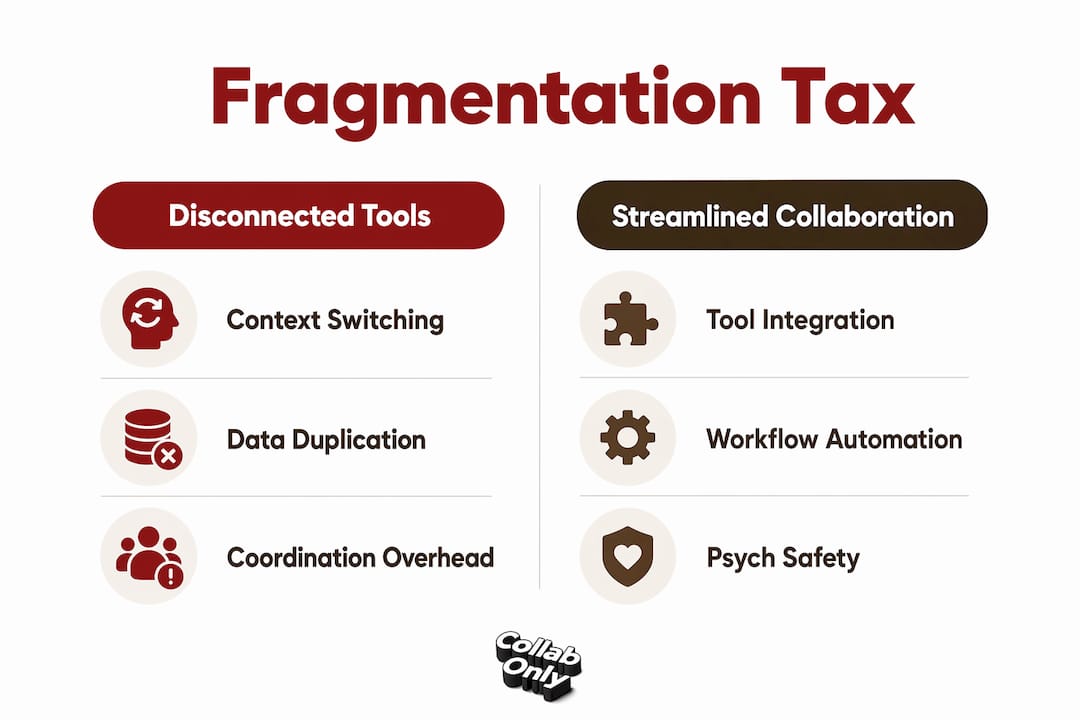
The table below illustrates how fragmented versus connected workflows differ across common team activities:
| Activity | Fragmented Workflow | Connected Workflow |
|---|---|---|
| Project status updates | Manual emails and separate spreadsheets | Real-time dashboards visible to all stakeholders |
| Document approvals | Sequential email chains with version confusion | Automated routing with tracked sign-off timestamps |
| Cross-team handoffs | Verbal briefings with no documented record | Structured handoff templates inside shared platforms |
| Decision tracking | Buried in meeting notes or individual inboxes | Centralized decision log accessible by all relevant parties |
"The goal of streamlining collaboration is clarity around priorities and ownership, not simply reducing meetings. Bad meeting overuse often compensates for poor transparency and documentation." — Wrike, Benefits of Collaboration in the Workplace
Adding more disconnected tools does not solve this problem. More tools deepen fragmentation by multiplying the number of systems teams must monitor, update, and reconcile. The sustainable fix is integration: connecting existing tools through a central intelligence layer so that data flows automatically between systems rather than requiring human relay.
What strategies and technologies actually improve team collaboration?
Effective collaboration improvement rests on three pillars: tool integration, workflow automation, and cultural infrastructure. Each addresses a distinct layer of the fragmentation problem.
Tool integration vs. tool addition
The instinct to solve collaboration problems by purchasing new software is understandable but counterproductive without a consolidation strategy. The comparison below clarifies the distinction:
| Approach | Outcome | Example |
|---|---|---|
| Adding disconnected tools | Increases context-switching and data silos | Separate apps for chat, tasks, files, and reporting |
| Integrating existing tools | Creates unified data flow and reduces manual work | Connecting Salesforce CRM with Asana project boards and Zoom for a single workflow view |
| Replacing with a unified platform | Eliminates silos but requires migration investment | Moving from fragmented stack to a platform like Microsoft 365 or Google Workspace |
For most organizations, integration outperforms replacement in the short term. Salesforce collaboration tools improve project outcomes by automating document routing and providing real-time status visibility, which reduces rework that typically accounts for 15–20% of project costs. That reduction alone justifies the integration investment in most mid-size organizations.
Workflow automation
Automated workflows remove the human relay problem from routine coordination. Approval chains, document routing, and status notifications can all be triggered by system events rather than individual action. This shifts manager attention from tracking progress to directing it.
Pro Tip: Before purchasing any new collaboration software, audit your current tool stack for unused integration capabilities. Most enterprise platforms, including Salesforce, Zoom, and Microsoft Teams, support native integrations that teams never activate.
Psychological safety as infrastructure
Technology alone does not produce collaboration. Psychological safety is the most important factor in team effectiveness, creating an environment where members share information openly and trust each other enough to surface problems early. Without it, even the best-integrated tool stack produces filtered, politically safe communication rather than honest, high-quality input. Leaders who invest in psychological safety see faster problem identification and more accurate project forecasting as direct results. Exploring platform-based collaboration models can help teams understand how structural design supports both tool integration and cultural trust.
How can leaders implement sustained collaboration improvements?
Implementation requires a diagnostic phase before any structural changes. The following sequence gives leaders a repeatable process for improving team collaboration without disrupting ongoing operations.
-
Diagnose friction points with targeted surveys. Short, focused surveys reveal specific friction points that generic engagement surveys miss entirely. Ask teams to identify the three workflow steps that consume the most unnecessary time. This produces specific, redesignable targets rather than vague dissatisfaction scores.
-
Establish documented communication channels. Every recurring decision type should have a designated channel and a documented record. When teams know where to find decisions and who owns them, they stop generating clarification meetings to compensate for missing context.
-
Reduce meetings by clarifying ownership. High-performing teams combine shared goals, defined roles, and open communication sustained through collaboration tools. When ownership is ambiguous, meetings multiply to fill the accountability gap. Assigning clear owners to each workstream reduces meeting volume without reducing coordination quality.
-
Automate status visibility. Replace manual progress reports with dashboard views that update automatically from task management systems. Managers who can see project status without requesting it spend less time in coordination and more time removing blockers.
-
Measure collaboration impact through output metrics. Track cycle time, rework rates, and cross-team handoff speed before and after changes. These metrics quantify collaboration quality in terms that connect directly to business outcomes.
Pro Tip: Run a 30-day pilot on one team before rolling out collaboration changes organization-wide. Pilots surface implementation gaps without creating organization-wide disruption, and they generate internal case studies that accelerate adoption elsewhere.
Sustaining improvements requires periodic reassessment. Collaboration friction evolves as teams grow, tools change, and priorities shift. Quarterly friction audits using the same short survey format from step one keep the diagnostic loop active. For marketing teams specifically, understanding how to collaborate with brands provides a practical framework for applying these principles to external partnership workflows.
Key takeaways
Improving team collaboration requires diagnosing friction first, integrating existing tools second, and building cultural infrastructure third, in that order.
| Point | Details |
|---|---|
| Fragmentation tax is measurable | Organizations lose 20–30% of operational capacity to coordination overhead from disconnected systems. |
| More tools worsen the problem | Adding disconnected software deepens silos; integration of existing tools is the correct fix. |
| Psychological safety drives output | Team effectiveness depends on open communication and trust, not just technology configuration. |
| Short surveys outperform generic ones | Targeted, workflow-focused surveys identify specific friction points that broad engagement surveys miss. |
| Automation reclaims project costs | Automated document routing and status visibility reduce rework, which accounts for 15–20% of project costs. |
The uncomfortable truth about collaboration tools
Most organizations treat collaboration as a technology problem. They buy new platforms, mandate adoption, and measure success by license utilization. That approach consistently underdelivers, and after years of watching teams operate this way, the pattern is clear.
The real problem is almost never the tools. It is the absence of documented ownership and the tolerance for ambiguity at the leadership level. When a manager does not know who owns a decision, no amount of Slack channels or project boards will produce clarity. The tool surfaces the ambiguity; it does not resolve it.
The organizations that see the largest gains from collaboration improvements are the ones that treat the tool rollout as the last step, not the first. They start by mapping where decisions stall, where handoffs break, and where teams duplicate work. Then they redesign the process. Then they select or configure the tool to support that redesigned process.
The other pattern worth naming: leaders who reduce meeting volume without improving documentation see collaboration quality decline, not improve. Meetings are often a symptom of missing transparency. Remove the meeting without creating the transparency, and you remove the only mechanism teams had for staying aligned. The goal is not fewer meetings. The goal is better information flow, which makes most meetings unnecessary on its own.
— Samuel
How Collabonly helps you build collaboration that converts
Collaboration improvements inside your organization create the operational foundation. The next layer is building the right external partnerships to accelerate growth.
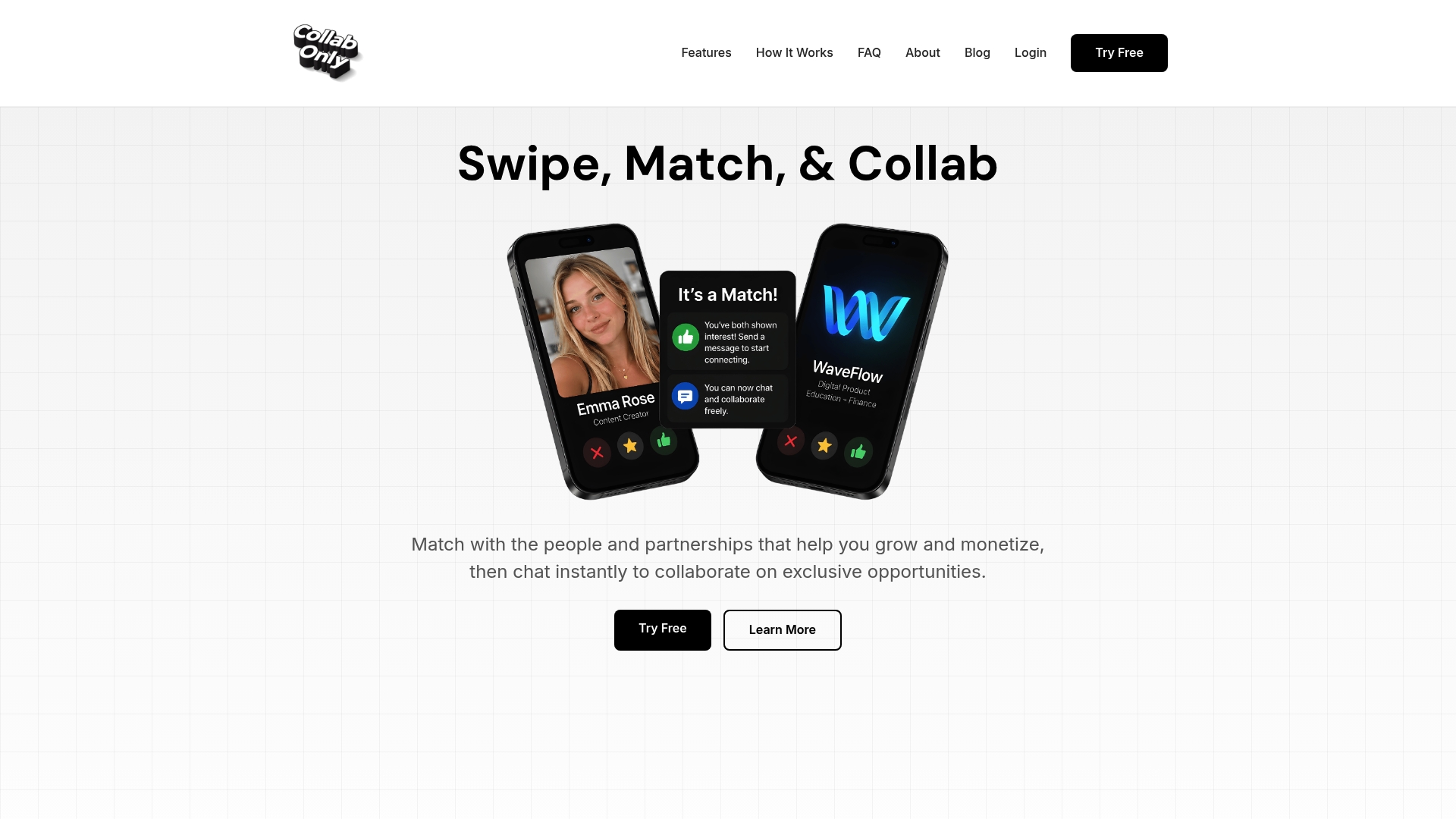
Collabonly is built specifically for brands and marketing teams that need to move from outreach to active partnership without the coordination overhead that kills campaign momentum. The platform's matching system connects brands with creators across TikTok, Instagram, and YouTube, replacing slow email chains and lost DMs with instant chat upon match. For teams that have already tightened their internal workflows, Collabonly provides the external collaboration layer that turns that efficiency into revenue. Explore nano influencer campaigns or browse the full influencer marketplace to find partners aligned with your campaign goals.
FAQ
What does it mean to streamline collaboration?
Streamlining collaboration means aligning communication channels, processes, and tools so teams execute work with minimal redundancy and maximum clarity. The goal is reducing coordination overhead, not simply cutting meetings.
Why do disconnected tools hurt team productivity?
Disconnected tools create a fragmentation tax, consuming 20–30% of operational capacity through manual tracking, duplicated data entry, and status meetings. Integration of existing tools eliminates this overhead more effectively than adding new software.
How do you measure collaboration improvement?
Track cycle time, rework rates, and cross-team handoff speed before and after changes. These output metrics connect collaboration quality directly to business performance rather than relying on subjective satisfaction scores.
What is the fastest way to identify collaboration friction?
Short, workflow-focused employee surveys that ask teams to name their top three time-wasting steps produce specific, redesignable targets faster than broad engagement surveys or leadership assumptions.
Does psychological safety affect collaboration outcomes?
Psychological safety is the single most important factor in team effectiveness. Teams that communicate openly and trust each other surface problems earlier, make better decisions, and implement changes faster than teams relying on tools alone.