

Co-marketing partnerships are formal, shared-promotion agreements between non-competing brands that jointly create and market an offer, trading audience access for measurable reach and pipeline impact. A single joint webinar between a cloud provider and a cybersecurity firm generated 1,200 registrations and more than 300 qualified leads, the kind of outcome that separates real co-marketing from vague "let's collaborate" gestures. Success looks like expanded reach paired with a countable number of qualified leads entering a pipeline, not just impressions.
TL;DR:
- A successful co-marketing campaign should produce measurable pipeline impact, such as qualified leads or pipeline value, rather than just high registration or impression counts.
- An ideal partner scores well on audience overlap, engagement reliability, and timing, with clear, written agreements on branding, lead sharing, and data privacy.
- The most effective formats include joint webinars, co-authored guides, bundled offers, creator activations, and co-branded paid campaigns, each suited to different goals and timelines.
- Campaign success relies on synchronizing promotion, setting specific KPIs, and conducting post-campaign reviews, emphasizing pipeline contribution over vanity metrics.
- Using platforms like Collab Only can streamline partner discovery through swipe-based matching and instant messaging, reducing the typical delays in co-marketing partnerships.
Table of Contents
- What Is Co-Marketing, and How Does It Differ From Co-Branding?
- Which Co-Marketing Format Fits Your Goal?
- What Results Should You Expect, and Which KPIs Matter?
- How Do You Find and Evaluate the Right Co-Marketing Partner?
- What Are Some Ready-to-Launch Co-Marketing Campaign Blueprints?
- What Belongs in a Co-Marketing Launch Checklist and Agreement?
- How Does a Matchmaking Platform Like Collab Only Change Partner Discovery?
- What Legal and Compliance Issues Should You Watch in Co-Marketing?
- What Common Co-Marketing Challenges Trip Up Marketing Teams?
- How Do You Keep a Co-Marketing Relationship Working Long-Term?
- What Marketers Consistently Get Wrong About Co-Marketing
- Where This Article's Claims Came From
- Find Your Next Co-Marketing Partner Faster With Collabonly
- Sources
- FAQ
What Is Co-Marketing, and How Does It Differ From Co-Branding?
Co-marketing is a shared-promotion arrangement where two or more brands with overlapping audiences jointly produce and distribute a piece of marketing, an ebook, a webinar, a bundled offer, and split the cost, the effort, and the resulting reach. Each partner keeps its own brand identity intact; the collaboration lives at the campaign level, not the product level.
That distinction matters because "co-marketing," "co-branding," and "partner marketing" get used interchangeably in pitch decks, and mixing them up leads to mismatched expectations on both sides of a deal.
- Co-marketing is campaign-level and temporary: two brands promote one joint asset, then go back to marketing independently.
- Co-branding is product-level and often long-term: two brands merge into a single offering, a credit card with an airline's name on it, or a shoe designed with a beverage company's colors.
- Partner marketing (sometimes called co-selling) usually involves a channel or reseller relationship where one company sells or supports another's product as part of an ongoing revenue arrangement, not a single campaign.
Co-marketing is the right choice when two brands share an audience but not a product, and when the goal is a defined, time-boxed lift in reach, leads, or awareness rather than a permanent joint offering. If your goal is a bundled SKU or a co-designed product, you're looking at co-branding. If you're building a reseller network, that's partner marketing. Collaborative marketing spans everything from a simple social media swap to a multi-month content series, but the common thread is always shared audience access in exchange for shared promotional cost.
Which Co-Marketing Format Fits Your Goal?
Not every partnership calls for the same activation. Matching the format to your goal, timeline, and internal bandwidth is where most campaigns either earn their budget back or quietly fizzle.
- Joint webinars. Ideal for lead generation and pipeline acceleration; medium effort, low risk when both partners commit to promoting equally. This is the format behind the 1,200-registration, 300-lead example, and it works because a live event forces both partners to show up for promotion on a fixed date.
- Co-authored ebooks or guides. Strong for top-of-funnel awareness and SEO reach; low to medium effort, low risk, though results build slowly since gated content converts over weeks, not days.
- Bundled offers or product pairings. Effective for revenue-focused campaigns where two complementary products sell better together; medium effort, medium risk because pricing and fulfillment logistics need real coordination.
- Co-branded paid ad campaigns. Useful when both brands want to split media spend and reach a combined audience without doubling cost; low to medium effort, but risk rises without tight creative approval workflows governing messaging consistency.
- In-person or virtual events. Best for relationship-building and enterprise pipeline; high effort, high risk given venue, logistics, and speaker coordination, but often the highest-trust format for B2B audiences.
- Creator or influencer activations. Strong for reach into a specific niche audience fast; effort varies by creator tier, and branded content strategies built around creator partnerships tend to outperform generic sponsored posts because the creator's own credibility carries the offer.
A B2B software pairing might run a joint webinar because their sales cycles are long and a live demo justifies the effort. A pair of consumer brands with younger audiences will usually get more mileage from a creator activation or a bundled giveaway, since that audience responds to social proof faster than to a downloadable guide.
What Results Should You Expect, and Which KPIs Matter?
Co-marketing delivers value in three buckets: expanded reach at shared cost, credibility borrowed from a partner's audience trust, and, when structured correctly, direct pipeline contribution. Each maps to a different business goal, and conflating them is where measurement falls apart.
1,200 registrations, 300+ qualified leads. That's the documented outcome of one joint webinar between a cloud provider and a cybersecurity firm, a benchmark worth holding your own campaigns against before declaring victory on registration count alone.
The KPI set should track the funnel, not just the top of it:
- Reach and impressions — measures audience exposure, useful for brand awareness goals but a poor stand-alone success metric.
- Engagement rate — click-throughs, video watch time, or session duration; signals whether the joint asset actually resonated.
- Marketing-qualified leads (MQLs) — the first real signal the campaign is feeding sales, not just marketing vanity metrics.
- Pipeline influence — dollar value of opportunities touched by the campaign, the number that gets a co-marketing program renewed.
- ROCMI (return on co-marketing investment) — pipeline or revenue generated divided by the combined cost both partners put in, cash, staff time, and promotional reach.
Joint webinars perform best when both partners synchronize promotion and build the event around a clear commercial next step, a demo request, a trial signup, rather than treating registration count as the finish line. A tool built for tracking campaign performance helps keep reach numbers honest against actual pipeline contribution.
How Do You Find and Evaluate the Right Co-Marketing Partner?
Most co-marketing failures trace back to partner selection, not execution. A brand with the right audience but the wrong incentive structure will underdeliver on promotion every time, and no amount of campaign polish fixes that. Running prospects through a consistent scorecard before you pitch saves weeks of wasted outreach.
Pro Tip: Score every prospective partner on the same seven criteria before you write a single outreach email. A partner that scores well on audience overlap but poorly on execution reliability will drain your team's time even if the campaign eventually launches.
- Audience overlap — do your ideal customer profiles genuinely intersect, or just sound similar on paper?
- Offer compatibility — does their product complement yours without competing for the same budget line?
- Distribution strength — do they have an email list, social following, or sales team that can actually move the asset?
- Execution reliability — have they run co-marketing before, and did they hit their promotional commitments?
- Commercial fairness — is the value exchange, leads, reach, cost, roughly balanced, or is one side subsidizing the other?
- Strategic timing — does this partnership fit both companies' current launch calendars, or is one side mid-rebrand and distracted?
- Trust transfer — does their brand reputation add credibility to your offer, or introduce risk?
For each prospect, collect: audience size and overlap estimate, average campaign engagement rate from past partnerships, decision-maker contact, and any existing relationship history. Score each criterion 1 to 5, and set a minimum combined threshold, 28 out of 35 is a reasonable bar, before committing outreach time.
The outreach pitch itself should promise something concrete in return: a defined audience size, a co-branded asset both sides can reuse, and a named point of contact for fast decisions. Vague "let's explore synergies" emails get ignored; a pitch with a proposed format, timeline, and expected reach gets a reply. Building a repeatable outreach and evaluation process turns partner-finding from a one-off scramble into a standing pipeline.

What Are Some Ready-to-Launch Co-Marketing Campaign Blueprints?
These five blueprints cover the formats most marketing teams can realistically launch within four to eight weeks, based on the fit criteria above.
- The joint webinar sprint. Roles: each partner supplies one speaker and promotes to its own list on a shared cadence (announcement, one-week reminder, day-of reminder). Channels: email plus one paid social boost per partner. Timeline: four weeks from kickoff to live event. This is the format behind the 1,200-registration, 300-lead benchmark, and it remains the highest-ROI blueprint when both partners commit equal promotional weight.
- The co-authored guide. Roles: one partner leads content production, the other supplies data or case examples. Channels: gated landing page, email nurture, organic social. Timeline: five to six weeks including design. Expect slower but compounding lead flow as the guide ranks and gets shared.
- The bundled offer launch. Roles: product and pricing teams from both sides align on packaging; marketing builds a single landing page. Channels: email, paid social, affiliate links. Timeline: six to eight weeks given the pricing and fulfillment coordination required.
- The creator co-activation. Roles: both brands brief a shared creator or run parallel creators covering the same campaign. Channels: TikTok, Instagram, YouTube. Timeline: two to four weeks, the fastest blueprint on this list. Pairing this with cross-platform promotion planning keeps posting cadence synchronized across both brands' channels.
- The co-branded paid push. Roles: shared media budget, one partner owns creative approval, the other owns targeting and bidding. Channels: paid social, programmatic display. Timeline: three weeks to launch, ongoing optimization after. Examples of partnership campaigns built on this model show how shared spend can outperform either brand's solo paid budget.
For a first pilot, the joint webinar sprint offers the clearest benchmark to measure against and the shortest path to a defensible pipeline number.
What Belongs in a Co-Marketing Launch Checklist and Agreement?
A shared brief should exist before either brand books a single piece of media. At minimum, it needs: campaign objective and success metric, target audience definition, asset list with an owner assigned to each, promotional cadence and channel split, and a single shared launch date both partners commit to publicly.
The written agreement matters more than most marketers expect going in. Joint marketing agreements should specify branding use, asset ownership, lead-sharing rules, proof-of-performance requirements, and termination terms, and skipping this step is the single most common source of post-campaign disputes. A good agreement covers:
- Branding use — which logos, colors, and messaging each side can use, and where.
- IP and asset ownership — who keeps the ebook, video, or landing page after the campaign ends.
- Lead-sharing rules — how leads get split, tagged, and handed to each partner's sales team.
- Proof-of-performance — what data each side must share to verify the other delivered on promotion.
- Termination and cure periods — what happens if one partner under-delivers, and how much time they get to fix it.
Pro Tip: Put a proof-of-performance clause in writing even for a "quick" campaign between friendly companies. The agreements that get skipped are almost always the ones that cause the messiest disputes later, precisely because nobody wrote down who owed what.
Before launch, confirm UTM parameters are set on every shared link, both partners' CRMs are tagged to attribute leads correctly, and a single dashboard (shared or mirrored) tracks registrations, MQLs, and pipeline in real time.
How Does a Matchmaking Platform Like Collab Only Change Partner Discovery?
Finding the right co-marketing partner traditionally means cold outreach, slow email threads, and DMs that vanish into an inbox nobody checks. A platform replaces that with a swipe-based matching system built specifically for brands, creators, and marketers looking to connect around shared campaigns across multiple platforms rather than locking discovery to one platform.
The friction in most co-marketing deals isn't the campaign idea. It's the three weeks lost waiting for a reply to the initial outreach email, and the pitches that die quietly because nobody ever responded at all.
Instant chat on a match means a partnership conversation can move from introduction to shared brief in days rather than weeks. For brands running influencer-driven co-marketing specifically, Collab Only's Instagram luxury lifestyle influencer directory shows how the same matching approach applies to creator discovery, not just brand-to-brand deals.
What Legal and Compliance Issues Should You Watch in Co-Marketing?
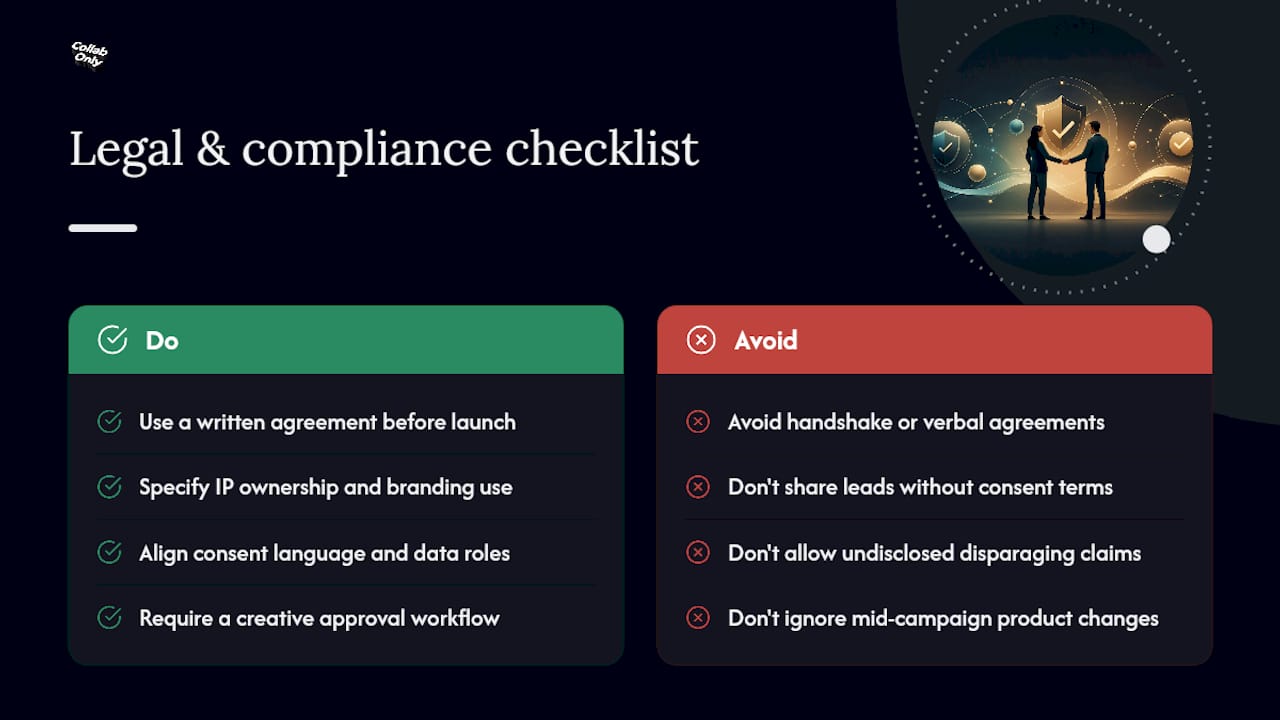
The biggest legal exposure in co-marketing isn't a lawsuit, it's an undocumented handshake deal that turns into a dispute six weeks after launch. Every campaign should run on a written agreement, even a short, informal one, because verbal understandings about who owns what fall apart the moment a campaign underperforms or a partner wants to reuse an asset.
Intellectual property ownership needs explicit terms before the first piece of creative gets built. Decide upfront whether the ebook, webinar recording, or landing page belongs to one partner, both partners jointly, or neither past a defined usage window. Written agreements that specify branding use and asset ownership prevent the awkward situation where one brand keeps promoting a co-branded asset the other partner assumed had expired.
Data privacy compliance adds another layer, particularly when leads flow between two companies' CRMs. Both partners need aligned consent language on any shared landing page or form, and the agreement should specify who is responsible for honoring opt-outs and data deletion requests under regulations like the CCPA for US-based campaigns.
Disparaging or misleading claims about either partner's product in shared creative can expose both brands to liability, so creative approval workflows aren't just a branding nicety, they're a compliance safeguard. Finally, spell out what happens if one partner's product changes materially, pricing, features, availability, mid-campaign, since that scenario comes up more often than most marketers plan for.
What Common Co-Marketing Challenges Trip Up Marketing Teams?
The most frequent failure point is goal misalignment: one partner wants brand awareness while the other expects immediate lead volume, and neither side's success metric matches the campaign's actual design. The fix is simple to state and easy to skip: agree on a single primary metric, and a single secondary one, before either team starts building assets.
Uneven promotional effort is the second recurring problem. One brand promotes aggressively while the other treats the campaign as an afterthought, and the resulting reach imbalance breeds resentment that kills future collaboration. Building a mutual promotion checklist into the shared brief, with specific dates and channels each partner commits to, closes that gap before it opens.
Timing conflicts show up constantly in practice. A partner mid-rebrand, mid-product-launch, or in a quiet-period ahead of an earnings call isn't going to show up for your campaign the way you need, no matter how good the partnership fit looks on paper. Screening for strategic timing during partner evaluation avoids this entirely rather than discovering it after contracts are signed.
Attribution disputes round out the list, usually because nobody agreed in advance on how a lead touched by both brands' promotion gets credited. Setting UTM and CRM tagging rules before launch, not after the first lead trickles in, prevents the argument from ever starting.
How Do You Keep a Co-Marketing Relationship Working Long-Term?
The partnerships that produce a second, third, and fourth campaign together share one trait: both sides treated the first campaign's debrief as seriously as the launch itself. Schedule a post-campaign review within two weeks of wrap, compare actual results against the KPIs set at kickoff, and document what each partner would do differently next time.
Sharing performance data transparently, not just the flattering numbers, builds the trust that makes a partner say yes to round two. A brand that only reports the wins while quietly burying a missed target will find partners less willing to commit resources the second time around.
Staying on each other's radar between campaigns matters more than most marketers assume. A quick check-in email when a partner launches something new, or a mention in a newsletter, costs nothing and keeps the relationship warm for the next opportunity. Treating a co-marketing partner like a one-time vendor rather than an ongoing relationship is the fastest way to lose access to their audience for good.
Finally, revisit the partner-fit scorecard annually. Audiences shift, product lines change, and a partner that scored well two years ago may no longer be the right fit, while a new prospect may have moved up the list.
What Marketers Consistently Get Wrong About Co-Marketing
Most teams over-invest in the campaign asset and under-invest in the partner agreement. A beautifully designed ebook with no lead-sharing clause in writing is a liability waiting to surface, not a finished deliverable.
Four corrections worth making now: define one shared success metric before any creative work starts; put lead-sharing and asset ownership in writing even for a "simple" campaign; screen for timing conflicts before evaluating audience overlap, since a poorly timed partner with a perfect audience still fails; and measure ROCMI, not just registrations, so a stakeholder review doesn't mistake vanity metrics for pipeline.
If you're testing this for the first time, run one pilot with a single defined success metric, qualified leads generated, not clicks, and commit to the debrief regardless of outcome.
— Samuel
Where This Article's Claims Came From
The figures and frameworks above draw on a small set of specific, checkable sources rather than general industry consensus.
- PartnerStack's co-marketing glossary for the joint webinar registration and lead benchmark.
- Ironclad's guide to joint marketing agreements for contract clause recommendations.
- HubSpot's co-marketing guide for goal-alignment guidance.
For more campaign examples and partner discovery tactics, visit Collabonly.
Find Your Next Co-Marketing Partner Faster With Collabonly
Every framework in this guide assumes you can actually find the right partner quickly, and that's the step most marketing teams get stuck on. A matching platform offers an alternative to cold email outreach and stalled DMs for finding co-marketing partners. Its swipe-based matching connects brands, creators, and marketers who fit each other's audience and goals, then opens instant chat the moment there's a match, no waiting days for a reply that never comes.
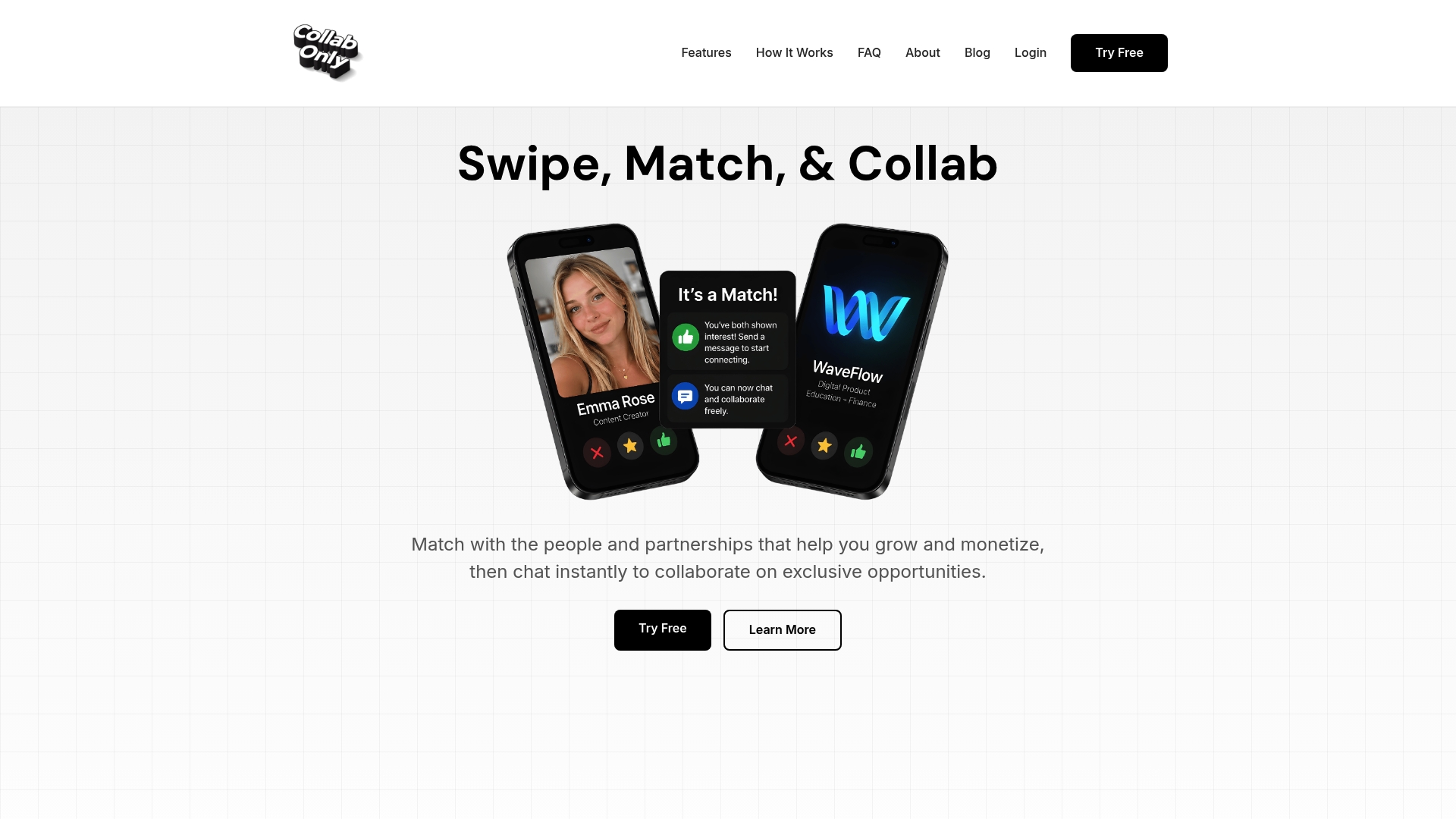
Whether you're scouting a webinar co-host, a creator for a cross-platform activation, or a brand to bundle an offer with, the same matching system applies across TikTok, Instagram, and YouTube. Brands running influencer-driven campaigns specifically can start with Collab Only's Instagram luxury lifestyle influencer directory to see how the matching process works for creator partnerships. Create a free profile on Collabonly and start swiping through potential co-marketing partners this week.
Sources
- PartnerStack — Co-marketing partnerships (glossary / case references)
- Ironclad — Joint marketing agreements: what you need to know
- HubSpot — What Is Co-Marketing? A Guide to Co-Branding Marketing Campaigns
FAQ
What Is the Difference Between Co-Marketing and Co-Branding?
Co-marketing is a temporary, campaign-level collaboration where two brands jointly promote one asset while keeping separate identities; co-branding merges two brands into a single, often permanent, product or offering.
How Many Leads Can a Co-Marketing Webinar Generate?
Results vary by industry and list size, but one documented case between a cloud provider and a cybersecurity firm produced 1,200 registrations and more than 300 qualified leads from a single joint webinar.
What Should Be Included in a Co-Marketing Agreement?
A solid agreement covers branding use, asset ownership, lead-sharing rules, proof-of-performance requirements, and termination terms to prevent disputes after launch.
How Do You Find the Right Co-Marketing Partner?
Score prospects against a fit scorecard covering audience overlap, offer compatibility, distribution strength, execution reliability, commercial fairness, timing, and trust transfer; platforms like Collabonly also speed up discovery through swipe-based matching and instant chat.
What KPI Matters Most in a Co-Marketing Campaign?
Pipeline influence and marketing-qualified leads matter more than raw reach or registration counts, since vanity metrics without a commercial next step rarely translate into revenue.