

TL;DR:
- Content development involves managing the entire content lifecycle, from research to governance, to meet business goals. It differs from content creation by emphasizing strategy, quality, and continuous improvement, not just producing assets. Implementing structured processes and governance frameworks ensures scalable, aligned, and measurable content programs.
Content development is defined as the strategic lifecycle of planning, creating, optimizing, publishing, and governing content to meet specific audience needs and business objectives. It is broader than content creation alone. Where creation refers to producing a single asset, development encompasses the full process from audience research and intent analysis through to post-publish performance monitoring and iteration. In 2026, effective content development requires integrating semantic analysis, E-E-A-T principles, and intent staging to produce content that earns trust and drives measurable results. Marketers who treat content development as a continuous strategic process consistently outperform those who treat it as a one-off production task.
What are the core steps in the content development process?
The content development process follows five distinct stages. Each stage builds on the previous one, and skipping any stage introduces risk to quality, alignment, and performance.
-
Research and audience analysis. This stage defines who the content serves and what they need at each decision phase. Semantic bases can contain 10,000 to 50,000 relevant keywords, making AI-powered tools necessary for identifying genuine opportunity clusters rather than relying on manual keyword lists. Intent staging maps those keywords to specific audience decision phases, so content addresses real questions rather than assumed ones.
-
Content strategy and brief development. A strategic content brief defines query intent, target length, structure, E-E-A-T requirements, and business goals before a single word is written. Failure to specify these elements leads directly to generic content, scope creep, and publication delays. The brief is the single most important document in the development cycle.
-
Content creation. Writers, designers, and subject matter experts produce the asset according to the brief. Quality at this stage depends entirely on the clarity of the brief. Vague briefs produce vague content.
-
Editing and optimization. This stage covers SEO alignment, readability review, E-E-A-T compliance checks, and structural refinement. Editors verify that the content matches current search engine preferences for format and depth before it moves to publication.
-
Publishing, distribution, and performance analysis. Content goes live across the appropriate channels, then enters a monitoring phase. High-performing teams use performance metrics to make immediate adjustments rather than waiting for quarterly reviews.
Pro Tip: Build a "verify-before-publish" checkpoint into every workflow. Confirm that the top-five ranking URLs for your target keyword have not shifted since the brief was written. Ranking dynamics are volatile, and a last-minute check prevents costly misalignment.
How does content development differ from content creation?

The distinction between content development and content creation is not semantic. It reflects fundamentally different scopes of work, different stakeholders, and different outcomes.
| Dimension | Content creation | Content development |
|---|---|---|
| Scope | Producing a specific asset | Full lifecycle from research to governance |
| Primary stakeholders | Writers, designers, videographers | Strategists, editors, SEO leads, analysts |
| Output | A finished piece of content | A governed content program |
| Goal alignment | Asset completion | Business objective achievement |
| Iteration | Rarely built in | Continuous, data-driven |
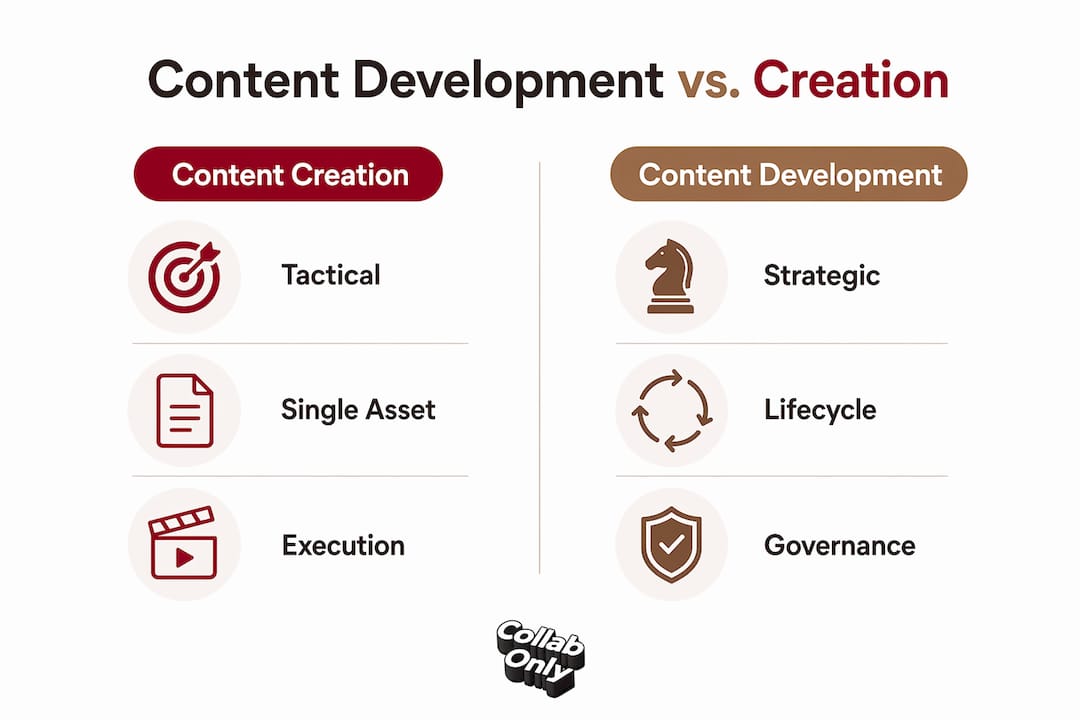
Content creation is a tactical execution. A copywriter drafts a blog post. A videographer edits a product demo. These are creation tasks. Content development is the strategic layer that decides what gets created, why, for whom, and how its performance will be measured and improved over time.
The business implications are significant. Organizations that practice content development rather than pure content creation maintain consistent brand voice, align content to conversion goals, and build compounding authority over time. Those that only create content produce assets that age quickly, drift from brand standards, and rarely connect to measurable revenue outcomes. Content governance systems bridge the gap from strategy to consistent execution, ensuring brand voice and quality persist as teams scale production.
Understanding types of content collaborations also becomes more relevant at the development level, where strategic partnerships shape what content gets produced and how it reaches audiences.
What are the best practices for effective content development in 2026?
Effective content development in 2026 requires more than good writing. It demands structured processes, governance frameworks, and intelligent use of AI tools.
-
Write briefs that embed E-E-A-T from the start. E-E-A-T requirements for YMYL content must include designated reviewers and citation slots in the brief itself. Treating E-E-A-T as a final-stage checklist item causes late-stage rework and delayed publishing. Assign reviewers before creation begins.
-
Capture SERP snapshots before finalizing briefs. Taking SERP screenshots for your target locale and device profile before writing a brief prevents format and angle mismatches. What ranks on desktop in one region may differ significantly from what ranks on mobile in another.
-
Use AI as a production tool, not a replacement for strategy. Personalized AI tools that incorporate brand identity from the start enable mass content production with maintained relevance and quality. AI handles keyword clustering, semantic gap analysis, and first-draft generation. Human strategists handle intent interpretation, editorial judgment, and governance.
-
Build content governance frameworks before scaling. Without governance, consistency suffers as team size grows. A governance framework defines tone of voice standards, approval workflows, content taxonomy, and update schedules. It is the infrastructure that makes content development repeatable.
-
Monitor performance continuously and update on a monthly cycle. Content development is a continuous loop with monthly reviews based on performance data. Static content decays. Regular updates based on traffic, engagement, and conversion data extend content lifespan and protect search rankings.
Pro Tip: Pair your content brief with a structured SEO framework that maps each section of the brief to a specific ranking signal. This reduces revision cycles and improves first-draft quality significantly.
The role of AI in content strategy has expanded rapidly. Teams that integrate AI at the research and brief stage, rather than only at the drafting stage, produce more targeted content with fewer revisions.
How can businesses align content development with marketing objectives?
Content development produces measurable business results only when it connects directly to defined marketing and sales objectives. Generic content, produced without a conversion goal, rarely moves audiences forward.
-
Map every content piece to an audience decision stage. Strategic content development includes specifying the intended next action for each piece. Awareness content should drive subscription or further reading. Consideration content should drive comparison or demo requests. Decision content should drive purchase or contact.
-
Define conversion paths before creation begins. Marketers who define the conversion path in the brief produce content that guides readers rather than informing them passively. The difference between a page that ranks and a page that converts is usually the presence or absence of a defined next action.
-
Use performance data to trigger updates, not just reports. Traffic drops, engagement declines, and conversion rate changes are signals that content needs revision. Teams that act on these signals within days rather than quarters maintain competitive positions in search and sustain pipeline contribution.
-
Integrate content development into broader brand strategy. Content does not operate in isolation. Digital brand promotion and content development share audience research, messaging frameworks, and performance metrics. Aligning these functions reduces duplication and strengthens brand consistency across channels.
-
Measure content contribution to revenue, not just traffic. Page views are a vanity metric without a conversion layer. Effective content development tracks assisted conversions, lead quality from content-sourced traffic, and content-influenced pipeline value.
What common pitfalls occur in content development, and how can teams avoid them?
Most content development failures trace back to a small set of recurring mistakes. Recognizing them early prevents wasted production effort and missed deadlines.
-
SERP mismatch. Planned content format or length does not match what search engines currently reward for the target query. The fix is capturing localized SERP snapshots before the brief is finalized, not after the content is written.
-
Under-specified briefs. Briefs that omit query intent, target length, E-E-A-T requirements, or conversion goals produce content that requires multiple revision rounds. Every brief should answer: who is this for, what decision stage does it serve, what does the reader do next, and who approves it.
-
Treating E-E-A-T as an afterthought. For YMYL topics, E-E-A-T compliance requires designated expert reviewers and verifiable citations embedded in the content. Adding these elements after drafting is expensive. Building them into the brief is not.
-
Absence of content governance. Teams that scale production without governance frameworks produce inconsistent content that drifts from brand standards. Content governance maintains tone, quality, and strategic alignment as volume increases.
-
Ignoring ranking volatility. Competitor URLs change during the content development cycle. A verify-before-publish step, where editors check current top-five rankings against the brief's competitive assumptions, prevents SEO losses from last-minute SERP shifts.
Key Takeaways
Content development is the structured, iterative process that transforms audience research and business objectives into governed content programs, not individual assets.
| Point | Details |
|---|---|
| Development vs. creation | Content development covers the full lifecycle; creation covers only asset production. |
| Strategic briefs are foundational | A brief that defines intent, E-E-A-T, and conversion goals prevents scope creep and revision cycles. |
| Governance enables scale | Content governance frameworks maintain brand voice and quality as production volume grows. |
| SERP snapshots prevent mismatch | Capturing localized SERP data before briefing avoids costly format and angle errors. |
| Performance data drives iteration | Monthly reviews using traffic and conversion metrics keep content competitive and current. |
Why most content programs stall before they scale
After working across content programs of varying sizes, one pattern stands out consistently. Organizations invest heavily in content creation and almost nothing in content governance. They hire writers, build editorial calendars, and publish at volume. Then, six months later, they wonder why traffic has plateaued and why the content feels inconsistent.
The answer is almost always the same. There is no governance layer. No defined process for updating aging content. No ownership of the brief template. No one responsible for ensuring that what gets published in month seven matches the strategic intent of month one.
The teams that scale content successfully treat the brief as a living document and governance as infrastructure, not overhead. They also recognize that AI tools accelerate production but do not replace the human judgment required to interpret audience intent, set conversion goals, and maintain editorial standards.
The most impactful content development programs I have observed connect tightly to staged audience needs. They define what the reader should do next before the writer types the first sentence. That discipline, more than any tool or tactic, separates content that drives revenue from content that merely fills a calendar.
— Samuel
How Collabonly amplifies your content development efforts
Strong content development builds the foundation. Distribution and reach determine whether that content achieves its objectives.

Collabonly connects brands with nano and micro influencers who extend content reach to precisely targeted audiences across TikTok, Instagram, and YouTube. Rather than relying on broad paid distribution, brands using Collabonly match with creators whose audiences align with specific campaign goals and content themes. The platform's swipe-based matching system eliminates slow outreach cycles, connecting brands and creators through instant chat upon match. For marketers who have invested in quality content development, nano influencer partnerships provide a direct channel to audiences that organic search alone cannot reach. Explore the full influencer marketplace to find creators aligned with your content strategy.
FAQ
What is content development in marketing?
Content development in marketing is the full strategic process of planning, creating, optimizing, publishing, and governing content to meet audience needs and business goals. It differs from content creation by encompassing the entire content lifecycle, not just asset production.
How does a content brief improve the development process?
A strategic content brief defines query intent, structure, E-E-A-T requirements, and conversion goals before creation begins. Briefs that omit these elements lead to generic content, scope creep, and delayed publishing.
Why does content development require ongoing iteration?
Content development is a continuous loop because search rankings shift, audience needs evolve, and performance data reveals gaps. Monthly reviews using traffic and conversion metrics keep content competitive and aligned with current search engine preferences.
What is E-E-A-T and why does it matter for content development?
E-E-A-T stands for Experience, Expertise, Authoritativeness, and Trustworthiness. Google uses these signals to evaluate content quality, particularly for YMYL topics. Integrating E-E-A-T requirements into content briefs from the start prevents costly late-stage revisions.
How do content development and content governance relate?
Content governance is the framework that makes content development repeatable at scale. It defines approval workflows, tone standards, update schedules, and quality benchmarks, ensuring that strategic alignment and brand consistency persist as production volume increases.