

A goal-aligned partnership is a collaboration where both parties formally tie their success metrics to the same outcome, rather than each side pursuing separate objectives under one contract. Alignment matters because it shortens decision cycles, cuts duplicated work, and gives partners a shared basis for resolving conflict when priorities shift. The immediate next step for most leaders is simple: pick one active partnership and run the 10-second line-of-sight test on it this week, asking a frontline contributor whether they can trace their daily task back to the partnership's stated objective.
Frameworks like the OKR framework and SMART goals exist precisely because vague alignment fails quietly. A platform such as Collabonly builds this connective structure into the matching process itself, so goal alignment gets defined before a partnership even starts rather than retrofitted after friction appears.
Here is what a healthy alignment check should surface before you sign anything or renew anything:
- A named, shared outcome both partners can state identically, not just similar-sounding versions of the same idea.
- Metrics that both sides actually track, not metrics one side reports to the other.
- A documented decision path for when priorities conflict mid-project.
- Evidence that goals cascade to the people actually doing the work, not just the executives who negotiated the deal.
Key Takeaways
Goal-aligned partnerships succeed when both sides share a measurable outcome, name clear roles, and revalidate alignment on a recurring cadence rather than treating it as a one-time agreement.
| Point | Details |
|---|---|
| Definition matters | A goal-aligned partnership ties both sides' success metrics to one shared outcome, unlike a standard vendor deal. |
| Run the line-of-sight test | Ask any team member to trace their task to the shared goal in under 10 seconds to check real alignment. |
| Follow the 5-step framework | Clarify intent, select by fit, co-design goals, cascade them, then measure and recalibrate on a set cadence. |
| Track an alignment score | Monitor the percentage of individual goals linked to the shared objective alongside collaboration frequency. |
| Assign named roles | Executive sponsor, partnership manager, HR lead, and delivery owner each need distinct, written responsibilities. |
| Use Jira and Confluence for visibility | Jira tracks execution against shared goals; Confluence houses the charter and KPI definitions both sides can edit. |
| Match by fit before signing | Platforms like Collabonly compress partner discovery through instant chat, so alignment work starts on day one. |
Table of Contents
- What Explaining Goal-Aligned Partnerships Actually Means in Practice
- Why Alignment Determines Whether a Partnership Actually Works
- Five Core Principles Behind Every Goal-Aligned Partnership
- A 5-Step Framework for Building Goal Alignment
- How to Measure Whether the Partnership Is Actually Aligned
- Who Owns Alignment and How Often Should Partners Meet
- Tools and Templates That Make Alignment Visible
- The Mistakes That Quietly Kill Goal Alignment
- What Research Says About Making Alignment Stick
- Running Your First Alignment Workshop
- Where a Matching Platform Fits Into the Alignment Process
- Sources
- FAQ
What Explaining Goal-Aligned Partnerships Actually Means in Practice
A goal-aligned partnership differs from a standard vendor relationship in one structural way: both parties share accountability for a common outcome rather than one party simply delivering a service to a specification. A vendor gets paid whether or not your campaign succeeds. A goal-aligned partner's compensation, reputation, or renewal depends at least partly on whether the shared objective lands. Strategic alliances allow companies to share resources and enter new markets while remaining operationally independent, but independence only works when the objective sits above both organizations, not inside either one alone.
Business professionals tend to conflate several structures under the word "partnership." They are not interchangeable, and picking the wrong one wastes months.
- Strategic alliances: Two independent companies collaborate on a specific initiative, such as a co-marketing campaign, without merging ownership or equity. Best when the goal is narrow and time-bound, like a joint product launch.
- Joint ventures: Partners create a distinct legal entity to pursue a shared goal, splitting ownership and risk. Best when the initiative requires dedicated capital and long-term commitment, such as entering a new geographic market together.
- Equity alliances: One partner takes a financial stake in the other as part of the collaboration. Best when you want deeper commitment than a handshake deal but don't need a fully separate entity.
- Non-equity alliances: A contractual agreement with no ownership exchange, often built around licensing, distribution, or co-development. Best for lower-risk pilots where either side wants an exit ramp.
- Channel, marketing, and innovation partnerships: Narrower collaborations focused on distribution, brand exposure, or joint R&D. Best for creator and brand collaborations where speed matters more than legal complexity, which is exactly the category Collabonly's partnership marketing guidance addresses.
Most modern brand-creator collaborations fall into that last category. They rarely need a joint venture's legal weight, but they still fail without the same underlying discipline: a shared objective, a way to measure it, and a plan for what happens when interests diverge.
Why Alignment Determines Whether a Partnership Actually Works
Goal-aligned partnerships produce faster decisions because both sides are optimizing for the same number instead of negotiating trade-offs every time a choice comes up. Teams that share a target stop asking "what's good for us" and start asking "what moves the shared metric," which eliminates an entire layer of internal politics. That single shift explains why alignment shows up repeatedly in strategic partnership research as a filter that grants teams the autonomy to say no to distracting work without needing a manager's sign-off.
The benefits compound in a few predictable ways:
- Faster decisions. Shared context removes the need for constant escalation.
- Less duplicated work. Both partners stop building parallel versions of the same asset.
- Higher campaign lift. Coordinated messaging and timing outperform two disconnected pushes.
- Shared risk and reward. Both sides absorb setbacks together instead of assigning blame.
Misalignment has its own recognizable fingerprint, and it usually shows up before anyone admits the partnership is in trouble.
- Conflicting priorities that surface only in status meetings, never before.
- Low ownership, where nobody on either side feels responsible for the outcome.
- Missed deadlines that get quietly renegotiated instead of investigated.
- Metrics each side reports differently, so nobody can agree on whether the work is succeeding.
Picture two companies co-launching a product line. The brand wants awareness; the manufacturing partner wants order volume. Nobody wrote either goal into the agreement, so marketing spends the launch budget on reach campaigns while the partner quietly stockpiles inventory nobody is buying yet. By the time leadership notices the mismatch, three months of budget and goodwill are gone. Research on strategic alignment consistently finds that leaders overestimate how aligned they actually are, which is exactly why this scenario repeats across industries.
Five Core Principles Behind Every Goal-Aligned Partnership
- Shared outcomes over shared activities. Partners should agree on what success looks like before agreeing on what tasks happen. A co-branded campaign that hits impressions but misses sales still counts as a failure if sales was the real target.
- Explicit value exchange. Both parties should be able to state, in one sentence, what they get out of the arrangement. If one side struggles to articulate its own benefit, the partnership is likely unbalanced and will erode over time.
- Traceable goals. Every task performed under the partnership should connect back to the shared objective in a way a new hire could follow without a briefing. This is the same discipline behind cascading OKRs, applied across company lines instead of just within one.
- Governance and decision rules. Someone needs authority to break a tie when partners disagree, and that person should be named before the disagreement happens, not during it.
- Continuous measurement. Alignment is not a one-time signing event. It needs the same recurring checkup as any other business metric, because priorities on either side shift constantly.
Each principle sounds obvious stated alone. The failures happen when leaders skip one because the partnership feels friendly enough not to need it. Friendliness is not governance, and enthusiasm is not a metric.
A 5-Step Framework for Building Goal Alignment
- Clarify intent. Write down, in one sentence per side, why each organization wants this partnership. If the sentences don't point at the same outcome, stop here and renegotiate before moving forward.
- Select the partner by fit, not convenience. Choose based on whether the other organization's incentives naturally support your goal, not because they responded fastest to outreach. Collabonly's outreach strategy guidance covers how to filter for fit before speed.
- Co-design measurable goals together. Both sides draft the KPIs jointly, using SMART goals as the format and shared OKRs as the cascade mechanism, so nobody feels the metric was imposed on them.
- Operationalize and cascade. Push the shared goal down to the people doing daily execution, not just the executives who signed the deal. This is where most partnerships quietly fail.
- Measure and recalibrate. Set a review cadence and actually change course when the data says to, rather than treating the original agreement as fixed.
A workable mini-charter for step 3 needs five items: the shared objective, the specific KPIs both sides track, named roles and decision authority, a meeting cadence, and an escalation path for disagreements. Skip any one of these and the partnership defaults back to informal goodwill, which does not survive its first real disagreement.
Pro Tip: Run the 10-second line-of-sight test at your next partnership check-in: ask any individual contributor on either side to explain, in ten seconds, how their current task connects to the shared objective. If they can't, the goal exists on paper but hasn't reached execution.
Use this checklist in your next partnership kickoff meeting:
- Confirm both parties can state the shared outcome identically.
- Draft KPIs together in the same room, not separately and merged later.
- Name a tiebreaker for disagreements before any disagreement occurs.
- Schedule the first recalibration meeting before the partnership even launches.
- Ask two frontline employees the line-of-sight question and record their answers.
How to Measure Whether the Partnership Is Actually Aligned
Alignment stops being a talking point once you attach numbers to it. Gartner's guidance on effective performance-goal structuring applies directly here: goals need to cascade and stay measurable at every level, not just at the leadership tier where the partnership was negotiated.
A useful mix of signals includes both hard numbers and softer behavioral indicators:
- Alignment score: the percentage of individual contributor goals explicitly linked to the shared partnership objective.
- Cross-functional collaboration frequency: how often people from each side actually interact outside scheduled meetings.
- Recognition tied to strategic behaviors: whether performance reviews or shout-outs mention the shared goal specifically, not just individual output.
- Lead time to decision: how long it takes to resolve a cross-partner disagreement once it's raised.
A hypothetical monthly snapshot makes the pattern easier to spot:
Executives should see the alignment score and decision lead time quarterly. Partnership managers need the collaboration frequency weekly, since it's the earliest warning sign of drift. HR or people teams should track recognition data monthly, because it reveals whether the shared goal has actually entered performance conversations or is still confined to slide decks.
Who Owns Alignment and How Often Should Partners Meet
Alignment fails most often not from bad intent but from nobody owning it. Four roles need clear responsibility:
- Executive sponsor: Approves the shared objective and breaks ties when partnership managers can't agree. Reviews alignment score quarterly.
- Partnership manager: Runs day-to-day coordination, owns the mini-charter, and flags drift before it becomes a crisis.
- HR or people lead: Embeds the shared goal into onboarding and performance reviews so it survives staff turnover on either side. HR's role in durable alignment is often underestimated because it operates in the background, through hiring and recognition rather than strategy documents.
- Delivery owner: Executes the actual work and reports execution-level blockers upward.
Governance needs three concrete elements: a written charter both sides sign, a shared KPI dashboard visible to both organizations, and a documented escalation path that names who gets pulled in and when.
Meeting cadence should match the stakes of each conversation:
- Quarterly strategic reviews — executive sponsors assess whether the shared objective still makes sense given market conditions.
- Monthly operations syncs — partnership managers review the KPI dashboard and resolve mid-level friction.
- Weekly tactical check-ins — delivery owners surface blockers before they compound into missed deadlines.
Tools and Templates That Make Alignment Visible
Templates only help if teams actually use them, so keep the list short and specific:
- Mini-charter: one page covering objective, KPIs, roles, cadence, and escalation. Use it as the founding document for every new partnership.
- Partnership canvas: a structured worksheet for mapping fit, value exchange, and risk before signing anything, similar to the staged approach BDA's partnership playbook recommends.
- KPI dashboard: a live, shared view both organizations can access, not a report one side emails the other monthly.
- OKR cascade template: breaks the shared objective into team-level and individual-level key results.
- SMART goal template: forces each goal into specific, measurable, achievable, relevant, and time-bound language before it gets approved.
Jira and Confluence show up repeatedly in partnership operations because they solve the visibility problem directly. Jira tracks execution-level tasks against the shared goal in real time, so a delivery owner on either side can see whether the partner's team is actually on pace. Confluence houses the mini-charter, KPI definitions, and meeting notes in one place both organizations can edit, which prevents the common failure where each side keeps its own version of the agreement.
Goal-alignment platforms that show rollups and parent-child goal relationships make the last mile of alignment visible instead of theoretical. That visibility is the entire point: a goal nobody can see is a goal nobody follows.
When choosing tools, weigh four criteria: visibility across both organizations, traceability from individual task to shared objective, ease of adoption for non-technical stakeholders, and integration with whatever project system each side already runs. A tool that requires a six-week rollout will kill alignment momentum before it starts.
The Mistakes That Quietly Kill Goal Alignment
Most partnership failures trace back to a handful of repeatable errors, and each one has a fix that takes less effort than the mistake itself cost.
- Forcing the wrong partnering strategy. Wharton's research on partnership archetypes identifies three distinct strategies, Window, Options, and Positioning, each suited to different levels of market uncertainty. Fix: name which archetype fits your situation before choosing a structure, rather than defaulting to whatever your last partnership used.
- Treating alignment as one-time. Signing a charter and never revisiting it. Fix: schedule the first recalibration meeting on the same day the partnership launches.
- Poor metrics. Tracking activity instead of outcomes, like counting meetings held instead of goals achieved. Fix: replace every activity metric with an outcome metric during the co-design step.
- Misaligned incentives. One side is rewarded for volume while the other is rewarded for quality, guaranteeing friction. Fix: audit both sides' compensation or evaluation structure before finalizing shared KPIs.
- Lack of operational visibility. Neither side can see the other's actual progress. Fix: stand up a shared dashboard in the first week, even a simple one, rather than waiting for a "proper" system.
A brand-creator collaboration illustrates the fix in action, highlighting effective relationship-marketing tactics that support long-term partnerships. A mid-size skincare brand initially measured a creator partnership purely on follower reach, while the creator was optimizing for engagement rate to protect their own audience relationship. Once both sides agreed to track conversion instead, a metric that served both goals, engagement quality improved and the brand's return on the partnership doubled within two campaign cycles. The case examples in Collabonly's partnership campaign library show similar patterns across different brand categories.
What Research Says About Making Alignment Stick
A handful of research findings hold up consistently across partnership types and are worth testing directly against your own partnerships in the next quarter.
That framing, drawn from Atlassian's work on operationalized alignment, implies a concrete test: pick any employee at random and ask them to name the shared partnership goal. If they can't, alignment lives in a slide deck, not in the work.
- Archetype mismatch causes failure. Wharton's three-archetype model implies you should classify every partnership by strategy type before structuring it, not after problems appear.
- HR is the connective tissue. Embedding shared goals into onboarding and recognition programs implies alignment survives staff turnover only when people processes reinforce it, not just leadership memos.
- Overconfidence is the default state. Leaders routinely believe they're more aligned than they are, which implies an active audit, not a self-assessment, should happen at least once a quarter.
- Alignment decays without revalidation. Treating alignment as a fixed state rather than a measurable, time-varying signal implies you need a recurring score, not a one-time certification.
Test one of these in the next 90 days: pick your most important active partnership, run the archetype classification, and see whether the structure you chose actually matches the uncertainty level of the goal. Most leaders find at least one mismatch on the first attempt.
Running Your First Alignment Workshop
Expect the first workshop to feel slower than you want it to. Book ninety minutes, not thirty, and invite the people who actually do the work alongside the executives who negotiated the deal. Executives tend to describe alignment in aspirational language; frontline staff describe it in terms of what confuses them day to day, and you need both perspectives in the room to see the real gaps.

Weeks one and two after the workshop usually surface disagreements nobody voiced during the meeting itself, because people need time to notice where their daily tasks don't actually connect to what got discussed. Real behavioral change, teams actually referencing the shared goal in decisions, typically takes six to eight weeks, not two. Don't judge the workshop's success by immediate enthusiasm; judge it by whether the line-of-sight test passes a month later.
To surface misalignment during the session itself, ask each attendee to write down the shared goal privately before anyone speaks, then compare answers out loud. The gap between versions is usually the most useful five minutes of the entire meeting.
Where a Matching Platform Fits Into the Alignment Process
Everything above assumes you already have a partner and are trying to keep both sides pointed at the same goal. The harder problem often comes earlier: finding a partner whose incentives naturally fit yours before you've invested weeks in outreach that goes nowhere.
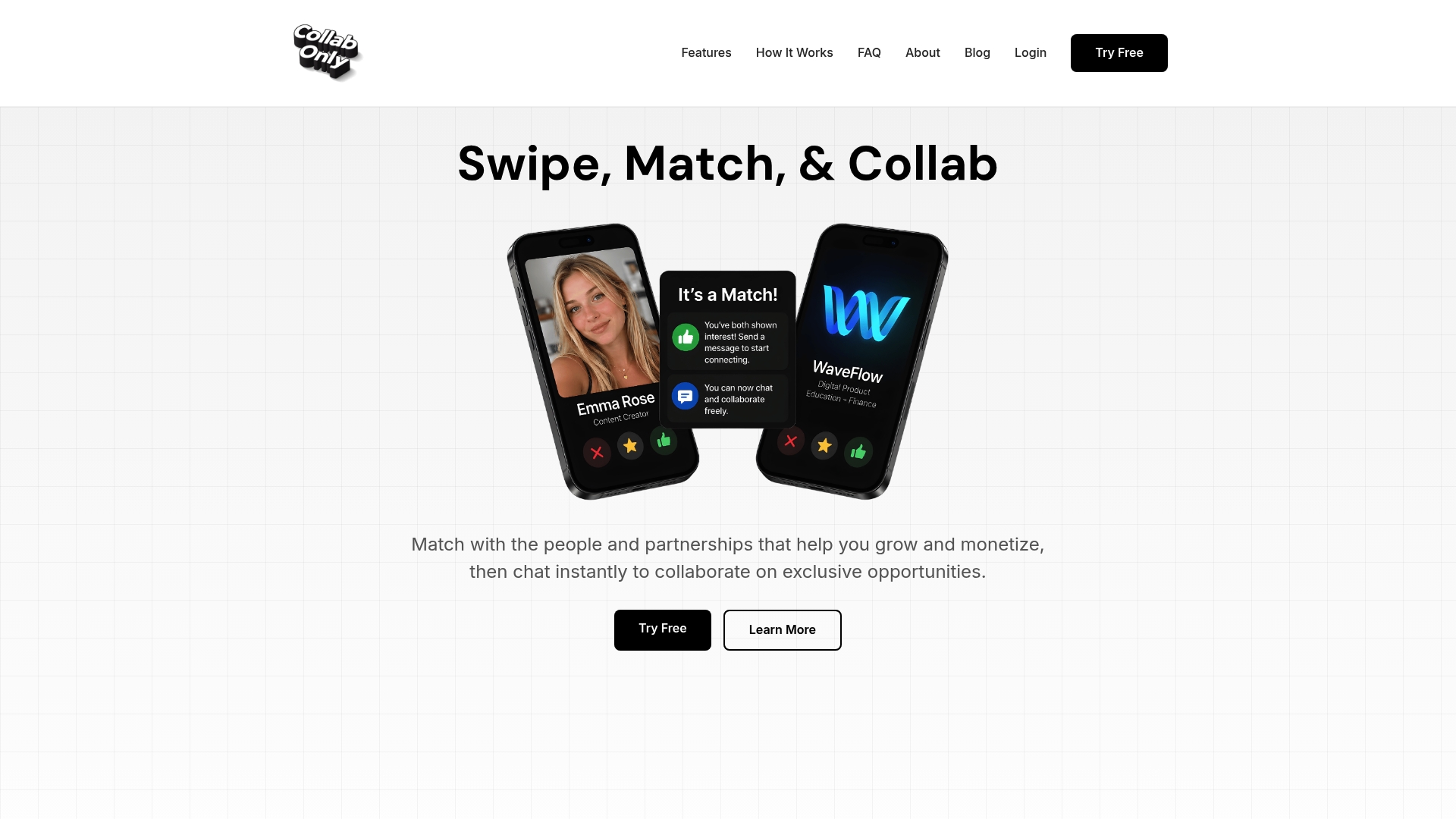
Collabonly approaches that earlier problem directly. Instead of cold emails and DMs that sit unread for days, the platform's swipe-based matching connects brands, creators, and marketers who've already signaled interest in the same kind of collaboration, then opens instant chat the moment both sides match. That compresses the "select partner by fit" step from the framework above from weeks of outreach into a conversation that can start the same day. Collabonly's matching approach reduces the outreach friction that usually delays goal-setting until months into a relationship.
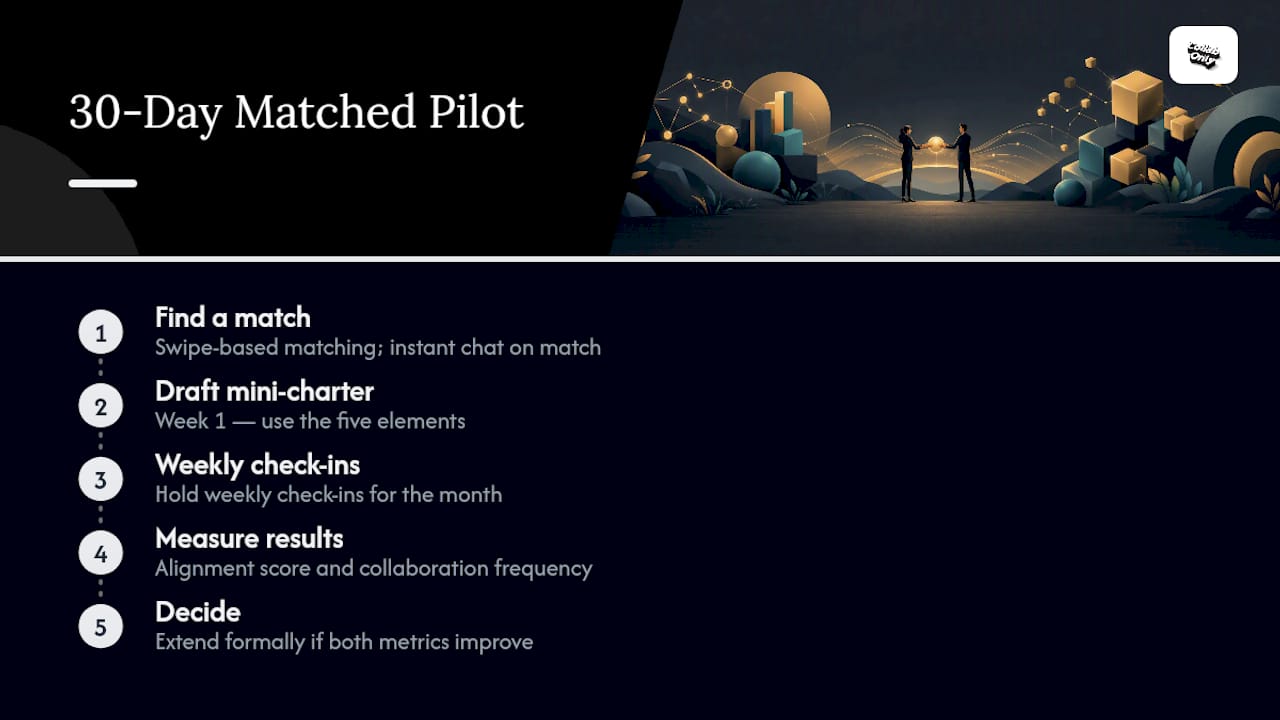
A practical way to test this: run a 30-day matched pilot. Match with one partner through the platform, draft the mini-charter in the first week using the five elements covered earlier, and hold a weekly check-in for the month. If the alignment score and collaboration frequency both improve by the end, extend the relationship formally. If a brand specifically needs creator reach at a manageable scale, the nano-influencer marketing option narrows that first match even further.
A platform is not the right first move if you already have a specific, named partner in mind and your only gap is internal governance, not discovery. In that case, skip straight to the 5-step framework above. Where the platform earns its place is in the search itself, when you don't yet know who the right-fit partner is. Start a free profile and run your first match this week.
Sources
FAQ
What are the five key principles of working in partnership?
Most frameworks converge on shared outcomes, explicit value exchange, traceable goals, clear governance and decision rules, and continuous measurement, the same five principles that anchor goal-aligned partnerships.
What does goal alignment actually mean?
Goal alignment means every party in a collaboration, from executives to frontline staff, can trace their own work back to the same shared objective without needing a separate explanation for each level.
What are the five types of partnerships, with examples?
The common types are strategic alliances (a co-marketing campaign between two independent brands), joint ventures (a new legal entity formed to enter a market together), equity alliances (one partner takes a financial stake), non-equity alliances (a licensing or distribution agreement), and channel or marketing partnerships (a brand-creator collaboration on a single campaign).
What is the actual goal of a partnership?
The goal of any partnership is to produce an outcome neither party could achieve as efficiently alone, whether that's market access, shared risk, or combined audience reach, and a goal-aligned structure exists to keep both sides accountable to that same outcome.
How does a platform like Collabonly support goal alignment?
Collabonly shortens the partner discovery phase through swipe-based matching and instant chat, which lets brands and creators start defining shared goals on the same day they connect instead of weeks into a slow outreach process.